production
/viewbook/list/all/?page=640
/
/static/
None
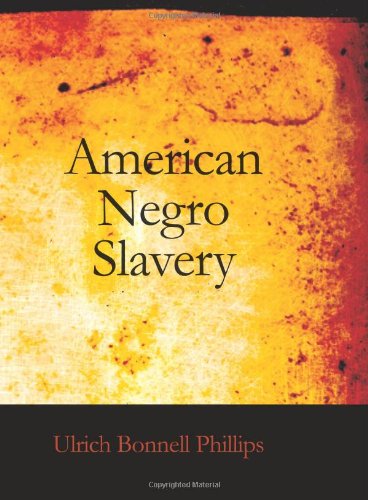
American Negro Slavery: A Survey of the Supply, Employment and...
Authors:
Ulrich Bonnell Phillips
Publisher:
BiblioBazaar
Publication Date:
Not available
ISBN:
1426447000
The Portuguese began exploring the west coast of Africa shortly before Christopher Columbus was born; and no sooner did they encounter negroes than they... began to seize and carry them in captivity to Lisbon.
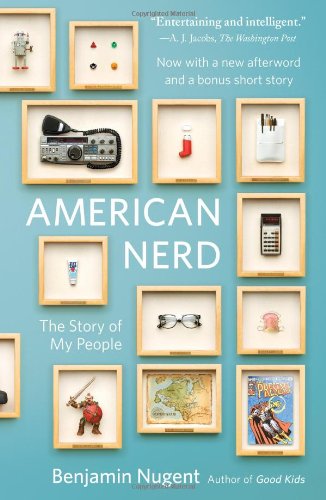
American Nerd: The Story of My People
Authors:
Benjamin Nugent
Publisher:
Scribner
Publication Date:
Not available
ISBN:
0743288025
“One of the season’s most talked about cultural studies” (Los Angeles Times)—an incisive and irreverent appreciation of nerds that combines... history, sociology, psychology, and memoir from noted journalist and self-proclaimed nerd Ben Nugent.Most people know a nerd when they see one, but yet can’t define just what a nerd is exactly. American Nerd: The Story of My People gives readers the history of the concept of nerdiness and its related subcultures. What makes Dr. Frankenstein the archetypal nerd? Where did the modern jock come from? When and how did being a self-described nerd become trendy? As the nerd emerged in the nineteenth century, and popped up again and again in college humor journals and sketch comedy, our culture obsessed over the phenomenon.“Part history, part memoir, and all funny” (GQ), American Nerd is critically acclaimed writer Benjamin Nugent’s entertaining fact-finding mission. He seeks the best definition of nerd and illuminates the common ground between nerd subcultures that might seem unrelated: high-school debate team kids and ham radio enthusiasts, medieval reenactors and pro-circuit videogame players. Why do the same people who like to work with computers also enjoy playing Dungeons & Dragons? How are those activities similar? This clever, enlightening book will appeal to the nerd (and anti-nerd) that lives inside everyone.
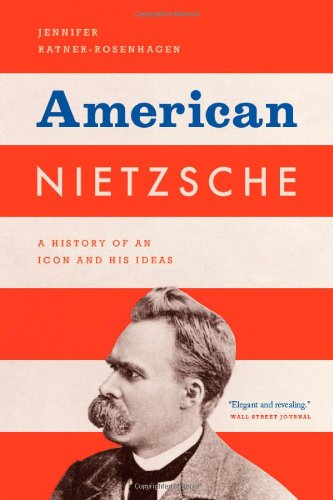
American Nietzsche: A History of an Icon and His Ideas
Authors:
Jennifer Ratner-Rosenhagen
Publisher:
University Of Chicago Press
Publication Date:
Not available
ISBN:
022600676X
If you were looking for a philosopher likely to appeal to Americans, Friedrich Nietzsche would be far from your first choice. After all, in his blazing... career, Nietzsche took aim at nearly all the foundations of modern American life: Christian morality, the Enlightenment faith in reason, and the idea of human equality. Despite that, for more than a century Nietzsche has been a hugely popular—and surprisingly influential—figure in American thought and culture.In American Nietzsche, Jennifer Ratner-Rosenhagen delves deeply into Nietzsche's philosophy, and America’s reception of it, to tell the story of his curious appeal. Beginning her account with Ralph Waldo Emerson, whom the seventeen-year-old Nietzsche read fervently, she shows how Nietzsche’s ideas first burst on American shores at the turn of the twentieth century, and how they continued alternately to invigorate and to shock Americans for the century to come. She also delineates the broader intellectual and cultural contexts within which a wide array of commentators—academic and armchair philosophers, theologians and atheists, romantic poets and hard-nosed empiricists, and political ideologues and apostates from the Left and the Right—drew insight and inspiration from Nietzsche’s claims for the death of God, his challenge to universal truth, and his insistence on the interpretive nature of all human thought and beliefs. At the same time, she explores how his image as an iconoclastic immoralist was put to work in American popular culture, making Nietzsche an unlikely posthumous celebrity capable of inspiring both teenagers and scholars alike.A penetrating examination of a powerful but little-explored undercurrent of twentieth-century American thought and culture, American Nietzsche dramatically recasts our understanding of American intellectual life—and puts Nietzsche squarely at its heart.
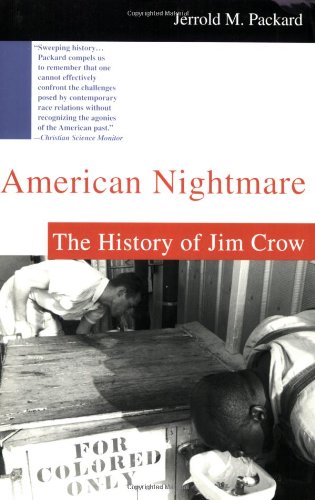
American Nightmare: The History of Jim Crow
Authors:
Jerrold M. Packard
Publisher:
St. Martin's Griffin
Publication Date:
Not available
ISBN:
031230241X
For a hundred years after the end of the Civil War, a quarter of all Americans lived under a system of legalized segregation called Jim Crow. Together... with its rigidly enforced canon of racial "etiquette," these rules governed nearly every aspect of life—and outlined draconian punishments for infractions.The purpose of Jim Crow was to keep African Americans subjugated at a level as close as possible to their former slave status. Exceeding even South Africa's notorious apartheid in the humiliation, degradation, and suffering it brought, Jim Crow left scars on the American psyche that are still felt today. American Nightmare examines and explains Jim Crow from its beginnings to its end: how it came into being, how it was lived, how it was justified, and how, at long last, it was overcome only a few short decades ago. Most importantly, this book reveals how a nation founded on principles of equality and freedom came to enact as law a pervasive system of inequality and virtual slavery.Although America has finally consigned Jim Crow to the historical graveyard, Jerrold Packard shows why it is important that this scourge—and an understanding of how it happened—remain alive in the nation's collective memory.
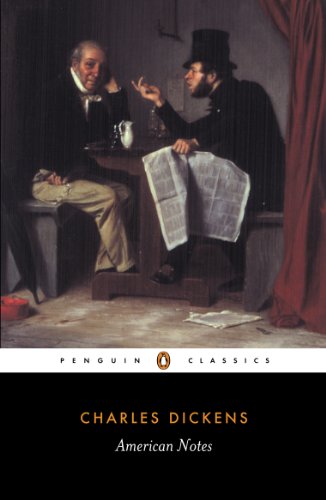
American Notes for General Circulation (Penguin Classics)
Authors:
Charles Dickens
Publisher:
Penguin Classics
Publication Date:
Not available
ISBN:
0140436499
Charles Dickens was the most famous of many travelers of his time who journeyed to America, curious about the revolutionary new civilization that had... captured the English imagination. His frank, often humorous descriptions in his 1842 account cover everything from his uncomfortable sea voyage to an ecstatic narrative of his visit to Niagara Falls. Yet Dickens is also critical of American society, its preoccupation with money, and reliance on slavery, as well as the rude, unsavory manners of Americans and their corrupt press. Above all, American Notes is a lively chronicle of what was for Dickens an illuminating encounter with the New World.
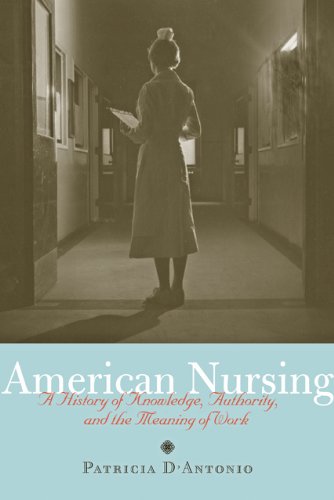
American Nursing: A History of Knowledge, Authority, and the...
Authors:
Patricia D'Antonio
Publisher:
The Johns Hopkins University Press
Publication Date:
Not available
ISBN:
0801895650
This new interpretation of the history of nursing in the United States captures the many ways women reframed the most traditional of all gender... expectations—that of caring for the sick—to create new possibilities for themselves, to renegotiate the terms of some of their life experiences, and to reshape their own sense of worth and power. For much of modern U.S. history, nursing was informal, often uncompensated, and almost wholly the province of female family and community members. This began to change at the end of the nineteenth century when the prospect of formal training opened for women doors that had been previously closed. Nurses became respected professionals, and becoming a formally trained nurse granted women a range of new social choices and opportunities that eventually translated into economic mobility and stability. Patricia D'Antonio looks closely at this history—using a new analytic framework and a rich trove of archival sources—and finds complex, multiple meanings in the individual choices of women who elected a nursing career. New relationships and social and professional options empowered nurses in constructing consequential lives, supporting their families, and participating both in their communities and in the health care system. Narrating the experiences of nurses, D'Antonio captures the possibilities, power, and problems inherent in the different ways women defined their work and lived their lives. Scholars in the history of medicine, nursing, and public policy, those interested in the intersections of identity, work, gender, education, and race, and nurses will find this a provocative book.
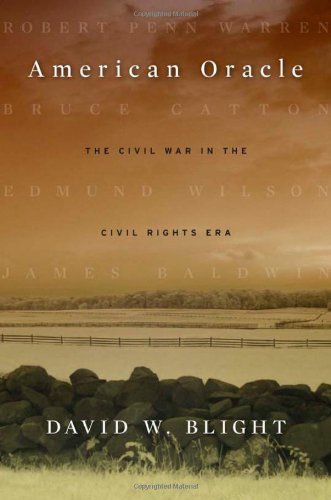
American Oracle: The Civil War in the Civil Rights Era
Authors:
David W. Blight
Publisher:
Belknap Press of Harvard University Press
Publication Date:
Not available
ISBN:
0674048555
Standing on the steps of the Lincoln Memorial on August 28, 1963, a century after the signing of the Emancipation Proclamation, Martin Luther King, Jr.,... declared, “One hundred years later, the Negro still is not free.” He delivered this speech just three years after the Virginia Civil War Commission published a guide proclaiming that “the Centennial is no time for finding fault or placing blame or fighting the issues all over again.”David Blight takes his readers back to the centennial celebration to determine how Americans then made sense of the suffering, loss, and liberation that had wracked the United States a century earlier. Amid cold war politics and civil rights protest, four of America’s most incisive writers explored the gulf between remembrance and reality. Robert Penn Warren, the southern-reared poet-novelist who recanted his support of segregation; Bruce Catton, the journalist and U.S. Navy officer who became a popular Civil War historian; Edmund Wilson, the century’s preeminent literary critic; and James Baldwin, the searing African-American essayist and activist—each exposed America’s triumphalist memory of the war. And each, in his own way, demanded a reckoning with the tragic consequences it spawned.Blight illuminates not only mid-twentieth-century America’s sense of itself but also the dynamic, ever-changing nature of Civil War memory. On the eve of the 150th anniversary of the war, we have an invaluable perspective on how this conflict continues to shape the country’s political debates, national identity, and sense of purpose.
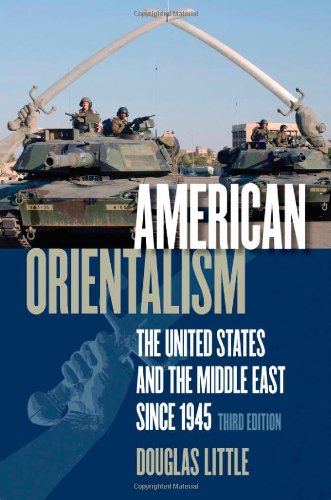
American Orientalism: The United States and the Middle East since 1945
Authors:
Douglas Little
Publisher:
The University of North Carolina Press
Publication Date:
Not available
ISBN:
0807858986
With the terrorist attacks of 11 September 2001, America's relationship with the Middle East exploded to the forefront of our national consciousness.... Looking back more than a half-century, Douglas Little offers valuable, historical context for anyone seeking a better understanding of this complicated relationship. He explores the encounters between the United States and the Middle East since 1945, focusing particularly on the complex, sometimes inconsistent attitudes and interests that have shaped U.S. relations in the region.Little begins by exposing the persistence of "orientalist" stereotypes in American popular culture and then examines U.S. policy toward the Middle East from many angles. Chapters focus on America's increasing dependence on petroleum; U.S.-Israeli relations; the threat of communism; the rise of revolutionary nationalist movements in Egypt, Iran, Iraq, and Libya; the futility of U.S. military and covert intervention; and the unsuccessful attempt to broker a "peace-for-land" settlement between the Israelis and the Palestinians. The overarching theme of the book is that a combination of American omnipotence and profound cultural misunderstanding ensured that the United States would encounter trouble in the Middle East after 1945 and that those forces continue to bedevil the relationship between these vastly different cultures to the present day.
American Originals: Homemade Varieties of Christianity
Authors:
Paul K. Conkin
Publisher:
The University of North Carolina Press
Publication Date:
Not available
ISBN:
080784649X
In a work of striking breadth and clarity, Paul Conkin offers an even-handed and in-depth look at the major American-made forms of Christianity—a... diverse group of religious traditions, each of which reflects a significant break from western Christian orthodoxy.Identifying six distinctive types, Conkin examines the major denominations representative of each original variety of American Christianity: restoration (Churches of Christ, Disciples of Christ); humanistic (Unitarians, Universalists); apocalyptic (Adventists, Jehovah's Witnesses); Mormon (Church of Jesus Christ of Latter-day Saints); spiritual (Christian Science, Unity); and ecstatic (Holiness and Pentecostal denominations). Focusing on the early years and maturation of these groups, he discusses their founders and leaders, origins and Old World roots, and essential doctrines and practices. Conkin closes each chapter with a guide to further reading.The first comprehensive survey of these American originals, this book will serve as a valuable resource on a number of religious traditions whose members not only comprise a significant percentage of the American population but also make up an increasing proportion of Christian converts worldwide.
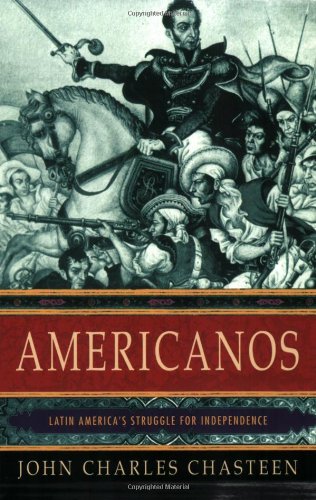
Americanos: Latin America's Struggle for Independence (Pivotal...
Authors:
John Charles Chasteen
Publisher:
Oxford University Press, USA
Publication Date:
Not available
ISBN:
0195392361
A premier volume in Oxford's Pivotal Moments in World History series, Americanos offers an engagingly written, compact history of the Latin American... wars of independence. Proceeding almost cinematically, scene by vivid scene, John Charles Chasteen introduces the reader to lead players, basic concepts, key events, and dominant trends, braided together in a single, taut narrative. He vividly depicts the individuals and events of those tumultuous years, capturing the gathering forces for independence, the clashes of troops and decisions of leaders, and the rich, elaborate tapestry of Latin American societies as they embraced nationhood.
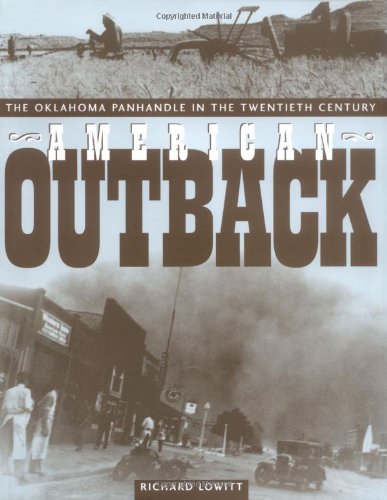
American Outback: The Oklahoma Panhandle in the Twentieth Century...
Authors:
Richard Lowitt
Publisher:
Texas Tech University Press
Publication Date:
Not available
ISBN:
0896725588
To settle and remain in the American Outback, the unforgiving land of the Oklahoma Panhandle, was an achievement. Prosperity and risk were present in... equal measure. Comprising land that Kansas, Colorado, and New Mexico did not want, and that Texas, after entering the Union as a slave state, could not have, the Oklahoma Panhandle was dubbed No Man’s Land.” This geographical anomaly, 165 miles long and only 35 miles wide, belonged to no one and, before statehood, served as a haven for desperadoes and villains. Only with the creation of the Oklahoma Territory in 1890 was the area finally claimed by a government entity. The history of the Oklahoma Panhandle is an integral part of the history of the Great Plains. In the 1930s the Panhandle attracted attention as the heart of the Dust Bowl. Later the area became a world leader in the production of natural gas, and in the 1990s corporate mega hog farms moved in, creating a new set of challenges. As the twenty-first century unfolds, despite concerns about water, pollution, and population growth, the Panhandle remains the most prosperous part of the state, with wheat, meat, and energy as the largest contributors to its economy. A sweeping survey of the Panhandle’s ups and downs . . . . a new chapter in the history of a little known geographical anomaly” Kansas History A carefully researched and readable book that will tell even well-informed Oklahomans something they didn’t know about one of the most fascinating parts of the state” Norman Transcript
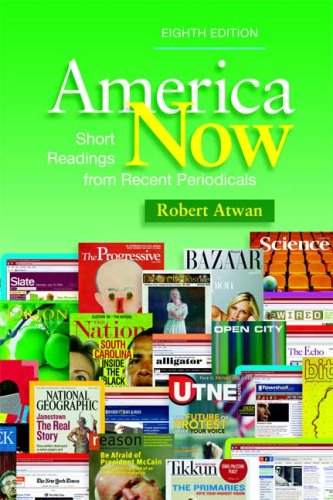
America Now: Short Readings from Recent Periodicals
Authors:
Robert Atwan
Publisher:
Bedford/St. Martin's
Publication Date:
Not available
ISBN:
0312486944
With 50 very brief readings — all new to this edition — from over 35 very recent periodicals and student newspapers on 12 topics of current... interest, America Now reflects what students are talking and writing about right now. A key challenge in the first-year composition course is to inspire students as readers and to spark the kind of thoughtful classroom discussion that leads to solid academic writing. As series editor of The Best American Essays, Robert Atwan constantly scours a wide range of print and online periodicals, bringing to America Now an unrivaled awareness of the best writing on today’s hottest issues — and the editorial support students need to approach it. To make these issues especially relevant for students, Atwan also explores hundreds of campus newspapers on the Internet to find the best student writing on current topics. These models by their peers from across the country show students that they, too, can share ideas through their own discussion and writing.
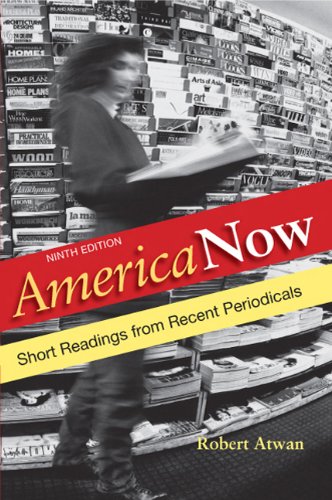
America Now: Short Readings from Recent Periodicals
Authors:
Robert Atwan
Publisher:
Bedford/St. Martin's
Publication Date:
Not available
ISBN:
0312646607
With more than 50 very brief readings -- all new to this edition -- from over 40 very recent periodicals and student newspapers on 12 topics of very... current interest, America Now reflects what students are talking and writing about right now. As series editor of The Best American Essays, Robert Atwan constantly scours a wide range of periodicals, bringing to America Now an unrivaled awareness of the best writing on today's hottest issues -- and the editorial support students need to approach it and to create solid academic writing of their own. To make these issues especially relevant for students, Atwan also explores hundreds of campus newspapers to find the best student writing on current topics. These models by their peers from across the country show students that they, too, can share ideas through their own discussion and writing.

AMERICAN PAGEANT V1:BNDLE
Authors:
Not Available
Publisher:
Not available
Publication Date:
Not available
ISBN:
Not available
AMERICAN PAGEANT V1 W/ COURSEREADER
Authors:
Not Available
Publisher:
Not available
Publication Date:
Not available
ISBN:
Not available
 '
'