production
/viewbook/list/all/?page=664
/
/static/
None
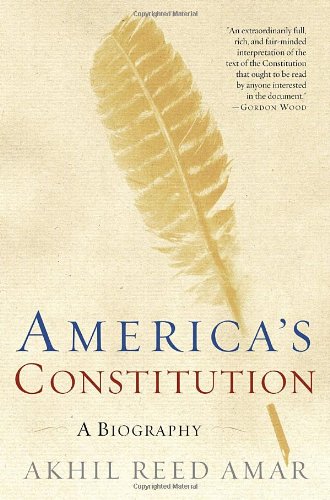
America's Constitution: A Biography
Authors:
Akhil Reed Amar
Publisher:
Random House Trade Paperbacks
Publication Date:
Not available
ISBN:
0812972724
In America’s Constitution, one of this era’s most accomplished constitutional law scholars, Akhil Reed Amar, gives the first comprehensive account... of one of the world’s great political texts. Incisive, entertaining, and occasionally controversial, this “biography” of America’s framing document explains not only what the Constitution says but also why the Constitution says it. We all know this much: the Constitution is neither immutable nor perfect. Amar shows us how the story of this one relatively compact document reflects the story of America more generally. (For example, much of the Constitution, including the glorious-sounding “We the People,” was lifted from existing American legal texts, including early state constitutions.) In short, the Constitution was as much a product of its environment as it was a product of its individual creators’ inspired genius.Despite the Constitution’s flaws, its role in guiding our republic has been nothing short of amazing. Skillfully placing the document in the context of late-eighteenth-century American politics, America’s Constitution explains, for instance, whether there is anything in the Constitution that is unamendable; the reason America adopted an electoral college; why a president must be at least thirty-five years old; and why–for now, at least–only those citizens who were born under the American flag can become president. From his unique perspective, Amar also gives us unconventional wisdom about the Constitution and its significance throughout the nation’s history. For one thing, we see that the Constitution has been far more democratic than is conventionally understood. Even though the document was drafted by white landholders, a remarkably large number of citizens (by the standards of 1787) were allowed to vote up or down on it, and the document’s later amendments eventually extended the vote to virtually all Americans. We also learn that the Founders’ Constitution was far more slavocratic than many would acknowledge: the “three fifths” clause gave the South extra political clout for every slave it owned or acquired. As a result, slaveholding Virginians held the presidency all but four of the Republic’s first thirty-six years, and proslavery forces eventually came to dominate much of the federal government prior to Lincoln’s election.Ambitious, even-handed, eminently accessible, and often surprising, America’s Constitution is an indispensable work, bound to become a standard reference for any student of history and all citizens of the United States.From the Hardcover edition.
America's Courts and the Criminal Justice System
Authors:
David W. Neubauer
Publisher:
Wadsworth Publishing
Publication Date:
Not available
ISBN:
049580990X
Open this book and step into America's court system! With Neubauer and Fradella's best-selling text, you will see for yourself what it is like to be a... judge, a prosecutor, a defense attorney, and more. This fascinating and well-researched text gives you a realistic sense of being in the courthouse--you will quickly gain an understanding of what it is like to work in and be a part of the American criminal justice system. This concept of the courthouse "players" makes it easy to understand each person's important role in bringing a case through the court process. Throughout the text, the authors highlight not only the pivotal role of the criminal courts but also the court's importance and impact on society as a whole.
America's Courts and the Criminal Justice System
Authors:
David W. Neubauer
Publisher:
Wadsworth Publishing
Publication Date:
Not available
ISBN:
0495095400
Open this book and step into America's court system! What's it like to be a judge? A prosecutor? A defense attorney? With Neubauer's best-selling book,... you'll find out! This fascinating and well-researched text gives you the sense of being in the courthouse-of what it is like to work in and be a part of the system. This concept of the courthouse "players" illustrates each person's important role in bringing a case through the court process. Throughout the text, Neubauer highlights not only the pivotal role of the criminal courts within the criminal justice system but also the court's importance and impact on society as a whole.

AMERICAS COURTS COURSE 360 BUNDLE
Authors:
Not Available
Publisher:
Not available
Publication Date:
Not available
ISBN:
Not available
AMERICA'S COURTS & CRIMINAL JUSTICE SYSTEM
Authors:
Not Available
Publisher:
Not available
Publication Date:
Not available
ISBN:
Not available
America's Courts + Criminal Justice System(Digital
Authors:
Not Available
Publisher:
Not available
Publication Date:
Not available
ISBN:
Not available
America's Democratic Republic (4th Edition) (Penguin Academics)
Authors:
Edward S. Greenberg
Publisher:
Pearson
Publication Date:
Not available
ISBN:
0205806740
Updated in a new 4th edition, America's Democratic Republic is a brief, affordable book in an accessible trade-like format that explores the clash... between the democratic aspirations of the American people and the republican foundations of our Constitution. Written with a lively, narrative style, this text traces the storyline of American government and focuses on the long standing and inescapable tension between the country’s 18th Century republican Constitutional foundations and the democratic aspirations of the American people.
America's Democratic Republic (Coursesmart)
Authors:
Not Available
Publisher:
Not available
Publication Date:
Not available
ISBN:
Not available
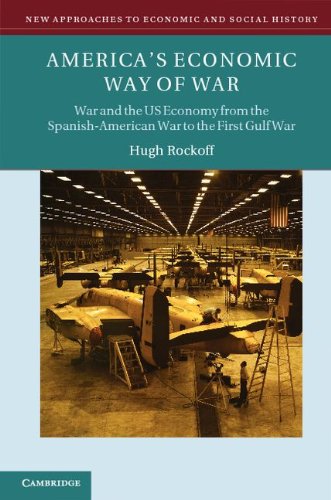
America's Economic Way of War: War and the US Economy from the...
Authors:
Hugh Rockoff
Publisher:
Cambridge University Press
Publication Date:
Not available
ISBN:
0521676738
How did economic and financial factors determine how America waged war in the twentieth century? This important new book exposes the influence of... economics and finance on the questions of whether the nation should go to war, how wars would be fought, how resources would be mobilized, and the long-term consequences for the American economy. Ranging from the Spanish-American War to the Gulf War, Hugh Rockoff explores the ways in which war can provide unique opportunities for understanding the basic principles of economics as wars produce immense changes in monetary and fiscal policy and so provide a wealth of information about how these policies actually work. He shows that wars have been more costly to the United States than most Americans realize as a substantial reliance on borrowing from the public, money creation and other strategies to finance America's war efforts have hidden the true cost of war.
America's Energy Future: Technology and Transformation
Authors:
Phase1 Committee on America's Energy Future
Publisher:
National Academies Press
Publication Date:
Not available
ISBN:
0309116023
Energy production and use touch our lives in countless ways. We are reminded of the cost of energy every time we fill up at the gas pump, pay an... electricity bill, or purchase an airline ticket. Energy use also has important indirect impacts, not all of which are reflected in current energy prices: depletion of natural resources, degradation of the environment, and threats to national security arising from a growing dependence on geopolitically unstable regions for some of our energy supplies. These indirect impacts could increase in the future if the demand for energy rises faster than available energy supplies. Our nation's challenge is to develop an energy portfolio that reduces these impacts while providing sufficient and affordable energy supplies to sustain our future economic prosperity. The United States has enormous economic and intellectual resources that can be brought to bear on these challenges through a sustained national effort in the decades ahead. America's Energy Future is intended to inform the development of wise energy policies by fostering a better understanding of technological options for increasing energy supplies and improving the efficiency of energy use. This summary edition of the book will also be a useful resource for professionals working in the energy industry or involved in advocacy and researchers and academics in energy-related fields of study. America's Energy Future examines the deployment potential, costs, barriers, and impacts of energy supply and end-use technologies during the next two to three decades, including energy efficiency, alternative transportation fuels, renewable energy, fossil fuel energy, and nuclear energy, as well as technologies for improving the nation's electrical transmission and distribution systems.
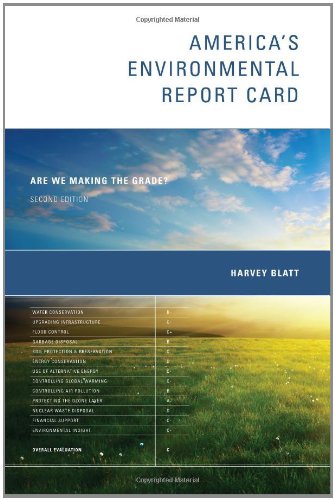
America's Environmental Report Card: Are We Making the Grade?
Authors:
Harvey Blatt
Publisher:
The MIT Press
Publication Date:
Not available
ISBN:
0262515911
Americans are concerned about the state of the environment, and yet polls show that many have lost faith in both scientists' and politicians' ability to... solve environmental problems. In America's Environmental Report Card, Harvey Blatt sorts through the deluge of conflicting information about the environment and offers an accessible overview of the environmental issues that are most important to Americans today. Blatt has thoroughly updated this second edition, revising and adding new material. He looks at water supplies and new concerns about water purity; the dangers of floods (increased by widespread logging and abetted by glacial melting); infrastructure problems (in a new chapter devoted entirely to this subject); the leaching of garbage buried in landfills; soil, contaminated crops, and organic food; fossil fuels; alternative energy sources (in another new chapter); controversies over nuclear energy; the increasing pace of climate change; and air pollution. Along the way, he outlines ways to deal with these problems--workable and reasonable solutions that map the course to a sustainable future. America can lead the way to a better environment, Blatt argues. We are the richest nation in the world, and we can afford it--in fact, we can't afford not to.
America's Fascinating Indian Heritage: The First Americans: Their...
Authors:
Not Available
Publisher:
Reader's Digest
Publication Date:
Not available
ISBN:
0895773724
Brings the whole story into focus-as it really happened. Meet these men and women, the memory of whom still haunts America-and get acquainted with an... integral part of our heritage-in this honest and informative celebration of the American Indian.
America's First Battles, 1776-1965
Authors:
Not Available
Publisher:
Not available
Publication Date:
Not available
ISBN:
0700602771
This volume, a collection of eleven original essays by many of the foremost U.S. military historians, focuses on the transition of the Army from parade... ground to battleground in each of nine wars the United States has fought. Through careful analysis of organization, training, and tactical doctrine, each essay seeks to explain the strengths and weaknesses evidenced by the outcome of the first significant engagement or campaign of the war. The concluding essay sets out to synthesize the findings and to discover whether or not American first battles manifest a characteristic "rhythm." America's First Battles provides a novel and intellectually challenging view of how America has prepared for war and how operations and tactics have changed over time. The thrust of the book--the emphasis on operational history--is at the forefront of scholarly activity in military history. This book is part of the Modern War Studies series.
America's First Cuisines
Authors:
Sophie D. Coe
Publisher:
University of Texas Press
Publication Date:
Not available
ISBN:
029271159X
After long weeks of boring, perhaps spoiled sea rations, one of the first things Spaniards sought in the New World was undoubtedly fresh food. Probably... they found the local cuisine strange at first, but soon they were sending American plants and animals around the world, eventually enriching the cuisine of many cultures.Drawing on original accounts by Europeans and native Americans, this pioneering work offers the first detailed description of the cuisines of the Aztecs, the Maya, and the Inca. Sophie Coe begins with the basic foodstuffs, including maize, potatoes, beans, peanuts, squash, avocados, tomatoes, chocolate, and chiles, and explores their early history and domestication. She then describes how these foods were prepared, served, and preserved, giving many insights into the cultural and ritual practices that surrounded eating in these cultures. Coe also points out the similarities and differences among the three cuisines and compares them to Spanish cooking of the period, which, as she usefully reminds us, would seem as foreign to our tastes as the American foods seemed to theirs. Written in easily digested prose, America's First Cuisines will appeal to food enthusiasts as well as scholars.
America's First Great Depression: Economic Crisis and Political...
Authors:
Alasdair Roberts
Publisher:
Cornell University Press
Publication Date:
Not available
ISBN:
0801450330
For a while, it seemed impossible to lose money on real estate. But then the bubble burst. The financial sector was paralyzed and the economy... contracted. State and federal governments struggled to pay their domestic and foreign creditors. Washington was incapable of decisive action. The country seethed with political and social unrest. In America's First Great Depression, Alasdair Roberts describes how the United States dealt with the economic and political crisis that followed the Panic of 1837.As Roberts shows, the two decades that preceded the Panic had marked a democratic surge in the United States. However, the nation's commitment to democracy was tested severely during this crisis. Foreign lenders questioned whether American politicians could make the unpopular decisions needed on spending and taxing. State and local officials struggled to put down riots and rebellion. A few wondered whether this was the end of America's democratic experiment.Roberts explains how the country's woes were complicated by its dependence on foreign trade and investment, particularly with Britain. Aware of the contemporary relevance of this story, Roberts examines how the country responded to the political and cultural aftershocks of 1837, transforming its political institutions to strike a new balance between liberty and social order, and uneasily coming to terms with its place in the global economy.
 '
'