production
/viewbook/list/all/?page=668
/
/static/
None
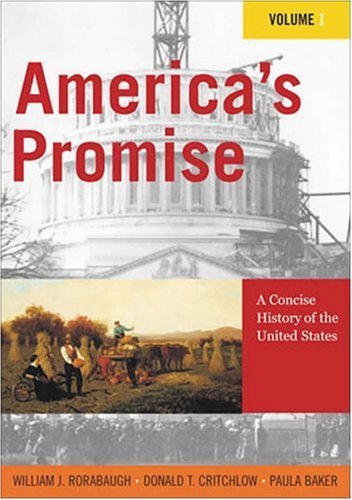
America's Promise: A Concise History of the United States (Volume I)
Authors:
William J. Rorabaugh
Publisher:
Rowman & Littlefield Publisher
Publication Date:
Not available
ISBN:
0742511898
America's Promise is a concise, highly readable introduction to American History. Designed to clearly explain major themes and events, it also captures... the rich and often amusing character of the American people. The strong narrative emphasizes public life and how individuals constructed public structures in which they lived and worked. Including the latest scholarship in social, cultural, and political history, the work integrates the history and importance of women and minorities.To aid students in learning and reviewing, each chapter begins with a preview of the main ideas that will be discussed and ends with a conclusion that reinforces the key concepts. Rather than being simply declaratory signposts, section headings highlight main ideas and help carry along the narrative. A glossary defines main terms, and a timeline helps students keep track of events. Selected readings are also included to encourage further reading and study. Finally, carefully selected illustrations and maps portray, pinpoint, and illuminate important episodes in American history.The most concise and competitively priced book available, America's Promise is a breath of fresh air in the introductory market.
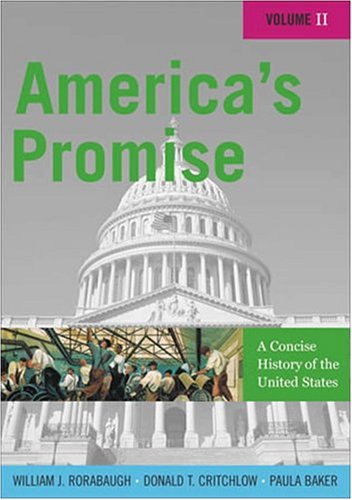
America's Promise: A Concise History of the United States (Volume II)
Authors:
William J. Rorabaugh
Publisher:
Rowman & Littlefield Publishers
Publication Date:
Not available
ISBN:
074251191X
America's Promise is a concise, highly readable introduction to American History. Designed to clearly explain major themes and events, it also captures... the rich and often amusing character of the American people. The strong narrative emphasizes public life and how individuals constructed public structures in which they lived and worked. Including the latest scholarship in social, cultural, and political history, the work integrates the history and importance of women and minorities.To aid students in learning and reviewing, each chapter begins with a preview of the main ideas that will be discussed and ends with a conclusion that reinforces the key concepts. Rather than being simply declaratory signposts, section headings highlight main ideas and help carry along the narrative. A glossary defines main terms, and a timeline helps students keep track of events. Selected readings are also included to encourage further reading and study. Finally, carefully selected illustrations and maps portray, pinpoint, and illuminate important episodes in American history.The most concise and competitively priced book available, America's Promise is a breath of fresh air in the introductory market.
America's Promise: Civil Society and the Renewal of American Culture
Authors:
Don E. Eberly
Publisher:
Rowman & Littlefield Publishers
Publication Date:
Not available
ISBN:
0847692299
Noted scholar and activist Don Eberly details the history, achievements, and goals of the civil society movement. He demonstrates why civil society is... crucial to the preservation of democratic values and institutions, and he explains why the concern over America's moral decay must be our major priority. Our society, argues Eberly, cannot thrive, and perhaps cannot survive, without strong social institutions, a vibrant moral order, and an active, intellectual grass roots dimension.
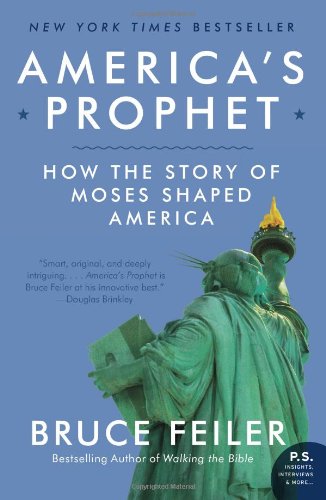
America's Prophet: How the Story of Moses Shaped America (P.S.)
Authors:
Bruce Feiler
Publisher:
Harper Perennial
Publication Date:
Not available
ISBN:
0061726273
Hailed as one of the most original works of history in years, America's Prophet reveals how generations of Americans have been inspired by the story of... Moses. The pilgrims quoted his story. Franklin and Jefferson proposed he appear on the U.S. seal. Washington and Lincoln were called his incarnations. The Statue of Liberty and Superman were molded in his image. Martin Luther King Jr. invoked him the night before he died. Ronald Reagan and Barack Obama cited him as inspiration. For four hundred years, one figure has inspired more Americans than any other. His name is Moses. Traveling through touchstones in American history, bestselling author Bruce Feiler traces the biblical prophet's influence from the Mayflower through today. Meticulously researched and highly readable, America's Prophet is a thrilling, original work of history that will forever change how we view America, our faith, and our future.

America's Public Schools: From the Common School to "No Child Left...
Authors:
William J. Reese
Publisher:
The Johns Hopkins University Press
Publication Date:
Not available
ISBN:
080188196X
William J. Reese's history of public schools in America examines why citizens have repeatedly turned to the schools to improve society and how... successive generations of reformers have tried to alter the curriculum and teaching practice to achieve their goals.Organized around two themes—education as the means for reforming American society and ongoing reform within the schools themselves—this study examines two centuries of American public education. It explores school and society in the nineteenth century, including public school growth in the antebellum and postbellum eras; competing visions of education and reform during the first half of the twentieth century; and social change and reform from the 1950s through the 1980s.Reese emphasizes the centrality of schools in the history of reform and their persistent allegiance to traditional practices and pedagogy despite two centuries of complaint by romantics and progressives. He describes tradition as a reliable friend of public schools, despite the enormous changes that have occurred over time: the centralization of authority, professionalization of teaching staff, and the expansion of curricular offerings. Reese's clear and accessible book is an original interpretation of the history of public elementary and secondary schools in America. It should become a standard text for future teachers as well as scholars of education.

America's Public Schools: From the Common School to "No Child Left...
Authors:
William J. Reese
Publisher:
The Johns Hopkins University Press
Publication Date:
Not available
ISBN:
1421400170
In this update to his landmark publication, William J. Reese offers a comprehensive examination of the trends, theories, and practices that have shaped... America’s public schools over the last two centuries. Reese approaches this subject along two main lines of inquiry—education as a means for reforming society and ongoing reform within the schools themselves. He explores the roots of contemporary educational policies and places modern battles over curriculum, pedagogy, race relations, and academic standards in historical perspective.A thoroughly revised epilogue outlines the significant challenges to public school education within the last five years. Reese analyzes the shortcomings of "No Child Left Behind" and the continued disjuncture between actual school performance and the expectations of government officials. He discusses the intrusive role of corporations, economic models for enticing better teacher performance, the continued impact of conservatism, and the growth of home schooling and charter schools. Informed by a breadth of historical scholarship and based squarely on primary sources, this volume remains the standard text for future teachers and scholars of education.

America's Religions: From Their Origins to the Twenty-first Century
Authors:
Peter W. Williams
Publisher:
University of Illinois Press
Publication Date:
Not available
ISBN:
025207551X
In this comprehensive survey, Williams offers concise descriptions of the background, beliefs, practices, and leaders of America's most influential and... distinctive religious movements and denominations. Thoroughly revised and updated, this third edition of America's Religions incorporates the latest scholarship on religion and considers timely issues such as status of Muslims in the United States after September 11, 2001; the impact of religion on American politics, especially concerning the emergence of the Religious Right; and the intense battles fought within the Catholic Church and other denominations over the status of gay marriage and accusations of clergy members' sexual abuse. This edition also includes thirty-eight new illustrations of key persons in American religious history and notable places of worship.
America's Response to China: A History of Sino-American Relations
Authors:
Warren I. Cohen
Publisher:
Columbia University Press
Publication Date:
Not available
ISBN:
0231150776
America's Response to China has long been the standard resource for a succinct, historically grounded assessment of an increasingly complicated... relationship. Written by one of America's leading diplomatic historians, this book analyzes the concerns and conceptions that have shaped U.S.-China policy and examines their far-reaching outcomes. Warren I. Cohen begins with the mercantile interests of the newly independent American colonies and discusses subsequent events up to the Tiananmen Square massacre and the policies of George H. W. Bush and Bill Clinton. For this fifth edition, Cohen adds a chapter on America in the age of potential Chinese ascendance, envisioning future partnerships and the shrinking global influence of the United States. Trenchant and insightful, America's Response to China is critically important for understanding U.S.-China relations in the twenty-first century.
America's Role in Nation-Building: From Germany to Iraq
Authors:
James Dobbins
Publisher:
Rand Corporation
Publication Date:
Not available
ISBN:
083303460X
America's School for War: Fort Leavenworth, Officer Education, and...
Authors:
Peter J. Schifferle
Publisher:
Univ Pr of Kansas
Publication Date:
Not available
ISBN:
0700617140
When the United States entered World War II, it took more than industrial might to transform its tiny army--smaller than even Portugal's--into an... overseas fighting force of more than eight and a half million. Peter Schifferle contends that the determination of American army officers to be prepared for the next big war was an essential component in America's ultimate triumph over its adversaries. Crucial to that preparation were the army schools at Fort Leavenworth. Interwar Army officers, haunted by the bloodshed of World War I's Meuse-Argonne Offensive, fully expected to return to Europe to conclude the "unfinished business" of that conflict, and they prepared well. Schifferle examines for the first time precisely how they accomplished this through a close and illuminating look at the students, faculty, curriculum, and essential methods of instruction at Fort Leavenworth. He describes how the interwar officer corps there translated the experiences of World War I into effective doctrine, engaged in intellectual debate on professional issues, conducted experiments to determine the viability of new concepts, and used military professional education courses to substitute for the experience of commanding properly organized and resourced units. Schifferle highlights essential elements of war preparation that only the Fort Leavenworth education could provide, including intensive instruction in general staff procedures, hands-on experience with the principles and techniques of combined arms, and the handling of large division-sized formations in combat. This readied army officers for an emerging new era of global warfare and enabled them to develop the leadership decision making they would need to be successful on the battlefield. But Schifferle offers more than a recitation of curriculum development through the skillful interweaving of personal stories about both school experiences and combat operations, collectively recounting the human and professional development of the officer corps from 1918 to 1945. Well crafted and insightful, Schifferle's meticulously researched study shows how and why the Fort Leavenworth experience was instrumental in producing that impressive contingent of military officers who led the U.S. Army to final victory in World War II. By the end of the book, the attentive reader will also fully comprehend why the military professionals at Fort Leavenworth have come to think of it as the "Intellectual Center of the Army." This book is part of the Modern War Studies series.
America's Secret War against Bolshevism: U.S. Intervention in the...
Authors:
David S. Foglesong
Publisher:
The University of North Carolina Press
Publication Date:
Not available
ISBN:
0807849588
From the Russian revolutions of 1917 to the end of the Civil War in 1920, Woodrow Wilson's administration sought to oppose the Bolsheviks in a variety... of covert ways. Drawing on previously unavailable American and Russian archival material, David Foglesong chronicles both sides of this secret war and reveals a new dimension to the first years of the U.S.-Soviet rivalry. Foglesong explores the evolution of Wilson's ambivalent attitudes toward socialism and revolution before 1917 and analyzes the social and cultural origins of American anti-Bolshevism. Constrained by his espousal of the principle of self-determination, by idealistic public sentiment, and by congressional restrictions, Wilson had to rely on secretive methods to affect the course of the Russian Civil War. The administration provided covert financial and military aid to anti-Bolshevik forces, established clandestine spy networks, concealed the purposes of limited military expeditions to northern Russia and Siberia, and delivered ostensibly humanitarian assistance to soldiers fighting to overthrow the Soviet government. In turn, the Soviets developed and secretly funded a propaganda campaign in the United States designed to mobilize public opposition to anti-Bolshevik activity, promote American-Soviet economic ties, and win diplomatic recognition from Washington.

America's Secret War: Inside the Hidden Worldwide Struggle Between...
Authors:
George Friedman
Publisher:
Anchor
Publication Date:
Not available
ISBN:
0767917855
Dubbed by Barron’s as “The Shadow CIA,” George Friedman’s global intelligence company, Stratfor, has provided analysis to Fortune 500 companies,... news outlets, and even the U.S. government. Now Friedman delivers the geopolitical story that the mainstream media has been unable to uncover — the startling truth behind America’s foreign policy and war effort in Afghanistan, Iraq, and beyond.Stratfor, one of the world’s most respected private global intelligence firms, has an unmatched ability to provide clear perspective on the current geopolitical map. In America's Secret War, George Friedman identifies the United States’ most dangerous enemies, delves into presidential strategies of the last quarter century, and reveals the real reasons behind the attack of 9/11—and the Bush administration’s motivation for the war in Iraq. It describes in eye-opening detail America’s covert and overt efforts in the global war against terrorism: Not only are U.S. armies in combat on every continent, but since 9/11 the intelligence services of dozens of nations have been operating in close partnership with the CIA.Drawing on Stratfor’s vast information-gathering network, Friedman presents an insightful picture of today’s world that goes far beyond what is reported on television and in other news media. Al Qaeda’s war plans and how they led to 9/11The threat of a suitcase nuclear bomb in New York and how that changed the course of the war.The deal the U.S. made with Russia and Iran which made the invasion of Afghanistan possible – and how those deals affect the United States today.How fear and suspicion of the Saudis after 9-11 tore apart the Bush-Saudi relationship and why Saudi Arabia’s closest friends in the administration became the Saudi’s worst enemies. The real reasons behind George W. Bush’s invasion of Iraq and how WMD became the cover for a much deeper game.How the CIA miscalculated about Saddam Hussein’s and Iran’s real plans, leaving the U.S. bogged down in the war.How the war in Iraq began with a ruse, pretending that a “target of opportunity” attack on Saddam Hussein had presented itself. The real story about why the U.S. raises and lowers its alert status and why the United States can’t find and destroy al Qaeda.The strategic successes that are slowly leading the United States to victoryAmerica's Secret War is an unprecedented look at the new world war being waged behind-the-scenes today. It is sure to stir debate and capture headlines around the world.
America's Spiritual Capital
Authors:
Nicholas N. Capaldi Ph.D.
Publisher:
St. Augustines Press
Publication Date:
Not available
ISBN:
1587310376
This book tells a story, a story about America’s spiritual capital. Spiritual capital is the fund of beliefs, examples, and commitments that are... transmitted from generation to generation through a religious tradition, and which attach people to the transcendent source of fulfillment and happiness. America has created the greatest civilization the world has ever know, and it has done this because of its spiritual capital, the values and beliefs by which individual Americans have interpreted and transformed the world. The Judeo-Christian heritage has historically served as the spiritual capital of America. It is not only the spiritual quest of modernity, but that quest has evolved into globalization, and America, because of its spiritual capital, has been able to provide leadership for that quest. The larger thesis is that America is by virtue of its specific spiritual capital heritage not only the beneficiary of its advantages but also the leading exemplar of the spiritual quest of modernity. It is because is engaged in a spiritual quest that it can exercise world leadership as opposed to domination and oppression. The authors examine the extent to which economic development, growth, and entrepreneurship depend on spiritual capital. They argue that there is a symbiotic relation between America’s spiritual capital and our political institutions and freedoms. The argument here is that the substantive spiritual vision supports the political and economic procedural norms of a free society. Like any form of capital, spiritual capital may lie dormant or be wasted, it may be used productively, it may be augmented, and it may be diminished or eroded. In the final chapter, we point out how the heritage is under assault from a variety of sources and what happens when scientific, technological, economic, and political institutions are detached from their spiritual roots. The result is a natural progression from governmental bureaucratic centralization to secularism to reductive materialism and ultimately to a social-collectivist conception of human welfare. Within the story there is an argument, namely, that these achievements will not be sustained without that heritage, and for all of the above reasons the heritage needs to be reaffirmed. The authors argue that the future of modernity, globalization, and America depend on the extent to which there is a reaffirmation of America’s spiritual capital.
America's Story: Land of Liberty Book Two : Since 1865 (America's...
Authors:
Vivian Bernstein
Publisher:
Steck-Vaughn Company
Publication Date:
Not available
ISBN:
0739897047
America's Strategic Choices: Revised Edition (An International...
Authors:
Not Available
Publisher:
The MIT Press
Publication Date:
Not available
ISBN:
0262522748
More than a decade has passed since the end of the Cold War, but the United States has yet to reach a consensus on a coherent approach to the... international use of American power. The essays in this volume present contending perspectives on the future of US grand strategy. US policy options include primacy, cooperative security, selective engagement, and retrenchment. This revised edition includes additional and more recent analysis and advocacy of these options. The volume includes the Clinton administration's National Security Strategy for a New Century, the most recent official statement of American grand strategy, so readers can compare proposed strategies with the official US government position.
 '
'