production
/viewbook/list/all/?page=679
/
/static/
None
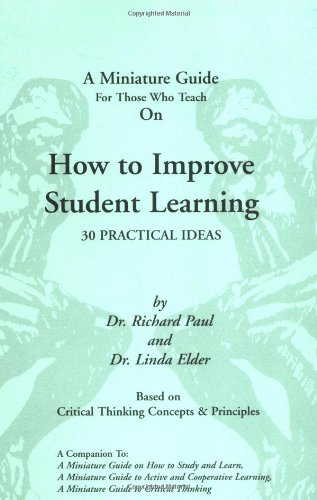
A Miniature Guide For Those Who Teach On How to Improve Student...
Authors:
Dr. Richard Paul
Publisher:
Foundation for Critical Thinking
Publication Date:
Not available
ISBN:
0944583121
This guide presents 30 instructional ideas based on the goal of teaching all subjects so that, as a consequence, students take ownership of the most... basic principles and concepts of the subject. Most of our suggestions represent possible teaching strategies. They are based on a vision of instruction implied by critical thinking and an analysis of the weaknesses typically found in most traditional didactic lecture/quiz/test formats of instruction. Students should master fundamental concepts and principles before they attempt to learn more advanced concepts. If class time is focused on helping students perform well on these foundational activities, we feel confident that the goals of most instruction will be achieved. Our goal is not to dictate to you, but to provide you with possible strategies with which to experiment. The specific suggestions we recommend represent methods and strategies we have developed and tested with our students. Judge for yourself their plausibility. Test them for their practicality. Those that work (i.e., improve instruction) keep; those that do not work, abandon or re-design.
A Mini Course in Training Design: A Simple Approach to a...
Authors:
William A. Welch Sr. EdD
Publisher:
iUniverse.com
Publication Date:
Not available
ISBN:
1462046622
If you want to learn how to bring the best performances out of the people who surround you, then this straightforward guidebook on human resource... development provides you with the tools you need to cause positive change. People new to the field as well as industry veterans will find practical information and guidance, including how to: • facilitate dynamic adult learning experiences; • help people develop confidence, vigor, and zeal to meet challenges; • write the best performance criteria; • establish an atmosphere where learning is always promoted. All supervisors must take responsibility in helping their employees meet expectations and become successful professionals. This also applies to ministers, rabbis, imams, and other leaders who encourage people to lead more productive and satisfying lives. Regardless of whether you are a human resource professional, it's imperative that you rise to the challenge and take the necessary steps to help others rise to their potential. Learn how to do it step by step with A Mini Course in Training Design. It provides guidance on how you can become a motivational force. Through human resource development tools, you can develop qualities such as expertise, empathy, and enthusiasm that will help you to develop training methods specialized to your purpose and to your people.
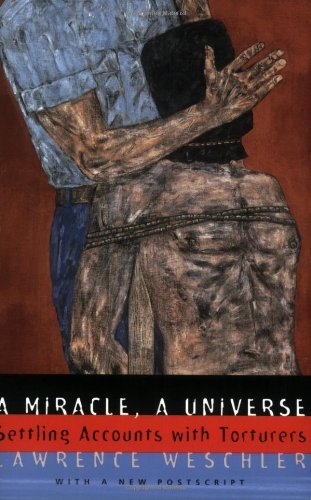
A Miracle, A Universe: Settling Accounts with Torturers
Authors:
Lawrence Weschler
Publisher:
University Of Chicago Press
Publication Date:
Not available
ISBN:
0226893944
During the past fifteen years, one of the most vexing issues facing fledgling transitional democracies around the world—from South Africa to Eastern... Europe, from Cambodia to Bosnia—has been what to do about the still-toxic security apparatuses left over from the previous regime. In this now-classic and profoundly influential study, the New Yorker's Lawrence Weschler probes these dilemmas across two gripping narratives (set in Brazil and Uruguay, among the first places to face such concerns), true-life thrillers in which torture victims, faced with the paralysis of the new regime, themselves band together to settle accounts with their former tormentors."Disturbing and often enthralling."—New York Times Book Review"Extraordinarily moving. . . . Weschler writes brilliantly."—Newsday"Implausible, intricate and dazzling."—Times Literary Supplement"As Weschler's interviewees told their tales, I paced agitatedly, choked back tears. . . . Weschler narrates these two episodes with skill and tact. . . . An inspiring book."—George Scialabba, Los Angeles Weekly

A Mirror For Witches
Authors:
Forbes
Publisher:
Academy Chicago Publishers
Publication Date:
Not available
ISBN:
0897331540
1928. A Mirror for Witches in which is reflected the life, machinations and death of famous Doll Bilby, who, with a more than feminine perversity,... preferred a demon to a mortal lover. Here is also told how and why a righteous and most awful judgment befell her, destroying both corporeal body and immortal soul. Illustrated with woodcuts.
Amis and Amiloun, Robert of Cisyle, and Sir Amadace
Authors:
Not Available
Publisher:
Western Michigan Univ Medieval
Publication Date:
Not available
ISBN:
1580441254
For the millions of readers who have been waiting for a book to make them laugh as did Catch-22, Joseph Heller has produced a new masterpiece. Good as... Gold combines the probing insight into anachronistic America of his last novel, Something Happened, with the biting, side-splitting brilliance of Catch-22.
Amish Children: Education in the Family, School, and Community...
Authors:
Gertrude Enders Huntington
Publisher:
Houghton Mifflin Harcourt (HMH)
Publication Date:
Not available
ISBN:
0030315921
Amish Grace: How Forgiveness Transcended Tragedy
Authors:
Donald B. Kraybill
Publisher:
Jossey-Bass
Publication Date:
Not available
ISBN:
0787997617
On Monday morning, October 2, 2006, a gunman entered a one-room Amish school in Nickel Mines, Pennsylvania. In front of twenty-five horrified pupils,... thirty-two-year-old Charles Roberts ordered the boys and the teacher to leave. After tying the legs of the ten remaining girls, Roberts prepared to shoot them execution with an automatic rifle and four hundred rounds of ammunition that he brought for the task. The oldest hostage, a thirteen-year-old, begged Roberts to "shoot me first and let the little ones go." Refusing her offer, he opened fire on all of them, killing five and leaving the others critically wounded. He then shot himself as police stormed the building. His motivation? "I'm angry at God for taking my little daughter," he told the children before the massacre.The story captured the attention of broadcast and print media in the United States and around the world. By Tuesday morning some fifty television crews had clogged the small village of Nickel Mines, staying for five days until the killer and the killed were buried. The blood was barely dry on the schoolhouse floor when Amish parents brought words of forgiveness to the family of the one who had slain their children.The outside world was incredulous that such forgiveness could be offered so quickly for such a heinous crime. Of the hundreds of media queries that the authors received about the shooting, questions about forgiveness rose to the top. Forgiveness, in fact, eclipsed the tragic story, trumping the violence and arresting the world's attention.Within a week of the murders, Amish forgiveness was a central theme in more than 2,400 news stories around the world. The Washington Post, The New York Times, USA Today, Newsweek, NBC Nightly News, CBS Morning News, Larry King Live, Fox News, Oprah, and dozens of other media outlets heralded the forgiving Amish. From the Khaleej Times (United Arab Emirates) to Australian television, international media were opining on Amish forgiveness. Three weeks after the shooting, "Amish forgiveness" had appeared in 2,900 news stories worldwide and on 534,000 web sites.Fresh from the funerals where they had buried their own children, grieving Amish families accounted for half of the seventy-five people who attended the killer's burial. Roberts' widow was deeply moved by their presence as Amish families greeted her and her three children. The forgiveness went beyond talk and graveside presence: the Amish also supported a fund for the shooter's family.AMISH GRACE explores the many questions this story raises about the religious beliefs and habits that led the Amish to forgive so quickly. It looks at the ties between forgiveness and membership in a cloistered communal society and ask if Amish practices parallel or diverge from other religious and secular notions of forgiveness. It will also address the matter of why forgiveness became news. "All the religions teach it," mused an observer, "but no one does it like the Amish." Regardless of the cultural seedbed that nourished this story, the surprising act of Amish forgiveness begs for a deeper exploration. How could the Amish do this? What did this act mean to them? And how might their witness prove useful to the rest of us?

Amish Grace: How Forgiveness Transcended Tragedy
Authors:
Donald B. Kraybill
Publisher:
Jossey-Bass
Publication Date:
Not available
ISBN:
0470344040
On Monday morning, October 2, 2006, a gunman entered a one-room Amish school in Nickel Mines, Pennsylvania. In front of twenty-five horrified pupils,... thirty-two-year-old Charles Roberts ordered the boys and the teacher to leave. After tying the legs of the ten remaining girls, Roberts prepared to shoot them execution style with an automatic rifle and four hundred rounds of ammunition that he brought for the task. The oldest hostage, a thirteen-year-old, begged Roberts to "shoot me first and let the little ones go." Refusing her offer, he opened fire on all of them, killing five and leaving the others critically wounded. He then shot himself as police stormed the building. His motivation? "I'm angry at God for taking my little daughter," he told the children before the massacre.The story captured the attention of broadcast and print media in the United States and around the world. By Tuesday morning some fifty television crews had clogged the small village of Nickel Mines, staying for five days until the killer and the killed were buried. The blood was barely dry on the schoolhouse floor when Amish parents brought words of forgiveness to the family of the one who had slain their children.The outside world was incredulous that such forgiveness could be offered so quickly for such a heinous crime. Of the hundreds of media queries that the authors received about the shooting, questions about forgiveness rose to the top. Forgiveness, in fact, eclipsed the tragic story, trumping the violence and arresting the world's attention.Within a week of the murders, Amish forgiveness was a central theme in more than 2,400 news stories around the world. The Washington Post, The New York Times, USA Today, Newsweek, NBC Nightly News, CBS Morning News, Larry King Live, Fox News, Oprah, and dozens of other media outlets heralded the forgiving Amish. From the Khaleej Times (United Arab Emirates) to Australian television, international media were opining on Amish forgiveness. Three weeks after the shooting, "Amish forgiveness" had appeared in 2,900 news stories worldwide and on 534,000 web sites.Fresh from the funerals where they had buried their own children, grieving Amish families accounted for half of the seventy-five people who attended the killer's burial. Roberts' widow was deeply moved by their presence as Amish families greeted her and her three children. The forgiveness went beyond talk and graveside presence: the Amish also supported a fund for the shooter's family.AMISH GRACE explores the many questions this story raises about the religious beliefs and habits that led the Amish to forgive so quickly. It looks at the ties between forgiveness and membership in a cloistered communal society and ask if Amish practices parallel or diverge from other religious and secular notions of forgiveness. It will also address the matter of why forgiveness became news. "All the religions teach it," mused an observer, "but no one does it like the Amish." Regardless of the cultural seedbed that nourished this story, the surprising act of Amish forgiveness begs for a deeper exploration. How could the Amish do this? What did this act mean to them? And how might their witness prove useful to the rest of us?
A Mission to Civilize: The Republican Idea of Empire in France and...
Authors:
Alice Conklin
Publisher:
Stanford University Press
Publication Date:
Not available
ISBN:
0804740127
This book addresses a central but often ignored question in the history of modern France and modern colonialism: How did the Third Republic, highly... regarded for its professed democratic values, allow itself to be seduced by the insidious and persistent appeal of a “civilizing” ideology with distinct racist overtones? By focusing on a particular group of colonial officials in a specific setting—the governors general of French West Africa from 1895 to 1930—the author argues that the ideal of a special civilizing mission had a decisive impact on colonial policymaking and on the evolution of modern French republicanism generally.French ideas of civilization—simultaneously republican, racist, and modern—encouraged the governors general in the 1890’s to attack such “feudal” African institutions as aristocratic rule and slavery in ways that referred back to France’s own experience of revolutionary change. Ironically, local administrators in the 1920’s also invoked these same ideas to justify such reactionary policies as the reintroduction of forced labor, arguing that coercion, which inculcated a work ethic in the “lazy” African, legitimized his loss of freedom. By constantly invoking the ideas of “civilization,” colonial policy makers in Dakar and Paris managed to obscure the fundamental contradictions between “the rights of man” guaranteed in a republican democracy and the forcible acquisition of an empire that violates those rights.In probing the “republican” dimension of French colonization in West Africa, this book also sheds new light on the evolution of the Third Republic between 1895 and 1930. One of the author’s principal arguments is that the idea of a civilized mission underwent dramatic changes, due to ideological, political, and economic transformations occurring simultaneously in France and its colonies. For example, revolts in West Africa as well as a more conservative climate in the metropole after World War I produced in the governors general a new respect for “feudal” chiefs, whom the French once despised but now reinstated as a means of control. This discovery of an African “tradition” in turn reinforced a reassertion of traditional values in France as the Third Republic struggled to recapture the world it had “lost” at Verdun.

A Missouri Railroad Pioneer: The Life of Louis Houck (Missouri...
Authors:
Joel P. Rhodes
Publisher:
University of Missouri Press
Publication Date:
Not available
ISBN:
0826217982
Lawyer and journalist, entrepreneur and philanthropist, Louis Houck is called the Father of Southeast Missouri because he brought the railroad to the... region and opened this backwater area to industrialization and modernization. Rhodes considers his career from social and political perspectives, grounding the story in state and national history. He especially tells how this self-taught railroader constructed a network of five hundred miles of track through wetland wilderness, providing a boost for population, agriculture, lumbering, and commerce that transformed Cape Girardeau and the surrounding area. Rhodes gives voice to Houck's critics and shows that he was not always an easy man to work with, at the same time that he followed Carnegie's lead by making art, culture, and formal education available to all social classes.

Amistad - A Novel
Authors:
David Pesci
Publisher:
Marlowe & Company
Publication Date:
Not available
ISBN:
156924703X
In 1839, 53 African slaves staged a rebellion on board the slave ship "Amistad", and were held for trail in the United States. The fate of the slaves,... hanging in the balance between the pro-slavery government and the abolitionist movement, makes a riveting story of hope against impossible odds and the will to be free.

AMISTADES PACKAGE (F12)
Authors:
Not Available
Publisher:
Not available
Publication Date:
Not available
ISBN:
Not available
Am I Still a Woman?: Hysterectomy and Gender Identity
Authors:
Jean Elson
Publisher:
Temple University Press
Publication Date:
Not available
ISBN:
1592132111
Recent scientific findings regarding the potential dangers associated with hormone replacement therapies bring renewed attention to the relationship... between women's bodies and gender identity. In "Am I Still A Woman?" Jean Elson offers the testimony of women who have thought deeply about this issue as a result of gynecological surgery. For the women in this book, gynecological surgery for benign conditions proved to be a crisis that prompted questions about the meanings of sexual and reproductive organs in relation to being female and feminine. Is a woman who no longer menstruates still a woman? What about a woman who can no longer bear children? Elson looks closely at the differences in responses to understand the impact of surgery and lost fertility on sexuality and partnerships as well as the steps some women take to deal with a sense of a stigmatized identity. Whether they reconceptualized their old notions of what it means to be a woman or put a new focus on making themselves attractive, they made conscious efforts to reclaim their female identity and femininity. This book provides a wealth of insight into the choices women make regarding gynecological surgery and maintaining their sense of themselves as women. Jean Elson teaches sociology at the University of New Hampshire.

Am I That Name: Feminism And The Category Of Women In History
Authors:
Denise Riley
Publisher:
Univ Of Minnesota Press
Publication Date:
Not available
ISBN:
0816642699
Writing about changes in the notion of womanhood, Denise Riley examines, in the manner of Foucault, shifting historical constructions of the category of... "women" in relation to other categories central to concepts of personhood: the soul, the mind, the body, nature, the social. Feminist movements, Riley argues, have had no choice but to play out this indeterminacy of women. This is made plain in their oscillations, since the 1790s, between concepts of equality and of difference. To fully recognize the ambiguity of the category of "women" is, she contends, a necessary condition for an effective feminist political philosophy. "A classic of feminist intellectual history. "Am I That Name?" is a sort of Anglo-American end of innocence for anyone who tries to speak of 'women.' Riley makes the word run, since she cannot make it stand still. She offers a history of how feminism has faced its paradoxical core." -Voice Literary Supplement "Essential reading for philosophers, historians, and feminist theorists." -History Review of Books Denise Riley teaches at the University of East Anglia, UK, and has also held teaching posts at Brown University and at the Institute for Advanced Study, Princeton. Her most recent books are The Words of Selves: Identification, Solidarity, Irony (2000) and Selected Poems (2000).

AM KURZEREN DER SONNENALLE
Authors:
Not Available
Publisher:
Easy Readers
Publication Date:
Not available
ISBN:
8723903910
 '
'