production
/viewbook/list/all/?page=687
/
/static/
None
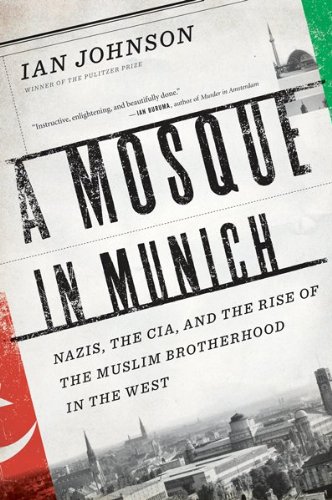
A Mosque in Munich: Nazis, the CIA, and the Rise of the Muslim...
Authors:
Ian Johnson
Publisher:
Mariner Books
Publication Date:
Not available
ISBN:
0547423179
In the wake of the news that the 9/11 hijackers had lived in Europe, journalist Ian Johnson wondered how such a radical group could sink roots into... Western soil. Most accounts reached back twenty years, to U.S. support of Islamist fighters in Afghanistan. But Johnson dug deeper, to the start of the Cold War, uncovering the untold story of a group of ex-Soviet Muslims who had defected to Germany during World War II. There, they had been fashioned into a well-oiled anti-Soviet propaganda machine. As that war ended and the Cold War began, West German and U.S. intelligence agents vied for control of this influential group, and at the center of the covert tug of war was a quiet mosque in Munich—radical Islam’s first beachhead in the West. Culled from an array of sources, including newly declassified documents, A Mosque in Munich interweaves the stories of several key players: a Nazi scholar turned postwar spymaster; key Muslim leaders across the globe, including members of the Muslim Brotherhood; and naïve CIA men eager to fight communism with a new weapon, Islam. A rare ground-level look at Cold War spying and a revelatory account of the West’s first, disastrous encounter with radical Islam, A Mosque in Munich is as captivating as it is crucial to our understanding the mistakes we are still making in our relationship with Islamists today
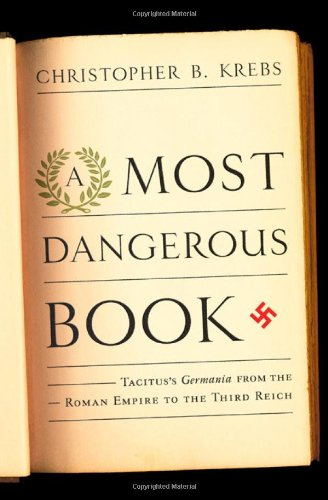
A Most Dangerous Book: Tacitus's Germania from the Roman Empire to...
Authors:
Christopher B. Krebs
Publisher:
W. W. Norton & Company
Publication Date:
Not available
ISBN:
0393062651
The riveting story of the Germania and its incarnations and exploitations through the ages.The pope wanted it, Montesquieu used it, and the Nazis... pilfered an Italian noble's villa to get it: the Germania, by the Roman historian Tacitus, took on a life of its own as both an object and an ideology. When Tacitus wrote a not-very-flattering little book about the ancient Germans in 98 CE, at the height of the Roman Empire, he could not have foreseen that the Nazis would extol it as "a bible," nor that Heinrich Himmler, the engineer of the Holocaust, would vow to resurrect Germany on its grounds. But the Germania inspired—and polarized—readers long before the rise of the Third Reich. In this elegant and captivating history, Christopher B. Krebs, a professor of classics at Harvard University, traces the wide-ranging influence of the Germania over a five-hundred-year span, showing us how an ancient text rose to take its place among the most dangerous books in the world. 14 black-and-white illustrations
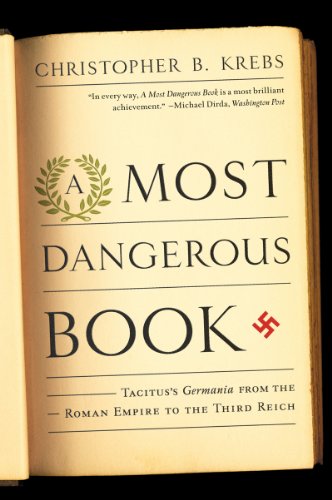
A Most Dangerous Book: Tacitus's Germania from the Roman Empire to...
Authors:
Christopher B. Krebs
Publisher:
W. W. Norton & Company
Publication Date:
Not available
ISBN:
0393342921
“A model of popular intellectual history. . . . In every way, A Most Dangerous Book is a most brilliant achievement.”—Washington PostWhen the... Roman historian Tacitus wrote the Germania, a none-too-flattering little book about the ancient Germans, he could not have foreseen that centuries later the Nazis would extol it as “a bible” and vow to resurrect Germany on its grounds. But the Germania inspired—and polarized—readers long before the rise of the Third Reich. In this elegant and captivating history, Christopher B. Krebs, a professor of classics at Harvard University, traces the wide-ranging influence of the Germania, revealing how an ancient text rose to take its place among the most dangerous books in the world. 14 illustrations
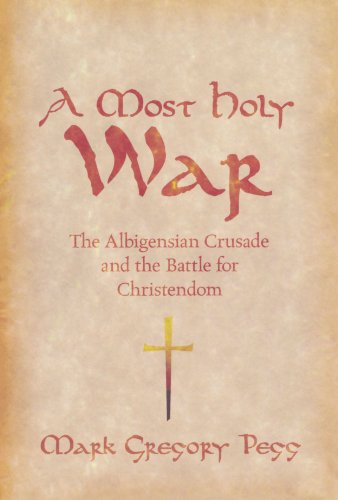
A Most Holy War: The Albigensian Crusade and the Battle for...
Authors:
Mark Gregory Pegg
Publisher:
Oxford University Press, USA
Publication Date:
Not available
ISBN:
0195393104
In January of 1208, a papal legate was murdered on the banks of the Rhone in southern France. A furious Pope Innocent III accused heretics of the crime... and called upon all Christians to exterminate heresy between the Garonne and Rhone rivers--a vast region now known as Languedoc--in a great crusade. This most holy war, the first in which Christians were promised salvation for killing other Christians, lasted twenty bloody years--it was a long savage battle for the soul of Christendom. In A Most Holy War, historian Mark Pegg has produced a swift-moving, gripping narrative of this horrific crusade, drawing in part on thousands of testimonies collected by inquisitors in the years 1235 to 1245. These accounts of ordinary men and women, remembering what it was like to live through such brutal times, bring the story vividly to life. Pegg argues that generations of historians (and novelists) have misunderstood the crusade; they assumed it was a war against the Cathars, the most famous heretics of the Middle Ages. The Cathars, Pegg reveals, never existed. He further shows how a millennial fervor about "cleansing" the world of heresy, coupled with a fear that Christendom was being eaten away from within by heretics who looked no different than other Christians, made the battles, sieges, and massacres of the crusade almost apocalyptic in their cruel intensity. In responding to this fear with a holy genocidal war, Innocent III fundamentally changed how Western civilization dealt with individuals accused of corrupting society. This fundamental change, Pegg argues, led directly to the creation of the inquisition, the rise of an anti-Semitism dedicated to the violent elimination of Jews, and even the holy violence of the Reconquista in Spain and in the New World in the fifteenth century. All derive their divinely sanctioned slaughter from the Albigensian Crusade. Haunting and immersive, A Most Holy War opens an important new perspective on a truly pivotal moment in world history, a first and distant foreshadowing of the genocide and holy violence in the modern world.
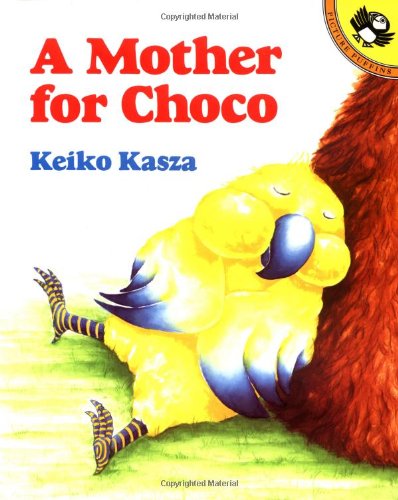
A Mother for Choco (Paperstar)
Authors:
Keiko Kasza
Publisher:
Puffin
Publication Date:
Not available
ISBN:
0698113640
Choco was a little bird who lived all alone. He wished he had a mother, but who could his mother be? "Just right for the preschool group or beginning... reader."--Kirkus Reviews, pointer review. "Young listeners will be charmed by the book's humor, warmth, and surprise ending."--Horn Book. Full color. Age 3-6.
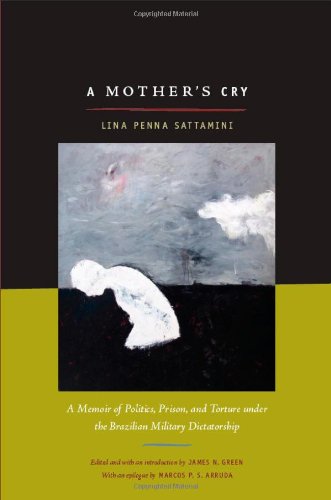
A Mother's Cry: A Memoir of Politics, Prison, and Torture under the...
Authors:
Lina Sattamini
Publisher:
Duke University Press Books
Publication Date:
Not available
ISBN:
0822347369
During the late 1960s and early 1970s, Brazil’s dictatorship arrested, tortured, and interrogated many people it suspected of subversion; hundreds of... those arrested were killed in prison. In May 1970, Marcos P. S. Arruda, a young political activist, was seized in São Paulo, imprisoned, and tortured. A Mother’s Cry is the harrowing story of Marcos’s incarceration and his family’s efforts to locate him and obtain his release. Marcos’s mother, Lina Penna Sattamini, was living in the United States and working for the U.S. State Department when her son was captured. After learning of his arrest, she and her family mobilized every resource and contact to discover where he was being held, and then they launched an equally intense effort to have him released. Marcos was freed from prison in 1971. Fearing that he would be arrested and tortured again, he left the country, beginning eight years of exile.Lina Penna Sattamini describes her son’s tribulations through letters exchanged among family members, including Marcos, during the year that he was imprisoned. Her narrative is enhanced by Marcos’s account of his arrest, imprisonment, and torture. James N. Green’s introduction provides an overview of the political situation in Brazil, and Latin America more broadly, during that tumultuous era. In the 1990s, some Brazilians began to suggest that it would be best to forget the trauma of that era and move on. Lina Penna Sattamini wrote her memoir as a protest against historical amnesia. First published in Brazil in 2000, A Mother’s Cry is testimonial literature at its best. It conveys the experiences of a family united by love and determination during years of political repression.
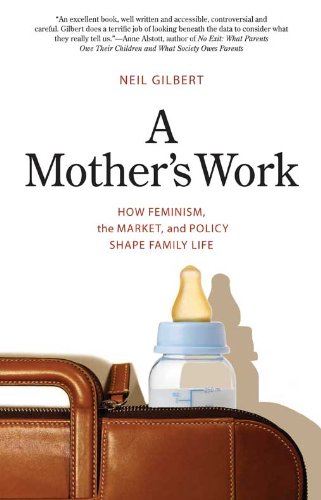
A Mother's Work: How Feminism, the Market, and Policy Shape Family...
Authors:
Professor Neil Gilbert
Publisher:
Yale University Press
Publication Date:
Not available
ISBN:
0300164610
The question of how best to combine work and family life has led to lively debates in recent years. Both a lifestyle and a policy issue, it has been... addressed psychologically, socially, and economically, and conclusions have been hotly contested. But as Neil Gilbert shows in this penetrating and provocative book, we haven’t looked closely enough at how and why these questions are framed, or who benefits from the proposed answers.A Mother’s Work takes a hard look at the unprecedented rise in childlessness, along with the outsourcing of family care and household production, which have helped to alter family life since the 1960s. It challenges the conventional view on how to balance motherhood and employment, and examines how the choices women make are influenced by the culture of capitalism, feminist expectations, and the social policies of the welfare state. Gilbert argues that while the market ignores the essential value of a mother’s work, prevailing norms about the social benefits of work have been overvalued by elites whose opportunities and circumstances little resemble those of most working- and middle-class mothers. And the policies that have been crafted too often seem friendlier to the market than to the family. Gilbert ends his discussion by looking at the issue internationally, and he makes the case for reframing the debate to include a wider range of social values and public benefits that present more options for managing work and family responsibilities.
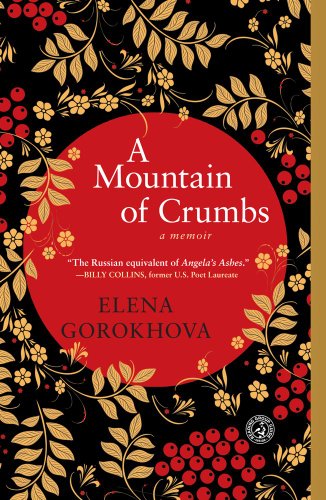
A Mountain of Crumbs: A Memoir
Authors:
Elena Gorokhova
Publisher:
Simon & Schuster
Publication Date:
Not available
ISBN:
1439125686
Elena Gorokhova’s A Mountain of Crumbs is the moving story of a Soviet girl who discovers the truths adults are hiding from her and the lies her... homeland lives by. Elena’s country is no longer the majestic Russia of literature or the tsars, but a nation struggling to retain its power and its pride. Born with a desire to explore the world beyond her borders, Elena finds her passion in the complexity of the English language—but in the Soviet Union of the 1960s such a passion verges on the subversive. Elena is controlled by the state the same way she is controlled by her mother, a mirror image of her motherland: overbearing, protective, difficult to leave. In the battle between a strong-willed daughter and her authoritarian mother, the daughter, in the end, must break free and leave in order to survive. Through Elena’s captivating voice, we learn not only the stories of Russian family life in the second half of the twentieth century, but also the story of one rebellious citizen whose curiosity and determination finally transport her to a new world. It is an elegy to the lost country of childhood, where those who leave can never return.

amour colere et folie
Authors:
Marie Vieux-Chauvet
Publisher:
ZELLIGE
Publication Date:
Not available
ISBN:
2914773366
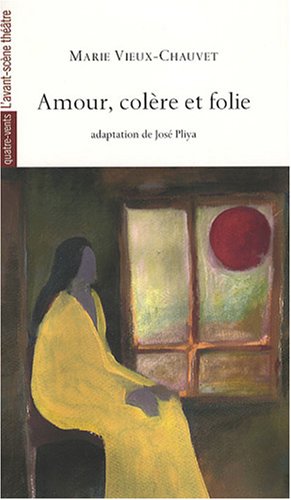
Amour, Colere et Folie
Authors:
Marie Vieux-Chauvet
Publisher:
quatre-vents
Publication Date:
Not available
ISBN:
274981037X
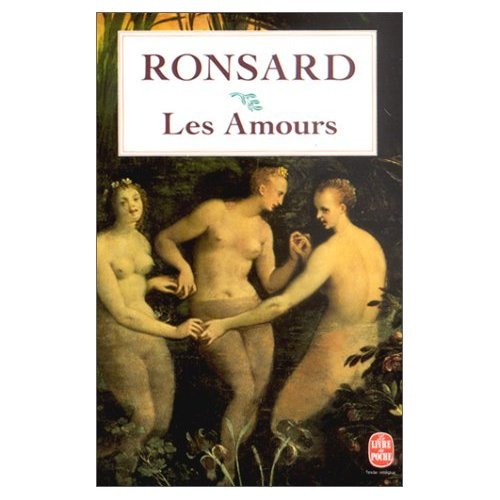
Amours (Ldp Classiques) (French Edition)
Authors:
P. Ronsard
Publisher:
Livre de Poche
Publication Date:
Not available
ISBN:
2253065498
Divin troupeau, qui sur les rives molles Du fleuve Eurote, ou sur le mont natal, Ou sur le bord du chevalin crystal, Assis, tenez vos plus sainctes... escolles : Si quelque foys aux saultz de vos carolles M'avez receu par ung astre fatal, Plus dur qu'en fer, qu'en cuyvre ou qu'en metal, Dans vostre temple engravez ces paroles : Ronsard, affin que le siecle a venir, De pere en filz se puisse souvenir, D'une beauté qui sagement affolé, De la main dextre append a nostre autel, L'humble discours de son livre immortel, Son cuoeur de l'autre, aux piedz de ceste idole.
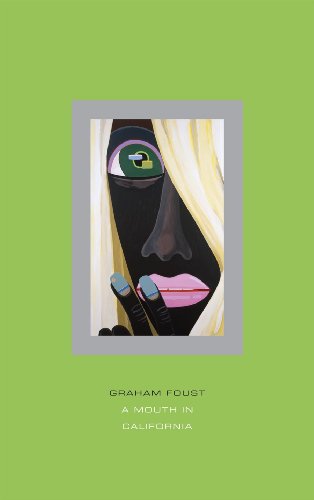
A Mouth in California
Authors:
Graham Foust
Publisher:
Flood Editions
Publication Date:
Not available
ISBN:
0981952011
Poetry. A MOUTH IN CALIFORNIA, Graham Foust's fourth book of poetry, uses the ironies and anxieties of contemporary life as a foil for mordant and... sometimes violent humor. Through mangled aphorisms, misheard song lyrics, and off-key phrasing, Foust creates a unique idiom of tragicomic pratfalls, a ballet of falling down. Yet the elasticity of Foust's language repels the stiff-necked adversaries of thought: "what's the wrong way to break / that brick of truth back into music?"
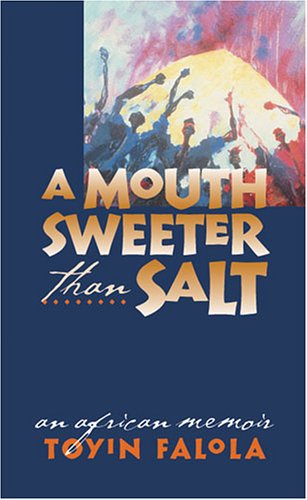
A Mouth Sweeter Than Salt: An African Memoir
Authors:
Toyin Omoyeni Falola
Publisher:
University of Michigan Press
Publication Date:
Not available
ISBN:
0472031325
"Toyin Falola has given us what is truly rare in modern African writing: a seriously funny, racy, irreverent package of memories, and full of the most... wonderful pieces of poetry and ordinary information. It is a matter of some interest, that the only other volume A Mouth Sweeter Than Salt reminds one of is Ake, by Wole Soyinka. What is it about these Yorubas?"-Ama Ata Aidoo"A splendid coming-of-age story so full of vivid color and emotion, the words seem to dance off the page. But this is not only Falola's memoir; it is an account of a new nation coming into being and the tensions and negotiations that invariably occur between city and country, tradition and modernity, men and women, rich and poor. A truly beautiful book."-Robin D. G. Kelley"More than a personal memoir, this book is a rich minihistory of contemporary Nigeria recorded in delicious detail by a perceptive eyewitness who grew up at the crossroads of many cultures."-Bernth Lindfors"The reader is irresistibly drawn into Falola's world. The prose is lucid. There is humor. This work is sweet. Period."-Ngugi wa Thiongo'oA Mouth Sweeter Than Salt gathers the stories and reflections of the early years of Toyin Falola, the grand historian of Africa and one of the greatest sons of Ibadan, the notable Yoruba city-state in Nigeria.Redefining the autobiographical genre altogether, Falola miraculously weaves together personal, historical, and communal stories, along with political and cultural developments in the period immediately preceding and following Nigeria's independence, to give us a unique and enduring picture of the Yoruba in the mid-twentieth century. This is truly a literary memoir, told in language rich with proverbs, poetry, song, and humor.Falola's memoir is far more than the story of one man's childhood experiences; rather, he presents us with the riches of an entire culture and community-its history, traditions, pleasures, mysteries, household arrangements, forms of power, struggles, and transformations.
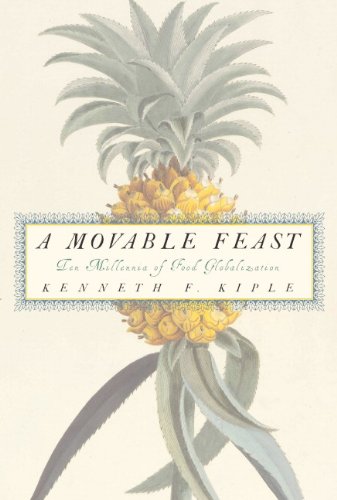
A Movable Feast: Ten Millennia of Food Globalization
Authors:
Kenneth F. Kiple
Publisher:
Cambridge University Press
Publication Date:
Not available
ISBN:
052179353X
In the last twenty-five years alone, the range of fruits and vegetables, even grains, that is available at most local markets has changed dramatically.... Over the last 10,000 years, that change is almost unimaginable. This groundbreaking new work, from the editor of the highly regarded Cambridge World History of Food, examines the exploding global palate. It begins with the transition from foraging to farming that got underway some 10,000 years ago in the Fertile Crescent, then examines subsequent transitions in Egypt, Africa south of the Sahara, China, southeast Asia, the Indus Valley Oceanic, Europe, and the Americas. It ends with chapters on genetically modified foods, the fast food industry, the nutritional ailments people have suffered from, famine, the obesity epidemic, and a look at the future on the food front. Food, at its most basic, fuels the human body. At its most refined, food has been elevated to a position of fine art. The path food has taken through history is a fairly straightforward one; the space which it occupies today could not be more fraught. This sweeping narrative covers both ends of the spectrum, reminding us to be grateful for and delighted in a grain of wheat, as well as making us aware of the many questions that remain unanswered about what lies ahead. Did you know. . .- That beans were likely an agricultural mistake?- That cheese making was originated in Iran over 6000 years ago?- That pepper was once worth its weight in gold?- That sugar is the world s best-selling food, surpassing even wheat?- That Winston Churchill asserted, in 1942, that tea was more important to his troops than ammunition?- That chili con carne is one of the earliest examples of food globalization?- That, by 1880, virtually every major city in America had a Chinese restaurant?- That white bread was once considered too nutritious?Kenneth Kiple reveals these facts and more within A Moveable Feast.
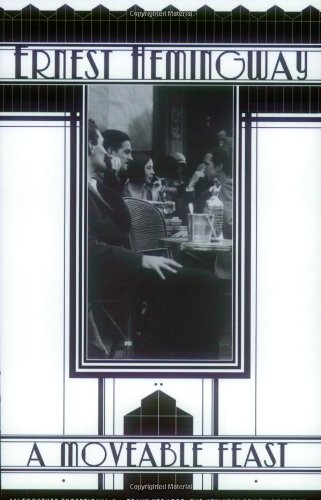
A Moveable Feast
Authors:
Ernest Hemingway
Publisher:
Scribner
Publication Date:
Not available
ISBN:
068482499X
Published posthumously in 1964, A Moveable Feast remains one of Ernest Hemingway's most beloved works. It is his classic memoir of Paris in the 1920s,... filled with irreverent portraits of other expatriate luminaries such as F. Scott Fitzgerald and Gertrude Stein; tender memories of his first wife, Hadley; and insightful recollections of his own early experiments with his craft. It is a literary feast, brilliantly evoking the exuberant mood of Paris after World War I and the youthful spirit, unbridled creativity, and unquenchable enthusiasm that Hemingway himself epitomized.
 '
'