production
/viewbook/list/all/?page=714
/
/static/
None

Anarchism and Other Essays
Authors:
Emma Goldman
Publisher:
CreateSpace Independent Publishing Platform
Publication Date:
Not available
ISBN:
1456494872
This collection chronicles the fiction and non fiction classics by the greatest writers the world has ever known. The inclusion of both popular as well... as overlooked pieces is pivotal to providing a broad and representative collection of classic works.

Anarchism: A Very Short Introduction
Authors:
Colin Ward
Publisher:
Oxford University Press
Publication Date:
Not available
ISBN:
0192804774
What do anarchists want? It seems easier to classify them by what they don't want, namely, the organizations of the State, and to identify them with... rioting and protest rather than with any coherent ideology. But with demonstrations like those against the World Bank and the International Monetary Fund being blamed on anarchists, it is clear that an explanation of what they do stand for is long overdue. Colin Ward provides answers to these questions by considering anarchism from a variety of perspectives: theoretical, historical, and international, and by exploring key anarchist thinkers, from Kropotkin to Chomsky. He looks critically at anarchism by evaluating key ideas within it, such as its blanket opposition to incarceration, and policy of "no compromise" with the apparatus of political decision-making. Can anarchy ever function effectively as a political force? Is it more "organized" and "reasonable" than is currently perceived? Whatever the politics of the reader, Ward's argument ensures that anarchism will be much better understood after experiencing this book.

Anarchist Papers
Authors:
Not Available
Publisher:
Black Rose Books
Publication Date:
Not available
ISBN:
1551641801
Essays contained within this volume of The Anarchist Papers include an assessment of Germany's Green Party and a study of the anarchist thought of Paul... Goodman by George Woodcock. Linguist Noam Chomsky examines the many ways in which the political powers rewrite history to suit their needs. Murray Bookchin theorizes on libertarian municipalism, and J. Frank Harrison discusses the politics of conformity and persuasion. Both Alice Wexler and Marsha Hewitt present essays on Emma Goldman that show the links between her anarchism and her feminism. "Wexler's article offers an acute portrait, showing Emma's contradictions and inconsistences, as well as her strengths and passions." —Choice Dimitrios Roussopoulos is an editor, writer and economist, who has written widely on international politics, and social change.

An Archive of Feelings: Trauma, Sexuality, and Lesbian Public...
Authors:
Ann Cvetkovich
Publisher:
Duke University Press Books
Publication Date:
Not available
ISBN:
0822330881
In this bold new work of cultural criticism, Ann Cvetkovich develops a queer approach to trauma. She argues for the importance of recognizing—and... archiving—accounts of trauma that belong as much to the ordinary and everyday as to the domain of catastrophe. An Archive of Feelings contends that the field of trauma studies, limited by too strict a division between the public and the private, has overlooked the experiences of women and queers. Rejecting the pathologizing understandings of trauma that permeate medical and clinical discourses on the subject, Cvetkovich develops instead a sex-positive approach missing even from most feminist work on trauma. She challenges the field to engage more fully with sexual trauma and the wide range of feelings in its vicinity, including those associated with butch-femme sex and aids activism and caretaking. An Archive of Feelings brings together oral histories from lesbian activists involved in act up/New York; readings of literature by Dorothy Allison, Leslie Feinberg, Cherríe Moraga, and Shani Mootoo; videos by Jean Carlomusto and Pratibha Parmar; and performances by Lisa Kron, Carmelita Tropicana, and the bands Le Tigre and Tribe 8. Cvetkovich reveals how activism, performance, and literature give rise to public cultures that work through trauma and transform the conditions producing it. By looking closely at connections between sexuality, trauma, and the creation of lesbian public cultures, Cvetkovich makes those experiences that have been pushed to the peripheries of trauma culture the defining principles of a new construction of sexual trauma—one in which trauma catalyzes the creation of cultural archives and political communities.

Anarchy and the Environment: The International Relations of Common...
Authors:
Not Available
Publisher:
State University of New York Press
Publication Date:
Not available
ISBN:
0791441849
Anarchy and the Environment examines how the recognition of environmental limits, combined with the ability of states to degrade common environmental... resources, affects the strategies and bargaining power of particular groups involved in international environmental negotiations. The contributors examine a wide range of environmental issues, including fisheries management, ozone depletion, acid rain, and water consumption rights, offering important practical insights into environmental negotiations and bargaining. Anarchy and the Environment also offers an important theoretical contribution by challenging the conventional explanations of bargaining dynamics and the resolution of collective action problems in international environmental politics. This book analyzes these problems and uses them as means to evaluate and expand upon common hypotheses regarding the shadow effect of the future on current behavior, the role of free riders in management regimes, and the role of market power in solving collective action and enforcement problems in international environmental management.

Anarchy and the Law: The Political Economy of Choice
Authors:
Edward Stringham
Publisher:
Transaction Publishers
Publication Date:
Not available
ISBN:
1412805791
Private-property anarchism, also known as anarchist libertarianism, individualist anarchism, and anarcho-capitalism, is a political philosophy and set... of economic and legal arguments that maintains that, just as the markets and private institutions of civil society provide food, shelter, and other human needs, markets and contracts should provide law and that the rule of law itself can only be understood as a private institution. To the libertarian, the state and its police powers are not benign societal forces, but a system of conquest, authoritarianism, and occupation. But whereas limited government libertarians argue in favor of political constraints, anarchist libertarians argue that, to check government against abuse, the state itself must be replaced by a social order of self-government based on contracts. Indeed, contemporary history has shown that limited government is untenable, as it is inherently unstable and prone to corruption, being dependent on the interest-group politics of the state's current leadership. Anarchy and the Law presents the most important essays explaining, debating, and examining historical examples of stateless orders. Section I, "Theory of Private Property Anarchism," presents articles that criticize arguments for government law enforcement and discuss how the private sector can provide law. In Section II, "Debate," limited government libertarians argue with anarchist libertarians about the morality and viability of private-sector law enforcement. Section III, "History of Anarchist Thought," contains a sampling of both classic anarchist works and modern studies of the history of anarchist thought and societies. Section IV, "Historical Case Studies of Non-Government Law Enforcement," shows that the idea that markets can function without state coercion is an entirely viable concept. Anarchy and the Law is a comprehensive reader on anarchist libertarian thought that will be welcomed by students of government, political science, history, philosophy, law, economics, and the broader study of liberty. Edward P. Stringham is professor of economics at San Jose State University and a research fellow at The Independent Institute. He is president of the Association of Private Enterprise Education, editor of the Journal of Private Enterprise, and the editor of Anarchy, State, and Public Choice.

Anarchy in Action
Authors:
Colin Ward
Publisher:
Freedom Press
Publication Date:
Not available
ISBN:
0900384204
With chapters on the family, topless federations, schools, housing, crime, employment, welfare, deviancy, planning, and more, this is probably the best... practical example of anarchist ideas in action. As he writes in his introduction "This book is not intended for people who had spent a lifetime pondering the problems of anarchism, but for those who either had no idea of what the word implied or knew exactly what it implied and rejected it, considering that it had no relevance for the modern world. My original preference as a title was the more cumbersome but more accurate 'Anarchism As A Theory Of Organization' because, as I urge in my preface, that is what the book is about. It is not about strategies for revolution and it is not involved in speculation on the way an anarchist society would function. It is about the ways in which people organize themselves in any kind of human society, whether we care to categorize those societies as primitive, traditional, capitalist or communist...

Anarchy, State, and Utopia
Authors:
Robert Nozick
Publisher:
Basic Books
Publication Date:
Not available
ISBN:
0465097200
In this brilliant and widely acclaimed book, winner of the 1975 National Book Award, Robert Nozick challenges the most commonly held political and... social positions of our age—liberal, socialist, and conservative.

ANARCHY,STATE+UTOPIA
Authors:
Not Available
Publisher:
Not available
Publication Date:
Not available
ISBN:
Not available
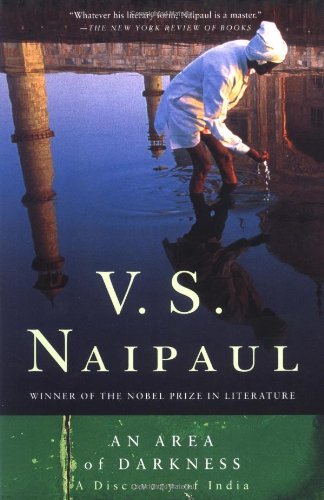
An Area of Darkness
Authors:
V.S. Naipaul
Publisher:
Vintage
Publication Date:
Not available
ISBN:
0375708359
A classic of modern travel writing, An Area of Darkness is Nobel laureate V. S. Naipaul’s profound reckoning with his ancestral homeland and an... extraordinarily perceptive chronicle of his first encounter with India.Traveling from the bureaucratic morass of Bombay to the ethereal beauty of Kashmir, from a sacred ice cave in the Himalayas to an abandoned temple near Madras, Naipaul encounters a dizzying cross-section of humanity: browbeaten government workers and imperious servants, a suavely self-serving holy man and a deluded American religious seeker. An Area of Darkness also abounds with Naipaul’s strikingly original responses to India’s paralyzing caste system, its apparently serene acceptance of poverty and squalor, and the conflict between its desire for self-determination and its nostalgia for the British raj. The result may be the most elegant and passionate book ever written about the subcontinent.

An Argument for Same-Sex Marriage: Religious Freedom, Sexual...
Authors:
Emily R. Gill
Publisher:
Georgetown University Press
Publication Date:
Not available
ISBN:
1589019202
The relationship between religious belief and sexuality as personal attributes exhibits some provocative comparisons. Despite the nonestablishment of... religion in the United States and the constitutional guarantee of free exercise, Christianity functions as the religious and moral standard in America. Ethical views that do not fit within this consensus often go unrecognized as moral values. Similarly, in the realm of sexual orientation, heterosexuality is seen as the yardstick by which sexual practices are measured. The notion that "alternative" sexual practices like homosexuality could possess ethical significance is often overlooked or ignored. In her new book, An Argument for Same-Sex Marriage, political scientist Emily Gill draws an extended comparison between religious belief and sexuality, both central components of one's personal identity. Using the religion clause of the First Amendment as a foundation, Gill contends that, just as US law and policy ensure that citizens may express religious beliefs as they see fit, it should also ensure that citizens may marry as they see fit. Civil marriage, according to Gill, is a public institution, and the exclusion of some couples from a state institution is a public expression of civic inequality. An Argument for Same-Sex Marriage is a passionate and timely treatment of the various arguments for and against same-sex marriage and how those arguments reflect our collective sense of morality and civic equality. It will appeal to readers who have an interest in gay and lesbian studies, political theory, constitutional law, and the role of religion in the contemporary United States.

An Army at Dawn: The War in North Africa, 1942-1943, Volume One of...
Authors:
Rick Atkinson
Publisher:
Holt Paperbacks
Publication Date:
Not available
ISBN:
0805074481
The liberation of Europe and the destruction of the Third Reich is a story of miscalculation and incomparable courage, of calamity and enduring triumph.... In this first volume of the Liberation Trilogy, Rick Atkinson focuses on 1942 and 1943, showing how central the great drama that unfolded in North Africa was to the ultimate victory of the Allied powers and to America's understanding of itself.Opening with the daring amphibious invasion in November 1942, An Army at Dawn follows the American and British armies as they fight the French in Morocco and Algiers, and then take on the Germans and Italians in Tunisia. Battle by battle, an inexperienced and often poorly led army gradually becomes a superb fighting force. Central to the tale are the extraordinary but flawed commanders who come to dominate the battlefield: Eisenhower, Patton, Bradley, Montgomery, and Rommel.Brilliantly researched, rich with new material and fresh insights, Atkinson's vivid narrative provides the definitive history of the war in North Africa. An Army at Dawn is the winner of the 2003 Pulitzer Prize for History.

An Army of Davids: How Markets and Technology Empower Ordinary...
Authors:
Glenn Reynolds
Publisher:
Thomas Nelson
Publication Date:
Not available
ISBN:
1595551131
There was a time in the not-too-distant past when large companies and powerful governments reigned supreme over the little guy. But new technologies are... empowering individuals like never before, and the Davids of the world-the amateur journalists, musicians, and small businessmen and women-are suddenly making a huge economic and social impact. In Army of Davids, author Glenn Reynolds, the man behind the immensely popular Instapundit.com, provides an in-depth, big-picture point-of-view for a world where the small guys matter more and more. Reynolds explores the birth and growth of the individual's surprisingly strong influence in: arts and entertainment, anti-terrorism, nanotech and space research, and much more. The balance of power between the individual and the organization is finally evening out. And it's high time the Goliaths of the world pay attention, because, as this book proves, an army of Davids is on the rise. "George Orwell feared that technology would enable dictators to enslave the masses. Glenn Reynolds shows that technology can empower individuals to determine their own futures and to defeat those who would enslave us. This is a book of profound importance-and also a darn good read."-MICHAEL BARONE, senior writer at U.S. News & World Report and author of Hard America, Soft America "Blogger extraordinaire Glenn Reynolds shows how average Americans can use new technologies to overcome the twin demons of corporate greed and incompetent government. Reynolds is a compelling evangelist for the power of the individual to change our world."-ARIANNA HUFFINGTON, author of Pigs at the Trough and Fanatics and Fools "A smart, fun tour of a major social and economic trend. From home-brewed beer to blogging, Glenn Reynolds is an engaging, uniquely qualified guide to the do-it-yourself movements transforming business, politics, and media."-VIRGINIA POSTREL, Forbes columnist and author of The Future and its Enemies and The Substance of Style "A student in her dorm room now commands the resources of a multi-million dollar music recording or movie editing studio of not so many years ago. The tools of creativity have been democratized and the tools of production are not far behind (Karl Marx take note). Glenn Reynolds's beguiling new book tells the insightful story of how an 'army of Davids' is inheriting the Earth, leaving a trail of obsolete business models not to mention cultural, economic, and political institutions in its wake."-RAY KURZWEIL, scientist, inventor, and author of several books including The Singularity is Near 'Must-read,' 'gotta have,' 'culture-changing' . . . I am suspicious of blurbs with such overused plugs. But Glenn Reynolds's An Army of Davids is in fact a must-read new book that you gotta have if you are going to understand the culture-changing forces that are unleashed and at work across the globe.-HUGH HEWITT, syndicated talk radio host and author of Blog and Painting the Map Red "Glenn Reynolds has written an essential book for understanding how technology and markets are creating a bottom-up shift in power to ordinary people that is changing business, government, and our world. Packed with fresh ideas and adorned with graceful prose, An Army of Davids is a masterpiece."-JOE TRIPPI, author of The Revolution Will Not Be Televised "I cannot think of a better book for the average reader to understand just how the Web and other digital technologies are reversing the polarities of modern society-restoring many features of daily life lost with the Industrial Revolution, while at the same time inventing powerful new cultural institutions. And for those of us who make careers out of watching this transformation, no book to date so well summarizes all of the diverse trends in a single narrative."-MICHAEL MALONE, "Silicon Insider," ABC News "Reynolds' highly informative book-a must-read if you want to have some idea of the direction things are taking-is about a lot more than the effect of blogging on Big Media. Its theme is 'the triumph of personal technology over mass technology,' which is a trend Reynolds believes is only 'going to strengthen over the coming decades.'"- FRANK WILSON, Philadelphia Inquirer "Instapundit's book reads fast. . . It's just one big idea after another, like a Hollywood thriller that piles on the plot rather than stopping to tie up the loose ends. . . He's fearless. . ."-MICKEY KAUS, Kausfiles "The book covers everything from home-brewing beer to space travel, but all the themes are connected by Glenn's faith in human imagination and creativity. It's a must-read for anyone interested in where technology is taking us."-JIM MEIGS, Popular Mechanics "Reynolds comes across as a good-humored, reasonable and even modest fellow, so it is astonishing to realize just how ambitious An Army of Davids really is. A hundred years ago, nobody could accurately explain or predict just where the Industrial Revolution would take us. Now, Reynolds attempts nothing short of explaining and predicting where the Information Revolution will take us. . . I will make a prediction-in December, when lists of the most important books of the year are drawn up, this one will be near the top."- JAMES L. MERRINER, Chicago Sun-Times "Reynolds argues that we are undergoing a sea change. The balance of advantage-in every aspect of society-is shifting from big organizations to small ones. . . Reynolds presents his case with verve and wit."-ADRIAN WOOLDRIDGE, Wall Street Journal ". . . crisp and readable. . . "-The Economist "Glenn Reynolds isn't just the author of An Army of Davids. He's a living, breathing embodiment of the book's attractive and persuasive thesis. . ."-NICK GILLESPIE, New York Post

An Army of Ex-Lovers: My Life at the Gay Community News
Authors:
Amy Hoffman
Publisher:
Univ. of Massachusetts Press
Publication Date:
Not available
ISBN:
1558496211
A vivid, funny portrait of the four tumultuous years a young editor spent working in the gay press. Boston's weekly Gay Community News was the center of... the universe during the late 1970s, writes Amy Hoffman in this memoir of gay liberation before AIDS, before gay weddings, and before The L Word. Provocative, informative, inspiring, and absurd, with a small circulation but a huge influence, Gay Community News produced a generation of leaders, writers, and friends. In addition to capturing the heady atmosphere of the times the victories, controversies, and tragedies Hoffman's memoir is also her personal story, written with wit and insight, of growing up in a political movement; of her deepening relationships with charismatic, talented, and sometimes utterly weird coworkers; and of trying to explain it all to her large Jewish family.

An Army of Lions: The Civil Rights Struggle Before the NAACP...
Authors:
Shawn Leigh Alexander
Publisher:
University of Pennsylvania Press
Publication Date:
Not available
ISBN:
0812243757
In January 1890, journalist T. Thomas Fortune stood before a delegation of African American activists in Chicago and declared, "We know our rights and... have the courage to defend them," as together they formed the Afro-American League, the nation's first national civil rights organization. Over the next two decades, Fortune and his fellow activists organized, agitated, and, in the process, created the foundation for the modern civil rights movement.An Army of Lions: The Civil Rights Struggle Before the NAACP traces the history of this first generation of activists and the organizations they formed to give the most comprehensive account of black America's struggle for civil rights from the end of Reconstruction to the formation of the National Association for the Advancement of Colored People in 1909. Here a host of leaders neglected by posterity—Bishop Alexander Walters, Mary Church Terrell, Jesse Lawson, Lewis G. Jordan, Kelly Miller, George H. White, Frederick McGhee, Archibald Grimké—worked alongside the more familiar figures of Ida B. Wells-Barnett, W. E. B. Du Bois, and Booker T. Washington, who are viewed through a fresh lens.As Jim Crow curtailed modes of political protest and legal redress, members of the Afro-American League and the organizations that formed in its wake—including the Afro-American Council, the Niagara Movement, the Constitution League, and the Committee of Twelve—used propaganda, moral suasion, boycotts, lobbying, electoral office, and the courts, as well as the call for self-defense, to end disfranchisement, segregation, and racial violence. In the process, the League and the organizations it spawned provided the ideological and strategic blueprint of the NAACP and the struggle for civil rights in the twentieth century, demonstrating that there was significant and effective agitation during "the age of accommodation."
 '
'