production
/viewbook/list/all/?page=746
/
/static/
None

ANDA!(LOOSELEAF)W/WKBK+CODE+DI CT.PKG
Authors:
Not Available
Publisher:
Not available
Publication Date:
Not available
ISBN:
Not available
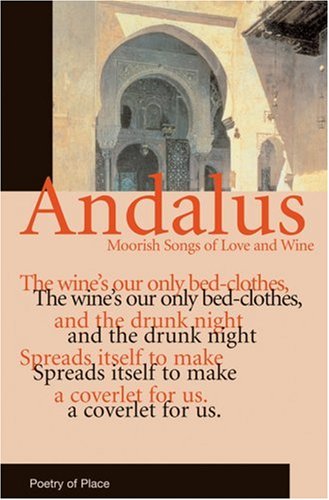
Andalus: Moorish Songs of Love and Wine (Poetry of Place)
Authors:
T.J. Gorton
Publisher:
Eland Books
Publication Date:
Not available
ISBN:
0955010586
The idea of Moorish Spain captures the modern imagination, with its tales of knowledge shared across the borders of medieval Islam and Christendom, and... of courts resounding to the gentle oriental strains of lute and ney. Yet it is an elusive place, glimpsed in the haunted emptiness of the Alhambra's gilded halls or amidst the pillars of the Great Mosque of Cordoba. This collection of its poetry, in a sparkling new translation by T. J. Gorton, fills those deserted spaces with the Moorish lust for life, and with a near-suffocating desire for love and for the rich enchantments of wine, laughter, moonlit picnics, and bare flesh.
ANDA..SPAN 111/112 NMSU ]CUSTOM[ PKG
Authors:
Not Available
Publisher:
Not available
Publication Date:
Not available
ISBN:
Not available

And a Time to Die: How American Hospitals Shape the End of Life
Authors:
Sharon R. Kaufman
Publisher:
Scribner
Publication Date:
Not available
ISBN:
0743264762
Most Americans, when pressed, have a vague sense of how they would like to die. They may imagine a quick and painless end or a gentle passing away... during sleep. Some may wish for time to prepare and make peace with themselves, their friends, and their families. Others would prefer not to know what's coming, a swift, clean break. Yet all fear that the reality will be painful and prolonged; all fear the loss of control that could accompany dying. That fear is justified. It is also historically unprecedented. In the past thirty years, the advent of medical technology capable of sustaining life without restoring health, the expectation that a critically ill person need not die, and the conviction that medicine should routinely thwart death have significantly changed where, when, and how Americans die and put us all in the position of doing something about death. In a penetrating and revelatory study, medical anthropologist Sharon R. Kaufman examines the powerful center of those changes -- the hospital, where most Americans die today. In the hospital world, the deep, irresolvable tension between the urge to extend life at all costs and the desire to allow "letting go" is rarely acknowledged, yet it underlies everything that happens there among patients, families, and health professionals. Over the course of two years, Kaufman observed and interviewed critically ill patients, their families, doctors, nurses, and other hospital staff at three community hospitals. In...And a Time to Die, her research places us at the heart of that science-driven yet fractured and often irrational world of health care delivery, where empathetic yet frustrated, hard-working yet constrained professionals both respond to and create the anxieties and often inchoate expectations of patients and families, who must make "decisions" they are ill-prepared to make. Filled with actual conversations between patients and doctors, families and hospital staff,...And a Time to Die clearly and carefully exposes the reasons for complicated questions about medical care at the end of life: for example, why "heroic" treatment so often overrides "humane" care; why patients and families are ambivalent about choosing death though they claim to want control; what constitutes quality of life and life itself; and, ultimately, why a "good" death is so elusive. In elegant, compelling prose, Kaufman links the experiences of patients and families, the work of hospital staff, and the ramifications of institutional bureaucracy to show the invisible power of the hospital system itself -- its rules, mandates, and daily activity -- in shaping death and our individual experience of it. ...And a Time to Die is a provocative, illuminating, and necessary read for anyone working in or navigating the health care system today, providing a much-needed road map to the disorienting territory of the hospital, where we all are asked to make life-and-death choices.

And a Time to Die: How American Hospitals Shape the End of Life
Authors:
Sharon R. Kaufman
Publisher:
University Of Chicago Press
Publication Date:
Not available
ISBN:
0226426858
Over the past thirty years, the way Americans experience death has been dramatically altered. The advent of medical technology capable of sustaining... life without restoring health has changed where, when, and how we die. In this revelatory study, medical anthropologist Sharon R. Kaufman examines the powerful center of those changes: the hospital, where most Americans die today. She deftly links the experiences of patients and families, the work of hospital staff, and the ramifications of institutional bureaucracy to show the invisible power of the hospital system in shaping death and our individual experience of it. In doing so, Kaufman also speaks to the ways we understand what it means to be human and to be alive.“An act of courage and a public service.”—San Francisco Chronicle“This beautifully synthesized and disquieting account of how hospital patients die melds disciplined description with acute analysis, incorporating the voices of doctors, nurses, social workers, and patients in a provocative analysis of the modern American quest for a ‘good death.’”—Publishers Weekly“Kaufman exposes the bureaucratic and ethical quandaries that hover over the modern deathbed.”—Psychology Today“Kaufman’s analysis illuminates the complexity of the care of critically ill and dying patients [and] the ambiguity of slogans such as ‘death with dignity,’ ‘quality of life,’ and ‘stopping life support.’ . . . Thought-provoking reading for everyone contemplating the fate of us all.”—New England Journal of Medicine

And Baby Makes Three: The Six-Step Plan for Preserving Marital...
Authors:
John Gottman Ph.D.
Publisher:
Three Rivers Press
Publication Date:
Not available
ISBN:
140009738X
Congratulations! You have a new baby. Don’t forget you also have a marriage. Having a baby is a joyous experience, but even the best relationships are... strained during the transition from duo to trio. In And Baby Makes Three, Love Lab™ experts John Gottman and Julie Schwartz Gottman teach couples the skills needed to maintain healthy marriages, so partners can avoid the pitfalls of parenthood by:• Focusing on intimacy and romance • Replacing an atmosphere of criticism and irritability with one of appreciation • Preventing postpartum depression • Creating a home environment that nurtures physical, emotional, and mental health, as well as cognitive and behavioral development for your babyComplete with exercises that separate the “master” from the “disaster” couples, And Baby Makes Three helps new parents positively manage the strain that comes along with their bundle of joy.
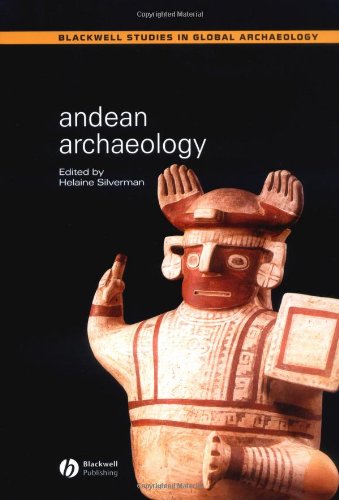
Andean Archaeology (Wiley-Blackwell Studies in Global Archaeology)
Authors:
Helaine Silverman
Publisher:
Wiley-Blackwell
Publication Date:
Not available
ISBN:
0631234012
This book provides an introduction to one of the most fascinating and well-known centers of ancient civilization. Explores the rise of civilization in... the Central Andes from the time of the region's earliest inhabitants to the emergence of the Inca state many thousands of years later. Comprised of 13 newly commissioned chapters written by leading archaeologists representing current thinking in the field. Presents the central debates in contemporary Inca and Andean archaeology. Progresses chronologically and culturally to reveal the processes by which multiple Andean societies became increasingly complex.
Andean Cocaine: The Making of a Global Drug
Authors:
Paul Gootenberg
Publisher:
The University of North Carolina Press
Publication Date:
Not available
ISBN:
0807859052
Illuminating a hidden and fascinating chapter in the history of globalization, Paul Gootenberg chronicles the rise of one of the most spectacular and... now illegal Latin American exports: cocaine. Gootenberg traces cocaine's history from its origins as a medical commodity in the nineteenth century to its repression during the early twentieth century and its dramatic reemergence as an illicit good after World War II. Connecting the story of the drug's transformations is a host of people, products, and processes: Sigmund Freud, Coca-Cola, and Pablo Escobar all make appearances, exemplifying the global influences that have shaped the history of cocaine. But Gootenberg decenters the familiar story to uncover the roles played by hitherto obscure but vital Andean actors as well--for example, the Peruvian pharmacist who developed the techniques for refining cocaine on an industrial scale and the creators of the original drug-smuggling networks that decades later would be taken over by Colombian traffickers. Andean Cocaine proves indispensable to understanding one of the most vexing social dilemmas of the late twentieth-century Americas: the American cocaine epidemic of the 1980s and, in its wake, the seemingly endless U.S. drug war in the Andes.
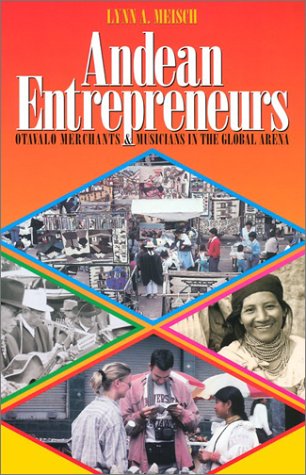
Andean Entrepreneurs: Otavalo Merchants and Musicians in the Global...
Authors:
Lynn A. Meisch
Publisher:
University of Texas Press
Publication Date:
Not available
ISBN:
0292752598
Native to a high valley in the Andes of Ecuador, the Otavalos are an indigenous people whose handcrafted textiles and traditional music are now sold in... countries around the globe. Known as weavers and merchants since pre-Inca times, Otavalos today live and work in over thirty countries on six continents, while hosting more than 145,000 tourists annually at their Saturday market.In this ethnography of the globalization process, Lynn A. Meisch looks at how participation in the global economy has affected Otavalo identity and culture since the 1970s. Drawing on nearly thirty years of fieldwork, she covers many areas of Otavalo life, including the development of weaving and music as business enterprises, the increase in tourism to Otavalo, the diaspora of Otavalo merchants and musicians around the world, changing social relations at home, the growth of indigenous political power, and current debates within the Otavalo community over preserving cultural identity in the face of globalization and transnational migration. Refuting the belief that contact with the wider world inevitably destroys indigenous societies, Meisch demonstrates that Otavalos are preserving many features of their culture while adopting and adapting modern technologies and practices they find useful.
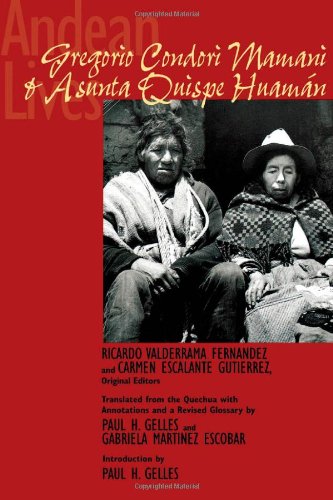
Andean Lives: Gregorio Condori Mamani and Asunta Quispe Huamán
Authors:
Not Available
Publisher:
University of Texas Press
Publication Date:
Not available
ISBN:
0292724926
Gregorio Condori Mamani and Asunta Quispe Huamán were runakuna, a Quechua word that means "people" and refers to the millions of indigenous inhabitants... neglected, reviled, and silenced by the dominant society in Peru and other Andean countries. For Gregorio and Asunta, however, that silence was broken when Peruvian anthropologists Ricardo Valderrama Fernández and Carmen Escalante Gutiérrez recorded their life stories. The resulting Spanish-Quechua narrative, published in the mid-1970s and since translated into many languages, has become a classic introduction to the lives and struggles of the "people" of the Andes.Andean Lives is the first English translation of this important book. Working directly from the Quechua, Paul H. Gelles and Gabriela Martínez Escobar have produced an English version that will be easily accessible to general readers and students, while retaining the poetic intensity of the original Quechua. It brings to vivid life the words of Gregorio and Asunta, giving readers fascinating and sometimes troubling glimpses of life among Cuzco's urban poor, with reflections on rural village life, factory work, haciendas, indigenous religion, and marriage and family relationships.
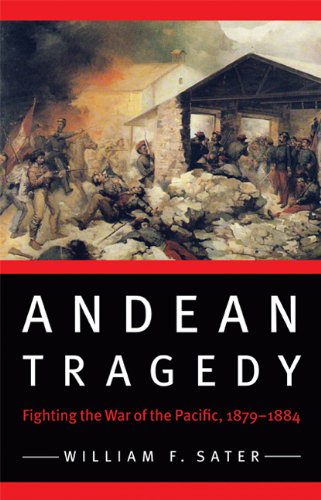
Andean Tragedy: Fighting the War of the Pacific, 1879-1884 (Studies...
Authors:
William F. Sater Ph.D. MA AB
Publisher:
University of Nebraska Press
Publication Date:
Not available
ISBN:
080322799X
The year 1879 marked the beginning of one of the longest, bloodiest conflicts of nineteenth-century Latin America. The War of the Pacific pitted Peru... and Bolivia against Chile in a struggle initiated over a festering border dispute. The conflict saw Chile’s and Peru’s armored warships vying for control of sea lanes and included one of the first examples of the use of naval torpedoes. On land, large armies using the most modern weapons—breech-loading rifles, Gatling guns, and steel-barreled artillery—clashed in battles that left thousands of men dead on the battlefields. Eventually, the warring parties revamped their respective military establishments, creating much needed, civilian-supported supply, transportation, and medical units. Chile ultimately prevailed. Bolivia lost its seacoast along with valuable nitrate and copper deposits to Chile, and Peru was forced to cede mineral rich Tarapaca and the province of Arica to the victor. Employing the primary and secondary sources of the countries involved, William F. Sater offers the definitive analysis of the conflict's naval and military campaigns. Andean Tragedy not only places the war in a crucial international context, but also explains why this devastating conflict resulted in a Chilean victory.
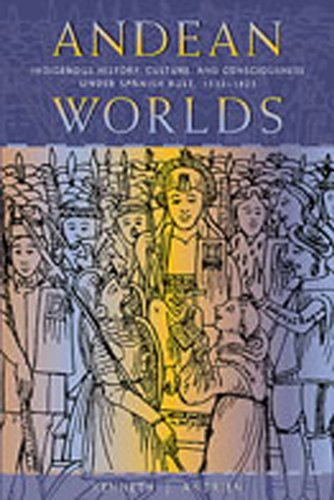
Andean Worlds: Indigenous History, Culture, and Consciousness under...
Authors:
Kenneth J. Andrien
Publisher:
University of New Mexico Press
Publication Date:
Not available
ISBN:
0826323588
This broadly gauged, synthetic study examines how the Spanish invasion of the Inca Empire (called Tawintinsuyu) in 1532 brought dramatic and... irreversible transformations in traditional Andean modes of production, technology, politics, religion, culture, and social hierarchies. At the same time, Professor Andrien explains how the indigenous peoples merged these changes with their own political, socioeconomic, and religious traditions. In this way European and indigenous life ways became intertwined, producing a new and constantly evolving hybrid colonial order in the Andes.After beginning with a study of Tawintinsuyu on the eve of the Spanish invasion, Andrien then presents the salient topics in Andean colonial history: the emergence of the colonial state; the colonial socioeconomic order; indigenous culture and society; Spanish attempts to impose Roman Catholic orthodoxy; and Andean resistance, rebellion, and political consciousness. By drawing on his own research and the contributions from scholars in many disciplines, Kenneth J. Andrien offers a masterful interpretation of Andean colonial history, one of the most dynamic and creative fields in Latin American studies."This is a clearly written, comprehensive, and well-balanced account. . . particularly in discussions of the often vexed and central question of Spanish versus Native American issues."--Peter J. Bakewell, Edmund and Louise Kahn Professor of History, Southern Methodist University

Anders gedacht: Text and Context in the German-Speaking World
Authors:
Irene Motyl-Mudretzkyj
Publisher:
Heinle
Publication Date:
Not available
ISBN:
1439082537
Written entirely in German, this content-based text will help you communicate meaningfully in interpersonal, interpretive, and presentational modes in... German. With a stimulating, comparative focus on topics such as contemporary politics, the environment, history, film, music, fine art, literature, and technology, this text encourages creative self-expression as well as critical thinking about the German language and contemporary cultures of the German-speaking world. ANDERS GEDACHT, Second Edition will keep you engaged in the learning process through inductive grammar instruction and review, cultural interpretation, analysis and comparison with your own culture, and interactive, task-based practice.
ANDERS GEDACHT- TEXT+SAM
Authors:
Not Available
Publisher:
Not available
Publication Date:
Not available
ISBN:
Not available
ANDERS GEDACHT-W/UBUNGSBUCH+CD PROG.
Authors:
Not Available
Publisher:
Not available
Publication Date:
Not available
ISBN:
Not available
 '
'