production
/viewbook/list/all/?page=820
/
/static/
None
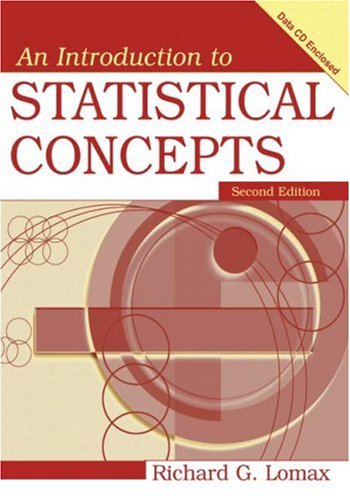
An Introduction to Statistical Concepts
Authors:
Richard G. Lomax
Publisher:
Routledge Academic
Publication Date:
Not available
ISBN:
0805857397
Unlike many other statistics texts, this one is comprehensive and flexible enough for either a single or a two-semester course. Instructors can select... only the topics that are most appropriate for their course. Its intuitive approach helps students more easily understand the concepts and interpret software results. Throughout the text, the author demonstrates how many statistical concepts relate to one another. Only the most crucial equations are included. The new edition features: SPSS sections throughout with input, output, and APA style write-ups using the book's dataset A CD with every example and problem dataset used in the text in SPSS format; More information on confidence intervals, effect size measures, power, and regression models A revised sequence of the regression and ANOVA chapters for enhanced conceptual flow De-emphasized computations to provide more discussion of concepts and software More end of chapter problems with more realistic data and a greater emphasis on interpretation Many more references An Instructor's Resource CD with all of the solutions to the problems and other teaching aids. The first five chapters cover basic descriptive statistics including ways of representing data graphically, statistical measures, the normal distribution and other standard scores, and probability and sampling. The remainder of the text covers inferential statistics involving means, proportions, variances, and correlations, basic and advanced analysis of variance (ANOVA) and regression models. It contains a number of topics not dealt with in other texts such as robust methods, multiple comparison and nonparametric procedures, and advanced ANOVA and multiple regression models. Realistic examples from education and the behavioral sciences illustrate the concepts. Each example includes an examination of the various procedures and necessary assumptions, tips on developing an APA style write-up, and sample SPSS output. Useful tables of assumptions and the effects of their violation are included, along with how to test assumptions in SPSS. Each chapter concludes with conceptual and computational problems, about a third of which are new to this edition. Answers to the odd-numbered problems are provided. Intended for a one- or a two-semester course in introductory statistics taught in education and/or behavioral science departments. Although used predominantly at the master's or doctoral level, the book is also used at the undergraduate level. Only a rudimentary knowledge of algebra is required.
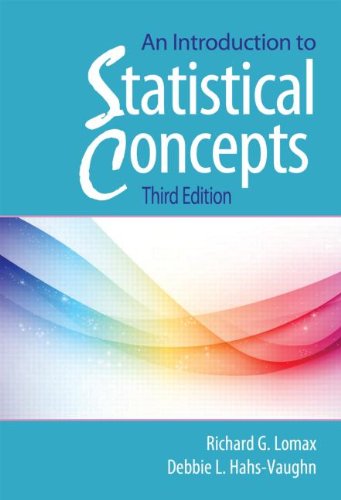
An Introduction to Statistical Concepts: Third Edition
Authors:
Richard G. Lomax
Publisher:
Routledge Academic
Publication Date:
Not available
ISBN:
041588005X
This comprehensive, flexible text is used in both one- and two-semester courses to review introductory through intermediate statistics. Instructors... select the topics that are most appropriate for their course. Its conceptual approach helps students more easily understand the concepts and interpret SPSS and research results. Key concepts are simply stated and occasionally reintroduced and related to one another for reinforcement. Numerous examples demonstrate their relevance. This edition features more explanation to increase understanding of the concepts. Only crucial equations are included.In addition to updating throughout, the new edition features: New co-author, Debbie L. Hahs-Vaughn, the 2007 recipient of the University of Central Florida's College of Education Excellence in Graduate Teaching Award. A new chapter on logistic regression models for today's more complex methodologies. More on computing confidence intervals and conducting power analyses using G*Power. Many more SPSS screenshots to assist with understanding how to navigate SPSS and annotated SPSS output to assist in the interpretation of results. Extended sections on how to write-up statistical results in APA format. New learning tools including chapter-opening vignettes, outlines, and a list of key concepts, many more examples, tables, and figures, boxes, and chapter summaries. More tables of assumptions and the effects of their violation including how to test them in SPSS. 33% new conceptual, computational, and all new interpretative problems. A website that features PowerPoint slides, answers to the even-numbered problems, and test items for instructors, and for students the chapter outlines, key concepts, and datasets that can be used in SPSS and other packages, and more. Each chapter begins with an outline, a list of key concepts, and a vignette related to those concepts. Realistic examples from education and the behavioral sciences illustrate those concepts. Each example examines the procedures and assumptions and provides instructions for how to run SPSS, including annotated output, and tips to develop an APA style write-up. Useful tables of assumptions and the effects of their violation are included, along with how to test assumptions in SPSS. 'Stop and Think' boxes provide helpful tips for better understanding the concepts. Each chapter includes computational, conceptual, and interpretive problems. The data sets used in the examples and problems are provided on the web. Answers to the odd-numbered problems are given in the book. The first five chapters review descriptive statistics including ways of representing data graphically, statistical measures, the normal distribution, and probability and sampling. The remainder of the text covers inferential statistics involving means, proportions, variances, and correlations, basic and advanced analysis of variance and regression models. Topics not dealt with in other texts such as robust methods, multiple comparison and nonparametric procedures, and advanced ANOVA and multiple and logistic regression models are also reviewed.Intended for one- or two-semester courses in statistics taught in education and/or the behavioral sciences at the graduate and/or advanced undergraduate level, knowledge of statistics is not a prerequisite. A rudimentary knowledge of algebra is required.
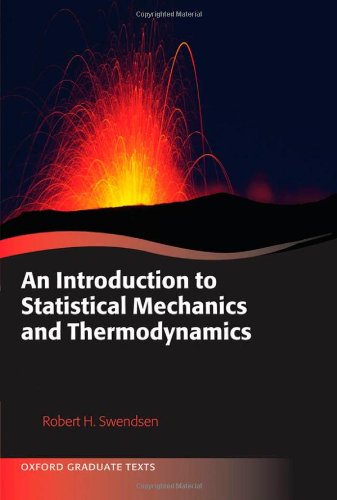
An Introduction to Statistical Mechanics and Thermodynamics (Oxford...
Authors:
Robert H. Swendsen
Publisher:
Oxford University Press, USA
Publication Date:
Not available
ISBN:
0199646945
This text presents the two complementary aspects of thermal physics as an integrated theory of the properties of matter. Conceptual understanding is... promoted by thorough development of basic concepts. In contrast to many texts, statistical mechanics, including discussion of the required probability theory, is presented first. This provides a statistical foundation for the concept of entropy, which is central to thermal physics. A unique feature of the book is the development of entropy based on Boltzmann's 1877 definition; this avoids contradictions or ad hoc corrections found in other texts. Detailed fundamentals provide a natural grounding for advanced topics, such as black-body radiation and quantum gases. An extensive set of problems (solutions are available for lecturers through the OUP website), many including explicit computations, advance the core content by probing essential concepts. The text is designed for a two-semester undergraduate course but can be adapted for one-semester courses emphasizing either aspect of thermal physics. It is also suitable for graduate study.
An Introduction to Statistical Methods and Data Analysis
Authors:
R. Lyman Ott
Publisher:
Duxbury Press
Publication Date:
Not available
ISBN:
0534251226
Statistics is a thought process. In this comprehensive introduction to statistical methods and data analysis, the process is presented utilizing a... four-step approach: 1) gathering data, 2) summarizing data, 3) analyzing data, and 4) communicating the results of data analyses.
An Introduction to Statistical Methods and Data Analysis
Authors:
R. Lyman Ott
Publisher:
Duxbury Press
Publication Date:
Not available
ISBN:
0495017582
Ott and Longnecker's AN INTRODUCTION TO STATISTICAL METHODS AND DATA ANALYSIS, Sixth Edition, provides a broad overview of statistical methods for... advanced undergraduate and graduate students from a variety of disciplines who have little or no prior course work in statistics. The authors teach students to solve problems encountered in research projects, to make decisions based on data in general settings both within and beyond the university setting, and to become critical readers of statistical analyses in research papers and in news reports. The first eleven chapters present material typically covered in an introductory statistics course, as well as case studies and examples that are often encountered in undergraduate capstone courses. The remaining chapters cover regression modeling and design of experiments.
An Introduction to Statistical Problem Solving in Geography
Authors:
J. Chapman McGrew Jr.
Publisher:
Waveland Pr Inc
Publication Date:
Not available
ISBN:
157766633X
Written for undergraduate geography majors and entry-level graduate students with limited backgrounds in statistical analysis and methods, McGrew and... Monroe provide a comprehensive and understandable introduction to statistical methods in a problem-solving framework. Engaging examples and problems are drawn from a variety of topical areas in both human and physical geography and are fully integrated into the text. Without compromising statistical rigor or oversimplifying, the authors stress the importance of written narratives that explain each statistical technique. After introducing basic statistical concepts and terminology, the authors focus on nonspatial and spatial descriptive statistics. They transition to inferential problem solving, including probability, sampling, and estimation, before delving deeper into inferential statistics for geographic problem solving. The final chapters examine the related techniques of correlation and regression. A list of major goals and objectives is included at the end of each chapter, allowing students to monitor their own progress and mastery of geographic statistical materials. An epilogue, offering over 150 geographic situations, gives students a chance to figure out which statistical technique should be used for a particular situation.
An Introduction to Statistical Thermodynamics (Dover Books on Physics)
Authors:
Terrell L. Hill
Publisher:
Dover Publications
Publication Date:
Not available
ISBN:
0486652424
Part I deals with principles of quantum statistical mechanics. Part II examines systems composed of independent molecules or other independent... subsystems. Part III considers systems of interacting molecules, and Part IV covers quantum statistics and includes sections on Fermi-Dirac and Bose-Einstein statistics, photon gas, and free-volume theories of quantum liquids.
An Introduction To Statutory Interpretation and the Legislative...
Authors:
Abner J. Mikva
Publisher:
Aspen Publishers
Publication Date:
Not available
ISBN:
1567066127
In an easy-to-read colloquial style, Mikva and Lane lead students to the understanding they need for succes in substantive courses with a heavy... statutory emphasis:<p class=copymedium> <li class=copymedium>The Interpretation of Statutes - Beginning whre students do, by reading interpretive cases, the authors demonstrate that statutory interpretation is not simply the search for legislative meaning or intent, but also the exercise of power by a separate branch of government. Organized around two types of cases, those where the statutory language is clear and where it is unclear, this chapter delves into judicial approaches to statutory interpretation and the tools employed for that purpose, as well as criticism of such approaches.<p class=copymedium> <li class=copymedium>The Legislative Process - Addresses the environment in which the consideration of legislation takes place and the dynamics of the enactment process.<p class=copymedium> <li class=copymedium>The Enactment of a Statute - Follows a particular bill through the window of the Congressional Record. This illustrates example focuses attention on the details and language of the legislative process.<p class=copymedium> <li class=copymedium>The Anatomy of a Statute - A complete dissection of the structure, form, and generic provisions.<p class=copymedium> <li class=copymedium>The Publication of Statutes - Offers little-known insights that can be used for tactical advantage.

An Introduction to Stellar Astrophysics
Authors:
Francis LeBlanc
Publisher:
Wiley
Publication Date:
Not available
ISBN:
0470699566
An Introduction to Stellar Astrophysics aspires to provide the reader with an intermediate knowledge on stars whilst focusing mostly on the explanation... of the functioning of stars by using basic physical concepts and observational results.The book is divided into seven chapters, featuring both core and optional content:Basic conceptsStellar FormationRadiative Transfer in StarsStellar AtmospheresStellar InteriorsNucleosynthesis and Stellar Evolution andChemically Peculiar Stars and Diffusion.Student-friendly features include:Detailed examples to help the reader better grasp the most important conceptsA list of exercises is given at the end of each chapter and answers to a selection of these are presented.Brief recalls of the most important physical concepts needed to properly understand stars.A summary for each chapterOptional and advanced sections are included which may be skipped without interfering with the flow of the core content.This book is designed to cover the most important aspects of stellar astrophysics inside a one semester (or half-year) course and as such is relevant for advanced undergraduate students following a first course on stellar astrophysics, in physics or astronomy programs. It will also serve as a basic reference for a full-year course as well as for researchers working in related fields.
An Introduction to Stochastic Modeling, Fourth Edition
Authors:
Mark Pinsky
Publisher:
Academic Press
Publication Date:
Not available
ISBN:
0123814162
Each double-sided plastic hologram window figure comes with a plastic suction cup for window attachment and official team colors emblazoned with an... authentic team logo. Comes with plug and cord to plug into car cigarette lighter. This item usually ships within 7-10 business days.
An Introduction to Stochastic Processes with Applications to...
Authors:
Linda J. S. Allen
Publisher:
Chapman and Hall/CRC
Publication Date:
Not available
ISBN:
1439818827
An Introduction to Stochastic Processes with Applications to Biology, Second Edition presents the basic theory of stochastic processes necessary in... understanding and applying stochastic methods to biological problems in areas such as population growth and extinction, drug kinetics, two-species competition and predation, the spread of epidemics, and the genetics of inbreeding. Because of their rich structure, the text focuses on discrete and continuous time Markov chains and continuous time and state Markov processes. New to the Second Edition A new chapter on stochastic differential equations that extends the basic theory to multivariate processes, including multivariate forward and backward Kolmogorov differential equations and the multivariate Itô’s formula The inclusion of examples and exercises from cellular and molecular biology Double the number of exercises and MATLAB® programs at the end of each chapter Answers and hints to selected exercises in the appendix Additional references from the literature This edition continues to provide an excellent introduction to the fundamental theory of stochastic processes, along with a wide range of applications from the biological sciences. To better visualize the dynamics of stochastic processes, MATLAB programs are provided in the chapter appendices.
An Introduction to Stochastic Processes with Biology Applications
Authors:
Linda J.S. Allen
Publisher:
Prentice Hall
Publication Date:
Not available
ISBN:
0130352187
Plenty of examples, diagrams, and figures take readers step-by-step through well-known classical biological models to ensure complete understanding of... stochastic formulation. Probability, Markov Chains, discrete time branching processes, population genetics, and birth and death chains. For biologists and other professionals who want a comprehensive, easy-to-follow introduction to stochastic formulation as it pertains to biology.

An Introduction To Student-Involved Assessment For Learning W/Mel
Authors:
Not Available
Publisher:
Not available
Publication Date:
Not available
ISBN:
Not available
An Introduction to Students with High-Incidence Disabilities
Authors:
Janine Peck Stichter
Publisher:
Pearson
Publication Date:
Not available
ISBN:
0131178024
Educating Students with Mild Disabilities provides a comprehensive and engaging overview of characteristics, assessment and current issues related to... the education of students with high incidence disabilities. Separate chapters detail well researched and up to date information on learning disabilities, behavioral disorders, mild mental retardation as well as other high incidence disabilities within applied educational settings.

An Introduction to Supervisory Practice in Human Services
Authors:
Ralph Dolgoff
Publisher:
Pearson
Publication Date:
Not available
ISBN:
0205405509
Clear and practical, An Introduction to Supervision in the Human prepares readers to become human service administrators by applying roles, theories,... knowledge, and skills to the supervisory process from interviewing and hiring to termination. Designed to prepare multi-skilled generalist supervisors or graduate human service students with an expanded set of functions in an “age of accountability,” this organized look at theories and practices underlying supervision in a multitude of human service work settings would also be useful in Departments of Social Services and other human service agencies. Readers will be enabled to accomplish various tasks within different organizational and societal contexts and provide services efficiently, effectively, and ethically. Dr. Dolgoff addresses such contingencies as the societal context, the agency itself, supervisees, peers, superiors, advocacy, conflict management, and external relations. Up-to-date “real life” supervisory problems are presented with theory and background applicable to all major functions.
 '
'