production
/viewbook/list/all/?page=866
/
/static/
None

ANTHROPOLOGY BUNDLE
Authors:
Not Available
Publisher:
Not available
Publication Date:
Not available
ISBN:
Not available
Anthropology Career Resources Handbook
Authors:
Margaret A. Gwynne
Publisher:
Pearson
Publication Date:
Not available
ISBN:
0205380751
Contains a comprehensive listing of available resources for 20 different career fields, including suggested readings, journals, organizations with... contact information, academic programs at Masters and Ph.D. levels, videos with ordering information, and additional web sites.
Anthropology Central Michigan Univ.
Authors:
Not Available
Publisher:
Not available
Publication Date:
Not available
ISBN:
Not available
Anthropology: Contemporary Perspectives (8th Edition)
Authors:
Phillip Whitten
Publisher:
Pearson
Publication Date:
Not available
ISBN:
0321047044
This collection of short readings on all aspects of anthropology conveys the excitement and relevance of contemporary anthropology. This book... organizes readings around the major subdisciplines within anthropology: biological anthropology, cultural anthropology, archaeology, and language and communication, making it easy to notice trends and themes. For anyone with an interest in anthropology.
ANTHROPOLOGY: CORE ED (CUSTOM)(PRESET ED)
Authors:
Not Available
Publisher:
Not available
Publication Date:
Not available
ISBN:
Not available
ANTHROPOLOGY COURSEMATE WITH EBOOK PRINTED ACCESS CARD FOR...
Authors:
Not Available
Publisher:
Not available
Publication Date:
Not available
ISBN:
Not available
ANTHROPOLOGY ]CUSTOM[
Authors:
Not Available
Publisher:
Not available
Publication Date:
Not available
ISBN:
Not available
ANTHROPOLOGY ]CUSTOM[
Authors:
Not Available
Publisher:
Not available
Publication Date:
Not available
ISBN:
Not available
Anthropology, Development and the Post-Modern Challenge...
Authors:
Katy Gardner
Publisher:
Pluto Press
Publication Date:
Not available
ISBN:
0745307477
Through detailed case studies and the issues raised by them, Gardner and Lewis outline key social issues and problems of development, and conclude that... anthropological perspectives can contribute positively to development policy and practice.
Anthropology, Economics, and Choice
Authors:
Michael Chibnik
Publisher:
University of Texas Press
Publication Date:
Not available
ISBN:
0292729022
In the midst of global recession, angry citizens and media pundits often offer simplistic theories about how bad decisions lead to crises. Many... economists, however, base their analyses on rational choice theory, which assumes that decisions are made by well-informed, intelligent people who weigh risks, costs, and benefits. Taking a more realistic approach, the field of anthropology carefully looks at the underlying causes of choices at different times and places.Using case studies of choices by farmers, artisans, and bureaucrats drawn from Michael Chibnik's research in Mexico, Peru, Belize, and the United States, Anthropology, Economics, and Choice presents a clear-eyed perspective on human actions and their economic consequences. Five key issues are explored in-depth: choices between paid and unpaid work; ways people deal with risk and uncertainty; how individuals decide whether to cooperate; the extent to which households can be regarded as decision-making units; and the "tragedy of the commons," the theory that social chaos may result from unrestricted access to commonly owned property.Both an accessible primer and an innovative exploration of economic anthropology, this interdisciplinary work brings fresh insight to a timely topic.
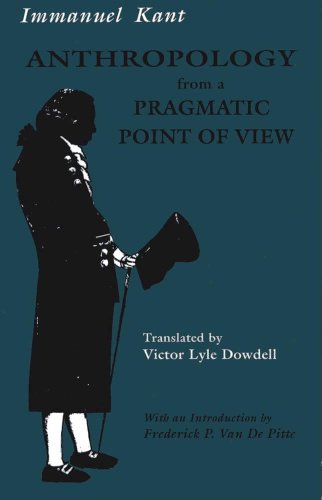
Anthropology from a Pragmatic Point of View
Authors:
Immanuel Kant
Publisher:
Southern Illinois University Press
Publication Date:
Not available
ISBN:
0809320606
In the fall semester of 1772/73 at the Albertus University of Königsberg, Immanuel Kant, metaphysician and professor of logic and metaphysics, began... lectures on anthropology, which he continued until 1776, shortly before his retirement from public life. His lecture notes and papers were first published in 1798, eight years after the publication of the Critique of Judgment, the third of his famous Critiques. The present edition of the Anthropology is a translation of the text found in volume 7 of Kants gesammelte Schriften, edited by Oswald Külpe.Kant describes the Anthropology as a systematic doctrine of the knowledge of humankind. (He does not yet distinguish between the academic discipline of anthropology as we understand it today and the philosophical.) Kant’s lectures stressed the "pragmatic" approach to the subject because he intended to establish pragmatic anthropology as a regular academic discipline. He differentiates the physiological knowledge of the human race—the investigation of "what Nature makes of man"—from the pragmatic—"what man as a free being makes of himself, what he can make of himself, and what he ought to make of himself." Kant believed that anthropology teaches the knowledge of humankind and makes us familiar with what is pragmatic, not speculative, in relation to humanity. He shows us as world citizens within the context of the cosmos.Summarizing the cloth edition of the Anthropology, Library Journal concludes: "Kant’s allusions to such issues as sensation, imagination, judgment, (aesthetic) taste, emotion, passion, moral character, and the character of the human species in regard to the ideal of a cosmopolitan society make this work an important resource for English readers who seek to grasp the connections among Kant’s metaphysics of nature, metaphysics of morals, and political theory. The notes of the editor and translator, which incorporate material from Ernst Cassirer’s edition and from Kant’s marginalia in the original manuscript, shed considerable light on the text."
ANTHROPOLOGY GLOBAL CUSTOM
Authors:
Not Available
Publisher:
Not available
Publication Date:
Not available
ISBN:
Not available
Anthropology, History, and Education (The Cambridge Edition of the...
Authors:
Immanuel Kant
Publisher:
Cambridge University Press
Publication Date:
Not available
ISBN:
0521181216
Anthropology, History, and Education, first published in 2007, contains all of Kant's major writings on human nature. Some of these works, which were... published over a thirty-nine year period between 1764 and 1803, had never before been translated into English. Kant's question 'What is the human being?' is approached indirectly in his famous works on metaphysics, epistemology, moral and legal philosophy, aesthetics and the philosophy of religion, but it is approached directly in his extensive but less well-known writings on physical and cultural anthropology, the philosophy of history, and education which are gathered in the present volume. Kant repeatedly claimed that the question 'What is the human being?' should be philosophy's most fundamental concern, and Anthropology, History, and Education can be seen as effectively presenting his philosophy as a whole in a popular guise.
ANTHROPOLOGY HUMAN CHALLENGE ]CUSTOM[
Authors:
Not Available
Publisher:
Not available
Publication Date:
Not available
ISBN:
Not available
Anthropology in Practice: Building a Career Outside the Academy...
Authors:
Riall W. Nolan
Publisher:
Lynne Rienner Pub
Publication Date:
Not available
ISBN:
1555879853
Places That Count offers professionals within the field of cultural resource management (CRM) valuable practical advice on dealing with traditional... cultural properties (TCPs). Responsible for coining the term to describe places of community-based cultural importance, Thomas King now revisits this subject to instruct readers in TCP site identification, documentation, and management. With more than 30 years of experience at working with communities on such sites, he identifies common issues of contention and methods of resolving them through consultation and other means. Through the extensive use of examples, from urban ghettos to Polynesian ponds to Mount Shasta, TCPs are shown not to be limited simply to American Indian burial and religious sites, but include a wide array of valued locations and landscapes--the United States and worldwide. This is a must-read for anyone involved in historical preservation, cultural resource management, or community development.
 '
'