production
/viewbook/list/all/?page=871
/
/static/
None
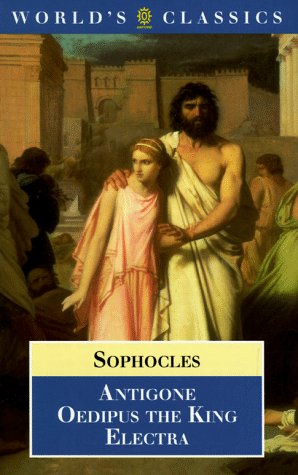
Antigone, Oedipus the King, Electra (World's Classics)
Authors:
Not Available
Publisher:
Oxford University Press, USA
Publication Date:
Not available
ISBN:
019282922X
This volume contains three masterpieces by the Greek playwright Sophocles, widely regarded since antiquity as the greatest of all the tragic poets. The... vivid translations, which combine elegance and modernity, are remarkable for their lucidity and accuracy, and are equally suitable for reading for pleasure, study, or theatrical performance. The selection of Antigone, Oedipus the King, and Electra not only offers the reader the most influential and famous of Sophocles' works, it also presents in one volume the two plays dominated by a female heroic figure, and the experience of the two great dynasties featured in Greek tragedy--the houses of Oedipus and Agamemnon.
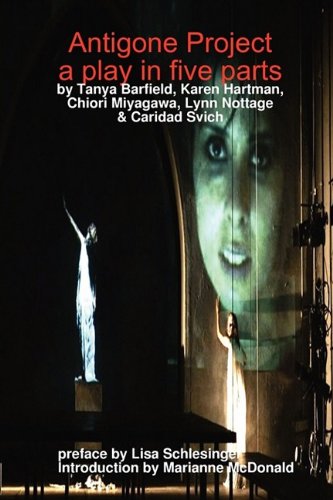
Antigone Project
Authors:
Tanya Barfield
Publisher:
NoPassport Press
Publication Date:
Not available
ISBN:
0578031507
ANTIGONE PROJECT is a play in five parts by Tanya Barfield, Karen Hartman, Chiori Miyagawa, 2009 Pulitzer Prize winner Lynn Nottage, and Caridad Svich... that reconsiders the story of Antigone from a variety of rich and radical perspectives. With a preface by dramatist Lisa Schlesinger and an introduction by classics scholar Marianne McDonald, this is a unique addition to contemporary drama.
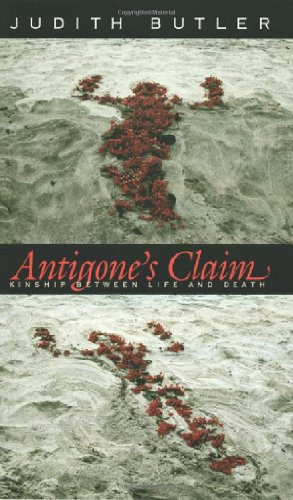
Antigone's Claim
Authors:
Judith Butler
Publisher:
Columbia University Press
Publication Date:
Not available
ISBN:
0231118953
The celebrated author of Gender Trouble here redefines Antigone's legacy, recovering her revolutionary significance and liberating it for a progressive... feminism and sexual politics. Butler's new interpretation does nothing less than reconceptualize the incest taboo in relation to kinship -- and open up the concept of kinship to cultural change.Antigone, the renowned insurgent from Sophocles's Oedipus, has long been a feminist icon of defiance. But what has remained unclear is whether she escapes from the forms of power that she opposes. Antigone proves to be a more ambivalent figure for feminism than has been acknowledged, since the form of defiance she exemplifies also leads to her death. Butler argues that Antigone represents a form of feminist and sexual agency that is fraught with risk. Moreover, Antigone shows how the constraints of normative kinship unfairly decide what will and will not be a livable life.Butler explores the meaning of Antigone, wondering what forms of kinship might have allowed her to live. Along the way, she considers the works of such philosophers as Hegel, Lacan, and Irigaray. How, she asks, would psychoanalysis have been different if it had taken Antigone -- the "postoedipal" subject -- rather than Oedipus as its point of departure? If the incest taboo is reconceived so that it does not mandate heterosexuality as its solution, what forms of sexual alliance and new kinship might be acknowledged as a result? The book relates the courageous deeds of Antigone to the claims made by those whose relations are still not honored as those of proper kinship, showing how a culture of normative heterosexuality obstructs our capacity to see what sexual freedom and political agency could be.
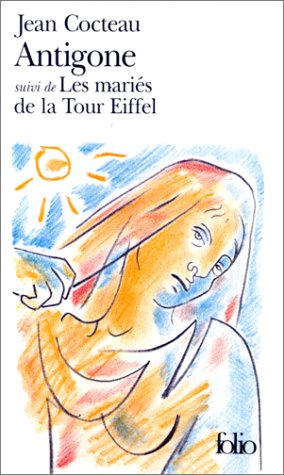
Antigone Suivi de les Maries de la Tour Eiffel (Collection Folio)...
Authors:
Jean Cocteau
Publisher:
Gallimard Education
Publication Date:
Not available
ISBN:
2070369080
Antigone - Translated by Ian Johnston
Authors:
Not Available
Publisher:
Richer Resources Publications
Publication Date:
Not available
ISBN:
097975710X
Sophocles (495-406 BC), the most prolific of the Greek playwrights whose works survive, wrote a number of plays about the family of Oedipus, legendary... king of Thebes. Of these plays, the two most popular are Oedipus the King and Antigone. The former tells the tragic story of Oedipus' search for the murderer of Laius, the previous king. His investigation inexorably uncovers Oedipus' true identity, the discovery of which is so horrific that Oedipus blinds himself and goes off into exile. The story of Antigone begins soon after Oedipus' downfall and the ensuing quarrel between his two sons over who should rule Thebes, a conflict which leads to a battle in which the two sons kill each other. The new rule, Creon, decrees that Polyneices, the son who brought a foreign army against Thebes, will not be allowed a proper burial. Antigone, Oedipus' daughter, believes the proclamation is contrary to the rule of the gods and so takes it upon herself to bury her brother. When Creon discovers what she has done, he orders her death. By the time he is dissuaded of this action by a prophecy of doom should it be carried out, Antigone has already accepted her fate and taken her own life. Her lover, Haemon, who is Creon's son, finds her and in his grief over her loss, takes his own life. Thus the prophecy is carried out despite Creon's last minute attempts to change fate's decree.
Antigonick
Authors:
Anne Carson
Publisher:
New Directions
Publication Date:
Not available
ISBN:
0811219577
An illustrated new translation of Sophokles’ Antigone.With text blocks hand-inked on the page by Anne Carson and her collaborator Robert Currie,... Antigonick features translucent vellum pages with stunning drawings by Bianca Stone that overlay the text.Anne Carson has published translations of the ancient Greek poets Sappho, Simonides, Aiskhylos, Sophokles and Euripides. Antigonick is her first attempt at making translation into a combined visual and textual experience. Sophokles’ luminous and disturbing tragedy is here given an entirely fresh language and presentation. Thoroughly delightful.

Antigua Poesie Espanola Lirica y Narrativa
Authors:
Manuel Alvar
Publisher:
Porrua
Publication Date:
Not available
ISBN:
970075619X

Anti-Indianism in Modern America: A Voice from Tatekeya's Earth
Authors:
Elizabeth Cook-Lynn
Publisher:
University of Illinois Press
Publication Date:
Not available
ISBN:
0252026624
In this powerful and essential work, Elizabeth Cook-Lynn confronts the politics and policies of genocide that continue to destroy the land, livelihood,... and culture of Native Americans. "Anti-Indianism in Modern America" tells the other side of stories of historical massacres and modern-day hate crimes, events that are dismissed or glossed over by historians, journalists, and courts alike. Cook-Lynn exposes the colonialism that works both overtly and covertly to silence and diminish Native Americans, supported by a rhetoric of reconciliation, assimilation, and multiculturalism. Comparing anti-Indianism to anti-Semitism, she sets the American history of broken treaties, stolen lands, mass murder, cultural dispossession, and Indian hating in an international context of ethnic cleansing, " ecocide" , and colonial oppression. Cook-Lynn also discusses the role Native American studies should take in reasserting tribal literatures, traditions, and politics and shows how the discipline has been sidelined by anthropology, sociology, postcolonial studies, and ethnic studies. Asserting the importance of a " native conscience" - a knowledge of the mythologies, mores, and experiences of tribal society - among American Indian writers, she calls for the expression in American Indian art and literature of a tribal consciousness that acts to assure a tribal-nation people of its future. Passionate, eloquent, and uncompromising, "Anti-Indianism in Modern America" concludes that there are no real solutions for Indians as long as they remain colonized peoples. Native Americans must be able to tell their own stories and, most important, regain their land, the source of religion, morality, rights, and nationhood. As long as public silence accompanies the outlaw maneuvers that undermine tribal autonomy, the racist strategies that affect all Americans will continue. It is difficult, Cook-Lynn concedes, to work toward the development of legal mechanisms against hate crimes, in Indian Country and elsewhere in the world. But it is not too late.

Anti-Intellectualism in American Life
Authors:
Richard Hofstadter
Publisher:
Vintage
Publication Date:
Not available
ISBN:
0394703170
T. J. Jackson Lears draws on a wealth of primary sources — sermons, diaries, letters — as well as novels, poems, and essays to explore the origins... of turn-of-the-century American antimodernism. He examines the retreat to the exotic, the pursuit of intense physical or spiritual experiences, and the search for cultural self-sufficiency through the Arts and Crafts movement. Lears argues that their antimodern impulse, more pervasive than historians have supposed, was not "simple escapism," but reveals some enduring and recurring tensions in American culture."It's an understatement to call No Place of Grace a brilliant book. . . . It's the first clear sign I've seen that my generation, after marching through the '60s and jogging through the '70s might be pausing to examine what we've learned, and to teach it."—Walter Kendrick, Village Voice"One can justly make the claim that No Place of Grace restores and reinterprets a crucial part of American history. Lears's method is impeccable."—Ann Douglas, The Nation

Antinomies of Art and Culture: Modernity, Postmodernity,...
Authors:
Not Available
Publisher:
Duke University Press Books
Publication Date:
Not available
ISBN:
0822342030
In this landmark collection, world-renowned theorists, artists, critics, and curators explore new ways of conceiving the present and understanding art... and culture in relation to it. They revisit from fresh perspectives key issues regarding modernity and postmodernity, including the relationship between art and broader social and political currents, as well as important questions about temporality and change. They also reflect on whether or not broad categories and terms such as modernity, postmodernity, globalization, and decolonization are still relevant or useful. Including twenty essays and seventy-seven images, Antinomies of Art and Culture is a wide-ranging yet incisive inquiry into how to understand, describe, and represent what it is to live in the contemporary moment.In the volume’s introduction the theorist Terry Smith argues that predictions that postmodernity would emerge as a global successor to modernity have not materialized as anticipated. Smith suggests that the various situations of decolonized Africa, post-Soviet Europe, contemporary China, the conflicted Middle East, and an uncertain United States might be better characterized in terms of their “contemporaneity,” a concept which captures the frictions of the present while denying the inevitability of all currently competing universalisms. Essays range from Antonio Negri’s analysis of contemporaneity in light of the concept of multitude to Okwui Enwezor’s argument that the entire world is now in a postcolonial constellation, and from Rosalind Krauss’s defense of artistic modernism to Jonathan Hay’s characterization of contemporary developments in terms of doubled and even para-modernities. The volume’s centerpiece is a sequence of photographs from Zoe Leonard’s Analogue project. Depicting used clothing, both as it is bundled for shipment in Brooklyn and as it is displayed for sale on the streets of Uganda, the sequence is part of a striking visual record of new cultural forms and economies emerging as others are left behind.Contributors: Monica Amor, Nancy Condee, Okwui Enwezor, Boris Groys, Jonathan Hay, Wu Hung, Geeta Kapur, Rosalind Krauss, Bruno Latour, Zoe Leonard, Lev Manovich, James Meyer, Gao Minglu, Helen Molesworth, Antonio Negri, Sylvester Okwunodu Ogbechie, Nikos Papastergiadis, Colin Richards, Suely Rolnik, Terry Smith, McKenzie Wark
Anti-Oedipus: Capitalism and Schizophrenia (Penguin Classics)
Authors:
Gilles Deleuze
Publisher:
Penguin Classics
Publication Date:
Not available
ISBN:
0143105825
An "introduction to the nonfascist life" (Michel Foucault, from the Preface)When it first appeared in France, Anti-Oedipus was hailed as a masterpiece... by some and "a work of heretical madness" by others. In it, Gilles Deleuze and Félix Guattari set forth the following theory: Western society's innate herd instinct has allowed the government, the media, and even the principles of economics to take advantage of each person's unwillingness to be cut off from the group. What's more, those who suffer from mental disorders may not be insane, but could be individuals in the purest sense, because they are by nature isolated from society. More than twenty-five years after its original publication, Anti-Oedipus still stands as a controversial contribution to a much-needed dialogue on the nature of free thinking.
Anti-Pamela and Shamela
Authors:
Eliza Haywood
Publisher:
Broadview Press
Publication Date:
Not available
ISBN:
155111383X
Published together for the first time, Eliza Haywood's Anti-Pamela and Henry Fielding's An Apology for the Life of Mrs. Shamela Andrews are the two most... important responses to Samuel Richardson's novel Pamela. Anti-Pamela comments on Richardson's representations of work, virtue, and gender, while also questioning the generic expectations of the novel that Pamela establishes, and it provides a vivid portrayal of the material realities of life for a woman in eighteenth-century London. Fielding's Shamela punctures both the figure Richardson established for himself as an author and Pamela's preoccupation with virtue This Broadview edition also includes a rich selection of historical materials, including writings from the period on sexuality, women's work, Pamela and the print trade, and education and conduct.
Antiphon and Andocides (Oratory of Classical Greece)
Authors:
Not Available
Publisher:
University of Texas Press
Publication Date:
Not available
ISBN:
0292728093
Classical oratory is an invaluable resource for the study of ancient Greek life and culture. The speeches offer evidence on Greek moral views, social... and economic conditions, political and social ideology, and other aspects of Athenian culture that have been largely ignored: women and family life, slavery, and religion, to name just a few.This volume contains the works of the two earliest surviving orators, Antiphon and Andocides. Antiphon (ca. 480-411) was a leading Athenian intellectual and creator of the profession of logography ("speech writing"), whose special interest was law and justice. His six surviving works all concern homicide cases. Andocides (ca. 440-390) was involved in two religious scandals--the mutilation of the Herms (busts of Hermes) and the revelation of the Eleusinian Mysteries--on the eve of the fateful Athenian expedition to Sicily in 415. His speeches are a defense against charges relating to those events.
Antiphon: The Speeches (Cambridge Greek and Latin Classics)
Authors:
Antiphon
Publisher:
Cambridge University Press
Publication Date:
Not available
ISBN:
0521389313
This volume provides a commentary on the six speeches of the fifth-century BC Athenian orator Antiphon, all of which concern homicide. This is the first... complete English commentary on Antiphon and the first in any language since 1838. The book opens with a substantial introduction to the life and work of Antiphon and the nature of Athenian law and legal oratory. A new Greek text follows. The commentary itself discusses grammatical, stylistic, legal, rhetorical and historical matters.
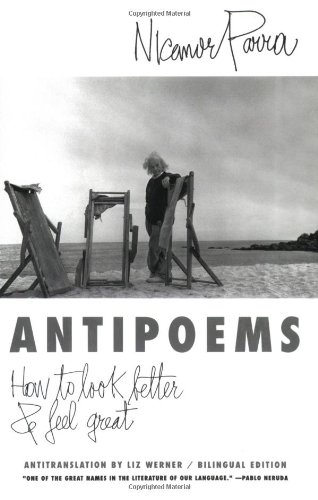
Antipoems: How to Look Better & Feel Great
Authors:
Nicanor Parra
Publisher:
New Directions
Publication Date:
Not available
ISBN:
0811215970
The first major collection in almost twenty years of new work by one of Latin America's greatest poets."Real seriousness," Nicanor Parra, the antipoet... of Chile, has said, rests in "the comic." And read in that light, this newest collection of his work is very serious indeed. It is an abundant offering of his signature mocking humor, subverting received conventions and pretensions in both poetry and everyday life, public and private, ingeniously and wittily rendered into English in an antitranslation (the word is Parra's) by Liz Werner. Of the fifty-eight pieces in Antipoems, the first twenty-three are taken from Parra's 1985 collection, Hojas de Parra ("Vine Leaves" or "Leaves of Parra"), two others appeared in his Paginas en Blanco ("Blank Pages," 2001), while the rest come straight out of his notebooks and have never been published before, either in Spanish or English. The book itself is divided into two sections, "Antipoems" (im)proper and a selection of Parra's most recent incarnation of the antipoem, the hand-drawn images of his "Visual Artefactos." As his anti-translator Liz Werner explains in her Introduction, Parra's scientific training infuses his work. "Viewed through the lens of antimatter," she writes, "antipoetry mirrors poetry, not as its adversary but as its perfect complement."
 '
'