production
/viewbook/list/all/?page=888
/
/static/
None

A People's Army: Massachusetts Soldiers and Society in the Seven...
Authors:
Fred Anderson
Publisher:
The University of North Carolina Press
Publication Date:
Not available
ISBN:
0807845760
A People's Army documents the many distinctions between British regulars and Massachusetts provincial troops during the Seven Years' War. Originally... published by UNC Press in 1984, the book was the first investigation of colonial military life to give equal attention to official records and to the diaries and other writings of the common soldier. The provincials' own accounts of their experiences in the campaign amplify statistical profiles that define the men, both as civilians and as soldiers. These writings reveal in intimate detail their misadventures, the drudgery of soldiering, the imminence of death, and the providential world view that helped reconcile them to their condition and to the war.

A People's Citizenship Guide: A Response to Conservative Canada
Authors:
Esyllt Jones
Publisher:
Arbeiter Ring Pub
Publication Date:
Not available
ISBN:
1894037561
In 2009, Stephen Harper's Conservative government changed the contents of the official citizenship guide that is given to all recent immigrants. The new... version contained a lot more military history and plenty of information about the monarchy, but little about public programs such as medicare or education, or our rich history of social justice movements. Ignoring the work and democratic struggles of generations of newcomers, it presumes that new immigrants need to be taught how to "take responsibility" for their families. In short, the official guide outlines an exceptionally narrow, conservative view of Canadian politics and society. In A People's Guide to Citizenship, a group of progressive historians offer an alternative citizenship guide: a lively, political, humane and more accurate alternative to Stephen Harper's version of the story.
A People's Contest: The Union and Civil War, 1861-1865
Authors:
Phillip Shaw Paludan
Publisher:
Not available
Publication Date:
Not available
ISBN:
0060916079
This detailed analysis of slavery in the antebellum South was written in 1975 in response to the prior year's publication of Robert Fogel and Stanley... Engerman's controversial "Time on the Cross", which argued that slavery was an efficient and dynamic engine for the southern economy and that its success was due largely to the willing cooperation of the slaves themselves. Noted labor historian Herbert G. Gutman was unconvinced, even outraged, by Fogel and Engerman's arguments. In this book, he offers a systematic dissection of "Time on the Cross", drawing on a wealth of data to contest that book's most fundamental assertions. A benchmark work of historical inquiry, Gutman's critique sheds light on a range of crucial aspects of slavery and its economic effectiveness. Gutman emphasizes the slaves' responses to their treatment at the hands of slaveowners. He shows that slaves labored, not because they shared values and goals with their masters, but because of the omnipresent threat of 'negative incentives,' primarily physical violence. In his introduction to this new edition, Bruce Levine provides a historical analysis of the debate over "Time on the Cross". Levine reminds us of the continuing influence of the latter book, demonstrated by Robert W. Fogel's 1993 Nobel Prize in Economic Sciences, and hence the importance and timeliness of Gutman's critique.
A People's Contest: The Union and Civil War 1861-1865 (Modern World...
Authors:
Phillip Shaw Paludan
Publisher:
Not available
Publication Date:
Not available
ISBN:
0700608125
Chosen by Civil War magazine as one of the 200 best books on the war. "One of the most thoughtful books ever written about the Civil War". -- Don E.... Fehrenbacher in the Journal of Southern History.

A People's Ecology: Explorations in Sustainable Living
Authors:
Not Available
Publisher:
Clear Light Publishing
Publication Date:
Not available
ISBN:
1574160281
This book presents a tapestry of perspectives on food and the interplay of health, cultural ecology, and environment, which are the fabric and... foundation of all sustainable living It offers personal stories, documented information, traditional understandings, and speculations on future directions. Each contribution calls on us to reclaim our human heritage of "caring for our home fires" -- a metaphor that can inspire the revitalisation of our connections to the earth, all living things, and each other. The writers examine the underlying ecology of sustainable living rooted in the historical traditions, environmental practices, and a sense of place of peoples of the Southwest; and they describe the impact that disruption of this way of life continues to have on health, well-being, communal identity. Drawing on an indigenous paradigm of "healthy environment, healthy culture, healthy people," this book explores possibilities of applying the principles of sustainable living in both traditional and non-traditional communities.

A People's Guide to U.S. Immigration Law
Authors:
Esq. Irene Scharf
Publisher:
Irene Scharf
Publication Date:
Not available
ISBN:
057805163X
This easy-to-read book will help immigrants and their families, law students, even lawyers new to immigration law. It offers straight-forward answers to... important questions about arriving; entering without inspection; distinguishing non-immigrants from immigrants; accessing public benefits; protecting rights at work, school, and during policy raids; working with lawyers; representing yourself; naturalizing; appealing cases; dealing with lengthy detention; and more.

A People's History of American Empire
Authors:
Howard Zinn
Publisher:
Metropolitan Books
Publication Date:
Not available
ISBN:
0805087443
Adapted from the bestselling grassroots history of the United States, the story of America in the world, told in comics formSince its landmark... publication in 1980, A People’s History of the United States has had six new editions, sold more than 1.7 million copies, become required classroom reading throughout the country, and been turned into an acclaimed play. More than a successful book, A People’s History triggered a revolution in the way history is told, displacing the official versions with their emphasis on great men in high places to chronicle events as they were lived, from the bottom up.Now Howard Zinn, historian Paul Buhle, and cartoonist Mike Konopacki have collaborated to retell, in vibrant comics form, a most immediate and relevant chapter of A People’s History: the centuries-long story of America’s actions in the world. Narrated by Zinn, this version opens with the events of 9/11 and then jumps back to explore the cycles of U.S. expansionism from Wounded Knee to Iraq, stopping along the way at World War I, Central America, Vietnam, and the Iranian revolution. The book also follows the story of Zinn, the son of poor Jewish immigrants, from his childhood in the Brooklyn slums to his role as one of America’s leading historians.Shifting from world-shattering events to one family’s small revolutions, A People’s History of American Empire presents the classic ground-level history of America in a dazzling new form.

A People's History of Christianity: The Other Side of the Story
Authors:
Diana Butler Bass
Publisher:
HarperOne
Publication Date:
Not available
ISBN:
0061448702
For too long, the history of Christianity has been told as the triumph of orthodox doctrine imposed through power and hierarchy. In A People's History... of Christianity, historian and religion expert Diana Butler Bass reveals an alternate history that includes a deep social ethic and far-reaching inclusivity: "the other side of the story" is not a modern phenomenon, but has always been practiced within the church. Butler Bass persuasively argues that corrective—even subversive—beliefs and practices have always been hallmarks of Christianity and are necessary to nourish communities of faith. In the same spirit as Howard Zinn's groundbreaking work The People's History of the United States, Butler Bass's A People's History of Christianity brings to life the movements, personalities, and spiritual disciplines that have always informed and ignited Christian worship and social activism. A People's History of Christianity authenticates the vital, emerging Christian movements of our time, providing the historical evidence that celebrates these movements as thoroughly Christian and faithful to the mission and message of Jesus.

A People's History of Christianity: The Other Side of the Story
Authors:
Diana Butler Bass
Publisher:
HarperOne
Publication Date:
Not available
ISBN:
0061448710
The Grassroots Movements That Preserved Jesus's Message of Social Justice for 2,000 Years and Their Impact on the Church Today For too long, the... history of Christianity has been told as the triumph of orthodox doctrine imposed through power. Now, historian Diana Butler Bass sheds new light on the surprising ways that many Christians have refused to conform to a rigid church hierarchy and sought to recapture the radical implications of Jesus's life and message.
A People's History of Poverty in America (New Press People's History)
Authors:
Stephen Pimpare
Publisher:
New Press, The
Publication Date:
Not available
ISBN:
1565849345
A sweeping, revelatory history of poverty in America from the nineteenth century to today, told through the eyes and experiences of the poor... themselves. "When you live in a shelter, other people control your life. They tell you when you may come in and when you must go out. They tell you when you can take your shower and when you can wash your clothing."—from A People's History of Poverty and Welfare in America In this compulsively readable social history, a brilliant new addition to The New Press's acclaimed People's History series, political scientist Stephen Pimpare vividly describes poverty from the perspective of poor and welfare-reliant Americans from the big city to the rural countryside. He focuses on how the poor have created community, secured shelter, and found food and illuminates their battles for dignity and respect. Through prodigious archival research and lucid analysis, Pimpare details the ways in which charity and aid for the poor have been inseparable, more often than not, from the scorn and disapproval of those who would help them. In the rich and often surprising historical testimonies he has collected from the poor in America, Pimpare overturns any simple conclusions about how the poor see themselves or what it feels like to be poor—and he shows clearly that the poor are all too often aware that charity comes with a price. It is that price that Pimpare eloquently questions in this book, reminding us through powerful anecdotes, some heart-wrenching and some surprisingly humorous, that poverty is not simply a moral failure.
A People's History of Poverty in America (The New Press People's...
Authors:
Stephen Pimpare
Publisher:
New Press, The
Publication Date:
Not available
ISBN:
1595586725
In A People’s History of Poverty in America, political scientist Stephen Pimpare brings the human lives and real-life stories of those who struggle... with poverty in America to the foreground, vividly describing life as poor and welfare-reliant Americans experience it, from the big city to the rural countryside. Prodigiously researched, A People’s History of Poverty in America unearths rich, poignant, and often surprising testimoniesboth heart-wrenching and humorousthat range from the early days of the United States to the present day. Pimpare shows us how the poor have found food, secured shelter, and created community, and, most important, he illuminates their battles for dignity and respect in the face of the judgment, control, and disdain that are all too often the price they must pay for charity and government aid.In telling these hidden stories, Pimpare argues eloquently for a fundamental rethinking of poverty, one that includes both a more nuanced understanding of the history of the American welfare state, and a meaningfuland truly accuratenew definition of the poverty line. Hailed by Kirkus Reviews as an illuminating history of America’s poor” and a useful counter against those who blame the poor for their bad luck,” A People’s History of Poverty in America reminds us that poverty is not in itself a moral failure, but our failure to understand it may well be.
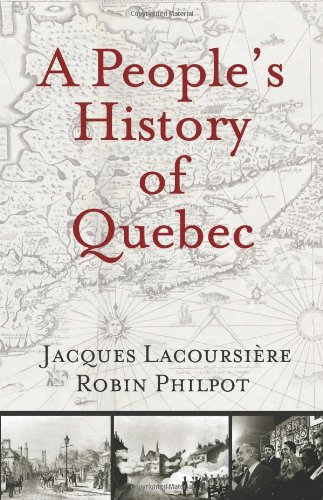
A People's History of Quebec
Authors:
Jacques Lacoursiere
Publisher:
Baraka Books
Publication Date:
Not available
ISBN:
098124050X
Revealing a little-known part of North American history, this lively guide tells the fascinating tale of the settlement of the St. Lawrence Valley. It... also tells of the Montreal and Quebec-based explorers and traders who traveled, mapped, and inhabited a very large part of North America, and embrothered the peoples” they met, as Jack Kerouac wrote.Connecting everyday life to the events that emerged as historical turning points in the life of a people, this book sheds new light on Quebec’s 450-year historyand on the historical forces that lie behind its two recent efforts to gain independence.
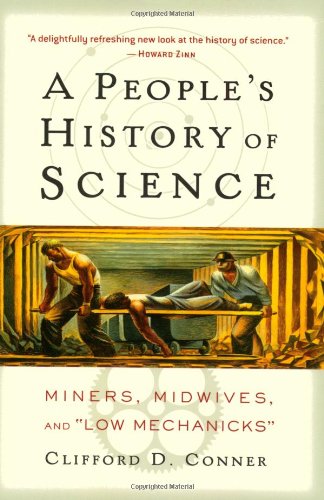
A People's History of Science: Miners, Midwives, and Low Mechanicks...
Authors:
Clifford D. Conner
Publisher:
Nation Books
Publication Date:
Not available
ISBN:
1560257482
We all know the history of science that we learned from grade school textbooks: How Galileo used his telescope to show that the earth was not the center... of the universe; how Newton divined gravity from the falling apple; how Einstein unlocked the mysteries of time and space with a simple equation. This history is made up of long periods of ignorance and confusion, punctuated once an age by a brilliant thinker who puts it all together. These few tower over the ordinary mass of people, and in the traditional account, it is to them that we owe science in its entirety. This belief is wrong. A People's History of Science shows how ordinary people participate in creating science and have done so throughout history. It documents how the development of science has affected ordinary people, and how ordinary people perceived that development. It would be wrong to claim that the formulation of quantum theory or the structure of DNA can be credited directly to artisans or peasants, but if modern science is likened to a skyscraper, then those twentieth-century triumphs are the sophisticated filigrees at its pinnacle that are supported by the massive foundation created by the rest of us.

A People's History of the American Revolution: How Common People...
Authors:
Ray Raphael
Publisher:
Harper Perennial
Publication Date:
Not available
ISBN:
0060004401
A sweeping narrative of the wartime experience, A People's History of the American Revolution is the first book to view the revolution through the eyes... of common folk. Their stories have long been overlooked in the mythic telling of America's founding, but are crucial to a comprehensive understanding of the fight for independence. Now, the experiences of farmers, laborers, rank and file soldiers, women, Native Americans, and African Americans -- found in diaries, letters, memoirs and other long-ignored primary sources -- create a gritty account of rebellion, filled with ideals and outrage, loss, sacrifice, and sometimes scurrilous acts...but always ringing with truth.
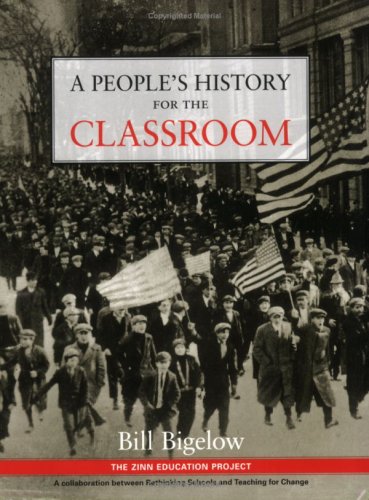
A People's History of the Classroom
Authors:
Bill Bigelow
Publisher:
Rethinking Schools Ltd.
Publication Date:
Not available
ISBN:
0942961390
A people's pedagogy, like a people's history, should alert students to deep currents of justice and equality in U.S. history, and in diverse ways... encourage students to try on the personas of people who worked to make this a more democratic society. A people's history and pedagogy ought to allow students to recognize that 'we' were not necessarily the ones stealing land, dropping bombs, or breaking strikes. 'We' were ending slavery, fighting for women's rights, organizing unions, marching against wars, and trying to create a society premised on the Golden Rule.
 '
'