production
/viewbook/list/all/?page=982
/
/static/
None

Arab Spring Dreams: The Next Generation Speaks Out for Freedom and...
Authors:
Not Available
Publisher:
Palgrave Macmillan
Publication Date:
Not available
ISBN:
0230115926
From a gay man secretly mourning his lover's suicide in Morocco to a young woman denied schooling because of religious discrimination in Iran, Arab... Spring Dreams spotlights some of the Middle East's most outspoken young dissidents. The essayists cover a wide range of experiences, including premarital sex, the lack of educational opportunities, teenage marriage, and the fight for political freedom. They also highlight how repressive laws and cultural mores snuff out liberty and stifle growth and consider how previous movements - particularly the American civil rights struggle - might be channeled to effect change in their own countries. Beautifully written and profoundly moving, these stories present a decisive call for change at a crucial point in the evolution of the Middle East.

Arab Spring, Libyan Winter
Authors:
Vijay Prashad
Publisher:
AK Press
Publication Date:
Not available
ISBN:
1849351120
The Arab Spring captivated the planet. Mass action overthrew Tunisia’s Ben Ali and Egypt’s Hosni Mubarak. The revolutionary wave spread to the far... corners of the Arab world, from Morocco to Bahrain. It seemed as if all the authoritarian states would finally be freed, even those of the Arabian Peninsula. People’s power had produced this wave, and continued to ride it out. In Libya, though, the new world order had different ideas. Social forces opposed to Muammar Qaddafi had begun to rebel, but they were weak. In came the French and the United States, with promises of glory. A deal followed with the Saudis, who then sent in their own forces to cut down the Bahraini revolution, and NATO began its assault, ushering in a Libyan Winter that cast its shadow over the Arab Spring. This brief, timely analysis situates the assault on Libya in the context of the winds of revolt that swept through the Middle East in the Spring of 2011. Vijay Prashad explores the recent history of the Qaddafi regime, the social forces who opposed him, and the role of the United Nations, NATO, and the rest of the world's superpowers in the bloody civil war that ensued. Vijay Prashad is the George and Martha Kellner Chair of South Asian History, and professor and director of international studies at Trinity College in Hartford, Connecticut. He is the author or editor of over a dozen books, including Karma of Brown Folk and, most recently, The Darker Nations: A People’s History of the Third World.

Arab Television Industries (International Screen Industries)
Authors:
Marwan M. Kraidy
Publisher:
British Film Institute
Publication Date:
Not available
ISBN:
1844573028
Arab Television Industries captures the fascinating metamorphosis of Arab television from separate state-owned terrestrial channels to a vibrant,... pan-Arab, commercial satellite industries, and explores the momentous social and political implications of this transformation.

Arab Television Today
Authors:
Naomi Sakr
Publisher:
I. B. Tauris
Publication Date:
Not available
ISBN:
1845115643
There is a great deal at stake for everyone in the future of Arab television. Political and social upheavals in this central but unsettled region are... increasingly played out on television screens and in the tussles over programming that take place behind them. Al-Jazeera is of course only one player among a still-growing throng of satellite channels, which now include private terrestrial stations in some Arab states. It is an industry urgently needing to be made sense of; this book does exactly this in a very readable and authoritative way, through exploring and explaining the evolving structures and content choices in both entertainment and news of contemporary Arab television. It shows how owners, investors, journalists, presenters, production companies, advertisers, regulators and media freedom advocates influence each other in a geolinguistic marketplace that encompasses the Arab region itself and communities abroad. Probing internal and external interventions in the Arab television landscape, the book offers a timely and compelling sequel to Naomi Sakr's 'Satellite Realms: Transnational Television, Globalization and the Middle East', which won the Middle Eastern Studies Book Prize in 2003.

ARAB UPRISING
Authors:
Not Available
Publisher:
Not available
Publication Date:
Not available
ISBN:
Not available

Arab Women in the Field: Studying Your Own Society (Modern Arab...
Authors:
Soraya Altorki
Publisher:
Syracuse Univ Pr (Sd)
Publication Date:
Not available
ISBN:
0815624492
An extended new preface and a new epilogue, written after the fall of the Taliban in 2001, place the Kirghiz and Wakhi of Afghanistan in the context of... a vastly changed world. The original book, first published in 1979, describes the cultural and ecological adaptation of the nomadic Kirghiz and their agriculturalist neighbors, the Wakhi, to high altitudes and a frigid climate in the Wakhan Corridor, a panhandle of Afghanistan that borders Pakistan, the former Soviet Union, and the People's Republic of China. The new Preface challenges the assumption that the root cause of terrorism is religious. Shahrani asserts that the problem of terrorism is fundamentally political and is historically linked to the inappropriate model of the centralized nation-state introduced to Afghanistan by colonial regimes. The differing responses of the Kirghiz and Wakhi to the Marxist coup are discussed in the new Epilogue. Shahrani has closely followed the flight of the Kirghiz to Pakistan in 1978 and their eventual resettlement among resentful Kurdish villagers in eastern Turkey in 1982. The ethnographic documentation and analysis of the transformation of Kirghiz society, politics, economics, and demography since their exodus from the Pamirs offers valuable lessons to our understanding of the dynamics and true resilience of small pastoral nomadic communities. M. Nazif Shahrani, an Afghan anthropologist, is chair of the Department of Near Eastern Languages and Culture at Indiana University.

Arab Women Novelists (Suny Series, Middle Eastern Studies)
Authors:
Joseph T. Zeidan
Publisher:
State University of New York Press
Publication Date:
Not available
ISBN:
0791421724
For companies to be competitive, leaders must engage people at all levels to focus their energy and enable them to apply lean principles to everything... they do. Strategy deployment, called hoshin kanri by Toyota, has proven to be the most effective process for meeting this ongoing challenge. In Getting the Right Things Done, Pascal Dennis outlines the nuts and bolts of strategy deployment, answering two tough questions that ultimately can make or break a lean transformation: What kind of planning system is required to inspire meaningful company-wide continuous improvement? How might we change existing mental models that do not support a culture of continuous improvement? Getting the Right Things Done tells the story of a fictional midsized company, Atlas Industries, that needs to dramatically improve to compete with emerging rivals and meet new customer demands. While Atlas had already applied some basic lean principles, it had not really connected the people and business processes so that the company could dramatically improve. Something was missing: a way of focusing and aligning the efforts of good people, and a delivery system, something that would direct the tools to the right places. The book provides readers with a framework for understanding the key components of strategy deployment: agreeing on True North for the company, working within the PDCA cycle, getting consensus through catchball, the deployment leader concept, and A3 thinking. It links action to theory and reminds us that lean tools are only the means to an end, not ends in themselves. It takes a step-by-step instructional approach to the strategy deployment process. Through this unique combination, Getting the Right Things Done balances the human and technical dimensions of making strategy deployment a vital part of the daily culture of any company.

Arab Women Writers: An Anthology Of Short Stories (Suny Series,...
Authors:
Dalya Cohen-Mor
Publisher:
State Univ of New York Pr
Publication Date:
Not available
ISBN:
0791464202
In this award-winning novel (Naguib Mahfouz Medal for Literature 2006), the celebrated Palestinian writer Sahar Khalifeh has penned what is at once a... re-casting of the story of the Holy Family, a lyrical ode to Arab Jerusalem, and a call for liberation, not just of a nation but for the individual women and men who inhabit it. After abandoning his beloved Mariam when she falls pregnant, and escaping her brothers' bullets, Ibrahim abandons his own ideals and dreams of becoming a novelist, opting instead to follow his father's wishes and seek wealth and commercial success abroad. Thirty years later, lonely and disillusioned, Ibrahim returns to Ramallah to retrace the past he tried to leave behind. He sets out on a long and frustrating quest to track down Mariam, which takes him from the West Bank to Israel. Along the way he encounters his son, Michael, a young man with spiritual powers that enable him to see what is unknown and find what has gone missing. Moving and lyrical, Khalifeh's novel weaves religious and political symbolism into a story of love and loss. At its core is Ibrahim's--the Palestinian's--agonizing but unrelenting search for a home.

A Race is a Nice Thing to Have, Second Edition
Authors:
Janet E. Helms
Publisher:
Microtraining Associates
Publication Date:
Not available
ISBN:
0917276132
The classic book on race and racism is once again available through Microtraining Associates, Inc. This book is designed to help White people assume... responsibility for ending racism, understand how racism impacts Whites as well as others, analyze racism, and discover positive alternatives for living in a multicultural society. Many self-analysis exercises and instruments enrich the text.

A Race of Singers: Whitman's Working-Class Hero from Guthrie to...
Authors:
Bryan K. Garman
Publisher:
The University of North Carolina Press
Publication Date:
Not available
ISBN:
0807848662
When Walt Whitman published Leaves of Grass in 1855, he dreamed of inspiring a "race of singers" who would celebrate the working class and realize the... promise of American democracy. By examining how singers such as Woody Guthrie, Bob Dylan, and Bruce Springsteen both embraced and reconfigured Whitman's vision, Bryan Garman shows that Whitman succeeded. In doing so, Garman celebrates the triumphs yet also exposes the limitations of Whitman's legacy. While Whitman's verse propounded notions of sexual freedom and renounced the competitiveness of capitalism, it also safeguarded the interests of the white workingman, often at the expense of women and people of color. Garman describes how each of Whitman's successors adopted the mantle of the working-class hero while adapting the role to his own generation's concerns: Guthrie condemned racism in the 1930s, Dylan addressed race and war in the 1960s, and Springsteen explored sexism, racism, and homophobia in the 1980s and 1990s.But as Garman points out, even the Boss, like his forebears, tends to represent solidarity in terms of white male bonding and homosocial allegiance. We can hear America singing in the voices of these artists, Garman says, but it is still the song of a white, male America.

Arachnids
Authors:
Jan Beccaloni
Publisher:
University of California Press
Publication Date:
Not available
ISBN:
0520261402
With around 11 distinctive lineages and over 38,000 species of spiders alone, arachnids are an amazingly diverse group of invertebrates--and with names... like the Goliath Bird-Eating Spider, the Tailless Whip Spider, and the Harvestman, they can be both spectacular and captivating. Most books about arachnids focus on spiders, neglecting scorpions, ticks, mites, wind spiders, and other fascinating yet poorly understood groups. This adventurous volume summarizes all existing knowledge about each major type of arachnid, revealing their secrets through detailed species accounts, brilliant photographs, and a compelling cast of eight-legged characters. It examines the anatomy, habitat, behavior and distribution of each lineage, from the garden spider to the death stalker scorpion and even a species of mite that lives inside a monkey's lungs. Drawing on the vast resources at London's Natural History Museum, Arachnids spins a sensational tale, debunking common myths and delving deep into the lives of these bizarre and beautiful creatures.

Aracoeli (Open Letter Modern Classics)
Authors:
Elsa Morante
Publisher:
Open Letter Books; Univ of Nebraska Press
Publication Date:
Not available
ISBN:
1934824151
The first time I read Aracoeli, I found it almost pointlessly disturbing and shocking. On rereading it, I still found it disturbing and shocking, but I... have also grown to admire it

A Radiant Curve: Poems and Stories (Sun Tracks)
Authors:
Luci Tapahonso
Publisher:
University of Arizona Press
Publication Date:
Not available
ISBN:
0816527091
In this sixth collection of stories and verse, award-winning writer Luci Tapahonso finds sacredness in everyday life. Viewing a sunset in a desert sky,... listening to her granddaughter recount how she spent her day, or visiting her mother after her father's passing, she finds traces of her own memories, along with echoes of the voices of her Navajo ancestors. The collection also includes an audio CD of the author reading aloud and her voice is warm and inviting, like the simmering soup and blue corn meal” of her childhood. These engaging words draw us into a workaday world that, magically but never surprisingly, has room for the Diyin Dine’é (the Holy People), Old Salt Woman, and Dawn Boy. When she describes her grandson’s First Laugh Ceremonyexplaining that it was originally performed for White Shell Girl, who grew up to be Changing Womanher account enriches us and we long to hear more. Tapahonso weaves the Navajo language into her work like she weaves the first four rows of black yarn” into a rug she is making for my little grandson, who inherited my father’s name: Hastiin Tsétah Naaki Bísóí.” As readers, we find that we too are surrounded by silent comfort, held lovingly in the confident hands of an accomplished writer who has a great deal to tell us about life.
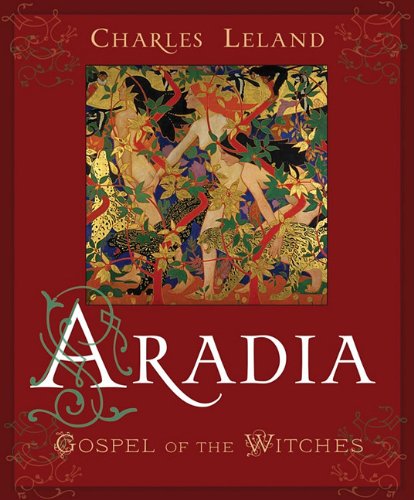
Aradia or The Gospel of the Witches
Authors:
Charles Godfrey Leland
Publisher:
The Witches Almanac
Publication Date:
Not available
ISBN:
0982432356
If Gerald Brosseau Gardner is the father of the religion that calls itself Wicca, then Charles Godfrey Leland is the grandfather of Witchcraft as a... religion in the English-speaking world, and his small book, Aradia, is that religion's birth-announcement.It is the first work in English in which Witchcraft is portrayed as an underground old religion, surviving in secret from ancient Pagan times. Until now Aradia has been a work more often cited than read. Its first edition (1899) garnered only one review, and sank from sight like a stone cast into murky waters; it sold poorly and is now a rare book. By chance a copy fell into the hands of Theda Kenyon, who devoted a few pages to it in her sensational Witches Still Live (1929), thereby calling it to the attention of many readers. By the 1950s Doreen Valiente had read Aradia, and she incorporated some of its most beautiful passages into the Wiccan rituals that she wrote. In the '60s and '70s it was reprinted four times, but always from a defective copy of the first edition that had lost its last page. Only in the '90s did another reprint finally restore the missing page. Aradia has always been a controversial work, among Witches and scholars alike. Scholars have questioned whether it may be a fiction or a forgery by Leland or by his principal informant, Maddalena (Margherita Taludi). Witches have objected to it on theological and ethical grounds, since some of the myths that it tells are about Lucifer and Cain as well as Diana and Aradia, some of its spells work by threatening or coercing the Deities and spirits, and in its revolutionary fervor it does not shrink even from teaching that the poor and downtrodden should use poisons to destroy their feudal overlords. Despite all that, it remains a beautiful and compelling work. This edition has brought the format and typography up to date, while keeping the text unchanged. A modern reader will undoubtedly find this new edition of Aradia much easier to read than the original or any of its facsimile reprints.

A Radical Approach to Lebesgue's Theory of Integration...
Authors:
David M. Bressoud
Publisher:
Cambridge University Press
Publication Date:
Not available
ISBN:
0521711835
This lively introduction to measure theory and Lebesgue integration is motivated by the historical questions that led to its development. The author... stresses the original purpose of the definitions and theorems, highlighting the difficulties mathematicians encountered as these ideas were refined. The story begins with Riemann's definition of the integral, and then follows the efforts of those who wrestled with the difficulties inherent in it, until Lebesgue finally broke with Riemann's definition. With his new way of understanding integration, Lebesgue opened the door to fresh and productive approaches to the previously intractable problems of analysis.
 '
'