production
/viewbook/list/all/?page=1375
/
/static/
None

BECOMING EFFECTIVE POLICY ADVOCATE DIGITAL BOOK
Authors:
Not Available
Publisher:
Not available
Publication Date:
Not available
ISBN:
Not available

Becoming Europe: Immigration Integration And The Welfare State
Authors:
Patrick Ireland
Publisher:
University of Pittsburgh Press
Publication Date:
Not available
ISBN:
0822958457
Patrick Ireland argues that it is incorrect to expect unavoidable conflict between Muslim immmigrants and European host socieites. His insighful work... shows that institutions matter more than culture in determining the shape and style of ethnic relations.

Becoming Evil: How Ordinary People Commit Genocide and Mass Killing
Authors:
James E. Waller
Publisher:
Oxford University Press, USA
Publication Date:
Not available
ISBN:
0195314565
The first edition of Becoming Evil spoke unforgettably to a world shell-shocked by 9/11 that faced a new war on terror against members of an Axis of... Evil. With this second edition, James Waller brings us up to date on some of the horrific events he used in the first edition to illustrate his theory of extraordinary human evil, particularly those from the perennially troubled Balkans and Africa, pointing out steps taken both forward and back. Nearly a third of the references are new, reflecting the rapid pace of scholarship in Holocaust and genocide studies, and the issue of gender now occupies a prominent place in the discussion of the social construction of cruelty. Waller also offers a reconfigured explanatory model of evil to acknowledge that human behavior is multiply influenced, and that any answer to the question "Why did that person act as he or she did?" can be examined at two levels of analysis-- the proximate and the ultimate. Bookended by a powerful new foreword from Greg Stanton, vice-president of the International Association of Genocide Scholars, and a devastating postscript that addresses current outbreaks of genocide and mass killing, this new edition demonstrates that genocide is a problem whose time has not yet passed, but Waller's clear vision gives hope that at least we can begin to understand how ordinary people are recruited into the process of destruction.
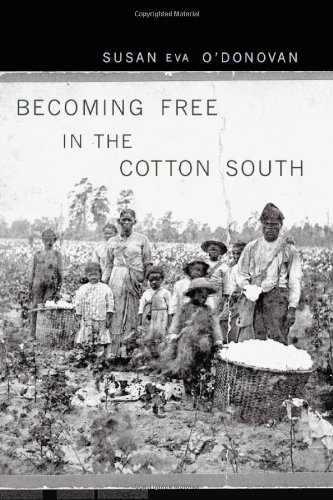
Becoming Free in the Cotton South
Authors:
Susan Eva O'Donovan
Publisher:
Harvard University Press
Publication Date:
Not available
ISBN:
0674045653
Becoming Free in the Cotton South challenges our most basic ideas about slavery and freedom in America. Instead of seeing emancipation as the beginning... or the ending of the story, as most histories do, Susan Eva O’Donovan explores the perilous transition between these two conditions, offering a unique vision of both the enormous changes and the profound continuities in black life before and after the Civil War. This boldly argued work focuses on a small place—the southwest corner of Georgia—in order to explicate a big question: how did black men and black women’s experiences in slavery shape their lives in freedom? The reality of slavery’s demise is harsh: in this land where cotton was king, the promise of Reconstruction passed quickly, even as radicalism crested and swept the rest of the South. Ultimately, the lives former slaves made for themselves were conditioned and often constrained by what they had endured in bondage. O’Donovan’s significant scholarship does not diminish the heroic efforts of black Americans to make their world anew; rather, it offers troubling but necessary insight into the astounding challenges they faced. Becoming Free in the Cotton South is a moving and intimate narrative, drawing upon a multiplicity of sources and individual stories to provide new understanding of the forces that shaped both slavery and freedom, and of the generation of African Americans who tackled the passage that lay between.
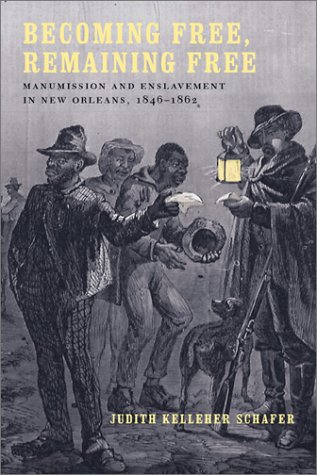
Becoming Free, Remaining Free: Manumission and Enslavement in New...
Authors:
Judith Kelleher Schafer
Publisher:
Louisiana State University Press
Publication Date:
Not available
ISBN:
0807128805
For more than 150 years, the tales of hundreds of slaves and free people of color who used the judicial system to negotiate their freedom lay buried... deep within the dusty records of the New Orleans district courts. Then Judith Kelleher Schafer spent fourteen years poring over Minute Books and trial transcripts, uncovering fascinating cases. In Becoming Free, Remaining Free, Schafer presents her findings and offers a profound analysis of slavery and manumission in the Crescent City. Louisiana state law was unique in allowing slaves to contract for their freedom and to initiate a lawsuit for liberty. Schafer describes the ingenious and remarkably sophisticated ways slaves used the legal system to gain their independence and find a voice in a society that ordinarily gave them none. Showing that remaining free was often as challenging as becoming free, she also recounts numerous cases in which free people of color were forced to use the courts to prove their status. She further documents seventeen free blacks who, when faced with deportation, amazingly sued to enslave themselves. Schafer's impressive detective work achieves a rare feat in the historical profession-the unveiling of an entirely new facet of the slave experience in the American South. With a rich bibliography sure to ease future research, Becoming Free, Remaining Free is a milestone in the historiography of slavery.

Becoming Friends: Worship, Justice, and the Practice of Christian...
Authors:
Paul J. Wadell
Publisher:
Brazos Press
Publication Date:
Not available
ISBN:
1587430517
How do Christians understand friendship and intimacy? How does worship form Christians into a community of the friends of God? What virtues does God... call us to incorporate into our lives? In Becoming Friends, Paul Wadell explores the connections between worship, justice, friendship, and the life we are called to live.
Becoming German: The 1709 Palatine Migration to New York
Authors:
Philip Otterness
Publisher:
Cornell University Press
Publication Date:
Not available
ISBN:
0801473446
Becoming German tells the intriguing story of the largest and earliest mass movement of German-speaking immigrants to America. The so-called Palatine... migration of 1709 began in the western part of the Holy Roman Empire, where perhaps as many as thirty thousand people left their homes, lured by rumors that Britain's Queen Anne would give them free passage overseas and land in America. They journeyed down the Rhine and eventually made their way to London, where they settled in refugee camps. The rumors of free passage and land proved false, but, in an attempt to clear the camps, the British government finally agreed to send about three thousand of the immigrants to New York in exchange for several years of labor. After their arrival, the Palatines refused to work as indentured servants and eventually settled in autonomous German communities near the Iroquois of central New York.Becoming German tracks the Palatines' travels from Germany to London to New York City and into the frontier areas of New York. Philip Otterness demonstrates that the Palatines cannot be viewed as a cohesive "German" group until after their arrival in America; indeed, they came from dozens of distinct principalities in the Holy Roman Empire. It was only in refusing to assimilate to British colonial culture-instead maintaining separate German-speaking communities and mixing on friendly terms with Native American neighbors-that the Palatines became German in America.
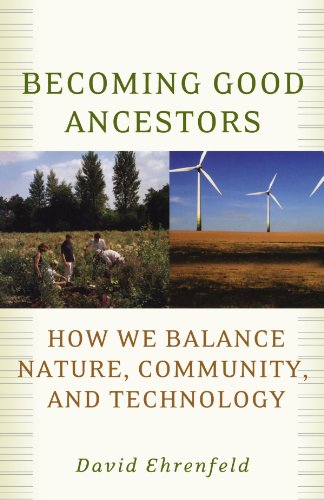
Becoming Good Ancestors: How We Balance Nature, Community, and...
Authors:
David Ehrenfeld
Publisher:
Oxford University Press, USA
Publication Date:
Not available
ISBN:
0195373782
A brilliant writer and gifted "big picture" thinker, David Ehrenfeld is one of America's leading conservation biologists. Becoming Good Ancestors unites... in a single, up-to-date framework pieces written over two decades, spanning politics, ecology, and culture, and illuminating the forces in modern society that thwart our efforts to solve today's hard questions about society and the environment. The book focuses on our present-day retreat from reality, our alienation from nature, our unthinking acceptance of new technology and rejection of the old, the loss of our ability to discriminate between events we can control and those we cannot, the denial of non-economic values, and the decline of local communities. If we are aware of what we are losing and why we are losing it, the author notes, all of these patterns are reversible. Through down-to-earth examples, ranging from a family canoe trip in the wilderness to the novels of Jane Austen to Chinese turtle and tiger farms, Ehrenfeld shows how we can use what we learn to move ourselves and our society towards a more stable, less frantic, and far more satisfying life, a life in which we are no longer compelled to damage ourselves and our environment, in which our children have a future, and in which fewer species are endangered and more rivers run clean. In the final chapter, he offers a dramatic view of the possibilities inherent in a fusion of the best elements of conservatism and liberalism. Our society has an inherent sense of what is right, says Ehrenfeld, and the creativity and persistence to make good things happen. It is now time to apply our intelligence, guided by our moral judgment, to the very large problems we all face. This book is an important first step.
Becoming Good: Building Moral Character
Authors:
David W. Gill
Publisher:
IVP Books
Publication Date:
Not available
ISBN:
0830822720
Becoming good--building character--is what we all want for ourselves and for others. But where do we begin? Becoming good is not simply a matter of a... few dos and don'ts. In fact we can't begin to do the right things until we have built an adequate foundation. This is precisely what David Gill sets out to help us do. His approach is deeply rooted within the Christian tradition and specifically designed for people who want to allow Scripture to shape the way they think and act. Gill's arguments are not drawn from ethical theory (though they are informed by it) but from the Bible--from Paul's admonitions to faith, hope and love, and from Jesus' Beatitudes. Here is rich, biblical teaching that will help people from every walk of life--whether engineers, bus drivers, managers, restaurant workers, PTA members, parents, neighborhood volunteers, nurses, teachers, coaches, attorneys, journalists or physicians--fulfill their calling to be salt and light within their own spheres of influence.
Becoming Historians
Authors:
Not Available
Publisher:
University Of Chicago Press
Publication Date:
Not available
ISBN:
0226036588
In this unique collection, the memoirs of eleven historians provide a fascinating portrait of a formative generation of scholars. Born around the time... of World War II, these influential historians came of age just before the upheavals of the 1960s and ’70s and helped to transform both their discipline and the broader world of American higher education. The self-inventions they thoughtfully chronicle led, in many cases, to the invention of new fields—including women’s and gender history, social history, and public history—that cleared paths in the academy and made the study of the past more capacious and broadly relevant. In these stories—skillfully compiled and introduced by James Banner and John Gillis—aspiring historians will find inspiration and guidance, experienced scholars will see reflections of their own dilemmas and struggles, and all readers will discover a rare account of how today’s seasoned historians embarked on their intellectual journeys.
Becoming Human
Authors:
Jean Vanier
Publisher:
Paulist Pr
Publication Date:
Not available
ISBN:
0809145871
In this provocative work, Jean Vanier shares his profoundly human vision for creating a common good that radically changes our communities, our... relationships, and ourselves. He proposes that by opening ourselves to outsiders, those that we perceive as weak, different, or inferior, we can achieve pure personal and societal freedom. Our society shuns weakness and glorifies strength. By embracing weakness, however, we learn new ways of living and discover greater compassion, trust and understanding. This spirit of inclusion has extraordinary implications for the we live our lives and build our communities.
Becoming Human: Evolution and Human Uniqueness
Authors:
Ian Tattersall
Publisher:
Mariner Books
Publication Date:
Not available
ISBN:
0156006537
In Becoming Human, noted anthropologist and renaissance man Ian Tattersall explores what makes us uniquely human, the qualities that set us apart from... our ancestors, and the significance of our knowledge. A worldwide tour of discovery, Tattersall takes the reader from 30,000-year-old cave paintings in France and anthropological digs in Africa, to examining human behavior in a New York restaurant. And by offering wisdom gleaned from fossil remains, primate behavior, prehistoric art, and archaeology, Tattersall presents a stunning picture of where humankind evolved, how Darwin's theories have changed, and what we reliably know about modern-day human's capacity for love, language, and thought. Widely praised in the media, and an Amazon.com Top-10 bestseller, Becoming Human is an amazing trip into the past and into the future.
Becoming Icons of Christ
Authors:
Mother Raphaela
Publisher:
St Vladimirs Seminary Pr
Publication Date:
Not available
ISBN:
0881413917
Becoming Icons of Christ, the third in a series of collections of talks and essays by Mother Raphaela,continues the practical and plain-spoken advice on... life and growth in Christ introduced and developed in the first two volumes.When we find ourselves in our times of passion,or when we are faced with the passion ofothers, we have only one way open to us to respondappropriately...we ask Christ to enter our lives, toteach us to pray, and Himself to come, live, and praywithin us. This way of entering into the life and Passionof Christ is the only way to His Resurrection ourown personal transfiguration by the life of God. And only as we are thus transfigured will webecome icons not icons of our righteousness and suffering, nor of our own strength, truthand courage, but in cons of the love, the power, and the peace of God.
Becoming Indian: The Struggle over Cherokee Identity in the...
Authors:
Circe Sturm
Publisher:
SAR Press
Publication Date:
Not available
ISBN:
1934691445
In Becoming Indian, author Circe Sturm examines Cherokee identity politics and the phenomenon of racial shifting. Racial shifters, as described by... Sturm, are people who have changed their racial self-identification from non-Indian to Indian on the US Census. Many racial shifters are people who, while looking for their roots, have recently discovered their Native American ancestry. Others have family stories of an Indian great-great-grandmother or -grandfather they have not been able to document. Still others have long known they were of Native American descent, including their tribal affiliation, but only recently have become interested in reclaiming this aspect of their family history. Despite their differences, racial shifters share a conviction that they have Indian blood when asserting claims of indigeneity. Becoming Indian explores the social and cultural values that lie behind this phenomenon and delves into the motivations of these Americans from so many different walks of life to reinscribe their autobiographies and find deep personal and collective meaning in reclaiming their Indianness. Sturm points out that becoming Indian was not something people were quite as willing to do forty years ago the willingness to do so now reveals much about the shifting politics of race and indigeneity in the United States.
Becoming Influential: A Guide for Nurses
Authors:
Eleanor J. Sullivan
Publisher:
Prentice Hall
Publication Date:
Not available
ISBN:
0130485195
This groundbreaking book applies a practical approach toward becoming a professional nurse with exemplary influence skills. The emphasis on the... importance of nurses' influence in the workplace, presented in this easy-to-read and timely volume, includes numerous examples of real-life situations. It provides techniques for enhancing influence-making skills and advice for using enhanced influence skills to solve common workplace problems. This volume addresses understanding and using influence including setting goals and making things happen, negotiating for what you want and dealing with difficult people and situations, as well as managing your career and preparing your successors. For nursing professionals including staff nurses and nurse managers.
 '
'