production
/viewbook/list/all/?page=1395
/
/static/
None
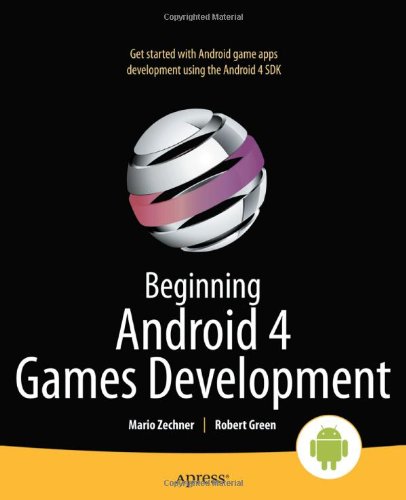
Beginning Android 4 Games Development (Beginning Apress)
Authors:
Robert Green
Publisher:
Apress
Publication Date:
Not available
ISBN:
1430239875
Beginning Android 4 Games Development offers everything you need to join the ranks of successful Android game developers. You'll start with game design... fundamentals and programming basics, and then progress toward creating your own basic game engine and playable game that works on Android 4.0 and earlier devices. This will give you everything you need to branch out and write your own Android games. The potential user base and the wide array of available high-performance devices makes Android an attractive target for aspiring game developers. Do you have an awesome idea for the next break-through mobile gaming title? Beginning Android 4 Games Development will help you kick-start your project. The book will guide you through the process of making several example games for the Android platform, and involves a wide range of topics: The fundamentals of Android game development targeting Android 1.5-4.0+ devices The Android platform basics to apply those fundamentals in the context of making a game The design of 2D and 3D games and their successful implementation on the Android platform What you’ll learn How to set up and use the development tools for developing your first Android 4 or earlier version game app The fundamentals of game programming in the context of the Android platform How to use the Android's APIs for graphics, audio, and user input to reflect those fundamentals How to develop two 2D games from scratch, based on the Canvas API and OpenGL ES How to create a full-featured 3D game How to publish your games, get crash reports, and support your users How to complete your own playable 2D OpenGL games Who this book is forThis book is for people with a basic knowledge of Java who want to write games on the Android platform. It also offers information for experienced game developers about the pitfalls and peculiarities of the platform. Table of Contents Android, the New Kid on the Block First Steps with the Android SDK Game Development 101 Android for Game Developers An Android Game Development Framework Mr. Nom Invades Android OpenGL ES: A Gentle Introduction 2D Game Programming Tricks Super Jumper: A 2D OpenGL ES Game OpenGL ES: Going 3D 3D Programming Tricks Droid Invaders: the Grand Finale Advanced Techniques from Latest SDK Publishing Your Game
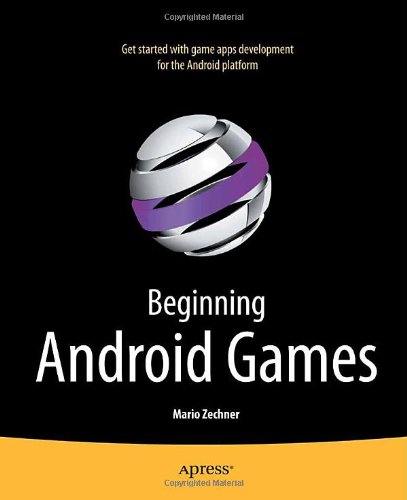
Beginning Android Games
Authors:
Mario Zechner
Publisher:
Apress
Publication Date:
Not available
ISBN:
1430230428
Beginning Android Games offers everything you need to join the ranks of successful Android game developers. You'll start with game design fundamentals... and programming basics, and then progress towards creating your own basic game engine and playable games. This will give you everything you need to branch out and write your own Android games. The potential user base and the wide array of available high-performance devices makes Android an attractive target for aspiring game developers. Do you have an awesome idea for the next break-through mobile gaming title? Beginning Android Games will help you kick-start your project. The book will guide you through the process of making several example games for the Android platform, and involves a wide range of topics: The fundamentals of game development The Android platform basics to apply those fundamentals in the context of making a game The design of 2D and 3D games and their successful implementation on the Android platform For those looking to learn about Android tablet game app development or want Android 4 SDK specific coverage, check out Beginning Android 4 Games Development, now available from Apress. What you’ll learn How to set up and use the development tools for developing your first Android application The fundamentals of game programming in the context of the Android platform How to use the Android's APIs for graphics (Canvas, OpenGL ES 1.0/1.1), audio, and user input to reflect those fundamentals How to develop two 2D games from scratch, based on the Canvas API and OpenGL ES. How to create a full-featured 3D game How to publish your games, get crash reports, and support your users How to complete your own playable 2D OpenGL games Who this book is for This book is for people with a basic knowledge of Java who want to write games on the Android platform. It also offers information for experienced game developers about the pitfalls and peculiarities of the platform. Table of Contents Android, the New Kid on the Block First Steps with the Android SDK Game Development 101 Android for Game Developers An Android Game Development Framework Mr. Nom Invades Android OpenGL ES: A Gentle Introduction 2D Game Programming Tricks Super Jumper: A 2D OpenGL ES Game OpenGL ES: Going 3D 3D Programming Tricks Droid Invaders: the Grand Finale Publishing Your Game What’s Next?
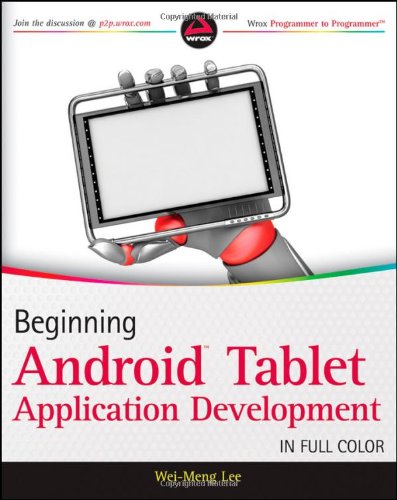
Beginning Android Tablet Application Development (Wrox Programmer...
Authors:
Wei-Meng Lee
Publisher:
Wrox
Publication Date:
Not available
ISBN:
1118106733
A full-color, fast-paced introduction to developing tablet applications using AndroidThe new release of Android 3 brings the full power of Android to... tablet computing and this hands-on guide offers an introduction to developing tablet applications using this new Android release. Veteran author Wei-Meng Lee explains how Android 3 is specifically optimized for tablet computing and he details Android's tablet-specific functions. Beginning with the basics, this book moves at a steady pace to provide everything you need to know to begin successfully developing your own Android tablet applications. Serves as a full-color, hands-on introduction to developing tablet applications with the new Android 3 Offers a helpful overview of Android 3 programming for tabletsDetails the components of Android tablet applicationsHighlights ways to build the Android user interface for tablets, create location-based services, publish Android applications, use Eclipse for Android development, and employ the Android emulatorBeginning Android Tablet Application Development is an ideal starting point for getting started with using Android 3 to develop tablet applications.
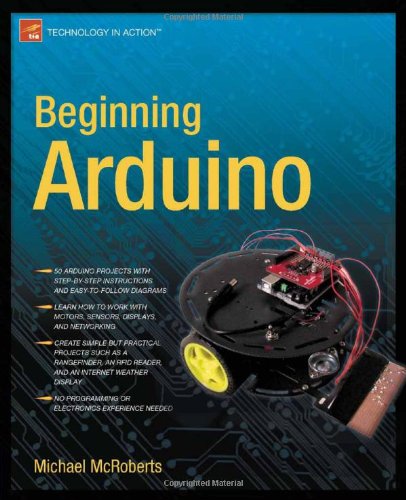
Beginning Arduino
Authors:
Michael McRoberts
Publisher:
Apress
Publication Date:
Not available
ISBN:
1430232404
In Beginning Arduino, you will learn all about the popular Arduino microcontroller by working your way through an amazing set of 50 cool projects.... You'll progress from a complete beginner regarding Arduino programming and electronics knowledge to intermediate skills and the confidence to create your own amazing Arduino projects. Absolutely no experience in programming or electronics required! Rather than requiring you to wade through pages of theory before you start making things, this book has a hands-on approach. You will dive into making projects right from the start, learning how to use various electronic components and how to program the Arduino to control or communicate with those components. Each project is designed to build upon the knowledge learned in earlier projects and to further your knowledge in programming as well as skills with electronics. By the end of the book you will be able create your own projects confidently and with creativity. Please note: the print version of this title is black & white; the eBook is full color. What you’ll learn Controlling LEDs Displaying text and graphics on LCD displays Making a line-following robot Using touch screens Using digital pressure sensors Reading and writing data to SD cards Connecting your Arduino to the Internet Who this book is for Electronics enthusiasts who are new to the Arduino as well as artists and hobbyists who want to learn this very popular platform for physical computing and electronic art. Table of Contents Introduction Light 'Em Up LED Effects Simple Sounders and Sensors Driving a DC Motor Binary Counters LED Displays Liquid Crystal Displays Servos Steppers and Robots Pressure Sensors Touch Screens Temperature Sensors Ultrasonic Rangefinders Reading and Writing to an SD Card Making an RFID Reader Communicating over Ethernet
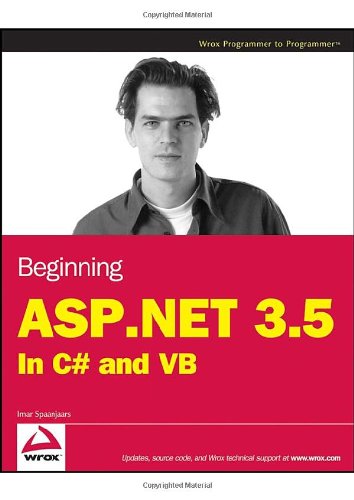
Beginning ASP.NET 3.5: In C# and VB (Programmer to Programmer)
Authors:
Imar Spaanjaars
Publisher:
Wrox
Publication Date:
Not available
ISBN:
047018759X
This book is for anyone who wants to learn how to build rich and interactive web sites that run on the Microsoft platform. With the knowledge you gain... from this book, you create a great foundation to build any type of web site, ranging from simple hobby-related web sites to sites you may be creating for commercial purposes.Anyone new to web programming should be able to follow along because no prior background in web development is assumed. The book starts at the very beginning of web development by showing you how to obtain and install Visual Web Developer. The chapters that follow gradually introduce you to new technologies, building on top of the knowledge gained in the previous chapters.Do you have a strong preference for Visual Basic over C# or the other way around? Or do you think both languages are equally cool? Or maybe you haven't made up your mind yet and want to learn both languages? Either way, you'll like this book because all code examples are presented in both languages!Even if you're already familiar with previous versions of ASP.NET, with the 1.x versions in particular, you may gain a lot from this book. Although many concepts from ASP.NET 2.0 are brought forward into ASP.NET 3.5, you'll discover there's a host of new stuff to be found in this book, including an introduction to LINQ, the new CSS and JavaScript debugging tools, new ASP.NET controls, and integrated support for ASP.NET Ajax.To build effective and attractive database-driven web sites, you need two things: a solid and fast framework to run your web pages on and a rich and extensive environment to create and program these web pages. With ASP.NET 3.5 and Visual Web Developer 2008 you get both. Together they form the platform to create dynamic and interactive web applications.ASP.NET 3.5 builds on top of its popular predecessor ASP.NET 2.0. While maintaining backward compatibility with sites built using this older version, the Microsoft .NET Framework 3.5 in general and ASP.NET 3.5 in particular add a lot of new, compelling features to the mix.Continuing the path of "less code" that was entered with the 2.0 version of the .NET Framework, ASP.NET 3.5 lets you accomplish more with even less code. New features like LINQ that are added to the .NET Framework allow you to access a database with little to no hand written code. The integration of Microsoft ASP.NET Ajax into the ASP.NET Framework and Visual Web Developer means you can now create fast responding and spiffy web interfaces simply by dragging a few controls onto your page and setting a few properties. This book gives you an in-depth look at both these technologies.The support for cascading style sheets (CSS), the language to lay out and format web pages, has undergone a major overhaul in Visual Web Developer. The design time support, that shows you how a page will eventually look in the browser, has been vastly improved. Additionally, Visual Web Developer now ships with a lot of tools that make writing CSS a breeze.However, drag-and-drop support and visual tools are not the only things you'll learn from this book. ASP.NET 3.5 and Visual Web Developer 2008 come with a great and extensive set of tools to help you program your web applications. These tools range from the new LINQ syntax that allows you to query data and databases in your web applications, to the vastly improved debugging capabilities that allow you to debug your application from client-side JavaScript all the way up into your server-side code, all with the same familiar user interface, commands, and actions.Under the hood, ASP.NET 3.5 makes use of the same run-time as version 2.0. This ensures a great backward compatibility with that version, which means that ASP.NET 2.0 applications continue to run under the new framework. But don't be fooled by the fact that the run-time hasn't changed. Although the technical underpinnings needed to execute your web application haven't changed, the .NET 3.5 Framework and ASP.NET add a lot of new features, as you'll discover in this book.Probably the best thing of Visual Web Developer 2008 is its price: it's available for free. Although the commercial versions of Visual Studio 2008 ship with Visual Web Developer, you can also download and install the free Express Edition. This makes Visual Web Developer 2008 and ASP.NET 3.5 probably the most attractive and compelling web development technologies available today.This book teaches you how to create a feature-rich, data-driven, and interactive web site. Although this is quite a mouthful, you'll find that with Visual Web Developer 2008 this isn’t as hard as it seems. You'll see the entire process of building a web site, from installing Visual Web Developer 2008 in Chapter 1 all the way up to putting your web application on a live server in Chapter 18. The book is divided into 18 chapters, each dealing with a specific subject.Chapter 1, “Getting Started With ASP.NET 3.5.” In this chapter you'll see how to obtain and install Visual Web Developer 2008. You'll get instructions for downloading and installing the free edition of Visual Web Developer 2008, called the Express Edition. You are also introduced to HTML, the language behind every web page. The chapter closes with an overview of the customization options that Visual Web Developer gives you.Chapter 2, “Building an ASP.NET Web Site.” This chapter shows you how to create a new web site and how to add new elements like pages to it. Besides learning how to create a well-structured site, you also see how to use the numerous tools in Visual Web Developer to create HTML and ASP.NET pages.Chapter 3, “Designing Your Web Pages.” Visual Web Developer comes with a host of tools that allow you to create well-designed and attractive web pages. In this chapter, you see how to make good use of these tools. Additionally, you learn about CSS, the language that is used to format web pages.Chapter 4, “Working with ASP.NET Controls.” ASP.NET Server controls are one of the most important concepts in ASP.NET. They allow you to create complex and feature-rich web sites with very little code. This chapter introduces you to the large number of server controls that are available, explains what they are used for, and shows you how to use them.Chapter 5, “Programming Your ASP.NET Web Pages.” Although the built-in CSS tools and the ASP.NET server controls can get you a long way in creating web pages, you are likely to use a programming language to enhance your pages. This chapter serves as an introduction to programming with a strong focus on programming web pages. Best of all: all the examples you see in this chapter (and the rest of the book) are in both Visual Basic and C#, so you can choose the language you like best.Chapter 6, “Creating Consistent Looking Web Sites.” Consistency is important to give your web site an attractive and professional appeal. ASP.NET helps you create consistent-looking pages through the use of master pages, which allow you to define the global look and feel of a page. Skins and themes help you to centralize the looks of controls and other visual elements in your site. You also see how to create a base page that helps to centralize programming code that you need on all pages in your site.Chapter 7, “Navigation.” To help your visitors find their way around your site, ASP.NET comes with a number of navigation controls. These controls are used to build the navigation structure of your site. They can be connected to your site's central site map that defines the pages in your web site. You also learn how to programmatically send users from one page to another.Chapter 8, “User Controls.” User Controls are reusable page fragments that can be used in multiple web pages. As such, they are great for repeating content like menus, banners, and so on. In this chapter, you learn how to create and use User Controls and enhance them with some programmatic intelligence.Chapter 9, “Validating User Input.” A large part of interactivity in your site is defined by the input of your users. This chapter shows you how to accept, validate, and process user input using ASP.NET server controls. Additionally, you see how to send e-mail from your ASP.NET web application and how to read from text files.Chapter 10, “ASP.NET Ajax.” Microsoft ASP.NET Ajax allows you to create good looking, flicker free web pages that close the gap between traditional desktop applications and web applications. In this chapter you learn how to use the built-in Ajax features to enhance the presence of your web pages, resulting in a smoother interaction with the web site.Chapter 11, “Introduction to Databases.” Understanding how to use databases is critical to building modern web sites, as most modern web sites require the use of a database. You'll learn the basics of SQL, the query language that allows you to access and alter data in a database. In addition, you are introduced to the database tools found in Visual Web Developer that help you create and manage your SQL Server databases.Chapter 12, “Displaying and Updating Data.” Building on the knowledge you gained in the previous chapter, this chapter shows you how to use the ASP.NET data-bound and data source controls to create a rich interface that enables your users to interact with the data in the database that these controls target.Chapter 13, “LINQ.” LINQ is Microsoft's new solution for accessing objects, databases, XML, and more. In this chapter you'll see how to use LINQ to SQL to access SQL Server databases. Instead of writing a lot of manual code, you create a bunch of LINQ objects that do the heavy work for you. This chapter shows you what LINQ is all about, how to use the visual LINQ designer built into Visual Web Developer, and how to write LINQ queries to get data in and out of your SQL Server database.Chapter 14, “Presenting Data: Advanced Topics....
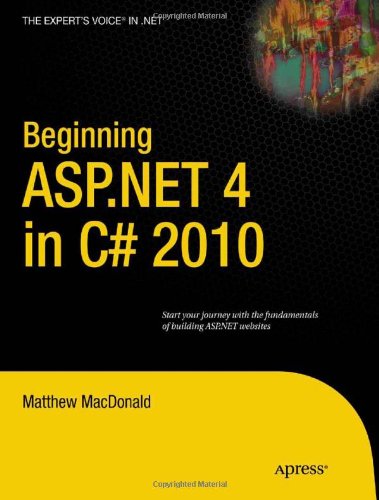
Beginning ASP.NET 4 in C# 2010
Authors:
Matthew MacDonald
Publisher:
Apress
Publication Date:
Not available
ISBN:
1430226080
The most up-to-date and comprehensive introductory ASP.NET book you’ll find on any shelf, Beginning ASP.NET 4 in C# 2010 guides you through... Microsoft’s latest technology for building dynamic web sites. Learn how to build sophisticated web pages quickly and easily using the most powerful tools available. Starting with the basics, this book provides exhaustive coverage of ASP.NET, guiding you from your first steps right through to advanced techniques - such as making database queries from within a web page, tuning your website for optimal performance and deploying your website to production servers. Within these pages, you’ll find tips for best practices and comprehensive discussions of key database and XML principles you need to know in order to be effective with ASP.NET. The book also fully explains the crucial coding techniques of object-orientation and code-behind on which your future as a successful ASP.NET developer relies. What you’ll learn How to build well-structured ASP.NET 4 applications including how to incorporate data from databases, XML files, web services, and other services. A solid understanding of key ASP.NET concepts such as master pages, themes, state management, session state, and error handling, and of which techniques work best in which situations. How to improve the user experience of your pages through the use of ASP.NET AJAX. Who this book is for This book is ideal for anyone new to .NET development who wants to learn how ASP.NET works. No prior programming knowledge is assumed and all concepts are explained from first principals. Table of Contents Part 1: Introducing .NET The .NET Framework The C# Language Types, Objects, and Namespaces Part 2: Developing ASP.NET Applications Visual Studio Web Form Fundamentals Web Controls Error Handling, Logging, and Tracing State Management Part 3: Building Better Web Forms Validation Rich Controls User Controls and Graphics Styles, Themes, and Master Pages Website Navigation Part 4: Working with Data ADO.NET Fundamentals Data Binding The Data Controls Files and Streams XML Part 5: Website Security Security Fundamentals Membership Profiles Part 6: Advanced ASP.NET Advanced ASP.NET Components Caching LINQ and the Entity Framework ASP.NET AJAX Deploying ASP.NET Applications
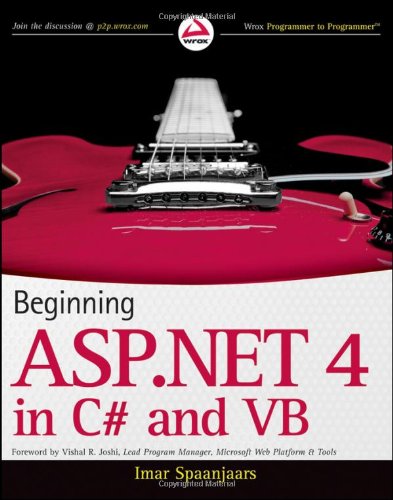
Beginning ASP.NET 4: in C# and VB (Wrox Programmer to Programmer)
Authors:
Imar Spaanjaars
Publisher:
Wrox
Publication Date:
Not available
ISBN:
0470502215
This book is for anyone who wants to learn how to build rich and interactive web sites that run on the Microsoft platform. With the knowledge you gain... from this book, you create a great foundation to build any type of web site, ranging from simple hobby-related web sites to sites you may be creating for commercial purposes.Anyone new to web programming should be able to follow along because no prior background in web development is assumed although it helps if you do have a basic understanding of HTML and the web in general. The book starts at the very beginning of web development by showing you how to obtain and install Visual Web Developer. The chapters that follow gradually introduce you to new technologies, building on top of the knowledge gained in the previous chapters.Do you have a strong preference for Visual Basic over C# or the other way around? Or do you think both languages are equally cool? Or maybe you haven't made up your mind yet and want to learn both languages? Either way, you'll like this book because all code examples are presented in both languages!Even if you have some experience with prior versions of ASP.NET, you may gain a lot from this book. Although many concepts from previous versions are brought forward into ASP.NET 4, you'll discover there's a lot of new stuff to be found in this book, including an introduction to the ADO.NET Entity Framework, the inclusion of jQuery, ASP.NET AJAX, the many changes to the ASP.NET 4 Framework, and much more.This book teaches you how to create a feature-rich, data-driven, and interactive web site called Planet Wrox. Although this is quite a mouthful, you'll find that with Visual Web Developer 2010, developing such a web site isn't as hard as it seems. You'll see the entire process of building a web site, from installing Visual Web Developer 2010 in Chapter 1 all the way up to putting your web application on a live server in Chapter 19. The book is divided into 19 chapters, each dealing with a specific subject.Chapter 1, “Getting Started with ASP.NET 4” shows you how to obtain and install Visual Web Developer 2010. You'll get instructions for downloading and installing the free edition of Visual Web Developer 2010, called the Express edition. You are also introduced to HTML, the language behind every web page. The chapter closes with an overview of the customization options that Visual Web Developer gives you.Chapter 2, “Building an ASP.NET Web Site” shows you how to create a new web site and how to add new elements like pages to it. Besides learning how to create a well-structured site, you also see how to use the numerous tools in Visual Web Developer to create HTML and ASP.NET pages.Chapter 3, “Designing Your Web Pages.” Visual Web Developer comes with a host of tools that allow you to create well-designed and attractive web pages. In this chapter, you see how to make good use of these tools. Additionally, you learn about CSS, the language that is used to format web pages.Chapter 4, “Working with ASP.NET Server Controls.” ASP.NET Server Controls are one of the most important concepts in ASP.NET. They allow you to create complex and feature-rich web sites with very little code. This chapter introduces you to the large number of server controls that are available, explains what they are used for, and shows you how to use them.Chapter 5, “Programming Your ASP.NET Web Pages.” Although the built-in CSS tools and the ASP.NET Server Controls can get you a long way in creating web pages, you are likely to use a programming language to enhance your pages. This chapter serves as an introduction to programming with a strong focus on programming web pages. Best of all: all the examples you see in this chapter (and the rest of the book) are in both Visual Basic and C#, so you can choose the language you like best.Chapter 6, “Creating Consistent Looking Web Sites.” ASP.NET helps you create consistent-looking pages through the use of master pages, which allow you to define the global look and feel of a page. Skins and themes help you to centralize the looks of controls and other visual elements in your site. You also see how to create a base page that helps to centralize programming code that you need on all pages in your site.Chapter 7, “Navigation.” To help your visitors find their way around your site, ASP.NET comes with a number of navigation controls. These controls are used to build the navigation structure of your site. They can be connected to your site's central site map that defines the pages in your web site. You also learn how to programmatically send users from one page to another.Chapter 8, “User Controls.” User controls are reusable page fragments that can be used in multiple web pages. As such, they are great for repeating content such as menus, banners, and so on. In this chapter, you learn how to create and use user controls and enhance them with some programmatic intelligence.Chapter 9, “Validating User Input.” A large part of interactivity in your site is defined by the input of your users. This chapter shows you how to accept, validate, and process user input using ASP.NET Server Controls. Additionally, you see how to send e-mail from your ASP.NET web application and how to read from text files.Chapter 10, “ASP.NET AJAX.” Microsoft ASP.NET AJAX allows you to create good-looking, flicker-free web pages that close the gap between traditional desktop applications and web applications. In this chapter you learn how to use the built-in Ajax features to enhance the presence of your web pages, resulting in a smoother interaction with the web site.Chapter 11, “jQuery.” jQuery is a popular, open source and cross-browser JavaScript library designed to make it easier to interact with web pages in the client’s browser. In this chapter you learn the basics of jQuery and see how to add rich visual effects and animations to your web pages.Chapter 12, “Introducing Databases.” Understanding how to use a database is critical to building web sites, as most modern web sites require the use of a database. You’ll learn the basics of SQL, the query language that allows you to access and alter data in a database. In addition, you are introduced to the database tools found in Visual Web Developer that help you create and manage your SQL Server databases.Chapter 13, “Displaying and Updating Data.” Building on the knowledge you gained in the previous chapter, this chapter shows you how to use the ASP.NET data-bound and data source controls to create a rich interface that enables your users to interact with the data in the database that these controls target.Chapter 14, “LINQ and the ADO.NET Entity Framework.” LINQ is Microsoft’s solution for accessing objects, databases, XML, and more. The ADO.NET Entity Framework (EF) is Microsoft's new technology for database access. This chapter shows you what LINQ is all about, how to use the visual EF designer built into Visual Studio, and how to write LINQ to EF queries to get data in and out of your SQL Server database.Chapter 15, “Working with Data—Advanced Topics.” While earlier chapters focused mostly on the technical foundations of working with data, this chapter looks at the same topic from a front-end perspective. You see how to change the visual appearance of your data through the use of control styles. You also see how to interact with the data-bound controls and how to speed up your application by keeping a local copy of frequently accessed data.Chapter 16, “Security in Your ASP.NET 4 Web Site.” Although presented quite late in the book, security is a first-class, important topic. This chapter shows you how to make use of the built-in ASP.NET features related to security. You learn about a number of application services that facilitate security. You also learn how to let users sign up for an account on your web site, how to distinguish between anonymous and logged-on users, and how to manage the users in your system.Chapter 17, “Personalizing Web Sites.” Building on the security features introduced in Chapter 16, this chapter shows you how to create personalized web pages with content targeted at individual users. You see how to configure and use ASP.NET Profile that enables you to store personalized data for known and anonymous visitors.Chapter 18, “Exception Handling, Debugging, and Tracing.” In order to understand, improve, and fix the code you write for your ASP.NET web pages you need good debugging tools. Visual Web Developer ships with great debugging support that enables you to diagnose the state of your application at run time, helping you find and fix problems before your users do.Chapter 19, “Deploying Your Web Site.” By the end of the book, you should have a web site that is ready to be shown to the world. But how exactly do you do that? What are the things you need to know and understand to put your web site out in the wild? This chapter gives the answers and provides you with a good look at configuring different production systems in order to run your final web site.Note: CD-ROM/DVD and other supplementary materials are not included as part of eBook file.
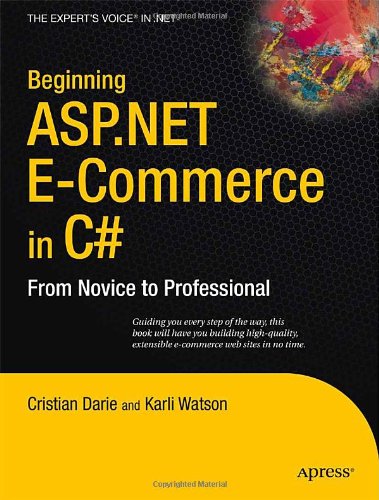
Beginning ASP.NET E-Commerce in C#: From Novice to Professional...
Authors:
Karli Watson
Publisher:
Apress
Publication Date:
Not available
ISBN:
1430210745
With the incarnations of ASP.NET 3.5 and SQL Server 2008, programming dynamic data–driven web sites with Microsoft technologies has become easier and... much more efficient than ever before. Fewer mouse clicks and fewer lines of code can now enable more powerful features and the tools you need—Visual Web Developer and SQL Server 2008 Express Edition—are free. In Beginning ASP.NET E-Commerce in C#: From Novice to Professional, you’ll learn how to best use the free development tools offered by Microsoft to build an online product catalog. You will gain an intimate understanding of every piece of code you write. This understanding will enable you to build your own powerful and flexible web sites efficiently and rapidly with ASP.NET 3.5. Build a complete site, including a shopping cart, checkout, product searching, product recommendations, control panel, customer accounts, order processing, and much, much more. Explore new challenges and theoretical concepts, which are carefully analyzed and explained throughout the book, with each feature you add to the web site. Learn to handle payments by integrating PayPal and DataCash into your site. What you’ll learn Use Microsoft’s Express products to build an online product catalog Add payment processing with PayPal and DataCash Expand your site’s product listing through web services Implement an order pipeline Take advantage of search engine optimization techniques to publicize your site Who this book is for Developers wanting to build professional e–commerce sites using .NET technologies.

BEGINNING AURAL SKILLS
Authors:
Not Available
Publisher:
Not available
Publication Date:
Not available
ISBN:
Not available
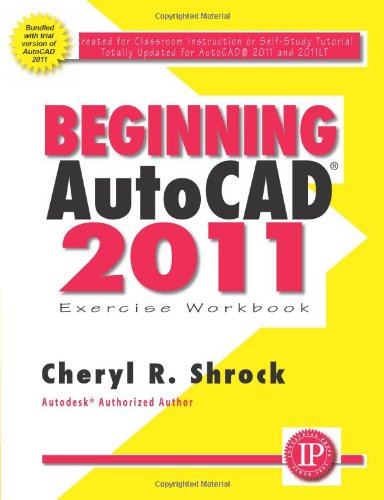
Beginning AutoCAD 2011 Exercise Workbook
Authors:
Cheryl Shrock
Publisher:
Industrial Press, Inc.
Publication Date:
Not available
ISBN:
083113416X
AutoCAD 2011 30-Day Trial Version included on the enclosed DVDs. This is the right book for you if…you're new to AutoCAD or want to brush... up on the basics, you're looking for a clear, no nonsense, easy-to-follow text, or you want to learn AutoCAD quickly and easily. Totally updated for AutoCAD 2011 and 2011 LT including Layer Transparency Control, View Cube and Navigation Bar, Online Help, and Express Tools, this workbook includes 30 lessons with step-by-step instructions followed by exercised designed for practicing the commands learned within the lesson. Providing only what you need without all of the jargon, it is ideal for classroom instruction or as a self-study tutorial. Features 2011 software includes Layer Transparency Control, View Cube and Navigation Bar, Online Help, and Express Tools. AutoCAD 2011 30-Day Trial Version included on the enclosed DVD. Ideal for classroom instruction or as a self-study tutorial. Provides only what you need without all of the jargon. Includes 30 lessons with step by step instructions followed by exercises designed for practicing the commands learned within the lesson. Each lesson starts very simple and progresses to more complex. The approach taken is to familiarize users with the drawing commands first, and then teach users to create their own setup drawings. Each lesson is explained clearly and in a non-intimidating manner. All exercises print easily on your 8-1/2 X 11 printer.
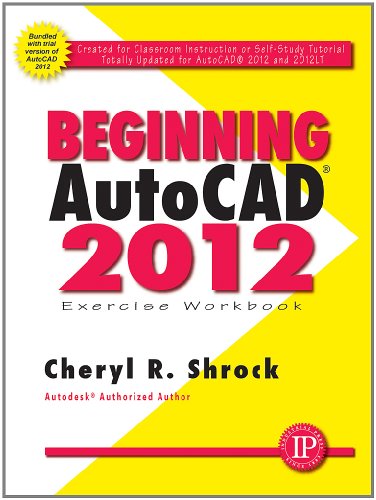
Beginning AutoCAD 2012 Exercise Workbook (My Workbook Series)
Authors:
Cheryl Shrock
Publisher:
Industrial Press
Publication Date:
Not available
ISBN:
0831134305
AutoCAD 2012 30-Day Trial Version included on the enclosed DVD. This is the right book for you if: you're new to AutoCAD or want to brush up on the... basics, you're looking for a clear, no nonsense, easy-to-follow text, or you want to learn AutoCAD quickly and easily. Totally updated for AutoCAD 2012 and 2012 LT, it includes Autodesk Exchange; Auto-Complete Command Entry; Group creation and control; Copy, Array; Array along a Path; Associative Array; and Creation Preview. Enhanced features include Updated Ribbon Interface; Faster Startups, Instantaneous response as you switch between ribbon and tabs; UCS control enhancements; File Previews; Grip functions; Quick Properties; Object Selection; and Multileader enhancements. Additionally it offers 30 lessons with step-by-step instructions followed by exercises designed for practicing the commands learned within the lesson. Providing only what you need without all of the jargon, it is ideal for classroom instruction or as a self-study tutorial.
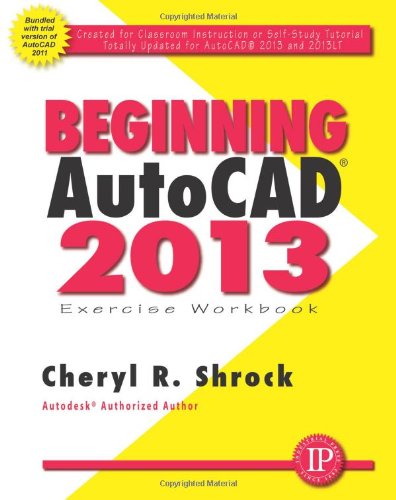
Beginning AUTOCAD 2013 Exercise Workbook
Authors:
Cheryl R. Shrock
Publisher:
Industrial Press
Publication Date:
Not available
ISBN:
0831134569
For Use with the PC version of AutoCAD 2013 only. This is the right book for you if... You're new to AutoCAD or want to brush up on the basics. You're... looking for a clear, no nonsense, easy-to-follow text. You want to learn AutoCAD quickly and easily. FEATURES Totally updated for AutoCAD 2013 and 2013 LT including Autodesk Cloud, Online Collaboration, Command Line Options, Polyline Reverse Direction, and Layout Tab and Panels. AutoCAD 2013 30-Day Trial Version included on the enclosed DVD. Ideal for classroom instruction or as a self-study tutorial. Provides only what you need without all of the jargon. Includes 30 lessons with step by step instructions followed by exercises designed for practicing the commands learned within the lesson. Each lesson starts very simple and progresses to more complex. The approach taken is to familiarize you with the drawing commands first, and then teach users to create their own setup drawings. Each lesson is explained clearly and in a non-intimidating manner. All exercises print easily on a standard 8.5 x 11 printer.

Beginning Behavioral Research: A Conceptual Primer (6th Edition)
Authors:
Ralph L. Rosnow
Publisher:
Pearson
Publication Date:
Not available
ISBN:
0136128750
This successful introduction to behavioral research methods–written by two leaders in the field–provides step-by-step guidance through the... processes of planning an empirical study, analyzing and interpreting data, and reporting findings and conclusions. It encourages readers to be analytical and critical, not only in interpreting research findings, but also in investigating what is behind the claims and conclusions in news reports of scientific results. While the primary emphasis is on behavioral and social research, a strong effort is made to connect these disciplines with the empirical reasoning used in other fields in order to underscore the unity of science. The volume examines behavioral research and scientific method, creative ideas and working hypotheses, ethical considerations and guidelines, observation and measurement, design and implementation, describing data and making inferences, and statistical tests. For those interested in an introduction to research methods.

Beginning Behavioral Research: A Conceptual Primer (7th Edition)
Authors:
Ralph L. Rosnow
Publisher:
Pearson
Publication Date:
Not available
ISBN:
0205810314
Continuing the Chain of Discovery and Understanding Beginning Behavioral Research introduces students to the broad base and conceptual... underpinnings of basic principles of ethical research with human participants from (a) the development of ideas and testable hypotheses, to (b) the selection of appropriate methods of measurement and data collection, to (c) the design and implementation of empirical research, to (d) the statistical analysis and interpretation of results, and finally, to (e) the reporting of findings and conclusions. The authors emphasize good research, empirical reasoning, and the continuity of psychological science in the continuing cycle of discovery and understanding. The beginning in the title of this text is intended to have a double meaning. It not only describes the level of the material but also conveys the idea of a journey. For some students, the journey will be completed at the end of the course in which this text is used. For others, the journey will have just begun. In either case, students will have a deeper understanding of the applicability and limits of the scientific method. They will also have learned how to frame questions about the scientific results they read or hear about in the media in ways that will allow them to reach beyond other people’s conclusions or assertions and decide for themselves what is true. Additional Learning Goals Upon completing this book, students who are expected to conduct a research study should be able to: Craft a research idea that can be empirically tested Choose methods of data collection and measurement Develop a research proposal Design and implement the research study Approach the research data Test and evaluate hypotheses and explore the results Report the research project in the APA style Note: MySearchLab with eText does not come automatically packaged with this text. To purchase MySearchLab with eText, please visit www.mysearchlab.com or you can purchase a ValuePack of the text + MySearchLab with eText (at no additional cost): ValuePack ISBN-10: 0205871895 / ValuePack ISBN-13: 9780205871896

Beginning Biblical Hebrew
Authors:
Mark David Futato
Publisher:
Eisenbrauns
Publication Date:
Not available
ISBN:
1575060221
Achieving the right balance of amount of information, style of presentation, and depth of instruction in first-year grammars is no easy task. But Mark... Futato has produced a grammar that, after years of testing in a number of institutions, will please many, with its concise, clear, and well-thought-out presentation of Biblical Hebrew. Because the teaching of biblical languages is in decline in many seminaries and universities, Futato takes pains to measure the amount of information presented in each chapter in a way that makes the quantity digestible, without sacrificing information that is important to retain. The book includes exercises that are drawn largely from the Hebrew Bible itself.
 '
'