production
/viewbook/list/all/?page=1396
/
/static/
None
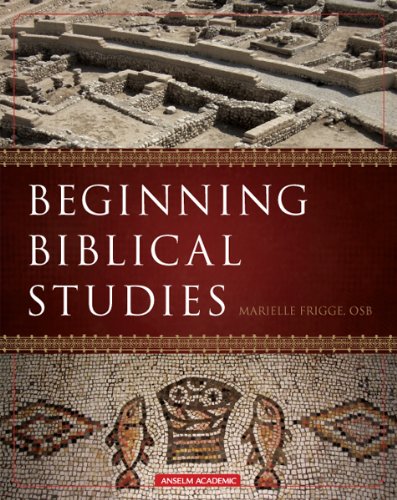
Beginning Biblical Studies
Authors:
OSB Marielle Frigge
Publisher:
Anselm Academic
Publication Date:
Not available
ISBN:
1599820021
In this new text, students will find a readable, comprehensive, and engaging companion for use with a study Bible. Beginning Biblical Studies does not... assume familiarity with the contents or origins of the Bible, or the Bible's major events, characters, and themes. To further support beginning students, each major section begins with an overview followed later by a more detailed explanation, to gradually clarify complex ideas or developments. Keywords and concepts are listed at the beginning of each major section, then are reinforced throughout the text. Instructors may choose from a variety of Bible texts for use with this book. Several appendices in Beginning Biblical Studies provide students and teachers with additional material on particular topics such as biblical criticism, Israelite worship, literary forms in the prophetic books and the Gospels, important biblical terms and concepts, to name a few. Timelines and maps help to make ideas clear. Appropriate for all introductory Scripture courses and core introductory religion courses where theology and Scripture are covered together.
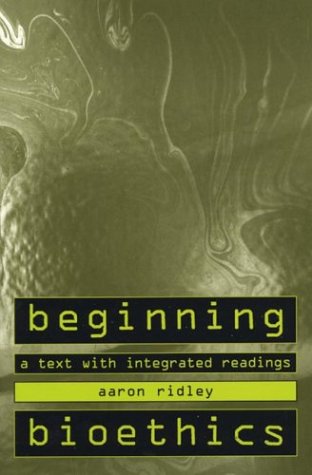
Beginning Bioethics: A Text with Integrated Readings
Authors:
Aaron Ridley
Publisher:
Bedford/St. Martin's
Publication Date:
Not available
ISBN:
0312132913
Beginning Bioethics: A Text with Integrated Readings gives students an introduction to the language of philosophical ethics before leading them through... six major issues in bioethics. The bioethics section not only includes Ridley’s clear explanations of all sides of a given issue, but also his analysis of a major, previously published article on that issue. It was written to accompany the third edition of Cases in Bioethics.
Beginning C# 2008 Objects: From Concept to Code (Expert's Voice in...
Authors:
Grant Palmer
Publisher:
Apress
Publication Date:
Not available
ISBN:
1430210885
Updated with the changes to C#, Beginning C# 2008 Objects: From Concepts to Code introduces complete beginners to C# coding practice with a solid... methodological foundation written by two critically–acclaimed experts in the field, already authors of the best–selling Beginning C# Objects. By building from first principles in object–oriented terminology, then advancing through application design with Unified Modeling Language (UML) into practical examples, Beginning C# 2008 Objects: From Concepts to Code provides a foundational guide written from the perspective of two experienced, working authorities on C#. Working coders will benefit from the object–oriented cast of the book and its section on use–case modeling. This is the book to read if you want to deepen and advance your existing professional development in C# with an eye towards advancing out of pure coding work. For the reader wishing to “simply learn C#”, this book will provide exactly that. In addition to listing code and syntax, Beginning C# 2008 Objects: From Concepts to Code also walks you through the design and architecting of a functioning C# application, showing the “why” and the “how” of the development decisions that go into professional C# coding.
Beginning Cantonese (Critical Languages Series)
Authors:
Dana Scott Bourgerie
Publisher:
University of Arizona Critical Languages Program
Publication Date:
Not available
ISBN:
1929986041
Despite the fact that they are spoken by millions of people, languages such as Korean or Turkish are not usually offered in schools or colleges. The... Critical Languages Program (CLP) at the University of Arizona was created to meet the need for interactive instruction in these less-commonly-taught languages. In order to meet the needs of a wide variety of learners who wish to gain proficiency in some of these languages, CLP has developed a series of CD-ROM courseware beginning with Brazilian Portuguese, Cantonese, Kazakh, Korean, Mandarin Chinese, and Turkish. CD-ROMs for other less-commonly-taught languages are planned for the future. Each package contains two CD-ROMs with a total of twenty lessons for the beginning learner, consisting of video dialogues and readings by native speakers, thousands of audio recordings, graphics, and extensive notes. Handy browser features enable users to go back and review words and pronunciations and to access five types of exercises: multiple choice, fill-in-the-blank, audio flashcard, pronunciation, and listening dictation. These exercises enable users to test and improve their knowledge of each lesson. Learners with microphone-equipped computers can record and play back their own voices and then compare their pronunciation with that of the native speaker. With the click of a button, learners can hear native speakers pronounce words or phrases, facilitating quick comprehension of these challenging languages. Each package of two CD-ROMs contains the equivalent of a textbook and workbook with audio and video components, making it practical for either self-instruction or directed educational, governmental, and business purposes.Works on Windows 2000/XP/Vista/7. For more information, visit the UA Critical Languages Web site at http://clp.arizona.edu/cls/
Beginning Cataloging
Authors:
Sheila S. Intner
Publisher:
Libraries Unlimited
Publication Date:
Not available
ISBN:
1591588391
In Beginning Cataloging, Jean Weihs and Sheila Intner offer a pragmatic approach that combines short instructional explanations with extensive examples... and exercises. The reader will learn how to apply standard descriptive cataloging rules to assign subject headings and classification numbers and to create electronic records. The book begins by examining the cataloging-in-publication data found on the verso of most books. Then, chapter-by-chapter, it explains how this data can be developed into a complete bibliographic record that can be used in an online public catalog.Covering all types of material formats, including books, audiovisuals, images, sound, electronic resources, and more, Beginning Cataloging conveys cataloging principles and practical methods for implementing them, empowering students with an understanding of the language of cataloging. Useful for library technicians and those working in areas where formal training is not accessible, the book can also be used as a workbook in formal education programs or distance education programs.
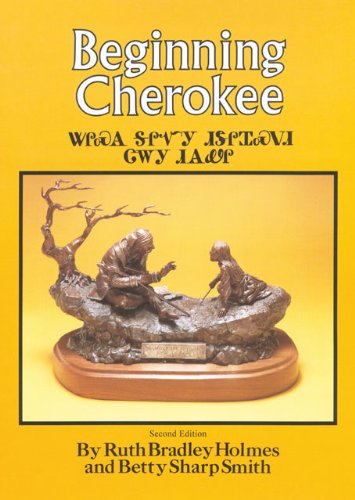
Beginning Cherokee
Authors:
Ruth Bradley Holmes
Publisher:
University of Oklahoma Press
Publication Date:
Not available
ISBN:
0806114630
This book, the first of its kind, teaches the rudiments of Cherokee, which is the native tongue of about 20,000 Americans, although most of those who... speak it use it only as a second language. Cherokee has had several recognized dialects in the past. The two main dialects today are the North Carolina, spoken on the Qualla Reservation by about 3,000 persons, and the Oklahoma, or Western, which is a consensus of the different ways of speech among the Cherokees mingled there after their removal from the East in the 1830’s. This book uses the Oklahoma dialect.Recent increased interest has created a demand for Amerindian language courses. Many Cherokees who ignored past opportunities to learn the language from their families are now regretting the loss. Parents who once believed that such knowledge would only be a disadvantage to their children have changed their minds. Youths who have now concluded that their ancestors had much to offer are anxious to investigate the language for themselves. Those who do not have time to spare for organized study would often like to have a convenient source book on the Cherokee language and its syllabary. Beginning Cherokee was written to fill these needs. It will help everyone who uses this book, whether Cherokee or not, to understand that Indian tribes are contemporary people with an enduring heritage. The Cherokee language frames an outlook and an intellect that can contribute much to civilization in the future, as it has in the past.

BEGINNING CHEROKEE 3 CD SET
Authors:
Not Available
Publisher:
Not available
Publication Date:
Not available
ISBN:
Not available
BEGINNING CHINESE 2 (2010)
Authors:
Not Available
Publisher:
Not available
Publication Date:
Not available
ISBN:
Not available
BEGINNING CHINESE BOOK 1 UPDATED ED
Authors:
Not Available
Publisher:
Not available
Publication Date:
Not available
ISBN:
Not available
BEGINNING CHORAL CONDUCTING RESOURCE+WK
Authors:
Not Available
Publisher:
Not available
Publication Date:
Not available
ISBN:
Not available
Beginning Classroom Guitar: A Musician's Approach (with CD-ROM)
Authors:
Philip Hemmo
Publisher:
Schirmer
Publication Date:
Not available
ISBN:
0534174329
Ideal for any teaching setting, this text includes all the information and instruction a novice student needs to successfully learn to play the guitar.... Drawing on his own experiences as a musician and instructor, the author capably guides student and teacher from the very first encounter with a time signature, through learning finger placement, playing chords and reading compound meter.
Beginning Creek: Mvskoke Emponvkv
Authors:
Pamela Innes
Publisher:
University of Oklahoma Press
Publication Date:
Not available
ISBN:
0806135832
Beginning Creek provides a basic introduction to the language and culture of the Mvskoke-speaking peoples, Muskogee (Creek) and Seminole Indians.... Written by linguistic anthropologist Pamela Innes and native speakers Linda Alexander and Bertha Tilkens, the text is accessible to general readers and students and is accompanied by two compact discs.The volume begins with an introduction to Creek history and language, and then each chapter introduces readers to a new grammatical feature, vocabulary set, and series of conversational sentences. Translation exercises from English to Mvskoke and Mvskoke to English reinforce new words and concepts. The chapters conclude with brief essays by Linda Alexander and Bertha Tilkens on Creek culture and history and suggestions for further reading.The two audio CDs present examples of ceremonial speech, songs, and storytelling and include pronunciations of Mvskoke language keyed to exercises and vocabulary lists in the book. The combination of recorded and written material gives students a chance to learn and practice Mvskoke as an oral and written language.Although Mvskoke speakers include the Muskogee (Creek) and Seminole Nations of Oklahoma, the Poarche Band of Creek Indians in Alabama, and some Florida Seminoles, the number of native speakers of Mvskoke has declined. Because the authors believe that language and culture are inextricably linked, they have combined their years of experience speaking and teaching Mvskoke to design an introductory textbook to help Creek speakers preserve their traditional language and way of life.
Beginning C++ Through Game Programming
Authors:
Michael Dawson
Publisher:
Course Technology PTR
Publication Date:
Not available
ISBN:
1435457420
BEGINNING C++ THROUGH GAME PROGRAMMING, THIRD EDITION approaches learning C++ from the unique and fun perspective of games. Written for the beginning... game developer or programmer, the book assumes no previous programming experience and each new skill and concept is taught using simple language and step-by-step instructions. Readers will complete small projects in each chapter to reinforce what they've learned and a final project at the end combines all of the major topics covered in the book. Featuring twenty five percent new material, this third edition covers all the latest technology and advances.
Beginning Dakota/Tokaheya Dakota Iyapi Kin: 24 Language and Grammar...
Authors:
Nicolette Knudson
Publisher:
Minnesota Historical Society Press
Publication Date:
Not available
ISBN:
0873517806
Members and descendants of the Sisseton Wahpeton Dakota Oyate, a division of the Great Sioux Nation, live east of the Missouri River, mostly in North... and South Dakota, and speak the Dakota dialect. As the population of native speakers ages, younger generations breathe new life into study of the language. In college courses, community education classes, and study teams, learners of all ages practice speaking and writing at the same time that they come to understand the storied history of this significant Native American group.Nicolette Knudson and Jody Snow, students of the language, along with Dakota instructor and revered elder Clifford Canku share their expertise through activities that organize the language at its most basic level. Twenty-four lesson plans build on each other and use cultural and historical information to increase understanding of the Dakota language and world view. Exercises offer opportunities to practice writing and speaking, increasing vocabulary and introducing grammatical building blocks that enhance comprehension. Glossaries provide translations from Dakota to English and back again. With these features and more, Beginning Dakota is an invaluable tool for speakers of all levels.Clifford Canku, an elder of the Sisseton Wahpeton Dakota Oyate and chair of the Dakota Studies department at NDSU, assisted Dakota language students Nicolette Knudson, also a member of the Sisseton Wahpeton Oyate, and Jody Snow, a language instructor, in creating this helpful resource.
Beginning Database Design Solutions (Wrox Programmer to Programmer)
Authors:
Rod Stephens
Publisher:
Wrox
Publication Date:
Not available
ISBN:
0470385499
This book is intended for IT professionals and students who want to learn how to design, analyze, and understand databases. The material will benefit... those who want a better high-level understanding of databases such as proposal managers, architects, project managers, and even customers. The material will also benefit those who will actually design, build, and work with databases such as database designers, database administrators, and programmers. In many projects, these roles overlap so the same person may be responsible for working on the proposal, managing part of the project, and designing and creating the database.This book is aimed at IT professionals and students of all experience levels. It does not assume that you have any previous experience with databases or programs that use them. It doesn’t even assume that you have experience with computers. All you really need is a willingness and desire to learn.This book explains database design. It tells how to plan a database’s structure so the database will be robust, resistant to errors, and flexible enough to accommodate a reasonable amount of future change. It explains how to discover database requirements, build data models to study data needs, and refine those models to improve the database’s effectiveness.The book solidifies these concepts by working through a detailed example that designs a realistic database. Later chapters explain how to actually build databases using two common database products: Access 2007 and MySQL.The book finishes by describing some of the topics you need to understand to keep a database running effectively such as database maintenance and security.This book explains database design. It tells how to determine what should go in a database and how the database should be structured to give the best results.This book does not focus on actually creating the database. The details of database construction are different for different database tools so, to remain as generally as useful as possible, this book doesn’t concentrate on any particular database system. You can apply the techniques described here equally to whatever database tool you use whether it’s Access, SQL Server, Oracle, MySQL, or some other database product.Most database products include free editions that you can use for smaller projects. For example, SQL Server Express Edition, Oracle Express Edition, and MySQL Community Server are all free.To remain database neutral, the book does not assume you are using a particular database so you don’t need any particular software or hardware. To work through the Exercises, all you really need is a pencil and some paper. You are welcome to type solutions into your computer if you like but you may actually find working with pencil and paper easier than using a graphical design tool to draw pictures, at least until you are comfortable with database design and are ready to pick a computerized design tool.“Goals of Effective Database Design,” explains the reasons why people and organizations use databases. It explains a database’s purpose and conditions that it must satisfy to be useful. This also describes the basic ACID (Atomicity, Consistency, Isolation, Durability) and CRUD (Create, Read, Update, Delete) features that any good database should have. It explains in high-level general terms what makes a good database and what makes a bad database.“Database Types,” explains some of the different types of databases that you might decide to use. These include flat files, spreadsheets, hierarchical databases (XML), object databases, and relational databases. The relational database is one of the most powerful and most commonly used forms of database so it is the focus of this book, but it is important to realize that there are alternatives that may be more appropriate under certain circumstances. This gives some tips on deciding which kind of database might be best for a particular project.“Relational Database Fundamentals,” explains basic relational database concepts such as tables, rows, and columns. It explains the common usage of relational database terms in addition to the more technical terms that are sometimes used by database theorists. It describes different kinds of constraints that databases use to guarantee that the data is stored safely and consistently.“Understanding User Needs,” explains how to learn about the users’ needs and gather user requirements. It tells how to study the users’ current operations, existing databases (if any), and desired improvements. It describes common questions that you can ask to learn about users’ operations, desires, and needs, and how to build the results into requirements documents and specifications. This explains what use cases are and tells how to use them and the requirements to guide database design and to measure success.“Translating User Needs into Data Models,” introduces data modeling. It explains how to translate the user’s conceptual model and the requirements into other more precise models that define the database design rigorously. This describes several database modeling techniques including user-interface models, semantic object models, entity-relationship diagrams, and relational models.“Extracting Business Rules,” explains how a database can handle business rules. It explains what business rules are, how they differ from database structure requirements, and how you can identify business rules. This explains the benefits of separating business rules from the database structure and tells how achieve that separation.“Normalizing Data,” explains one of the biggest tools in database design: normalization. Normalization techniques allow you to restructure a database to increase its flexibility and make it more robust. This explains the various forms of normalization, emphasizing the stages that are most common and important: first, second, and third normal forms (1NF, 2NF, and 3NF). It explains how each of these kinds of normalization helps prevent errors and tells why it is sometimes better to leave a database slightly less normalized to improve performance.“Designing Databases to Support Software Applications,” explains how databases fit into the larger context of application design and lifecycle. This explains how later development depends on the underlying database design. It discusses multi-tier architectures that can help decouple the application and database design so there can be at least some changes to either without requiring changes to the other.“Common Design Patterns,” explains some common patterns that are useful in many applications. Some of these techniques include implementing various kinds of relationships among objects, storing hierarchical and network data, recording temporal data, and logging and locking.“Common Design Pitfalls,” explains some common design mistakes that occur in database development. It describes problems that can arise from insufficient planning, incorrect normalization, and obsession with ID fields and performance.“User Needs and Requirements,” walks through the steps required to analyze the users’ problem, define requirements, and create use cases. It describes interviews with fictitious customers that are used to identify the application’s needs and translate them into database requirements.“Building a Data Model,” translates the requirements gathered in the previous into a series of data models that precisely define the database’s structure. This builds user-interface models, entity-relationship diagrams, semantic object models, and relational models to refine the database’s initial design. The final relational models match the structure of a relational database fairly closely so they are easy to implement.“Extracting Business Rules,” identifies the business rules embedded in the relational model. It shows how to extract those rules in order to separate them logically from the database’s structure. This makes the database more robust in the face of future changes to the business rules.“Normalization and Refinement,” refines the relational model by normalizing it. It walks through several versions of the database that are in different normal forms. It then selects the degree of normalization that provides a reasonable tradeoff between robust design and acceptable performance.“Microsoft Access,” explains how to build a database with Microsoft Access 2007. This explains enough to get started and to use Access to build non-trivial databases. You can use other versions of Access to work through this, although the locations of menus, buttons, and other Access features are different in different versions.“MySQL,” explains how to build a database with MySQL. This tells where to download a free version of MySQL. It explains how to use the MySQL Command Line Client as well as some useful graphical tools including MySQL Query Browser and MySQL Workbench.“Introduction to SQL,” provides an introduction to SQL (Structured Query Language). It explains how to use SQL commands to add, insert, update, and delete data. By using SQL, you can help insulate a program from the idiosyncrasies of the particular database product that it uses to store data.“Building Databases with SQL Scripts,” explains how to use SQL scripts to build a database. It explains the advantages of this technique, such as the ability to create scripts to initialize a database before performing tests. It also explains some of the restrictions on this method, such as the fact that the user must create and delete tables in specific orders to satisfy table relationships.“Database Maintenance,” describes some of the database maintenance issues that are part of any database application. Though performing and restoring ba...
 '
'