production
/viewbook/list/all/?page=1801
/
/static/
None

BUILDING CLASS DISCIPLINE+WETSKA PKG
Authors:
Not Available
Publisher:
Not available
Publication Date:
Not available
ISBN:
Not available
Building Classroom Community: The Early Childhood Teacher's Role
Authors:
Jeannette G. Stone
Publisher:
Natl Assn for the Education
Publication Date:
Not available
ISBN:
0935989986
Building Classroom Discipline (10th Edition)
Authors:
C. M. Charles
Publisher:
Pearson
Publication Date:
Not available
ISBN:
0137034059
The leading text in the field, this book analyzes the contributions of the leading authorities in discipline to show how their theories and systems can... be used by teachers to create structures of positive discipline. The text analyzes 18 models of school discipline developed by educational thinkers over the past 60 years and shows how they can be applied in realistic situations. A unique contribution of the text is that the present-day theorists listed also coordinate with Professor Charles to ensure accuracy in the presentation of their models. Teachers are motivated to create a structure of positive discipline based on the most effective elements from traditional and current disciplinary approaches.
Building Classroom Discipline (9th Edition)
Authors:
C. M. Charles
Publisher:
Allyn & Bacon
Publication Date:
Not available
ISBN:
0205510728
The leading text in the field, this book analyzes the contributions of the leading authorities in discipline to show how their theories and systems can... be used by teachers to create structures of positive discipline. The text analyzes 18 models of school discipline developed by educational thinkers over the past 60 years and shows how they can be applied in realistic situations. A unique contribution of the text is that the present-day theorists listed also coordinate with Professor Charles to ensure accuracy in the presentation of their models. Teachers are motivated to create a structure of positive discipline based on the most effective elements from traditional and current disciplinary approaches.
Building Classroom Discipline (with MyEducationLab) (10th Edition)
Authors:
C. M. Charles
Publisher:
Pearson
Publication Date:
Not available
ISBN:
013138113X
The leading text in the field, this book analyzes the contributions of the leading authorities in discipline to show how their theories and systems can... be used by teachers to create structures of positive discipline. The text analyzes 18 models of school discipline developed by educational thinkers over the past 60 years and shows how they can be applied in realistic situations. A unique contribution of the text is that the present-day theorists listed also coordinate with Professor Charles to ensure accuracy in the presentation of their models. Teachers are motivated to create a structure of positive discipline based on the most effective elements from traditional and current disciplinary approaches.
Building Coalitions, Making Policy: The Politics of the Clinton,...
Authors:
Not Available
Publisher:
The Johns Hopkins University Press
Publication Date:
Not available
ISBN:
1421405083
In an age when partisan politics has reached a deafening—and arguably impotent—pitch, how does the real work of politics get done? This book opens... the door on backroom politics and gives readers an insider’s perspective on the efforts of policymakers from three presidential administrations to get past the naysayers and effect real and lasting policy changes.The editors take a comparative approach, offering a thorough overview of policymaking during the Clinton and George W. Bush administrations, with further discussion of President Obama’s successful and failed attempts to build coalitions and get past no. The contributors, a national network of prominent political scientists, reveal the sausage-making of politics and policy. Readers can almost see the political players in the proverbial smoke-filled room, shirtsleeves rolled up and BlackBerrys in hand, developing the strategies and hammering out the compromises designed to hold the party base while winning over independent voters. Combining an insider’s perspective with actual case studies, the volume examines the policymaking behind such programs as• No Child Left Behind• tax cuts• Social Security privatization• Medicare prescription drug reform• education and immigration reform• environmental policy• judicial politics• national securityCovering all major areas of policymaking, Building Coalitions, Making Policy gives instructors in political science, public administration and policy, American government, and American presidential studies plenty of provocative examples for classroom debate.
Building Code Basics: Residential: Based on 2009 International...
Authors:
International Code Council
Publisher:
Delmar Cengage Learning
Publication Date:
Not available
ISBN:
1435400631
The first book of its kind to hit the market, BUILDING CODE BASICS: RESIDENTIAL, BASED ON THE 2009 INTERNATIONAL RESIDENTIAL CODE departs from... traditional code books by using non-code language, detailed illustrations, and an emphasis on practical information to give readers a solid, working knowledge of critical code applications. Part of Building Code Basics, a series dedicated to providing high-quality, technically accurate, simplified code texts for anyone seeking greater understanding of the workings of the I-Codes; this installment focuses on the basics of the residential code. Topic coverage follows the logical order of construction, beginning with site work and foundations, and ending with fire- and life-safety and the environmental requirements of a finished building. These code requirements are introduced using non-intimidating language and an easy-to-understand writing style, facilitating learning and comprehension. Code references are also included, and when paired with these practical explanations, they are a valuable addition to the book's resources, making this an ideal tool for students of construction technology or anyone considering a career in the design, construction, or inspection of residential buildings. Check out our app, DEWALT Mobile Pro™. This free app is a construction calculator with integrated reference materials and access to hundreds of additional calculations as add-ons. To learn more, visit dewalt.com/mobilepro.
Building Code of New York State, 2010 Edition
Authors:
International Code Council
Publisher:
Saturn Resource Management
Publication Date:
Not available
ISBN:
1609830008
A fully integrated custom code based on the 2006 International Building Code. The scope of this code covers all buildings except three-story one- and... two-family dwellings and townhomes.
Building Code Requirements and Specification for Masonry Structures...
Authors:
The Masonry Society
Publisher:
Joint publication of The Masonry Society
Publication Date:
Not available
ISBN:
1929081367
The 2011 edition of Building Code Requirements and Specification for Masonry Structures covers the design and construction of masonry structures. As a... Standard, it is written in such form that it may be adopted by reference in a legally adopted building code. Changes to this edition include a recalibration of allowable stresses, the addition of provisions for infill masonry, and a refinement of the quality assurance/special inspection provisions for masonry that includes references to relevant requirements for each inspection task. Topics include: definitions, contract documents, quality assurance, materials, placement of embedded items, analysis and design, strength and serviceability, flexural and axial loads, shear, details and development of reinforcement, walls, columns, pilasters, beams and lintels, seismic design requirements, glass unit masonry, and veneers. An empirical design method applicable to buildings meeting specific location and construction criteria are also included. This Standard is an essential reference for structural engineers, contractors, and inspection officials working on masonry structures.
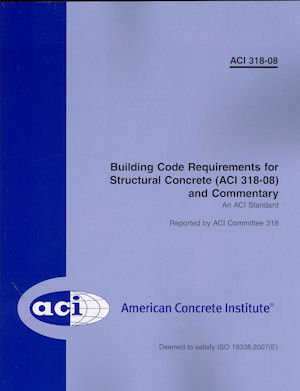
Building Code Requirements for Structural Concrete and Commentary...
Authors:
Committee 318
Publisher:
ACI
Publication Date:
Not available
ISBN:
0870312642
Abstract: The "Building Code Requirements for Structural Concrete" ("Code") covers the materials, design, and construction of structural concrete used... in buildings and where applicable in nonbuilding structures. The Code also covers the strength evaluation of existing concrete structures. Among the subjects covered are: drawings and specifications; inspection; materials; durability requirements; concrete quality, mixing, and placing; formwork; embedded pipes; construction joints; reinforcement details; analysis and design; strength and serviceability; flexural and axial loads; shear and torsion; development and splices of reinforcement; slab systems; walls; footings; precast concrete; composite flexural members; prestressed concrete; shells and folded plate members; strength evaluation of existing structures; provisions for seismic design; structural plain concrete; strut-and-tie modeling in Appendix A; alternative design provisions in Appendix B; alternative load and strength reduction factors in Appendix C; and anchoring to concrete in Appendix D. The quality and testing of materials used in construction are covered by reference to the appropriate ASTM standard specifications. Welding of reinforcement is covered by reference to the appropriate AWS standard. Uses of the Code include adoption by reference in general building codes, and earlier editions have been widely used in this manner. The Code is written in a format that allows such reference without change to its language. Therefore, background details or suggestions for carrying out the requirements or intent of the Code portion cannot be included. The Commentary is provided for this purpose. Some of the considerations of the committee in developing the Code portion are discussed within the Commentary, with emphasis given to the explanation of new or revised provisions.
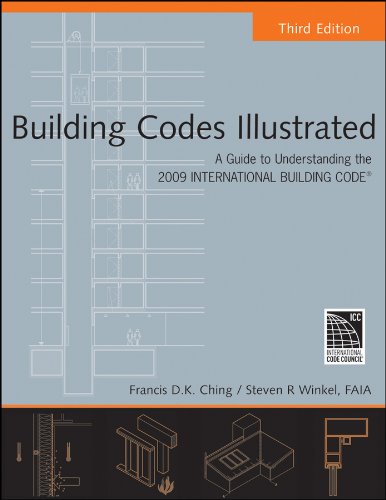
Building Codes Illustrated: A Guide to Understanding the 2009...
Authors:
Francis D. K. Ching
Publisher:
Wiley
Publication Date:
Not available
ISBN:
0470191430
An easy-to-use, illustrated guide to the 2009 edition of the International Building CodeAs the U.S. building industry adapts the international... standards, architects and other building professionals need a clear, practical guide to the International Building Code. Marrying the graphic skills of bestselling author Frank Ching with the code expertise of Steven Winkel, FAIA, this invaluable reference provides an easy-to-understand interpretation in both words and illustrations of the portions of the building code that are most relevant for the architect. Highlighting major changes between the new code and previous model building codes, this book will help architects understand how this code change will affect their practice.Provides a visually-oriented guide to the 2009 International Building CodeUses illustrations and concise explanations to hone the building codes down to the fundamentals that most designers needIncludes reviews by the International Code Council (ICC) and follows the ICC's 2009 International Building CodeDrawings by Frank D.K. Ching (Seattle, WA), Professor Emeritus of Architecture at the University of Washington, is world-renowned for his numerous architecture and design books, including Architecture: Form, Space, and Order; A Global History of Architecture; Interior Design Illustrated; Building Codes Illustrated; and Building Construction Illustrated, all from WileyCommentary written by nationally-recognized building codes expert Steven Winkel, the Architect member of the California Building Standards Commission, a past national board member of The American Institute of Architects (AIA), and past president of the AIA California CouncilWinkel is also co-author of Building Codes Illustrated for Elementary and Secondary Schools, Building Codes Illustrated for Healthcare Facilities, and Residential Building Codes Illustrated
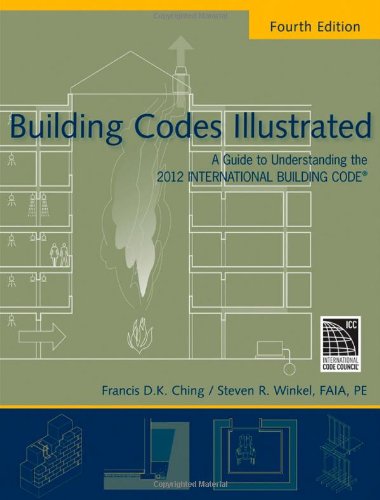
Building Codes Illustrated: A Guide to Understanding the 2012...
Authors:
Francis D. K. Ching
Publisher:
Wiley
Publication Date:
Not available
ISBN:
0470903570
An easy-to-use, updated illustrated guide to the 2012 edition of the International Building CodeThis unique reference to the 2012 International Building... Code marries the graphic skills of bestselling author Frank Ching with the code expertise of Steven Winkel, FAIA. It pulls out the portions of the building code that are most relevant for the architect and provides an easy-to-understand interpretation in both words and illustrations. Rather than a text-heavy book, this is much more conducive to quick comprehension of the code, presenting information in an exciting user-friendly visual format.
Building Communication Theory
Authors:
Dominic A. Infante
Publisher:
Waveland Pr Inc
Publication Date:
Not available
ISBN:
1577662709
As a long-standing definitive work in the field, Building Communication Theory has given introductory readers a solid foundation in the essentials of... communication theory. Infante, Rancer, and Womack have been praised for their clear and comprehensive presentation of various approaches to understanding human communication and the major theories within the structure of each approach. The Fourth Edition maintains these strengths. Complex material is presented in clear, user-friendly prose. In addition, the volume is grounded with compelling and realistic examples that engage the uninitiated and help them see the connection between theory and practical applications. Readers gain an appreciation of the importance of communication, the value and applicability of its teachings, and the richness of its philosophy.
Building Communities from the Inside Out: A Path Toward Finding and...
Authors:
John P. Kretzmann
Publisher:
ACTA Publications
Publication Date:
Not available
ISBN:
087946108X
This guide summarizes lessons learned by studying successful community-building initiatives in hundreds of neighborhoods across the U.S. It outlines... what local communities can do to start their own journies down the path of asset-based development.
Building Communities, Not Audiences: The Future of the Arts in the...
Authors:
Doug Borwick
Publisher:
ArtsEngaged
Publication Date:
Not available
ISBN:
0972780416
Building Communities, Not Audiences: The Future of the Arts in the U.S , written and edited by Doug Borwick, holds that established arts organizations,... for practical and moral reasons, need to be more deeply connected to their communities. It serves as an essential primer for any member of the arts community–artist, administrator, board member, patron, or friend–who is interested in the future of the arts in the U.S. It also provides new ways of looking at the arts as a powerful force for building better communities and improving lives. “It is from community that the arts developed and it is in serving communities that the arts will thrive . . . Communities do not exist to serve the arts; the arts exist to serve communities.” Building Communities, Not Audiences identifies the factors that serve to isolate established arts organizations from their communities, points out the trends that loom as imminent threats to the long-term viability of the artistic status quo, and presents principles and mechanisms whereby arts organizations can significantly extend their reach into the community, supporting enhanced sustainability. Included are case studies and examples of successful community engagement work being conducted by arts organizations from around the U.S. Twenty-three contributors, representing chamber music, dance, museums, opera, orchestras, and theatre as well as an array of arts administration perspectives provide breadth of coverage. “The economic, social, and political environments out of which the infrastructure for Western ‘high arts’ grew have changed. Today’s major arts institutions, products of that legacy, no longer benefit from relatively inexpensive labor, a nominally homogeneous culture, or a polity openly managed by an elite class. Expenses are rising precipitously and competition for major donors is increasing; as a result, the survival of established arts organizations hinges on their ability to engage effectively with a far broader segment of the population than has been true to date.” -------------------------- From the Foreword by Rocco Landesman, Chairman, National Endowment for the Arts: “I think the days of the arts in ivory towers are behind us; the very best arts organizations are . . . connecting communities with artists . . . . Not only can the arts build communities, I think we must.” From the Foreword by Robert L. Lynch, President & CEO, Americans for the Arts: “Doug Borwick calls for substantive rather than superficial efforts, authentic and systemic changes. . . . The challenge is not whether to build communities or audiences but how to build communities and audiences together.” -------------------------- Contributors: Barbara Schaffer Bacon: Co-Director, Animating Democracy Sandra Bernhard: Director/HGOco, Houston Grand Opera Susan Badger Booth: Professor, Eastern Michigan University Tom Borrup: Principal, Creative Community Builders Ben Cameron: Program Director for the Arts, Doris Duke Charitable Foundation William Cleveland: Director, Center for the Study of Art and Community Lyz Crane: Community Development Consultant David Dombrosky: CMO/InstantEncore Maryo Gard Ewell: Community Arts Consultant Tom Finkelpearl: Executive Director, Queens Museum of Art Pam Korza: Co-Director, Animating Democracy Denise Kulawik: Principal, Oneiros, LLC Helen Lessick: Artist, Civic Art Advocate Dorothy Gunther Pugh: Founder & Artistic Director, Ballet Memphis Stephanie Moore: Arts and Culture Researcher Diane Ragsdale: Cultural Critic, Speaker, Writer Noel Raymond: Co-Director, Pillsbury House Theatre, St. Paul, MN Preranna Reddy: Director-Public Events, Queens Museum of Art Sebastian Ruth: Founder/Artistic Director, Community MusicWorks, Providence, RI Russell Willis Taylor: President & CEO, National Arts Strategies James Undercofler: Professor, Drexel University; former President/CEO, Philadelphia Orchestra Roseann Weiss: Director, CAT Institute, Regional Arts Commission, St. Louis, MO
 '
'