production
/viewbook/list/all/?page=1996
/
/static/
None

Capitalism and Modernity: An Excursus on Marx and Weber
Authors:
Derek Sayer
Publisher:
Routledge
Publication Date:
Not available
ISBN:
0415017289
The nature of modernity, and its connection with capitalism, are questions at the forefront of contemporary sociological debate. Derek Sayer... re-examines the answers given by Karl Marx and Max Weber, authors of two of the most profound sociological critiques of modernity. His reassessment of Marx and Weber on capitalism and modernity provides a new reading which reveals the remarkable consonances between their sociologies of the modern condition. Going beyond the well-known stereotypes of the Marx-Weber debate', Professor Sayer shows that both Marx and Weber produced a challenging critique of the nature of power and subjectivity in modern society, a critique which retains all its intellectual force and moral relevance today.
Capitalism and Modernity: The Great Debate
Authors:
Jack Goody
Publisher:
Polity
Publication Date:
Not available
ISBN:
0745631916
This important new book investigates how the West attained its current position of economic and social advantage. In an incisive historical analysis,... Jack Goody examines when and why Europe (and Anglo-America) started to outstrip all other continents in socio-economic growth. Drawing on non-Western examples of economic and technical progress, Goody challenges assumptions about long-term European supremacy of a 'cultural' kind, as was a feature of many theories current in social science. He argues that the divergence came with the Industrial Revolution and that the earlier bourgeois revolution of the sixteenth century was but one among many Eurasia-wide expressions of developing mercantile and manufacturing activity. This original book casts new light on the history of capitalism, industrialization and modernity, and will be essential reading for all those interested in the great debate about the economic rise of the West.

Capitalism and Modern Social Theory: An Analysis of the Writings of...
Authors:
Anthony Giddens
Publisher:
Cambridge University Press
Publication Date:
Not available
ISBN:
0521097851
Giddens's analysis of the writings of Marx, Durkheim and Weber has become the classic text for any student seeking to understand the three thinkers who... established the basic framework of contemporary sociology. The first three sections of the book, based on close textual examination of the original sources, contain separate treatments of each writer. The author demonstrates the internal coherence of their respective contributions to social theory. The concluding section discusses the principal ways in which Marx can be compared with the other two authors, and discusses misconceptions of some conventional views on the subject.

Capitalism and Slavery
Authors:
Eric Williams
Publisher:
The University of North Carolina Press
Publication Date:
Not available
ISBN:
0807844888
Slavery helped finance the Industrial Revolution in England. Plantation owners, shipbuilders, and merchants connected with the slave trade accumulated... vast fortunes that established banks and heavy industry in Europe and expanded the reach of capitalism worldwide.Eric Williams advanced these powerful ideas in Capitalism and Slavery, published in 1944. Years ahead of its time, his profound critique became the foundation for studies of imperialism and economic development. Binding an economic view of history with strong moral argument, Williams's study of the role of slavery in financing the Industrial Revolution refuted traditional ideas of economic and moral progress and firmly established the centrality of the African slave trade in European economic development. He also showed that mature industrial capitalism in turn helped destroy the slave system. Establishing the exploitation of commercial capitalism and its link to racial attitudes, Williams employed a historicist vision that set the tone for future studies. In a new introduction, Colin Palmer assesses the lasting impact of Williams's groundbreaking work and analyzes the heated scholarly debates it generated when it first appeared.

Capitalism and the Historians
Authors:
Not Available
Publisher:
University Of Chicago Press
Publication Date:
Not available
ISBN:
0226320723
The views generally held about the rise of the factory system in Britain derive from highly distorted accounts of the social consequences of that... system—so say the distinguished economic historians whose papers make up this book. The authors offer documentary evidence to support their conclusion that under capitalism the workers, despite long hours and other hardships of factory life, were better off financially, had more opportunities, and led a better life than had been the case before the Industrial Revolution.

Capitalism and the Jews
Authors:
Jerry Z. Muller
Publisher:
Princeton University Press
Publication Date:
Not available
ISBN:
069115306X
The unique historical relationship between capitalism and the Jews is crucial to understanding modern European and Jewish history. But the subject has... been addressed less often by mainstream historians than by anti-Semites or apologists. In this book Jerry Muller, a leading historian of capitalism, separates myth from reality to explain why the Jewish experience with capitalism has been so important and complex--and so ambivalent. Drawing on economic, social, political, and intellectual history from medieval Europe through contemporary America and Israel, Capitalism and the Jews examines the ways in which thinking about capitalism and thinking about the Jews have gone hand in hand in European thought, and why anticapitalism and anti-Semitism have frequently been linked. The book explains why Jews have tended to be disproportionately successful in capitalist societies, but also why Jews have numbered among the fiercest anticapitalists and Communists. The book shows how the ancient idea that money was unproductive led from the stigmatization of usury and the Jews to the stigmatization of finance and, ultimately, in Marxism, the stigmatization of capitalism itself. Finally, the book traces how the traditional status of the Jews as a diasporic merchant minority both encouraged their economic success and made them particularly vulnerable to the ethnic nationalism of the nineteenth and twentieth centuries. Providing a fresh look at an important but frequently misunderstood subject, Capitalism and the Jews will interest anyone who wants to understand the Jewish role in the development of capitalism, the role of capitalism in the modern fate of the Jews, or the ways in which the story of capitalism and the Jews has affected the history of Europe and beyond, from the medieval period to our own.

Capitalism: An Ethnographic Approach (Explorations in Anthropology)
Authors:
Daniel Miller
Publisher:
Berg Publishers
Publication Date:
Not available
ISBN:
1859731287
This provocative book challenges many of our ingrained assumptions about the direction of contemporary capitalism and offers fresh perspectives that... will inform the development of a new and relevant political economy for our times. The complex and often contradictory world within which modern commodities are produced, sold and consumed is set within the larger context of transnational business and economic developments. The importance of factors such as profitability and globalization is highlighted, and a sophisticated analysis of the contradictions and ironies of the world of modern commodities emerges. Trinidad provides an ideal setting for this study, given its recent oil boom and recession and the subsequent experience of both wealth and poverty.
Capitalism at the Crossroads: Aligning Business, Earth, and...
Authors:
Stuart L. Hart
Publisher:
Wharton School Publishing
Publication Date:
Not available
ISBN:
0136134394
"Capitalism at the Crossroads is built on strong theoretical underpinnings and illustrated with many practical examples. The author offers a pioneering... roadmap to responsible macroeconomics and corporate growth."-Clayton Christensen, Professor of Business Administration, Harvard Business School and author of The Innovator's Dilemma"I hope this book will be able to influence the thought processes of corporations and motivate them to adapt to forthcoming business realities for the sake of their own long-term existence. Besides business leaders, this is a thought-provoking book for the readers who are looking for solutions to capitalism’s problems."-Muhammad Yunus, Founder and Managing Director, Grameen Bank, Bangladesh and 2007 Nobel Peace Prize recipient"Capitalism at the Crossroads is a practical manifesto for business in the twenty-first century. Professor Stuart L. Hart provides a succinct framework for managers to harmonize concerns for the planet with wealth creation and unambiguously demonstrates the connection between the two. This book represents a turning point in the debate about the emerging role and responsibility of business in society."-C.K. Prahalad, Ross School of Business, University of Michigan, co-author of Competing for the Future and author of The Fortune at the Bottom of the Pyramid"Stuart Hart was there at the beginning. Years ago when the term ‘sustainability’ had not yet reached the business schools, Stuart Hart stood as a beacon glowing in the umbrage. It is clear commerce is the engine of change, design the first signal of human intention, and global capitalism is at the crossroads. Stuart Hart is there again; this time lighting up the intersection."-William McDonough, University of Virginia, co-author of Cradle to Cradle"Professor Hart is on the leading edge of making sustainability an understandable and useful framework for building business value. This book brings together much of his insights developed over the past decade. Through case studies and practical advice, he argues powerfully that unlimited opportunities for profitable business growth will flow to those companies that bring innovative technology and solutions to bear on some of the world’s most intractable social and environmental problems."-Chad Holliday, Chairman and CEO, DuPont"Capitalism at the Crossroads clearly reveals the essence of what sustainability means to today’s business world. Hart’s analysis that businesses must increasingly adopt a business framework based on building sustainable value speaks to the entire sustainability movement’s relevance. Sustainability is more than today’s competitive edge; it is tomorrow’s model for success."-Don Pether, President and CEO, Dofasco Inc."Stuart Hart has written a book full of big insights painted with bold strokes. He may make you mad. He will certainly make you think."-Jonathan Lash, President, The World Resources Institute"A must-read for every CEO—and every MBA."-John Elkington, Chairman, SustainAbility"This book provides us with a vast array of innovative and practical ideas to accelerate the transformation to global sustainability and the role businesses and corporations will have to play therein. Stuart Hart manages to contribute in an essential way to the growing intellectual capital that addresses this topic. But, beyond that, the book will also prove to be a pioneer in the literature on corporate strategy by adding this new dimension to the current thinking."-Jan Oosterveld, Professor, IESE Business School, Barcelona, Spain Member, Group Management Committee (Ret.), Royal Philips Electronics"Capitalism at the Crossroads captures a disturbing and descriptive picture of the global condition. Dr. Hart constructs a compelling new corporate business model that simultaneously merges the metric of profitability along with societal value and environmental integrity. He challenges the corporate sector to take the lead and to invoke this change so that the benefits of capitalism can be shared with the entire human community worldwide."-Mac Bridger, CEO of Tandus Group"Stuart L. Hart makes a very important contribution to the understanding of how enterprise can help save the world’s environment. Crucial reading."-Hernando de Soto, President of The Institute for Liberty and Democracy and author of The Mystery of Capital"Stuart Hart’s insights into the business sense of sustainability come through compellingly in Capitalism at the Crossroads. Any businessperson interested in the long view will find resonance with his wise reasoning."-Ray Anderson, Founder and Chairman, Interface, Inc."This stimulating book documents the central role that business will play in humanity’s efforts to develop a sustainable global economy. Professor Hart presents an attractive vision of opportunity for those corporations that develop the new technologies, new business models, and new mental frames that are essential to a sustainable future."-Jeffrey Lehman, Former President of Cornell University"The people of the world are in desperate need of new ideas if global industrial development is ever to result in something other than the rich getting richer and the poor getting poorer, with nature (and potentially all of us) suffering the collateral damage. Few have contributed more to meeting this need over the past decade than Stuart Hart by helping to illuminate the potential role for business and new thinking in business strategy in the journey ahead. Capitalism at the Crossroads challenges, provokes, and no doubt will stimulate many debates—which is exactly what is needed."-Peter Senge, Massachusetts Institute of Technology, Chairperson of the Society for Organizational Learning, and author of The Fifth Discipline: The Art and Practice of The Learning OrganizationNew Foreword by Al GoreBrand-New Second Edition, Completely Revised with: Up-to-the-minute trends and lessons learnedNew and updated case studiesThe latest corporate responses to climate change, energy, and terrorism Global capitalism stands at a crossroads-facing terrorism, environmental destruction, and anti-globalization backlash. Today's global companies are at a crossroads, too-searching desperately for new sources of profitable growth. Stuart L. Hart's Capitalism at the Crossroads, Second Edition is about solving both of those problems at the same time.It's about igniting new growth by creating sustainable products that solve urgent societal problems. It's about using new technology to deliver profitable solutions that reduce poverty and protect the environment. It's about becoming truly indigenous to all your markets, and avoiding the pitfalls of first-generation "greening" and "sustainability" strategies.Hart has thoroughly revised this seminal book with new case studies, trends, and lessons learned-including the latest experiences of leaders like GE and Wal-Mart. You'll find new insights from the pioneering BoP Protocol initiative, in which multinationals are incubating new businesses in income-poor communities. You'll also discover creative new ways in which corporations are responding to global warming and terrorism. More than ever, this book points the way toward a capitalism that's more inclusive, more welcome, and far more successful-for both companies and communities, worldwide. Paths to profitable sustainability: Lessons from GE and Wal-MartShattering the "trade-off" mythNew commercial strategies for serving the "base of the pyramid"What enterprises have learned about doing business in income-poor regionsBecoming indigenous-for real, for goodCodiscovering new opportunities, cocreating new businesses with the poorLearning from leaders: 20+ new and updated case studiesBest practices from DuPont, HP, Unilever, SC Johnson, Tata, P&G, Cemex, and more About the Author xiiAcknowledgments xiiiForeword: Al Gore, Former Vice President of the U.S. xxivForeword: Fisk Johnson, Chairman and CEO, S.C. Johnson & Son, Inc. xxviiPrologue: Capitalism at the Crossroads xxxiPART ONE: MAPPING THE TERRAINChapter 1: From Obligation to Opportunity 3Chapter 2: Worlds in Collision 31Chapter 3: The Sustainable Value Portfolio 59PART TWO: BEYOND GREENINGChapter 4: Creative Destruction and Sustainability 87Chapter 5: The Great Leap Downward 111Chapter 6: Reaching the Base of the Pyramid 139 PART THREE: BECOMING INDIGENOUSChapter 7: Broadening the Corporate Bandwidth 169Chapter 8: Developing Native Capability 193Chapter 9: Toward a Sustainable Global Enterprise 223Epilogue 249Index 254
Capitalism at the Crossroads: Next Generation Business Strategies...
Authors:
Stuart L. Hart
Publisher:
Pearson Prentice Hall
Publication Date:
Not available
ISBN:
0137042329
Today’s era of economic crisis has sent a powerful message: The age of "mercenary" capitalism is ending. We must finally embark on a new age of... sustainable, stakeholder-based capitalism. While enlightened executives and policymakers understand the critical need for change, few have tangible plans for making it happen. In Capitalism at the Crossroads: Next Generation Business Strategies for a Post-Crisis World, Third Edition, Stuart L. Hart presents new strategies for identifying sustainable products, technologies, and business models that will drive urgently needed growth and help solve social and environmental problems at the same time. Drawing on his experience consulting with top companies and NGOs worldwide, Hart shows how to craft your optimal sustainability strategy and overcome the limitations of traditional "greening" approaches. In this edition, he presents new and updated case studies from the United States and around the world, demonstrating what’s working and what isn’t. He also guides business leaders in building an organizational "infrastructure for sustainability"--one that can survive budgeting and boardrooms, recharging innovation and growth throughout your enterprise. Discover: · The new business case for pursuing sustainable capitalism · Sustainability strategies that go far beyond environmental sensitivity · How to fully embed your enterprise in the local context--and why you should · Tactics for making long-term sustainability work in a short-term world

Capitalism: A Very Short Introduction
Authors:
James Fulcher
Publisher:
Oxford University Press
Publication Date:
Not available
ISBN:
0192802186
This Introduction explores the origins of capitalism and questions whether it did indeed originate in Europe. It examines a distinctive stage in the... development of capitalism that began in the 1980s, in order to understand where we are now and how capitalism has evolved since. The book discusses the crisis tendencies of capitalism--including the S.E. Asian banking crisis, the collapse of the Russian economy, and the 1997-1998 global financial crisis--asking whether capitalism is doomed to fail. In the end, the author ruminates on a possible alternative to capitalism, discussing socialism, communal and cooperative experiments, and alternatives proposed by environmentalists.About the Series: Combining authority with wit, accessibility, and style, Very Short Introductions offer an introduction to some of life's most interesting topics. Written by experts for the newcomer, they demonstrate the finest contemporary thinking about the central problems and issues in hundreds of key topics, from philosophy to Freud, quantum theory to Islam.
Capitalism, Democracy, and Ralph's Pretty Good Grocery.
Authors:
John Mueller
Publisher:
Princeton University Press
Publication Date:
Not available
ISBN:
0691090823
Democracy is overrated. Capitalism, on the other hand, doesn't get enough credit. In this provocative and engaging book, John Mueller argues that these... mismatches between image and reality create significant political and economic problems--inspiring instability, inefficiency, and widespread cynicism. We would be far better off, he writes, if we recognized that neither system is ideal or disastrous and accepted instead the humdrum truth that both are "pretty good." And, to Mueller, that means good enough. He declares that what is true of Garrison Keillor's fictional store "Ralph's Pretty Good Grocery" is also true of democracy and capitalism: if you can't get what you want there, "you can probably get along without it."Mueller begins by noting that capitalism is commonly thought to celebrate greed and to require discourtesy, deceit, and callousness. However, with examples that range from car dealerships and corporate boardrooms to the shop of an eighteenth-century silk merchant, Mueller shows that capitalism in fact tends to reward behavior that is honest, fair, civil, and compassionate. He argues that this gap between image and reality hampers economic development by encouraging people to behave dishonestly, unfairly, and discourteously to try to get ahead and to neglect the virtuous behavior that is an important source of efficiency and gain.The problem with democracy's image, by contrast, is that our expectations are too high. We are too often led by theorists, reformers, and romantics to believe that democracy should consist of egalitarianism and avid civic participation. In fact, democracy will always be chaotic, unequal, and marked by apathy. It offers reasonable freedom and security, but not political paradise. To idealize democracy, Mueller writes, is to undermine it, since the inevitable contrast with reality creates public cynicism and can hamper democracy's growth and development.Mueller presents these arguments with sophistication, wit, and erudition. He combines mastery of current political and economic literature with references to figures ranging from Plato to P. T. Barnum, from Immanuel Kant to Ronald Reagan, from Shakespeare to Frank Capra. Broad in scope and rich in detail, the book will provoke debate among economists, political scientists, and anyone interested in the problems (or non-problems) of modern democracy and capitalism.

Capitalisme et liberté
Authors:
Milton Friedman
Publisher:
LEDUC.S
Publication Date:
Not available
ISBN:
2848993693

Capitalism from Below: Markets and Institutional Change in China
Authors:
Victor Nee
Publisher:
Harvard University Press
Publication Date:
Not available
ISBN:
0674050207
Over 630 million Chinese escaped poverty since the 1980s, the largest decrease in poverty in history. Studying 700 manufacturing firms in the Yangzi... region, the authors argue that the engine of China’s economic miracle—private enterprise—did not originate at the top but bubbled up from below, overcoming initial obstacles set up by the government.

Capitalism, God, and a Good Cigar: Cuba Enters the Twenty-first...
Authors:
Lydia Chavez
Publisher:
Duke University Press Books
Publication Date:
Not available
ISBN:
0822334941
When the Soviet Union dissolved, so did the easy credit, cheap oil, and subsidies it had provided to Cuba. The bottom fell out of the Cuban economy, and... many expected that Castro’s revolution—the one that had inspired the Left throughout Latin America and elsewhere—would soon be gone as well. More than a decade later, the revolution lives on, albeit in a modified form. Following the collapse of Soviet communism, Castro legalized the dollar, opened the island to tourism, and allowed foreign investment, small-scale private enterprise, and remittances from exiles in Miami. Capitalism, God, and a Good Cigar describes what the changes implemented since the early 1990s have meant for ordinary Cubans: hotel workers, teachers, priests, factory workers, rap artists, writers, homemakers, and others.Based on reporting by journalists, writers, and documentary filmmakers since 2001, each of the essays collected here covers a particular dimension of contemporary Cuban society, revealing what it is like to have lived, for more than a decade, suspended between communism and capitalism. There are pieces on hip hop musicians, fiction writing and censorship, the state of ballet and the performing arts, and the role of computers and the Internet. Other essays address the shrinking yet still sizeable numbers of true believers in the promise of socialist revolution, the legendary cigar industry, the changing state of religion, the significance of the recent influx of money and people from Spain, and the tensions between recent Cuban emigrants and previous generations of exiles. Including more than seventy striking documentary photographs of Cuba’s people, countryside, and city streets, this richly illustrated collection offers keen, even-handed insights into the abundant ironies of life in Cuba today.Contributors. Juliana Barbassa, Ana Campoy, Mimi Chakarova, Lydia Chávez, John Coté, Julian Foley, Angel González, Megan Lardner, Ezequiel Minaya, Daniela Mohor, Archana Pyati, Alicia Roca, Olga R. Rodríguez, Bret Sigler, Annelise Wunderlich
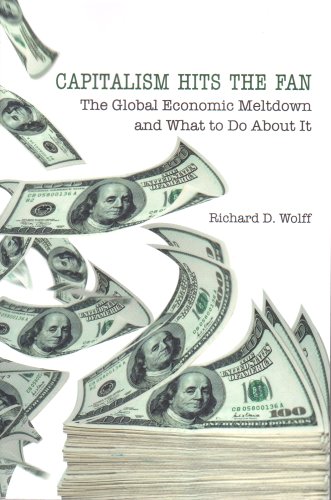
Capitalism Hits the Fan: The Global Economic Meltdown and What to...
Authors:
Richard Wolff
Publisher:
Olive Branch Pr
Publication Date:
Not available
ISBN:
156656784X
"With unerring coherence and unequaled breadth of knowledge, Rick Wolff offers a rich and much needed corrective to the views of mainstream economists... and pundits. It would be difficult to come away from this... with anything but an acute appreciation of what is needed to get us out of this mess." --Stanley Aronowitz, Distinguished Professor of Sociology and Urban Education, City University of New York Capitalism Hits the Fan chronicles one economist's growing alarm and insights as he watched, from 2005 onwards, the economic crisis build, burst, and then dominate world events. The argument here differs sharply from most other explanations offered by politicians, media commentators, and other academics. Step by step, Professor Wolff shows that deep economic structures--the relationship of wages to profits, of workers to boards of directors, and of debts to income--account for the crisis. The great change in the US economy since the 1970s, as employers stopped the historic rise in US workers' real wages, set in motion the events that eventually broke the world economy. The crisis resulted from the post-1970s profit explosion, the debt-driven finance-industry expansion, and the sequential stock market and real estate booms and busts. Bailout interventions by the Federal Reserve and the US Treasury have thrown too little money too late at a problem that requires more than money to solve. As this book shows, we must now ask basic questions about capitalism as a system that has now convulsed the world economy into two great depressions in 75 years (and countless lesser crises, recession, and cycles in between). The book's essays engage the long-overdue public discussion about basic structural changes and systemic alternatives needed not only to fix today's broken economy but to prevent future crises.
 '
'