production
/viewbook/list/all/?page=2073
/
/static/
None
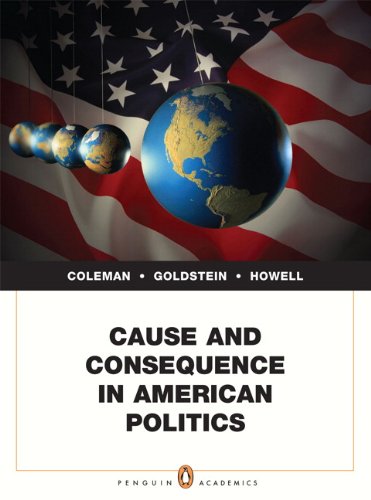
Cause and Consequence in American Politics (Penguin Academics)
Authors:
John J. Coleman
Publisher:
Pearson
Publication Date:
Not available
ISBN:
0205743625
Debuting it its first edition, Cause and Consequence in American Politics emphasizes and explores causal questions in American politics. This... best-selling author team writes with a clear, straightforward style brimming with rich, real-world examples. This text helps you to apply critical thinking tools—tools pulled directly from a social scientist’s playbook—to start answering those questions, see past today’s headlines, and understand why things really happen in our political world.
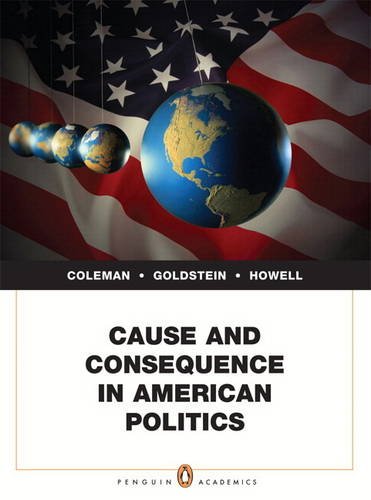
Cause and Consequence in American Politics Plus MyPoliSciLab with...
Authors:
John J. Coleman
Publisher:
Pearson
Publication Date:
Not available
ISBN:
0205249574
Debuting it its first edition, Cause and Consequence in American Politics emphasizes and explores causal questions in American politics. This... best-selling author team writes with a clear, straightforward style brimming with rich, real-world examples. This text helps you to apply critical thinking tools—tools pulled directly from a social scientist’s playbook—to start answering those questions, see past today’s headlines, and understand why things really happen in our political world.

CAUSE& CONSEQUENCE/CORE/YOU DECIDE PKG
Authors:
Not Available
Publisher:
Not available
Publication Date:
Not available
ISBN:
Not available
CAUSE+EFFECT W/AUDIO CDS (COLLEGE)
Authors:
Not Available
Publisher:
Not available
Publication Date:
Not available
ISBN:
Not available
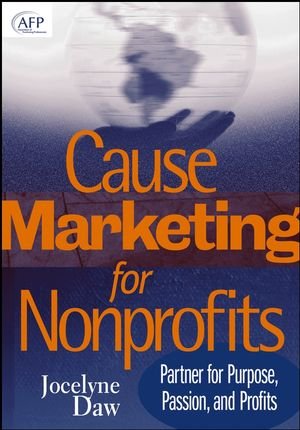
Cause Marketing for Nonprofits: Partner for Purpose, Passion, and...
Authors:
Jocelyne Daw
Publisher:
Wiley
Publication Date:
Not available
ISBN:
0471717509
This book captures the exciting potential for business and nonprofits to partner for mutual benefit and discovery. Cause marketing aligns nonprofits and... businesses to combine the power of their individual brands with a company's marketing might to achieve social and shareholder value while communicating their values. Cause Marketing for Nonprofits changes the way nonprofits view and execute cause marketing programs. It provides a wealth of hands-on, practical experience that can benefit any nonprofit organization interested in this innovative and growing form of generating revenue, building profile and achieving mission. No nonprofit can afford to ignore the contents of this important new book, the first designed specifically for the sector.
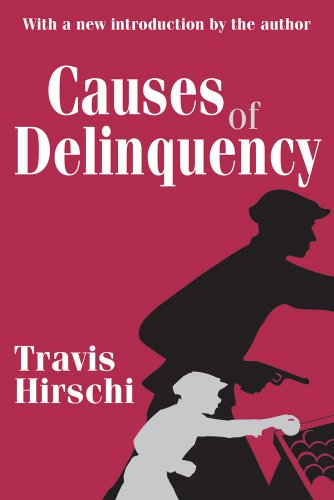
Causes of Delinquency
Authors:
Travis Hirschi
Publisher:
Transaction Publishers
Publication Date:
Not available
ISBN:
0765809001
In Causes of Delinquency, Hirschi attempts to state and test a theory of delinquency, seeing in the delinquent a person relatively free of the intimate... attachments, the aspirations, and the moral beliefs that bind most people to a life within the law. In prominent alternative theories, the delinquent appears either as a frustrated striver forced into delinquency by his acceptance of the goals common to us all, or as an innocent foreigner attempting to obey the rules of a society that is not in position to make the law or define conduct as good or evil. Hirschi analyzes a large body of data on delinquency collected in Western Contra Costa County, California, contrasting throughout the assumptions of the strain, control, and cultural deviance theories. He outlines the assumptions of these theories and discusses the logical and empirical difficulties attributed to each of them. Then draws from sources an outline of social control theory, the theory that informs the subsequent analysis and which is advocated here. Often listed as a "Citation Classic," Causes of Delinquency retains its force and cogency with age. It is an important volume and a necessary addition to the libraries of sociologists, criminologists, scholars and students in the area of delinquency.
Causes of the Civil War
Authors:
Kenneth M. Editor; Stampp
Publisher:
Touchstone Books
Publication Date:
Not available
ISBN:
0671751557
Was the Civil War inevitable? What really caused it? Drawing on original sources--from Jefferson Davis to Frederick Douglass--and interpretive essays by... today's most influential historians, this collection of essays gives a vivid sense of the political, economic, and cultural currents that swept the nation to war.
Causes of War
Authors:
David Sobek
Publisher:
Polity
Publication Date:
Not available
ISBN:
0745641997
Wars often spring out of nowhere with little warning. One need only look at the recent troubles at the Lebanon-Israeli border for evidence of this... claim. At other points in history, such as the run-up to the Second World War, wars seem all but foretold. How does one understand a phenomenon that, at times, seems so random, while at others so predictable? Is there an underlying "cause" of war and, if so, what is it? In this book, David Sobek argues that there is no single explanation for war: factors leading to war in one case may well lead to peace in another. Understanding the onset of war, he contends, requires a movement away from single theories towards one that embraces the multi-faceted causes of war.The characteristics of individual states, the strategic interaction of multiple states, and the broad structure of the international system all affect the risk of war. Throughout the book Sobek draws on a wide range of examples – from the rise of Japan in the 19th century to the emergence of Hamas in the 21st century – to show how both domestic and international politics push states to, or pull them from, the brink of armed conflict. While civil war and terrorism are often viewed as a from of violence distinct from interstate war, Sobek examines them as simply an extreme form of asymmetric warfare. From this perspective terrorism emerges as just another tactic used by actors engaged in armed conflict.The Causes of War will be essential reading for students of security and strategic studies as well as anyone seeking to understand the rise of violent conflict in the contemporary world.
Causes of War
Authors:
Jack S. Levy
Publisher:
Wiley-Blackwell
Publication Date:
Not available
ISBN:
1405175591
Written by leading scholars in the field, Causes of War provides the first comprehensive analysis of the leading theories relating to the origins of... both interstate and civil wars.Utilizes historical examples to illustrate individual theories throughoutIncludes an analysis of theories of civil wars as well as interstate wars -- one of the only texts to do bothWritten by two former International Studies Association Presidents
Causes of War
Authors:
Stephen Van Evera
Publisher:
Cornell University Press
Publication Date:
Not available
ISBN:
080148295X
What causes war? How can military conflicts best be prevented? A prominent political scientist here addresses these questions, offering ideas that will... be widely debated.Stephen Van Evera frames five conditions that increase the risk of interstate war: false optimism about the likely outcome of a war, a first-strike advantage, fluctuation in the relative power of states, circumstances that allow nations to parlay one conquest into another, and circumstances that make conquest easy. According to Van Evera, all but one of these conditions-false optimism-rarely occur today, but policymakers often erroneously believe in their existence. He argues that these misperceptions are responsible for many modern wars, and explores both World Wars, the Korean War, and the 1967 Mideast War as test cases. Finally, he assesses the possibility of nuclear war by applying all five hypotheses to its potential onset.Van Evera's book demonstrates that ideas from the Realist paradigm can offer strong explanations for international conflict and valuable prescriptions for its control.
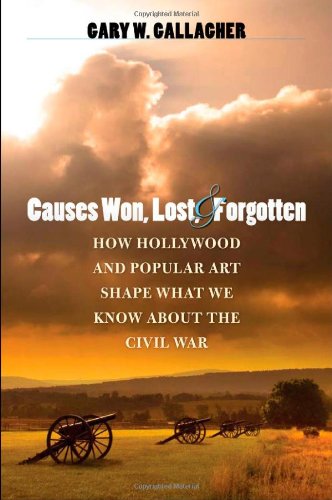
Causes Won, Lost, and Forgotten: How Hollywood and Popular Art...
Authors:
Gary W. Gallagher
Publisher:
The University of North Carolina Press
Publication Date:
Not available
ISBN:
0807832065
More than 60,000 books have been published on the Civil War. Most Americans, though, get their ideas about the war&#151why it was fought, what was... won, what was lost&#151not from books but from movies, television, and other popular media. In an engaging and accessible survey, renowned Civil War historian Gary Gallagher guides readers through the stories told in recent film and art, showing how they have both reflected and influenced the political, social, and racial currents of their times. Too often these popular portrayals overlook many of the very ideas that motivated the generation that fought the war. The most influential perspective for the Civil War generation, says Gallagher, is almost entirely absent from the Civil War stories being told today.Gallagher argues that popular understandings of the war have been shaped by four traditions that arose in the nineteenth century and continue to the present: the Lost Cause, in which Confederates are seen as having waged an admirable struggle against hopeless odds; the Union Cause, which frames the war as an effort to maintain a viable republic in the face of secessionist actions; the Emancipation Cause, in which the war is viewed as a struggle to liberate 4 million slaves and eliminate a cancerous influence on American society; and the Reconciliation Cause, which represents attempts by northern and southern whites to extol "American" virtues and mute the role of African Americans.Gallagher traces an arc of cinematic interpretation from one once dominated by the Lost Cause to one now celebrating Emancipation and, to a lesser degree, Reconciliation. In contrast, the market for art among contemporary Civil War enthusiasts reflects an overwhelming Lost Cause bent. Neither film nor art provides sympathetic representations of the Union Cause, which, Gallagher argues, carried the most weight in the Civil War era.This lively investigation into what popular entertainment teaches us and what it reflects about us will prompt readers to consider how we form opinions on current matters of debate, such as the use of the military, the freedom of dissent, and the flying of the Confederate flag.
Causes Won, Lost, and Forgotten: How Hollywood and Popular Art...
Authors:
Gary W. Gallagher
Publisher:
University of North Carolina Press
Publication Date:
Not available
ISBN:
0807866121
More than 60,000 books have been published on the Civil War. Most Americans, though, get their ideas about the war--why it was fought, what was won,... what was lost--from movies, television, and other popular media. Renowned Civil War historian Gary Gallagher guides readers through the stories told in recent film and art, showing how they have both reflected and influenced the political, social, and racial currents of their times. Too often these popular portrayals overlook many of the very ideas that motivated the generation that fought the war. The most influential perspective for the Civil War generation, says Gallagher, is almost entirely absent from the Civil War stories being told today.
Causeway (Green Rose Books)
Authors:
Elaine Sexton
Publisher:
New Issues Poetry & Prose
Publication Date:
Not available
ISBN:
1930974779
Poetry. "Lodged in various locales, whether urban or rural, earthbound or on the open sea, answering a landscape, a family memory, or the vagaries of... love, the poems of CAUSEWAY are always informed by an honest buoyancy of spirit that can mix 'the scent of lilacs' with 'smokers' coughs,' as imagination testifies to the hard-won realization that 'Even in these / toxic times, we live, we thrive.'"--Eamon Grennan. "Again and again the poet attempts to reconcile herself to 'the everyday obscene,' always 'searching for home / in a thrift shop find, something a mother, / not yours or mine, left behind.' CAUSEWAY celebrates the probability of such human connection in poems taut and insistent and resonant with desire. When Sexton writes, speaking for us all, '[T]he ones / who love me love me, god knows why,' we know she's not quite joking"--Michael Waters.

Cautionary Tales: Critical Curating
Authors:
Jean-Hubert Martin
Publisher:
apexart
Publication Date:
Not available
ISBN:
1933347104
Ten international art related professionals consider the increased influence of independent curators and cultural producers and how the role of the... curator has changed over the last ten years. Using examples from past exhibitions and personal experiences, the writers address how working within an institution differs from being independent, the difficulties of balancing artistic vision with expectations of funders and institutions, and the ethical issues of working with artists and collectors, among many other subjects. A resource text for students and others interested in the curatorial field, Cautionary Tales: Critical Curating will provide valuable and interesting reading for students considering a curatorial career and others interested in current trends in today's art world.
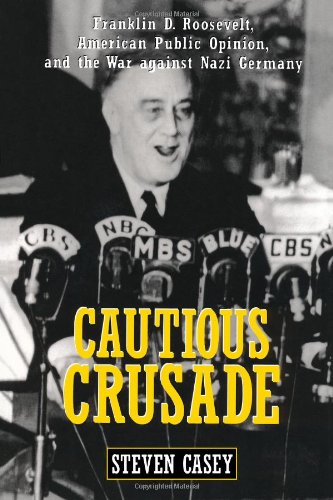
Cautious Crusade: Franklin D. Roosevelt, American Public Opinion,...
Authors:
Steven Casey
Publisher:
Oxford University Press, USA
Publication Date:
Not available
ISBN:
0195174011
America's struggle against Nazism is one of the few aspects of World War II that has escaped controversy. Historians agree that it was a widely popular... war, different from the subsequent conflicts in Korea and Vietnam because of the absence of partisan sniping, ebbing morale, or calls for a negotiated peace. In this provocative book, Steven Casey challenges conventional wisdom about America's participation in World War II. Drawing on the numerous opinion polls and surveys conducted by the U.S. government, he traces the development of elite and mass attitudes toward Germany, from the early days of the war up to its conclusion. Casey persuasively argues that the president and the public rarely saw eye to eye on the nature of the enemy, the threat it posed, or the best methods for countering it. He describes the extensive propaganda campaign that Roosevelt designed to build support for the war effort, and shows that Roosevelt had to take public opinion into account when formulating a host of policies, from the Allied bombing campaign to the Morgenthau plan to pastoralize the Third Reich. By examining the previously unrecognized relationship between public opinion and policy making during World War II, Casey's groundbreaking book sheds new light on a crucial era in American history.
 '
'