production
/viewbook/list/all/?page=2657
/
/static/
None
Computational Methods for Electric Power Systems, Second Edition...
Authors:
Mariesa Crow
Publisher:
CRC Press
Publication Date:
Not available
ISBN:
142008660X
Improve Compensation Strategies for Package Shortcomings In today's deregulated environment, the nation's electric power network is forced to operate... in a manner for which it was not designed. As a result, precision system analysis is essential to predict and continually update network operating status, estimate current power flows and bus voltages, determine stability limits, and minimize costs. Computational Methods for Electric Power Systems is an introductory overview of computational methods used for analytical studies in power systems and other engineering and scientific fields. As power systems increasingly operate under stressed conditions, techniques such as computer simulation remain integral to control and security assessment. This volume analyzes the algorithms used in commercial analysis packages and presents salient examples of their implementation that are simple and thorough enough to be reproduced easily. Most of the examples were produced using MATLAB® language. Presents General Theory Applicable to Different Systems Commercial packages routinely fail or give erroneous results when used to simulate stressed systems, and understanding their underlying numerical algorithms is imperative to correctly interpret their results. This edition paints a broad picture of the methods used in such packages but omits extraneous detail. It includes new chapters that address function approximation and finite element analysis, in addition to new sections on: Generalized Minimal Residual (GMRES) methods Numerical differentiation Secant method Homotopy and continuation methods Power method for computing dominant eigenvalues Singular-value decomposition and pseudoinverses Matrix pencil method This book will enable users to make better choices and improve their grasp of the situations in which methods may fail—instilling greater confidence in the use of commercial packages.

Computational Methods For Engineers
Authors:
Not Available
Publisher:
Not available
Publication Date:
Not available
ISBN:
1121171095
Computational Methods for Fluid Dynamics
Authors:
Joel H. Ferziger
Publisher:
Springer
Publication Date:
Not available
ISBN:
3540420746
In its third revised and extended edition the book offers an overview of the techniques used to solve problems in fluid mechanics on computers. The... authors describe in detail the most often used techniques. Included are advanced techniques in computational fluid dynamics, such as direct and large-eddy simulation of turbulence. Moreover, a new section deals with grid quality and an extended description of discretization methods has also been included. Common roots and basic principles for many apparently different methods are explained. The book also contains a great deal of practical advice for code developers and users.
Computational Methods for Plasticity: Theory and Applications
Authors:
E. A. de Souza Neto
Publisher:
Wiley
Publication Date:
Not available
ISBN:
0470694521
The subject of computational plasticity encapsulates the numerical methods used for the finite element simulation of the behaviour of a wide range of... engineering materials considered to be plastic – i.e. those that undergo a permanent change of shape in response to an applied force. Computational Methods for Plasticity: Theory and Applications describes the theory of the associated numerical methods for the simulation of a wide range of plastic engineering materials; from the simplest infinitesimal plasticity theory to more complex damage mechanics and finite strain crystal plasticity models. It is split into three parts - basic concepts, small strains and large strains. Beginning with elementary theory and progressing to advanced, complex theory and computer implementation, it is suitable for use at both introductory and advanced levels. The book:Offers a self-contained text that allows the reader to learn computational plasticity theory and its implementation from one volume.Includes many numerical examples that illustrate the application of the methodologies described.Provides introductory material on related disciplines and procedures such as tensor analysis, continuum mechanics and finite elements for non-linear solid mechanics.Is accompanied by purpose-developed finite element software that illustrates many of the techniques discussed in the text, downloadable from the book’s companion website.This comprehensive text will appeal to postgraduate and graduate students of civil, mechanical, aerospace and materials engineering as well as applied mathematics and courses with computational mechanics components. It will also be of interest to research engineers, scientists and software developers working in the field of computational solid mechanics.
Computational Methods in Environmental Fluid Mechanics (Engineering...
Authors:
Olaf Kolditz
Publisher:
Springer
Publication Date:
Not available
ISBN:
354042895X
Fluids play an important role in environmental systems appearing as surface water in rivers, lakes, and coastal regions or in the subsurface as well as... in the atmosphere. Mechanics of environmental fluids is concerned with fluid motion, associated mass and heat transport as well as deformation processes in subsurface systems. In this reference work the fundamental modelling approaches based on continuum mechanics for fluids in the environment are described, including porous media and turbulence. Numerical methods for solving the process governing equations as well as its object-oriented computer implementation are discussed and illustrated with examples. Finally, the application of computer models in civil and environmental engineering is demonstrated.
Computational Methods in Finance (Chapman & Hall/CRC Financial...
Authors:
Ali Hirsa
Publisher:
CRC Press
Publication Date:
Not available
ISBN:
1439829578
As today’s financial products have become more complex, quantitative analysts, financial engineers, and others in the financial industry now require... robust techniques for numerical analysis. Covering advanced quantitative techniques, Computational Methods in Finance explains how to solve complex functional equations through numerical methods. The first part of the book describes pricing methods for numerous derivatives under a variety of models. The book reviews common processes for modeling assets in different markets. It then examines many computational approaches for pricing derivatives. These include transform techniques, such as the fast Fourier transform, the fractional fast Fourier transform, the Fourier-cosine method, and saddlepoint method; the finite difference method for solving PDEs in the diffusion framework and PIDEs in the pure jump framework; and Monte Carlo simulation. The next part focuses on essential steps in real-world derivative pricing. The author discusses how to calibrate model parameters so that model prices are compatible with market prices. He also covers various filtering techniques and their implementations and gives examples of filtering and parameter estimation. Developed from the author’s courses at Columbia University and the Courant Institute of New York University, this self-contained text is designed for graduate students in financial engineering and mathematical finance as well as practitioners in the financial industry. It will help readers accurately price a vast array of derivatives.
Computational Methods of Neutron Transport
Authors:
Elmer E. Lewis
Publisher:
Amer Nuclear Society
Publication Date:
Not available
ISBN:
0894484524
Smith and Smith apply current thinking in the areas of valuation, real options, and the economics of contracts to new venture decision making. Readers... learn to think of new ventures as portfolios of real options, value financial claims of the entrepreneur and venture capital investors, and structure financial contracts in light of new venture information problems. They also learn to use simulation and scenario analysis to evaluate the implications of uncertainty and financial decisions.* Stresses the importance of strategy in new venture planning.* Develops real-world context through relevant examples.* Spreadsheet modeling and simulation using custom software provides hands-on learning.
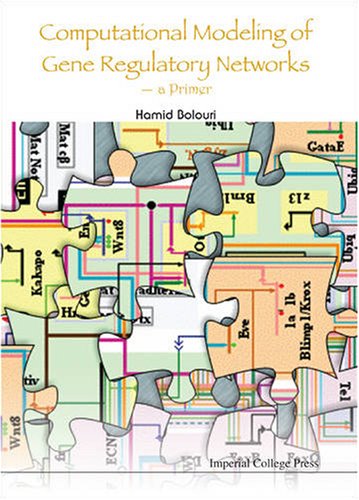
Computational Modelling Of Gene Regulatory Networks -- A Primer
Authors:
Hamid Bolouri
Publisher:
Imperial College Press
Publication Date:
Not available
ISBN:
1848162219
This book serves as an introduction to the myriad computational approaches to gene regulatory modeling and analysis, and is written specifically with... experimental biologists in mind. Mathematical jargon is avoided and explanations are given in intuitive terms. In cases where equations are unavoidable, they are derived from first principles or, at the very least, an intuitive description is provided. Extensive examples and a large number of model descriptions are provided for use in both classroom exercises as well as self-guided exploration and learning. As such, the book is ideal for self-learning and also as the basis of a semester-long course for undergraduate and graduate students in molecular biology, bioengineering, genome sciences, or systems biology. Contents: Introduction; What Is a System, and Why Should We Care?; What Models Can and Cannot Predict; Why Make Computational Models of Gene Regulatory Networks?; Graphical Representations of Gene Regulatory Networks; Implicit Modeling via Interaction Network Maps; The Biochemical Basis of Gene Regulation; A Single-Cell Model of Transcriptional Regulation; Simplified Models: Mass-Action Kinetics; Simplified Models: Boolean and Multi-valued Logic; Simplified Models: Bayesian Networks; The Relationship between Logic and Bayesian Networks; Network Inference in Practice; Searching DNA Sequences for Transcription Factor Binding Sites; Model Selection Theory; Simplified Models -- GRN State Signatures in Data; System Dynamics; Robustness Analysis; GRN Modules and Building Blocks; Notes on Data Processing for GRN Modeling; Applications of Computational GRN Modeling; Quo Vadis.
Computational Molecular Biology: An Algorithmic Approach...
Authors:
Pavel A. Pevzner
Publisher:
MIT Press
Publication Date:
Not available
ISBN:
0262161974
In one of the first major texts in the emerging field of computational molecular biology, Pavel Pevzner covers a broad range of algorithmic and... combinatorial topics and shows how they are connected to molecular biology and to biotechnology. The book has a substantial "computational biology without formulas" component that presents the biological and computational ideas in a relatively simple manner. This makes the material accessible to computer scientists without biological training, as well as to biologists with limited background in computer science. Computational Molecular Biology series Computer science and mathematics are transforming molecular biology from an informational to a computational science. Drawing on computational, statistical, experimental, and technological methods, the new discipline of computational molecular biology is dramatically increasing the discovery of new technologies and tools for molecular biology. The new MIT Press Computational Molecular Biology series provides a unique venue for the rapid publication of monographs, textbooks, edited collections, reference works, and lecture notes of the highest quality.

Computational Nanoscience: Applications for Molecules, Clusters,...
Authors:
Kálmán Varga
Publisher:
Cambridge University Press
Publication Date:
Not available
ISBN:
1107001706
Computer simulation is an indispensable research tool in modeling, understanding and predicting nanoscale phenomena. However, the advanced computer... codes used by researchers are too complicated for graduate students wanting to understand computer simulations of physical systems. This book gives students the tools to develop their own codes. Describing advanced algorithms, the book is ideal for students in computational physics, quantum mechanics, atomic and molecular physics, and condensed matter theory. It contains a wide variety of practical examples of varying complexity to help readers at all levels of experience. An algorithm library in Fortran 90, available online at www.cambridge.org/9781107001701, implements the advanced computational approaches described in the text to solve physical problems.
Computational Partial Differential Equations Using MATLAB (Chapman...
Authors:
Jichun Li
Publisher:
Chapman and Hall/CRC
Publication Date:
Not available
ISBN:
1420089048
This textbook introduces several major numerical methods for solving various partial differential equations (PDEs) in science and engineering, including... elliptic, parabolic, and hyperbolic equations. It covers traditional techniques that include the classic finite difference method and the finite element method as well as state-of-the-art numerical methods, such as the high-order compact difference method and the radial basis function meshless method. Helps Students Better Understand Numerical Methods through Use of MATLAB®The authors uniquely emphasize both theoretical numerical analysis and practical implementation of the algorithms in MATLAB, making the book useful for students in computational science and engineering. They provide students with simple, clear implementations instead of sophisticated usages of MATLAB functions. All the Material Needed for a Numerical Analysis CourseBased on the authors’ own courses, the text only requires some knowledge of computer programming, advanced calculus, and difference equations. It includes practical examples, exercises, references, and problems, along with a solutions manual for qualifying instructors. Students can download MATLAB code from www.crcpress.com, enabling them to easily modify or improve the codes to solve their own problems.
Computational Physics
Authors:
Jos Thijssen
Publisher:
Cambridge University Press
Publication Date:
Not available
ISBN:
0521833469
This second edition describes the computational methods used in theoretical physics, and has been fully updated. New sections have been added to cover... finite element methods and lattice Boltzmann simulation, density functional theory, quantum molecular dynamics, Monte Carlo simulation, and diagonalisation of one-dimensional quantum systems. It covers many different areas of physics research and different computational methodologies, including computational methods such as Monte Carlo and molecular dynamics, various electronic structure methodologies, methods for solving partial differential equations, and lattice gauge theory. Throughout the book the relations between the methods used in different fields of physics are emphasised. Several new programs are described and can be downloaded from www.cambridge.org/9780521833462. The book requires a background in elementary programming, numerical analysis, and field theory, as well as undergraduate knowledge on condensed matter theory and statistical physics. It will be of interest to graduate students and researchers in theoretical, computational and experimental physics.
Computational Physics (2nd Edition)
Authors:
Nicholas J. Giordano
Publisher:
Addison-Wesley
Publication Date:
Not available
ISBN:
0131469908
Contains a wealth of topics to allow instructors flexibility in the choice of topics and depth of coverage: Examines projective motion with and... without realistic air resistance. Discusses planetary motion and the three-body problem. Explores chaotic motion of the pendulum and waves on a string. Includes topics relating to fractal growth and stochastic systems. Offers examples on statistical physics and quantum mechanics. Contains ample explanations of the necessary algorithms students need to help them write original programs, and provides many example programs and calculations for reference.
Computational Physics: Fortran Version
Authors:
Steven E. Koonin
Publisher:
Westview Press
Publication Date:
Not available
ISBN:
0201386232
Computational Physics is designed to provide direct experience in the computer modeling of physical systems. Its scope includes the essential numerical... techniques needed to "do physics" on a computer. Each of these is developed heuristically in the text, with the aid of simple mathematical illustrations. However, the real value of the book is in the eight Examples and Projects, where the reader is guided in applying these techniques to substantial problems in classical, quantum, or statistical mechanics. These problems have been chosen to enrich the standard physics curriculum at the advanced undergraduate or beginning graduate level. The book will also be useful to physicists, engineers, and chemists interested in computer modeling and numerical techniques. Although the user-friendly and fully documented programs are written in FORTRAN, a casual familiarity with any other high-level language, such as BASIC, PASCAL, or C, is sufficient. The codes in BASIC and FORTRAN are available on the web at http://www.computationalphysics.info (Please follow the link at the bottom of the page). They are available in zip format, which can be expanded on UNIX, Window, and Mac systems with the proper software. The codes are suitable for use (with minor changes) on any machine with a FORTRAN-77 compatible compiler or BASIC compiler. The FORTRAN graphics codes are available as well. However, as they were originally written to run on the VAX, major modifications must be made to make them run on other machines.
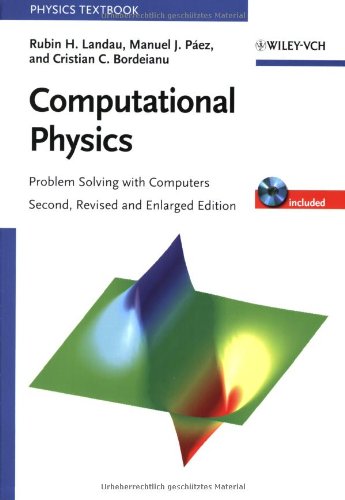
Computational Physics: Problem Solving with Computers
Authors:
Rubin H. Landau
Publisher:
Wiley-VCH
Publication Date:
Not available
ISBN:
3527406263
This second edition increases the universality of the previous edition by providing all its codes in the Java language, whose compiler and development... kit are available for free for essentially all operating systems. In addition, the accompanying CD provides many of the same codes in Fortran 95, Fortran 77, and C, for even more universal application, as well as MPI codes for parallel applications. The book also includes new materials on trial-and-error search techniques, IEEE floating point arithmetic, probability and statistics, optimization and tuning in multiple languages, parallel computing with MPI, JAMA the Java matrix library, the solution of simultaneous nonlinear equations, cubic splines, ODE eigenvalue problems, and Java plotting programs.From the reviews of the first edition:"Landau and Paez's book would be an excellent choice for a course on computational physics which emphasizes computational methods and programming." - American Journal of Physics
 '
'