production
/viewbook/list/all/?page=2779
/
/static/
None

Consuming Grief: Compassionate Cannibalism in an Amazonian Society
Authors:
Beth A. Conklin
Publisher:
University of Texas Press
Publication Date:
Not available
ISBN:
0292712367
Mourning the death of loved ones and recovering from their loss are universal human experiences, yet the grieving process is as different between... cultures as it is among individuals. As late as the 1960s, the Wari' Indians of the western Amazonian rainforest ate the roasted flesh of their dead as an expression of compassion for the deceased and for his or her close relatives. By removing and transforming the corpse, which embodied ties between the living and the dead and was a focus of grief for the family of the deceased, Wari' death rites helped the bereaved kin accept their loss and go on with their lives. Drawing on the recollections of Wari' elders who participated in consuming the dead, this book presents one of the richest, most authoritative ethnographic accounts of funerary cannibalism ever recorded. Beth Conklin explores Wari' conceptions of person, body, and spirit, as well as indigenous understandings of memory and emotion, to explain why the Wari' felt that corpses must be destroyed and why they preferred cannibalism over cremation. Her findings challenge many commonly held beliefs about cannibalism and show why, in Wari' terms, it was considered the most honorable and compassionate way of treating the dead.

Consuming Habits: Drugs in History and Anthropology
Authors:
Not Available
Publisher:
Routledge
Publication Date:
Not available
ISBN:
0415425824
Covering a wide range of substances, including opium, cocaine, coffee, tobacco, kola, and betelnut, from prehistory to the present day, this new edition... has been extensively updated, with an updated bibliography and two new chapters on cannabis and khat. Consuming Habits is the perfect companion for all those interested in how different cultures have defined drugs across the ages. Psychoactive substances have been central to the formation of civilizations, the definition of cultural identities, and the growth of the world economy. The labelling of these substances as 'legal' or 'illegal' has diverted attention away from understanding their important cultural and historical role. This collection explores the rich analytical category of psychoactive substances from challenging historical and anthropological perspectives.

Consuming Life
Authors:
Zygmunt Bauman
Publisher:
Polity Press
Publication Date:
Not available
ISBN:
0745640028
With the advent of liquid modernity, the society of producers is transformed into a society of consumers. In this new consumer society, individuals... become simultaneously the promoters of commodities and the commodities they promote. They are, at one and the same time, the merchandise and the marketer, the goods and the travelling salespeople. They all inhabit the same social space that is customarily described by the term the market. The test they need to pass in order to acquire the social prizes they covet requires them to recast themselves as products capable of drawing attention to themselves. This subtle and pervasive transformation of consumers into commodities is the most important feature of the society of consumers. It is the hidden truth, the deepest and most closely guarded secret, of the consumer society in which we now live.In this new book Zygmunt Bauman examines the impact of consumerist attitudes and patterns of conduct on various apparently unconnected aspects of social life politics and democracy, social divisions and stratification, communities and partnerships, identity building, the production and use of knowledge, and value preferences. The invasion and colonization of the web of human relations by the worldviews and behavioural patterns inspired and shaped by commodity markets, and the sources of resentment, dissent and occasional resistance to the occupying forces, are the central themes of this brilliant new book by one of the worlds most original and insightful social thinkers.
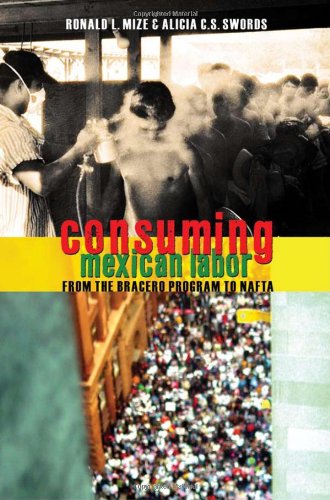
Consuming Mexican Labor: From the Bracero Program to NAFTA
Authors:
Ronald L. Mize
Publisher:
University of Toronto Press, Higher Education Division
Publication Date:
Not available
ISBN:
1442601574
Mexican migration to the United States and Canada is a highly contentious issue in the eyes of many North Americans, and every generation seems to... construct the northward flow of labor as a brand new social problem. The history of Mexican labor migration to the United States, from the Bracero Program (1942-1964) to the North American Free Trade Agreement (NAFTA), suggests that Mexicans have been actively encouraged to migrate northward when labor markets are in short supply, only to be turned back during economic downturns. In this timely book, Mize and Swords dissect the social relations that define how corporations, consumers, and states involve Mexican immigrant laborers in the politics of production and consumption. The result is a comprehensive and contemporary look at the increasingly important role that Mexican immigrants play in the North American economy.
Consuming Modernity: Public Culture in a South Asian World
Authors:
Carol A. Breckenridge
Publisher:
Univ Of Minnesota Press
Publication Date:
Not available
ISBN:
0816623066
This volume brings together a group of international scholars to analyze the globalized networks of Indian cinema. It provides a critique of a common... scholarly tendency in the field of popular cinema of defining Indian films in terms of their modernity and desire for nationhood. Bollyworld argues that Indian cinema cannot be understood in terms of this national paradigm, and must be more properly described as a field of visual and cultural production that interlinks sites as diverse as the cosmopolitan city of Bombay, the provincial region of Maharashtra, and countries such as Nigeria, Germany, South Africa and the United Kingdom. The twelve essays track the intra-national and trans-national movements of Bollywood cinema. Divided into three sections, the first discusses the technology and aesthetics of India's commercial cinema as it developed in the period that spans the silents from 1913 to the advent of the talkies in 1931. The second section studies these films as 'local', 'intertextual' manifestations of globalization and highlights the changes in post-liberalization cinema. Against the backdrop of economic liberalization, the institutionalization of multiculturalism and a strong voice of migrant Indian populations, the third section focuses on the overseas reception of Indian films.
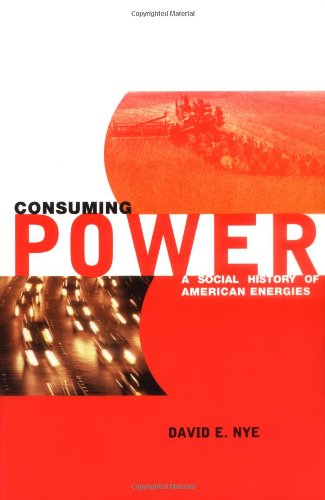
Consuming Power: A Social History of American Energies
Authors:
David E. Nye
Publisher:
The MIT Press
Publication Date:
Not available
ISBN:
0262640384
How did the United States become the world's largest consumer of energy? David Nye shows that this is less a question about the development of... technology than it is a question about the development of culture. In Consuming Power Nye uses energy as a touchstone to examine the lives of ordinary people engaged in normal activities. He looks at how these activities changed as new energy systems were constructed, from colonial times to recent years. He also shows how, as Americans incorporated new machines and processes into their lives, they became ensnared in power systems that were not easily changed: they made choices about the conduct of their lives, and those choices accumulated to produce a consuming culture.Nye examines a sequence of large systems that acquired and then lost technological momentum over the course of American history, including water power, steam power, electricity, the internal-combustion engine, atomic power, and computerization. He shows how each system became part of a larger set of social constructions through its links to the home, the factory, and the city. The result is a social history of America as seen through the lens of energy consumption.

Consuming the Caribbean: From Arawaks to Zombies (International...
Authors:
Mimi Sheller
Publisher:
Routledge
Publication Date:
Not available
ISBN:
0415257603
From sugar to indentured labourers, tobacco to reggae music, Europe and North America have been relentlessly consuming the Caribbean and its assets for... the past five hundred years. In this fascinating book, Mimi Sheller explores this troublesome history, investigating the complex mobilities of producers and consumers, of material and cultural commodities, including: foodstuffs and stimulants - sugar, fruit, coffee and rum human bodies - slaves, indentured labourers and service workers cultural and knowledge products - texts, music, scientific collections and ethnology entire 'natures' and landscapes consumed by tourists as tropical paradise. Consuming the Caribbean demonstrates how colonial exploitation of the Caribbean led directly to contemporary forms of consumption of the region and its products. It calls into question innocent indulgence in the pleasures of thoughtless consumption and calls for a global ethics of consumer responsibility.

Consuming the Congo: War and Conflict Minerals in the World's...
Authors:
Peter Eichstaedt
Publisher:
Chicago Review Press
Publication Date:
Not available
ISBN:
1569763100
Every time you use a cell phone or log on to a computer, you could be contributing to the death toll in the bloodiest, most violent region in the world:... the eastern Congo. Rich in conflict minerals”--valuable resources mined in the midst of armed conflict and egregious human rights abuses--this remote and lawless land is home to deposits of gold and diamonds as well as coltan, tin, and tungsten, all critical to cell phones, computers, and other popular electronics.In Consuming the Congo, veteran journalist and author Peter Eichstaedt goes into these killing fields to find what is behind the bloodshed, hearing the stories of those who live this nightmarish reality. He talks with survivors of villages decimated by war and miners slogging knee-deep in muck, desperately digging up the gold, tin, and coltan on which Western culture depends. While these men work with picks, shovels, and iron bars, marauding militias and renegade army units who control the mines roam the jungles, killing and raping with impunity, taking their profits, and leaving villagers to a life of grueling manual labor, brutality, and disease.Some five million Congolese have died unnecessarily, the worst loss of human life since World War II, yet the pillaging and bloodletting continue at a frightening pace. Consuming the Congo not only explores the violence suffered by the Congolese but also examines how we, as part of the problem, can become part of the solution.
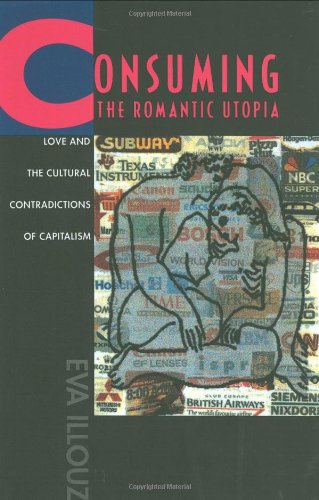
Consuming the Romantic Utopia: Love and the Cultural Contradictions...
Authors:
Eva Illouz
Publisher:
University of California Press
Publication Date:
Not available
ISBN:
0520205715
To what extent are our most romantic moments determined by the portrayal of love in film and on TV? Is a walk on a moonlit beach a moment of perfect... romance or simply a simulation of the familiar ideal seen again and again on billboards and movie screens? In her unique study of American love in the twentieth century, Eva Illouz unravels the mass of images that define our ideas of love and romance, revealing that the experience of "true" love is deeply embedded in the experience of consumer capitalism. Illouz studies how individual conceptions of love overlap with the world of clichés and images she calls the "Romantic Utopia." This utopia lives in the collective imagination of the nation and is built on images that unite amorous and economic activities in the rituals of dating, lovemaking, and marriage.Since the early 1900s, advertisers have tied the purchase of beauty products, sports cars, diet drinks, and snack foods to success in love and happiness. Illouz reveals that, ultimately, every cliché of romance--from an intimate dinner to a dozen red roses--is constructed by advertising and media images that preach a democratic ethos of consumption: material goods and happiness are available to all.Engaging and witty, Illouz's study begins with readings of ads, songs, films, and other public representations of romance and concludes with individual interviews in order to analyze the ways in which mass messages are internalized. Combining extensive historical research, interviews, and postmodern social theory, Illouz brings an impressive scholarship to her fascinating portrait of love in America.
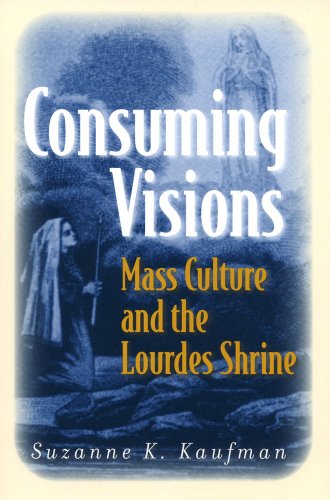
Consuming Visions: Mass Culture and the Lourdes Shrine
Authors:
Suzanne K. Kaufman
Publisher:
Cornell University Press
Publication Date:
Not available
ISBN:
0801475325
Plastic Madonnas, packaged holy tours, and biblical theme parks can arouse discomfort, laughter, and even revulsion in religious believers and... nonbelievers alike. Scholars, too, often see the intermingling of religion and commerce as a corruption of true spirituality. Suzanne K. Kaufman challenges these assumptions in her examination of the Lourdes pilgrimage in late nineteenth-century France.Consuming Visions offers new ways to interpret material forms of worship, female piety, and modern commercial culture. Kaufman argues that the melding of traditional pilgrimage activities with a newly developing mass culture produced fresh expressions of popular faith. For the devout women of humble origins who flocked to the shrine, this intensely exciting commercialized worship offered unprecedented opportunities to connect with the sacred and express their faith in God.New devotional activities at Lourdes transformed the act of pilgrimage: the train became a moving chapel, and popular entertainments such as wax museums offered vivid recreations of visionary events. Using the press and the strategies of a new advertising industry to bring a mass audience to Lourdes, Church authorities remade centuries-old practices of miraculous healing into a modern public spectacle. These innovations made Lourdes one of the most visited holy sites in Catholic Europe.Yet mass pilgrimage also created problems. The development of Lourdes, while making religious practice more democratically accessible, touched off fierce conflicts over the rituals and entertainments provided by the shrine. These conflicts between believers and secularists played out in press scandals across the European continent. By taking the shrine seriously as a site of mass culture, Kaufman not only breaks down the opposition between sacred and profane but also deepens our understanding of commercialized religion as a fundamental feature of modernity itself.

Consumption and Everyday Life (The New Sociology)
Authors:
Mark Paterson
Publisher:
Routledge
Publication Date:
Not available
ISBN:
0415355079
Introducing all the key ideas and major theorists of consumption in a lively and engaging manner, this book draws on theories of everyday life and... aspects of sociology, cultural geography and cultural studies, and presents a comprehensive exploration of the central themes in consumption and consumer culture. Readily accessible case studies describe familiar forms of consumption from areas of everyday life, grounding the debates and ideas discussed. Key topics covered include: the semiotics of branding and advertising the representation of 'nature' and the environment the relations between consumer and producer ethical consumption the tensions between local spaces of consumption and globalized markets. While each of the chapters crystallize the debate in a specific subject area, they also lie within a larger argument concerning the ethics, the poetics and the politics of consumption in everyday life, making this essential reading for undergraduates on cultural studies, sociology and cultural geography courses.

Consumption and Social Change in a Post-Soviet Middle Class
Authors:
Jennifer Patico
Publisher:
Stanford University Press
Publication Date:
Not available
ISBN:
0804761698
What happens when your once-dignified profession no longer supports a dignified lifestyle? In 1990s St. Petersburg, teachers had to find out the hard... way. Although the institutions and ideologies of Soviet life situated them as "cultured" consumers, contemporary processes of marketization and privatization left them unable to attain what they now considered to be respectable material standards of living. In this fascinating new ethnographic study, Patico examines the various ways in which teachers have adjusted their activities and interactions as consumers, demonstrating how this has led to dramatic shifts in their assessments of their own lives and of the society around them.Consumption and Social Change in a Post-Soviet Middle Class presents a much-needed look at the lives of ordinary people in Russia today, in the process contributing both to postsocialist studies of social change and to broader anthropological theorizations of consumption and value.

CONSYSMT 546 COURSE PACKET (P57051) F11
Authors:
Not Available
Publisher:
Not available
Publication Date:
Not available
ISBN:
Not available
CONSYSMT 642 #1 CONTRACTS (P45975) F10
Authors:
Not Available
Publisher:
Not available
Publication Date:
Not available
ISBN:
Not available

Contact
Authors:
Carl Sagan
Publisher:
Pocket Books
Publication Date:
Not available
ISBN:
0671004107
 '
'