production
/viewbook/list/all/?page=3013
/
/static/
None
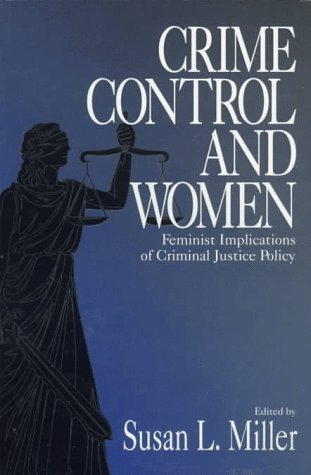
Crime Control and Women: Feminist Implications of Criminal Justice...
Authors:
Not Available
Publisher:
Sage Publications, Inc
Publication Date:
Not available
ISBN:
0761907149
Crime Control and Women reveals the current limitations of criminal justice policies that are oblivious to the impact they exert on citizens who vary by... gender, race and/or social class. Feminist in perspective, the contributors to this volume share a common vision of hope that social change will result from social control and punishment that is just and human, with commitments to prevention, education, and treatment.
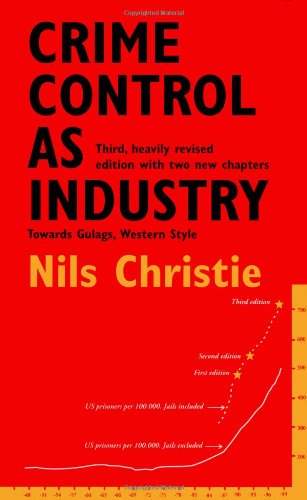
Crime Control as Industry
Authors:
Nils Christie
Publisher:
Routledge
Publication Date:
Not available
ISBN:
0415234875
This classic text argues that crime control, rather than crime itself is the real danger for our future. Since the second edition was published in 1994,... prison populations , especially in Russia and America, have grown at an increasingly rapid rate. This third edition is published to take account of these changes and draw attention to the scale of an escalating problem. It contains completely new chapters - one on 'penal geography', the other on 'the Russian case' - and has been extensively revised.

CRIME CONTROL IN AMERICA PACKAGE ARIZONA STATE UNIVERSITY
Authors:
Not Available
Publisher:
Not available
Publication Date:
Not available
ISBN:
Not available
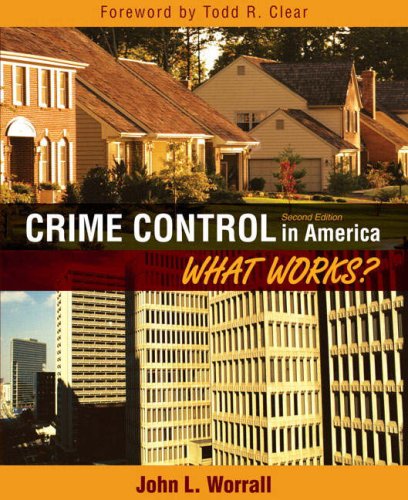
Crime Control in America: What Works? (2nd Edition)
Authors:
John L. Worrall
Publisher:
Prentice Hall
Publication Date:
Not available
ISBN:
0205593399
Crime Control in America introduces readers to the many methods of crime control and reviews the research concerning their effectiveness. The text... covers policing, prosecution and courts, and legislative methods of crime control. It also moves beyond the justice system and examines the effectiveness of crime control at the individual, family, school, and community levels. Finally, it covers environmental criminology, juvenile crime control, and explanations of large-scale crime trends, particularly the reductions witnessed during the 1990s.

Crime Control, Politics and Policy, Second Edition
Authors:
Peter K. Benekos
Publisher:
Anderson
Publication Date:
Not available
ISBN:
1593453477
This book reviews concepts, information and points of view that help to explain the context and constraints of the criminal justice system. The chapters... summarize developments in public policy and crime control, and interweave themes central to the discussion: the impact of ideology, the role of the media, and the politicization of crime and criminal justice.Includes tables, photos and discussion questions.
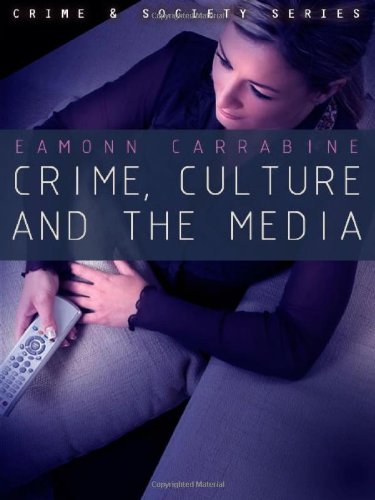
Crime, Culture and the Media (PCSS-Polity Crime and Society)
Authors:
Eamonn Carrabine
Publisher:
Polity
Publication Date:
Not available
ISBN:
0745634664
Why are newspapers and television programmes filled with stories about crime and criminals? Is their portrayal of crime accurate? How do the media... transform our attitudes to crime? Is fear of crime, for example, really created by the media?The relationships between crime and the media have long been the subject of intense debate. From the earliest days of the printing press to the explosion of cyberspace chat rooms, there have been persistent concerns about the harmful criminogenic effects of the media. At the same time, the media are fascinated with crime – on the news, in films and on television there are countless stories about crime, both real and imagined. In this innovative and accessible new book, Eamonn Carrabine carefully untangles these debates, and grapples with the powerful dynamics of fear and desire that underlie our obsession with crime. Chapter-by-chapter the book introduces the different ways in which relationships between crime and the media have been understood, including classic debates about the media’s effects, news production, and moral panics, as well as more cutting-edge studies of the representation of crime in the contemporary media.Combining empirical research findings with the latest theoretical developments, the book will appeal to advanced undergraduates and graduate students across the social sciences, especially those taking courses in criminology and media studies.
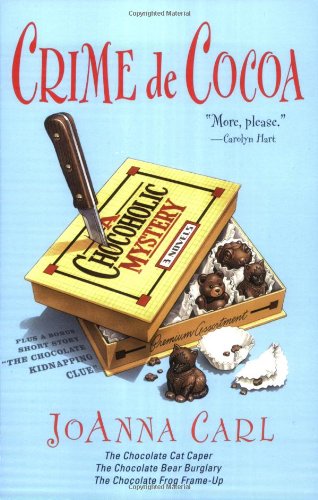
Crime de Cocoa: Three Chocoholic Mysteries (Chocoholic Mystery)
Authors:
JoAnna Carl
Publisher:
NAL Trade
Publication Date:
Not available
ISBN:
0451216946

Crime Fiction (The New Critical Idiom)
Authors:
John Scaggs
Publisher:
Routledge
Publication Date:
Not available
ISBN:
0415318246
Crime Fiction provides a lively introduction to what is both a wide-ranging and hugely popular literary genre. Using examples from a variety of novels,... short stories, films and televisions series, John Scaggs: *presents a concise history of crime fiction - from biblical narratives to James Ellroy - broadening the genre to include revenge tragedy and the gothic novel *explores the key sub-genres of crime fiction, such as 'Rational Criminal Investigation', The Hard-Boiled Mode', 'The Police Procedural' and 'Historical Crime Fiction' *locates texts and their recurring themes and motifs in a wider social and historical context *outlines the various critical concepts that are central to the study of crime fiction, including gender, narrative theory and film theory *considers contemporary television series like C.S.I.: Crime Scene Investigation alongside the 'classic' whodunnits of Agatha Christie. Accessible and clear, this comprehensive overview is the essential guide for all those studying crime fiction and concludes with a look at future directions for the genre in the twentieth-first century.

Crime Films (Genres in American Cinema)
Authors:
Thomas Leitch
Publisher:
Cambridge University Press
Publication Date:
Not available
ISBN:
0521646715
Focusing on ten films that span the range of the twentieth century, Thomas Leitch traces the transformation of three figures common to all crime films:... the criminal, the victim and the avenger. He shows how the distinctions among them become blurred throughout the course of the century, reflecting and fostering a deep social ambivalence towards crime and criminals. The criminal, victim and avenger characters effectively map the shifting relations between subgenres (such as the erotic thriller and the police film) within the larger genre of crime film.
Crime in a Psychological Context: From Career Criminals to Criminal...
Authors:
Glenn D. Walters
Publisher:
Sage Publications, Inc
Publication Date:
Not available
ISBN:
1412996082
This engaging book presents a contextual psychological interpretation of crime. It covers essential topics including psychopathy, antisocial personality... disorder, and criminal lifestyle. The author’s compelling analysis explains criminal behavior, by showing how the criminal lifestyle is capable of integrating two seemingly incompatible crime paradigms: the career criminal paradigm and the criminal career paradigm. Starting with a context for criminality, and then moving from particular conceptions of crime to more evidence-based theories, this volume challenges students to think in a different way about crime and criminal behavior.
Crime in California: A Case Reader in California Criminal Law
Authors:
KUBICEK LAURIE
Publisher:
Kendall Hunt Publishing
Publication Date:
Not available
ISBN:
0757591345
Dealing with dialogue, this work addresses two issues. The primary focus is on the theoretical understanding and empirical analysis of... talk-in-interaction; secondly, the work explores the possiblities and limitations in dialogism as a general epistemology for cognition and communication.
Crime in the Making: Pathways and Turning Points through Life
Authors:
Robert J. Sampson
Publisher:
Harvard University Press
Publication Date:
Not available
ISBN:
0674176057
This new theory of crime over the life course provides an important foundation for rethinking criminal justice policy. It is based on the reanalysis... of a classic set of data: Sheldon and Eleanor Gluecks' mid-century study of 500 delinquents and 500 nondelinquents from childhood to adulthood. Several years ago, Robert Sampson and John Laub dusted off sixty cartons of the Gleucks' data that had been stored in the basement of the Harvard Law School and undertook a lengthy process of recoding, computerizing, and reanalyzing it. On the basis of their findings, they developed a theory of informal social control that acknowledges the importance of childhood behavior but rejects the implication that adult social factors have little relevance. This theory accounts for both stability and change in crime and deviance throughout the life course.
CRIME & JUSTICE: A CASEBOOK APPROACH
Authors:
Not Available
Publisher:
Not available
Publication Date:
Not available
ISBN:
Not available
Crime, Justice, and Society: An Introduction to Criminology
Authors:
Ronald J. Berger
Publisher:
Lynne Rienner Pub
Publication Date:
Not available
ISBN:
1588266850
As international travel became cheaper and national economies grew more connected over the past thirty years, millions of poor people from the Third... World emigrated to richer countries. A tenth of the population of Mexico relocated to the United States between 1980 and 2000. Globalization theorists claimed that reception cities could do nothing about this trend, since nations make immigration policy, not cities. In Deflecting Immigration, sociologist Ivan Light shows how Los Angeles reduced the sustained, high-volume influx of poor Latinos who settled there by deflecting a portion of the migration to other cities in the United States. In this manner, Los Angeles tamed globalization's local impact, and helped to nationalize what had been a regional immigration issue. Los Angeles deflected immigrants elsewhere in two ways. First, the protracted network-driven settlement of Mexicans naturally drove up rents in Mexican neighborhoods while reducing immigrants' wages, rendering Los Angeles a less attractive place to settle. Second, as migration outstripped the city's capacity to absorb newcomers, Los Angeles gradually became poverty-intolerant. By enforcing existing industrial, occupational, and housing ordinances, Los Angeles shut down some unwanted sweatshops and reduced slums. Their loss reduced the metropolitan region's accessibility to poor immigrants without reducing its attractiveness to wealthier immigrants. Additionally, ordinances mandating that homes be built on minimum-sized plots of land with attached garages made home ownership in L.A.'s suburbs unaffordable for poor immigrants and prevented low-cost rental housing from being built. Local rules concerning home occupancy and yard maintenance also prevented poor immigrants from crowding together to share housing costs. Unable to find affordable housing or low-wage jobs, approximately one million Latinos were deflected from Los Angeles between 1980 and 2000. The realities of a new global economy are still unfolding, with uncertain consequences for the future of advanced societies, but mass migration from the Third World is unlikely to stop in the next generation. Deflecting Immigration offers a shrewd analysis of how America's largest immigrant destination independently managed the challenges posed by millions of poor immigrants and, in the process, helped focus attention on immigration as an issue of national importance.
Crime Lab: A Guide for Nonscientists
Authors:
John Houde
Publisher:
Calico Press, LLC
Publication Date:
Not available
ISBN:
096582862X
Documentaries centering around detective work and the science of criminal investigation are popular these days but how in-depth can they get in 30 to 60... minutes? Crime Lab: A Guide for Nonscientists takes you behind the scenes, describing each step of the analysis of evidence gathered at crime scenes, explaining in easy-to-understand concepts exactly what's happening along the way. Complex instruments such as the gas chromatograph and techniques such as DNA amplification are thoughtfully described with 130 illustrations including 100 in color.
 '





