production
/viewbook/list/all/?page=3310
/
/static/
None
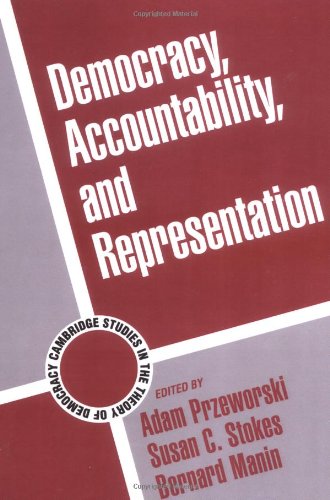
Democracy, Accountability, and Representation (Cambridge Studies in...
Authors:
Not Available
Publisher:
Cambridge University Press
Publication Date:
Not available
ISBN:
0521646162
This book examines whether mechanisms of accountability characteristic of democratic systems are sufficient to induce the representatives to act in the... best interest of the represented. The first part of the volume focuses on the role of elections, distinguishing different ways in which they may cause representation. The second part is devoted to the role of checks and balances, between the government and the parliament as well as between the government and the bureaucracy. Overall, the essays combine theoretical discussions, game-theoretic models, case studies, and statistical analyses, within a shared analytical approach and a standardized terminology. The empirical material is drawn from the well established democracies as well as from new democracies.

Democracy Against the State: Marx and the Machiavellian Movement
Authors:
Miguel Abensour
Publisher:
Polity
Publication Date:
Not available
ISBN:
0745650104
In the "Critique of Hegel's Philosophy of Right,” the young Marx elliptically alludes to a "true democracy" whose advent would go hand in hand with... the disappearance of the state. Miguel Abensour’s rigorous interpretation of this seminal text reveals an “unknown Marx” who undermines the identification of democracy with the state and defends a historically occluded form of politics.True democracy does not entail the political and economic power of the state, but it does not dream of a post-political society either. On the contrary, the battle of democracy is waged by a demos that invents a public sphere of permanent struggles, a politics that counters political bureaucracy and representation. Democracy is "won" by a people forewarned that any dissolution of the political realm in its independence, any subordination to the state, is tantamount to annihilating the site for gaining and regaining a genuinely human existence.In this explicitly heterodox reading of Marx, Miguel Abensour proposes a theory of "insurgent" democracy that makes political liberty synonymous with a living critique of domination.

Democracy, an American Novel
Authors:
Henry Adams
Publisher:
Not available
Publication Date:
Not available
ISBN:
Not available

Democracy: An American Novel
Authors:
Henry Adams
Publisher:
CreateSpace Independent Publishing Platform
Publication Date:
Not available
ISBN:
1449502113
An instant bestseller when first published in 1880, Democracy: An American Novel is the quintessential American political novel. At its heart is... Madeleine Lee, a young widow who comes to Washington, D.C., to understand the workings of power. Pursued by Silas Ratcliffe, the most influential member of the Senate, Madeleine soon sees enough of power and its corrupting influence to last her a lifetime. Democracy: An American Novel, a political novel, was written by Henry Brooks Adams and published anonymously in 1880. Only after Henry Adam's death in 1918 did the publisher reveal Adams's authorship. Democracy: An American Novel is about political power, its acquisition, use and abuse. It is set at the beginning of a new administration, with the election campaign just over and the new President of the United States just having been elected. Though the characters are fictitious, some resemblance could be seen between them and Presidents Andrew Jackson, James Garfield, and Ulysses Grant.

Democracy: An American Novel (Meridian)
Authors:
Henry Adams
Publisher:
Plume
Publication Date:
Not available
ISBN:
0452009421
An immediate bestseller upon its publication in 1880, the anonymously penned Democracy prompted widespread speculation and guessing games as to its... author’s identity. It is the story of Mrs. Lightfoot Lee, a society widow, and Silas Ratcliffe, the most influential member of the Senate, who, throughout the novel, pursues Mrs. Lee while at the same time battling her for power. Set in Washington in the 1870s, Democracy presents a scathing and incisive look at the intricate inner workings of politics and corruption that remains relevant today.This Modern Library Paperback Classic is set from the 1880 first edition and includes a contemporary review from The Atlantic Monthly.From the Trade Paperback edition.
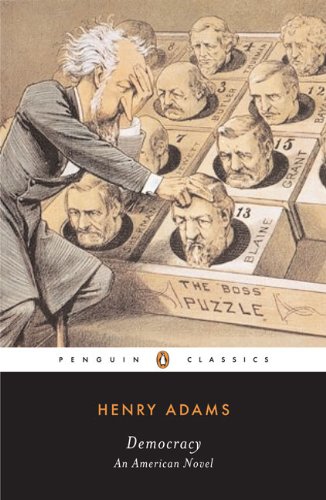
Democracy: An American Novel (Penguin Classics)
Authors:
Henry Adams
Publisher:
Penguin Classics
Publication Date:
Not available
ISBN:
0143039806
An instant bestseller when first published in 1880, Democracy is the quintessential American political novel. At its heart is Madeleine Lee, a young... widow who comes to Washington, D.C., to understand the workings of power. Pursued by Silas Ratcliffe, the most influential member of the Senate, Madeleine soon sees enough of power and its corrupting influence to last her a lifetime.
Democracy Ancient and Modern (Mason Welch Gross Lectureship Series)
Authors:
M. I. Finley
Publisher:
Rutgers University Press
Publication Date:
Not available
ISBN:
0813511275
This elegant and provocative book is perhaps more important now than when it was first published. The three essays that comprised the first edition... developed a remarkable discourse between ancient Greek and modern conceptions of democracy, in the belief that each society could help us understand the other. To the original three essays, Sir M. I. Finley has added two that clarify and elaborate the thinking of the first edition. The two new essays, "Athenian Dialogues" and "Censorship in Classical Antiquity" combine with "Leaders and Followers," "Democracy, Consensus, and the National Interest," "Socrates and After" to make this book an unusual inquiry. Few contemporary writers are able to bring to the subject the depth of learning and the persuasive power of language that Sir M. I. Finley brings.
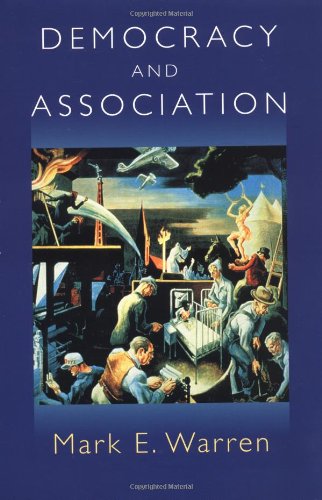
Democracy and Association
Authors:
Mark E. Warren
Publisher:
Princeton University Press
Publication Date:
Not available
ISBN:
0691050775
Tocqueville's view that a virtuous and viable democracy depends on robust associational life has become a cornerstone of contemporary democratic theory.... Democratic theorists generally agree that issue networks, recreational associations, support circles, religious groups, unions, advocacy groups, and myriad other kinds of associations enhance democracy by cultivating citizenship, promoting public deliberation, providing voice and representation, and enabling varied forms of governance. Yet there has been little work to show how and why different kinds of association have different effects on democracy--many supportive but others minimal or even destructive.This book offers the first systematic assessment of what associations do and don't do for democracy. Mark Warren explains how and when associational life expands the domain, inclusiveness, and authenticity of democracy. He looks at which associations are most likely to foster individuals' capacities for democratic citizenship, provoke political debate, open existing institutions, guide market activities, or bring democratic decision-making to new venues. Throughout, Warren also considers the trade-offs involved, noting, for example, that organizational solidarity can dampen internal dissent and deliberation even as it enhances public deliberation. Blending political and social theory with an eye to social science, Democracy and Association will draw social scientists with interests in democracy, political philosophers, students of public policy, as well as the many activists who fortify the varied landscape we call civil society. As an original analysis of which associational soils yield vigorous democracies, the book will have a major impact on democratic theory and empirical research.
Democracy and Authoritarianism in South Asia: A Comparative and...
Authors:
Ayesha Jalal
Publisher:
Cambridge University Press
Publication Date:
Not available
ISBN:
0521478626
Challenging the view that a shared colonial legacy led to contrasting patterns of political development in South Asia--democracy in India and... authoritarianism in Pakistan and Bangladesh--Ayesha Jalal argues that, despite differences in form, central political authority in each state has confronted similar threats from ethnic and regional movements. By comparing state structures and political processes, the author evaluates and redefines democracy, citizenship, sovereignty and the nation state, arguing for more decentralized government.

Democracy and Authoritarianism in the Arab World
Authors:
Nicola Christine Pratt
Publisher:
Lynne Rienner Pub
Publication Date:
Not available
ISBN:
1588264866

Democracy and Civil Society in Arab Political Thought:...
Authors:
Michaelle Browers
Publisher:
Syracuse University Press
Publication Date:
Not available
ISBN:
0815630999
Uncovers a rich and varied debate occurring in the world of Arab intellectuals about the meaning and function of a civil society in democratic political... theory. This book provides a significant and unique contribution to the emerging literature of comparative political thought. Michaelle L. Browers offers compelling evidence, with extensive analysis and references, that a rigorous debate is taking place in Arabic concerning the value of democracy and civil society. Exploring the globalization of ideas of democracy and civil society, Browers addresses the question of what occurs when concepts cross the boundaries of cultures or languages. She analyzes the historical concept of democracy in Arab and Islamic political thought, the transformations that have occurred over the past several decades resulting from Arab forays into an international discussion of civil society and what these transformations tell us about the status of ideological and conceptual debates in the region. The book’s value, however, lies in its main premise: despite the dearth of actual democratic practices in the Arab world, intellectual elites of the region have vigorously debated reform concepts for decades. Browers emphasizes that current conflicts involving the Middle East are less about Islam against the west and its secular allies in the region and more about diverse sectors of Arab society grappling with how to reform overreaching and unjust states. Browers shows that the seeds of democratic reform in the region were well planted prior to the war on Iraq and the Greater Middle East Initiative.

Democracy and Coercive Diplomacy (Cambridge Studies in...
Authors:
Kenneth A. Schultz
Publisher:
Cambridge University Press
Publication Date:
Not available
ISBN:
0521796695
Schultz explores the effects of democratic politics on coercive diplomacy. He argues that open political competition between government and opposition... parties influences threats in international crises, how rival states interpret those threats, and whether or not crises can be settled short of war. Compared to their nondemocratic counterparts, democracies make threats more selectively, but those they do make are more likely to be successful--that is, to gain a favorable outcome without war. Schultz uses game-theoretic models and tests the resulting hypothesis using both statistical analyses and historical case studies.
Democracy and Complexity: A Realist Approach
Authors:
Danilo Zolo
Publisher:
Pennsylvania State University Press
Publication Date:
Not available
ISBN:
027100892X
This book is a highly original and provocative contribution to democratic theory. Zolo argues that the increasing complexity of modern societies... represents a fundamental challenge to the basic assumptions of the Western democratic tradition and calls for a reformulation of some of the key questions of political theory. Zolo maintains that, as modern societies become more complex and more involved in the "information revolution," they are subjected to new and unprecedented forms of stress- as manifested, for instance, in the growing autonomy and power of political parties, and in new kinds of political communication which create the fiction of consensus. These stresses have become so serious that they threaten to undermine some of the values traditionally associated with democracy, such as the rationality and autonomy of the individual, and the visibility and accountability of power.In conclusion, Zolo develops a set of proposals which seek to renew democratic values and to contribute to a fundamental reform of Western political systems.

Democracy and Counterterrorism: Lessons from the Past
Authors:
Robert J. Art
Publisher:
United States Institute of Peace
Publication Date:
Not available
ISBN:
1929223935

Democracy and Democratization: Processes and Prospects in a...
Authors:
Georg Sorensen
Publisher:
Westview Press
Publication Date:
Not available
ISBN:
0813343801
What is democracy? What are the pitfalls and the positive potentials in the growing trend toward democratization? This book examines the prospects for... democracy in the world today and frames the central dilemma confronting all states touched by the process of democratization. Georg Sørensen clarifies the concept of democracy, shows its application in different contexts, and questions whether democratic advancement will continue-and if so, at what price. The consequences of democracy for economic development, human rights, and peaceful relations among countries are illuminated in both their positive and negative aspects. This third edition includes an entirely new chapter on the promotion of democracy from the outside which covers current issues of state building in Iraq. Further revisions include updates to the section on the prospects of democracy in today’s world, an extended discussion of the economic performance of recently democratized countries, and an evaluation of the possibilities for further democratic consolidation. There are also new case studies, examples, and anecdotes to illustrate historical as well as contemporary instances of democratic transition. Democracy, as Sørensen convincingly portrays it, is a value in itself as well as a potential promoter of peace, prosperity, and human well-being. But democracy is not inevitable, and actions at every level-from the individual to the international-are necessary to ensure that frail or frozen” democracies do not flounder and that established democracies flourish.
 '





