production
/viewbook/list/all/?page=3311
/
/static/
None
Democracy and Development: Political Institutions and Well-Being in...
Authors:
Adam Przeworski
Publisher:
Cambridge University Press
Publication Date:
Not available
ISBN:
0521793793
Is economic development conducive to political democracy? Does democracy foster or hinder material welfare? These two questions are examined by looking... at the experiences of 135 countries between 1950 and 1990. Descriptive information, statistical analyses, and historical narratives are interwoven to gain an understanding of the dynamic of political regimes and their impact on economic development. The often surprising findings dispel any notion of a tradeoff between democracy and development. Economic development does not generate democracies, but democracies are much more likely to survive in wealthy societies.

Democracy and Difference through the Aesthetics of Film
Authors:
TAHVILDARAN-JESSWEIN RICHARD
Publisher:
Kendall Hunt Publishing
Publication Date:
Not available
ISBN:
0757591531
Democracy and Distrust: A Theory of Judicial Review (Harvard...
Authors:
John Ely
Publisher:
Harvard University Press
Publication Date:
Not available
ISBN:
0674196376
This powerfully argued appraisal of judicial review may change the face of American law. Written for layman and scholar alike, the book addresses one... of the most important issues facing Americans today: within what guidelines shall the Supreme Court apply the strictures of the Constitution to the complexities of modern life? Until now legal experts have proposed two basic approaches to the Constitution. The first, "interpretivism," maintains that we should stick as closely as possible to what is explicit in the document itself. The second, predominant in recent academic theorizing, argues that the courts should be guided by what they see as the fundamental values of American society. Mr. Ely demonstrates that both of these approaches are inherently incomplete and inadequate. Democracy and Distrust sets forth a new and persuasive basis for determining the role of the Supreme Court today. Ely's proposal is centered on the view that the Court should devote itself to assuring majority governance while protecting minority rights. "The Constitution," he writes, "has proceeded from the sensible assumption that an effective majority will not unreasonably threaten its own rights, and has sought to assure that such a majority not systematically treat others less well than it treats itself. It has done so by structuring decision processes at all levels in an attempt to ensure, first, that everyone's interests will be represented when decisions are made, and second, that the application of those decisions will not be manipulated so as to reintroduce in practice the sort of discrimination that is impermissible in theory. Thus, Ely's emphasis is on the procedural side of due process, on the preservation of governmental structure rather than on the recognition of elusive social values. At the same time, his approach is free of interpretivism's rigidity because it is fully responsive to the changing wishes of a popular majority. Consequently, his book will have a profound impact on legal opinion at all levels-from experts in constitutional law, to lawyers with general practices, to concerned citizens watching the bewildering changes in American law.

Democracy and Education
Authors:
John Dewey
Publisher:
Dover Publications
Publication Date:
Not available
ISBN:
0486433994
In this landmark work on public education, Dewey discusses methods of providing quality public education in a democratic society. First published close... to 90 years ago, it sounded the call for a revolution in education, stressing growth, experience, and activity as factors that promote a democratic character in students.

Democracy and Education
Authors:
John Dewey
Publisher:
Echo Library
Publication Date:
Not available
ISBN:
1406861022
Democracy And Education
Authors:
John Dewey
Publisher:
Simon & Brown
Publication Date:
Not available
ISBN:
161382095X
John Dewey's "Democracy and Education" addresses the challenge of providing quality public education in a democratic society. In this classic work Dewey... calls for the complete renewal of public education, arguing for the fusion of vocational and contemplative studies in education and for the necessity of universal education for the advancement of self and society. First published in 1916, "Democracy and Education" is regarded as the seminal work on public education by one of the most important scholars of the century.
Democracy And Education
Authors:
John Dewey
Publisher:
Free Press
Publication Date:
Not available
ISBN:
0684836319
John Dewey's "Democracy and Education" addresses the challenge of providing quality public education in a democratic society. In this classic work Dewey... calls for the complete renewal of public education, arguing for the fusion of vocational and contemplative studies in education and for the necessity of universal education for the advancement of self and society. First published in 1916, "Democracy and Education" is regarded as the seminal work on public education by one of the most important scholars of the century.
Democracy and Education: An Introduction to the Philosophy of...
Authors:
John Dewey
Publisher:
Simon & Brown
Publication Date:
Not available
ISBN:
1936041871
In this landmark work on public education, Dewey discusses methods of providing quality public education in a democratic society. First published close... to 90 years ago, it sounded the call for a revolution in education, stressing growth, experience, and activity as factors that promote a democratic character in students.

Democracy and Education: Complete and Unabridged
Authors:
John Dewey
Publisher:
CreateSpace Independent Publishing Platform
Publication Date:
Not available
ISBN:
1449979203
"Democracy and Education" is a truly wonderful book with none of the dogmatic pretense or "scientific methods" features in so many competing treatises.... John Dewey's ideas are fresh, original, and beautifully crafted. Rather than presenting Dewey's ideas as explicit recommendations to be implemented, "Democracy and Education" provides a general exploration of educational aims and processes. In "Democracy and Education," Dewey explores closely connected concepts which are left out of other educational texts. His writing is clear and concise. Despite the passage of time, John Dewey remains as one of the greatest educational philosophers. Many of Dewey's catch phrases, such as "learning by doing," are now commonly repeated in educational circles. If you have not done so already, take the time to read "Democracy and Education," and see if you don't agree that it eclipses all other books on education.

Democracy and Education (Dodo Press)
Authors:
John Dewey
Publisher:
Dodo Press
Publication Date:
Not available
ISBN:
140993201X
Professor John Dewey (1859-1952) was an American philosopher, psychologist, and educational reformer, whose thoughts and ideas have been greatly... influential in the United States and around the world. He, along with Charles Sanders Peirce and William James, is recognized as one of the founders of the philosophical school of Pragmatism. He is also known as the father of functional psychology; he was a leading representative of the progressive movement in U. S. schooling during the first half of the 20th century. Along with the historian Charles Beard, economists Thorstein Veblen and James Harvey Robinson, Dewey is one of the founders of The New School for Social Research. Dewey's most significant writings were The Reflex Arc Concept in Psychology (1896), a critique of a standard psychological concept and the basis of all his further work; Human Nature and Conduct (1922), a study of the role of habit in human behaviour; The Public and its Problems (1927), a defense of democracy; Experience and Nature (1925), Dewey's most "metaphysical" statement; Art as Experience (1934), Dewey's major work on aesthetics and A Common Faith (1934), a humanistic study of religion.

Democracy and Elections in Africa
Authors:
Staffan I. Lindberg
Publisher:
The Johns Hopkins University Press
Publication Date:
Not available
ISBN:
0801883334
This volume studies elections as a core institution of liberal democracy in the context of newly democratizing countries. Political scientist Staffan I.... Lindberg gathers data from every nationally contested election in Africa from 1989 to 2003, covering 232 elections in 44 countries. He argues that democratizing nations learn to become democratic through repeated democratic behavior, even if their elections are often flawed. Refuting a number of established hypotheses, Lindberg finds no general negative trend in either the frequency or the quality of African elections. Rather, elections in Africa, based on his findings, are more than just the goal of a transition toward democracy or merely a formal procedure. The inception of multiparty elections usually initiates liberalization, and repeated electoral activities create incentives for political actors, fostering the expansion and deepening of democratic values. In addition to improving the democratic qualities of political regimes, a sequence of elections tends to expand and solidify de facto civil liberties in society. Drawing on a wealth of data, Lindberg makes the case that repetitive elections are an important causal factor in the development of democracy. He thus extends Rustow's (1970) theory that democratic behavior produces democratic values.
Democracy and Expertise: Reorienting Policy Inquiry
Authors:
Frank Fischer
Publisher:
Oxford University Press, USA
Publication Date:
Not available
ISBN:
0199565244
This book explores the role of policy expertise in a democratic society. From the perspectives of political science and policy theory, the chapters... examine the implications of deliberative democratic governance for professional expertise and extends them to specific policy practices. Following the earlier lead of John Dewey, the discussion focuses in particular on the ways professional practices might be reoriented to assist citizens in understanding and discussing the complex policy issues of an advanced technological society. In doing so, it also explores how public deliberation can be improved through more cooperative forms of policy inquiry. Adopting a deliberative-analytic approach to policy inquiry, grounded in a postempiricist, constructivist understanding of inquiry and knowledge and the participatory practices that support such an approach, the chapters draw on thriving theoretical and practical work dedicated to revitalizing the citizen's role in both civil society and newer practices of democratic governance-in particular deliberative democracy, practical work with deliberative experiments, the theory and practices of democratic governance, and participatory research. Deliberative practices are promoted here as a new component part of policy-related disciplines required for participatory governance. Calling for a specialization of "policy epistemics" to advance such practices, the second half of the book takes up issues related to deliberative empowerment, including the relation of technical and social knowledge, the interpretive dimensions of social meaning and multiple realities, the role of narrative knowledge and storylines, policy inquiry, social learning, tacit knowledge, the design of discursive spaces, and the place of emotional expression in public deliberation.
Democracy and International Conflict: An Evolution of the...
Authors:
James Lee Ray
Publisher:
University of South Carolina Press
Publication Date:
Not available
ISBN:
1570032416
In Democracy and International Conflict, James Lee Ray defends the idea, so optimistically advanced by diplomats in the wake of the Soviet Union’s... demise and so hotly debated by international relations scholars, that democratic states do not initiate war against one another and therefore offer an avenue to universal peace. Ray acknowledges that despite persuasive theoretical arguments and empirical evidence in favor of this idea, the democratic peace proposition is susceptible to attack on three points: the statistical rarity of both international wars and democracies; the difficulty in defining democracy; and the vulnerability of democratic regimes. To confront these criticisms, Ray offers a systematic analysis of regime transitions and a workable definition of democracy as well as careful scrutiny of cases in which democracies averted international conflict.
Democracy and Its Critics
Authors:
Robert A. Dahl
Publisher:
Yale University Press
Publication Date:
Not available
ISBN:
0300049382
In this book, one of the most prominent political theorists of our era makes a statement about what democracy is and why it is important. Robert Dahl... examines the most basic assumptions of democratic theory, tests them against the questions raised by its critics, and recasts the theory of democracy in a new and coherent whole. He concludes by discussing the directions in which democracy must move if advanced democratic states are to exist in the future.
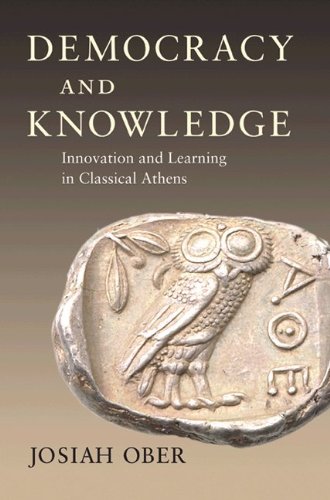
Democracy and Knowledge: Innovation and Learning in Classical Athens
Authors:
Josiah Ober
Publisher:
Princeton University Press
Publication Date:
Not available
ISBN:
0691146241
When does democracy work well, and why? Is democracy the best form of government? These questions are of supreme importance today as the United States... seeks to promote its democratic values abroad. Democracy and Knowledge is the first book to look to ancient Athens to explain how and why directly democratic government by the people produces wealth, power, and security. Combining a history of Athens with contemporary theories of collective action and rational choice developed by economists and political scientists, Josiah Ober examines Athenian democracy's unique contribution to the ancient Greek city-state's remarkable success, and demonstrates the valuable lessons Athenian political practices hold for us today. He argues that the key to Athens's success lay in how the city-state managed and organized the aggregation and distribution of knowledge among its citizens. Ober explores the institutional contexts of democratic knowledge management, including the use of social networks for collecting information, publicity for building common knowledge, and open access for lowering transaction costs. He explains why a government's attempt to dam the flow of information makes democracy stumble. Democratic participation and deliberation consume state resources and social energy. Yet as Ober shows, the benefits of a well-designed democracy far outweigh its costs. Understanding how democracy can lead to prosperity and security is among the most pressing political challenges of modern times. Democracy and Knowledge reveals how ancient Greek politics can help us transcend the democratic dilemmas that confront the world today.
 '





