production
/viewbook/list/all/?page=3312
/
/static/
None

Democracy and Other Neoliberal Fantasies: Communicative Capitalism...
Authors:
Jodi Dean
Publisher:
Duke University Press Books
Publication Date:
Not available
ISBN:
0822345056
Democracy and Other Neoliberal Fantasies is an impassioned call for the realization of a progressive left politics in the United States. Through an... assessment of the ideologies underlying contemporary political culture, Jodi Dean takes the left to task for its capitulations to conservatives and its failure to take responsibility for the extensive neoliberalization implemented during the Clinton presidency. She argues that the left’s ability to develop and defend a collective vision of equality and solidarity has been undermined by the ascendance of “communicative capitalism,” a constellation of consumerism, the privileging of the self over group interests, and the embrace of the language of victimization. As Dean explains, communicative capitalism is enabled and exacerbated by the Web and other networked communications media, which reduce political energies to the registration of opinion and the transmission of feelings. The result is a psychotic politics where certainty displaces credibility and the circulation of intense feeling trumps the exchange of reason.Dean’s critique ranges from her argument that the term democracy has become a meaningless cipher invoked by the left and right alike to an analysis of the fantasy of free trade underlying neoliberalism, and from an examination of new theories of sovereignty advanced by politicians and left academics to a look at the changing meanings of “evil” in the speeches of U.S. presidents since the mid-twentieth century. She emphasizes the futility of a politics enacted by individuals determined not to offend anyone, and she examines questions of truth, knowledge, and power in relation to 9/11 conspiracy theories. Dean insists that any reestablishment of a vital and purposeful left politics will require shedding the mantle of victimization, confronting the marriage of neoliberalism and democracy, and mobilizing different terms to represent political strategies and goals.

Democracy and Pluralism: The Political Thought of William E. Connolly
Authors:
Not Available
Publisher:
Routledge
Publication Date:
Not available
ISBN:
0415500559
William E. Connolly’s political theory forms a distinct and influential contribution to contemporary debates about the nature and prospects of... democratic life in the twenty-first century. His original conceptualisations of pluralism, naturalism, the politics of the body, religion, secularism and his daring incorporation of contemporary neurobiology into political theory and analysis, have opened new paths for intellectual enquiry. Connolly has brought an American tradition of pragmatist political thinking into fruitful conversation with the best of contemporary continental European philosophy and given to both a new energy and focus. In this edited collection, a distinguished panel of political theorists from both Europe and the US provide a critical and nuanced assessment of his contribution to the discipline, especially in the field of democratic theory. They identify the sources of Connolly’s work, its connections to other ways of thinking about the political and they evaluate his continuing contribution to our understanding of the problems and promises of the present and to our appreciation of what it might mean to fulfil the promise of the democratic way of life. The final chapter provides space for Connolly himself to reflect on his interlocutors and further develop his conception of a ‘world of becoming’ considering the links between political theory and the science of complexity while focusing on the immediate challenges facing both American and world politics. Democracy and Pluralism provides a critical introduction to the work of William E. Connolly and to contemporary debates in political theory encompassing topics such as radical democracy, the body, religion, time and contingency.

Democracy and Political Culture in Eastern Europe (Routledge...
Authors:
Not Available
Publisher:
Routledge
Publication Date:
Not available
ISBN:
0415479622
What is the relationship between democracy and political culture in countries undergoing major systemic change? Have subjective political orientations... of citizens been important in shaping the development of democracy in central and eastern Europe after the fall of communism? These core questions are tackled by an impressive range of twenty political scientists, sixteen of which are based in the central and eastern European countries covered in this essential new book. Their analyses draw on a unique set of data collected and processed by the contributors to this volume within the framework of the World Values Survey project. This data enables these authors to establish similarities and differences in support of democracy between a large number of countries with different cultural and structural conditions as well as historical legacies. The macro-level findings of the book tend to support the proposition that support of democracy declines the further east one goes. In contrast, micro-level relationships have been found to be astonishingly similar. For example, support of democracy is always positively related to higher levels of education – no matter where an individual citizen happens to live. This new book builds a clear understanding of what makes democracies strong and resistant to autocratic temptation.

Democracy and Public Administration
Authors:
Richard C. Box
Publisher:
M.E.Sharpe
Publication Date:
Not available
ISBN:
0765617013
This book examines the concepts, issues, and practices that comprise the core of organizational leadership from a global perspective. Underpinning its... story with a mixture of description, analysis, and critique, this book achieves a distinct point of view by examining leadership through a variety of unusual prisms and by giving competing and globally diverse viewpoints equal shares in the debate.

Democracy and Redistribution (Cambridge Studies in Comparative...
Authors:
Carles Boix
Publisher:
Cambridge University Press
Publication Date:
Not available
ISBN:
0521532671
Employing analytical tools borrowed from game theory, Carles Boix offers a complete theory of political transitions. It is one in which political... regimes ultimately depend on the nature of economic assets, their distribution among individuals, and the balance of power among different social groups. Backed by detailed historical research and extensive statistical analysis from the mid-nineteenth century, the study reveals why democracy emerged in classical Athens. It also covers the early triumph of democracy in nineteenth-century agrarian Norway, Switzerland and northeastern America as well as its failure in countries with a powerful landowning class.

Democracy and Social Ethics
Authors:
Jane Addams
Publisher:
CreateSpace Independent Publishing Platform
Publication Date:
Not available
ISBN:
1449582699
"Democracy and Social Ethics" is Jane Addam's earliest book on ethics, in which she reflects on the factors that hinder the ability of all members of... society to determine their own well-being. Observing relationships between charitable workers and their clients, between factory owners and their employers, and between household employers and their servants, Jane Addams identifies sources of friction and shows how conceiving of democracy as a social obligation can lead to new, mutually beneficial lines of conduct. In "Democracy and Social Ethics," Addams also considers the proper education of workers, struggles between parents and their adult daughters over conflicting family and social claims, and the merging of politics with the daily lives of constituents. Anyone who wants to know why we have a forty hour work, minimum wage laws, social security disability laws, age discrimination laws, social security laws, welfare laws, and large education budgets should read "Democracy and Social Ethics," where Addams tells about people earning pennies an hour, having their peak earning years in their twenties, being disabled in their thirties, and being dependent on children for financial support. The children, in turn had their education stop before high school so they can support their families.

Democracy and Social Ethics
Authors:
Jane Addams
Publisher:
CreateSpace Independent Publishing Platform
Publication Date:
Not available
ISBN:
1470049678
This anthology is a thorough introduction to classic literature for those who have not yet experienced these literary masterworks. For those who have... known and loved these works in the past, this is an invitation to reunite with old friends in a fresh new format. From Shakespeare s finesse to Oscar Wilde s wit, this unique collection brings together works as diverse and influential as The Pilgrim s Progress and Othello. As an anthology that invites readers to immerse themselves in the masterpieces of the literary giants, it is must-have addition to any library.

Democracy and Social Ethics
Authors:
Jane Addams
Publisher:
University of Illinois Press
Publication Date:
Not available
ISBN:
0252070232
Nearly a century before the advent of "multiculturalism," Jane Addams put forward her conception of the moral significance of diversity. Each member of... a democracy, Addams believed, is under a moral obligation to seek out diverse experiences, making a daily effort to confront others' perspectives. Morality must be seen as a social rather than an individual endeavor, and democracy as a way of life rather than merely a basis for laws. Failing this, both democracy and ethics remain sterile, empty concepts. In this, Addams' earliest book on ethics - presented here with a substantial introduction by Charlene Haddock Seigfried - she reflects on the factors that hinder the ability of all members of society to determine their own well-being. Observing relationships between charitable workers and their clients, between factory owners and their employers, and between household employers and their servants, she identifies sources of friction and shows how conceiving of democracy as a social obligation can lead to new, mutually beneficial lines of conduct. She also considers the proper education of workers, struggles between parents and their adult daughters over conflicting family and social claims, and the merging of politics with the daily lives of constituents. "The sphere of morals is the sphere of action," Addams proclaims. It is not enough to believe passively in the innate dignity of all human beings. Rather, one must work daily to root out racial, gender, class, and other prejudices from personal relationships.

Democracy and the Arts of Schooling
Authors:
Donald Arnstine
Publisher:
State University of New York Press
Publication Date:
Not available
ISBN:
0791427226
Arnstine shows how schools have been distracted from education by reformers urging higher standards-the code word for higher test scores. But education... is revealed in the dispositions a person has: sensitivity and resourcefulness, amiability and responsibility, taste, wit, and a disciplined intelligence. This book examines the conditions needed to foster dispositions like these, for they are not acquired by having the young spend more time studying standard academic subjects in preparation for competitive tests. Without recourse to esoteric jargon, Democracy and the Arts of Schooling shows why test scores are less significant than the quality of the experiences students have in school. When that quality is high-when it has the richness and the absorbing character we associate with the aesthetic-then learning takes place.

Democracy and the Foreigner
Authors:
Bonnie Honig
Publisher:
Princeton University Press
Publication Date:
Not available
ISBN:
0691114765
What should we do about foreigners? Should we try to make them more like us or keep them at bay to protect our democracy, our culture, our well-being?... This dilemma underlies age-old debates about immigration, citizenship, and national identity that are strikingly relevant today. In Democracy and the Foreigner, Bonnie Honig reverses the question: What problems might foreigners solve for us? Hers is not a conventional approach. Instead of lauding the achievements of individual foreigners, she probes a much larger issue--the symbolic politics of foreignness. In doing so she shows not only how our debates over foreignness help shore up our national or democratic identities, but how anxieties endemic to liberal democracy themselves animate ambivalence toward foreignness.Central to Honig's arguments are stories featuring ''foreign-founders,'' in which the origins or revitalization of a people depend upon a foreigner's energy, virtue, insight, or law. From such popular movies as The Wizard of Oz, Shane, and Strictly Ballroom to the biblical stories of Moses and Ruth to the myth of an immigrant America, from Rousseau to Freud, foreignness is represented not just as a threat but as a supplement for communities periodically requiring renewal. Why? Why do people tell stories in which their societies are dependent on strangers?One of Honig's most surprising conclusions is that an appreciation of the role of foreigners in (re)founding peoples works neither solely as a cosmopolitan nor a nationalist resource. For example, in America, nationalists see one archetypal foreign-founder--the naturalized immigrant--as reconfirming the allure of deeply held American values, whereas to cosmopolitans this immigrant represents the deeply transnational character of American democracy. Scholars and students of political theory, and all those concerned with the dilemmas democracy faces in accommodating difference, will find this book rich with valuable and stimulating insights.

Democracy and the Limits of Self-Government (Cambridge Studies in...
Authors:
Adam Przeworski
Publisher:
Cambridge University Press
Publication Date:
Not available
ISBN:
0521140110
The political institutions under which we live today evolved from a revolutionary idea that shook the world in the second part of the eighteenth... century: that a people should govern itself. Yet if we judge contemporary democracies by the ideals of self-government, equality, and liberty, we find that democracy is not what it was dreamt to be. This book addresses central issues in democratic theory by analyzing the sources of widespread dissatisfaction with democracies around the world. With attention throughout to historical and cross-national variations, the focus is on the generic limits of democracy in promoting equality, effective participation, control of governments by citizens, and liberty. The conclusion is that although some of this dissatisfaction has good reasons, some is based on an erroneous understanding of how democracy functions. Hence, although the analysis identifies the limits of democracy, it also points to directions for feasible reforms.

Democracy and the Market: Political and Economic Reforms in Eastern...
Authors:
Adam Przeworski
Publisher:
Cambridge University Press
Publication Date:
Not available
ISBN:
052142335X
The quest for freedom from hunger and repression has triggered in recent years a worldwide movement toward political democracy and economic rationality.... Never have so many people experimented with democratic institutions. At the same time, traditional strategies of economic development have collapsed in Eastern Europe and Latin America and entire economic systems are being transformed on both continents. What should we expect in the countries that venture on the paths to democracy and markets? Will these transitions result in democracies or in new dictatorships? What economic system, new or old, will emerge? This major book analyzes recent events in Eastern Europe and Latin America, focusing on transitions to democracy and market-oriented economic reforms. The author underscores the interdependence of political and economic transformations and draws on extensive local data as part of his analysis. A distinctive feature of the book is that it employs models derived from politics, economics, and game theory. This book will be of particular interest to scholars and graduate students in political science and sociology.

Democracy and the New Religious Pluralism
Authors:
Not Available
Publisher:
Oxford University Press, USA
Publication Date:
Not available
ISBN:
0195307291
Religious pluralism is everywhere in today's politics. Increased immigration flows, the collapse of communism, and the globalization of communications... technologies have all fostered a wider variety of religious beliefs, practices, and organizations within and across democratic societies. This is true in both the United States and Europe, where growing and diverse minority communities are transforming the political landscape. As a result, controversies over such things as headscarves and depictions of Mohammed are unsettling a largely secular Europe, while a Christian majority in the US faces familiar questions about church-state relations amidst unprecedented religious diversity. Far from receding into the background, religious language pervades arguments around established issues such as abortion and capital punishment, and new ones such as stem cell research and same-sex marriage. In Democracy and the New Religious Pluralism, leading scholars from multiple disciplines explore these dynamics and their implications for democratic theory and practice. What are the contours of this new religious pluralism? What are its implications for the theory and practice of democracy? Does increasing religious pluralism erode the cultural and social foundations of democracy? To what extent do different religious communities embrace similar -- or at least compatible -- ethical and political commitments? By seeking answers to these questions and revealing religious pluralism as both a source of animosity and a potent force for peaceful engagement, this book offers a revealing look at the future of religion in democratic societies.

Democracy and the Police (Critical Perspectives on Crime and Law)
Authors:
David Sklansky
Publisher:
Stanford University Press
Publication Date:
Not available
ISBN:
0804755647
Everyone is for "democratic policing"; everyone is against a "police state." But what do those terms mean, and what should they mean? The first half... of this book traces the connections between the changing conceptions of American democracy over the past half-century and the roughly contemporaneous shifts in ideas about the police—linking, on the one hand, the downfall of democratic pluralism and the growing popularity of participatory and deliberative democracy with, on the other hand, the shift away from the post-war model of professional law enforcement and the movement toward a new orthodoxy of community policing. The second half of the book explores how a richer set of ideas about policing might change our thinking about a range of problems and controversies associated with the police, ranging from racial profiling and the proliferation of private security, to affirmative action and the internal governance of law enforcement agencies.
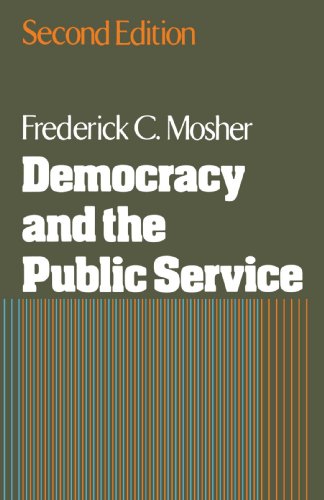
Democracy and the Public Service (Public Administration &...
Authors:
Frederick C. Mosher
Publisher:
Oxford University Press, USA
Publication Date:
Not available
ISBN:
0195030184
This revised edition, like the original, concerns the problems of harmonizing effective governmental administration with the requirements of a... democracy. It features a new chapter on the impact of management and theories of management upon public personnel administration, including discussion of the Model Public Personnel Law of 1940, the Watergate scandals and President Carter's personnel reforms of 1978.
 '





