production
/viewbook/list/all/?page=3316
/
/static/
None
Democracy Incorporated: Managed Democracy and the Specter of...
Authors:
Sheldon S. Wolin
Publisher:
Princeton University Press
Publication Date:
Not available
ISBN:
0691135665
Democracy is struggling in America--by now this statement is almost cliché. But what if the country is no longer a democracy at all? In Democracy... Incorporated, Sheldon Wolin considers the unthinkable: has America unwittingly morphed into a new and strange kind of political hybrid, one where economic and state powers are conjoined and virtually unbridled? Can the nation check its descent into what the author terms "inverted totalitarianism"? Wolin portrays a country where citizens are politically uninterested and submissive--and where elites are eager to keep them that way. At best the nation has become a "managed democracy" where the public is shepherded, not sovereign. At worst it is a place where corporate power no longer answers to state controls. Wolin makes clear that today's America is in no way morally or politically comparable to totalitarian states like Nazi Germany, yet he warns that unchecked economic power risks verging on total power and has its own unnerving pathologies. Wolin examines the myths and mythmaking that justify today's politics, the quest for an ever-expanding economy, and the perverse attractions of an endless war on terror. He argues passionately that democracy's best hope lies in citizens themselves learning anew to exercise power at the local level. Democracy Incorporated is one of the most worrying diagnoses of America's political ills to emerge in decades. It is sure to be a lightning rod for political debate for years to come.

Democracy, Inequality, and Representation: A Comparative Perspective
Authors:
Not Available
Publisher:
Russell Sage Foundation Publications
Publication Date:
Not available
ISBN:
0871543249

Democracy in Europe: The EU and National Polities
Authors:
Vivien A. Schmidt
Publisher:
Oxford University Press, USA
Publication Date:
Not available
ISBN:
0199266980
Democracy in Europe is about the impact of European integration on national democracies. It argues that the oft-cited democratic deficit is indeed a... problem, but not so much at the level of the European Union per se as at the national level. This is because national leaders and publics have yet to come to terms with the institutional impact of the EU on the traditional workings of their national democracies.The book begins with a discussion of what the EU is-a new form of 'regional state' in which sovereignty is shared, boundaries are variable, identity composite, and democracy fragmented. It then goes on to examine the effects of this on EU member-states' institutions and ideas about democracy, finding that institutional 'fit' matters. The 'compound' EU, in which governing activity is highly dispersed among multiple authorities, is more disruptive to 'simple' polities like Britain and France, where governing activity has traditionally been more concentrated in a single authority, than to similarly 'compound' polities like Germany and Italy.But the book concludes that the real problem for member-states is not so much that their practices have changed as that national ideas and discourse about democracy have not. The failure has been one of the 'communicative' discourse to the general public-which again has been more pronounced for simple polities, despite their potentially greater capacity to communicate through a single voice, than for compound polities, where the 'coordinative' discourse among policy actors predominates.
Democracy in Iran: History and the Quest for Liberty
Authors:
Ali Gheissari
Publisher:
Oxford University Press, USA
Publication Date:
Not available
ISBN:
0195189671
Today Iran is once again in the headlines. Reputed to be developing nuclear weapons, the future of Iraq's next-door neighbor is a matter of grave... concern both for the stability of the region and for the safety of the global community. President George W. Bush labeled it part of the "Axis of Evil," and rails against the country's authoritarian leadership. Yet as Bush trumpets the spread of democracy throughout the Middle East, few note that Iran has one of the longest-running experiences with democracy in the region.In this book, Ali Gheissari and Vali Nasr look at the political history of Iran in the modern era, and offer an in-depth analysis of the prospects for democracy to flourish there. After having produced the only successful Islamist challenge to the state, a revolution, and an Islamic Republic, Iran is now poised to produce a genuine and indigenous democratic movement in the Muslim world. Democracy in Iran is neither a sudden development nor a western import, Gheissari and Nasr argue. The concept of democracy in Iran today may appear to be a reaction to authoritarianism, but it is an old idea with a complex history, one that is tightly interwoven with the main forces that have shaped Iranian society and politics, institutions, identities, and interests. Indeed, the demand for democracy first surfaced in Iran a century ago at the end of the Qajar period, and helped produce Iran's surprisingly liberal first constitution in 1906. Gheissari and Nasr seek to understand why democracy failed to grow roots and lost ground to an autocratic Iranian state. Why was democracy absent from the ideological debates of the 1960s and 1970s? Most important, why has it now become a powerful social, political, and intellectual force? How have modernization, social change, economic growth, and the experience of the revolution converged to make this possible?
Democracy in Iran: History and the Quest for Liberty
Authors:
Ali Gheissari
Publisher:
Oxford University Press, USA
Publication Date:
Not available
ISBN:
0195396960
Today Iran is once again in the headlines. Reputed to be developing nuclear weapons, the future of Iraq's next-door neighbor is a matter of grave... concern both for the stability of the region and for the safety of the global community. President George W. Bush labeled it part of the "Axis of Evil," and rails against the country's authoritarian leadership. Yet as Bush trumpets the spread of democracy throughout the Middle East, few note that Iran has one of the longest-running experiences with democracy in the region.In this book, Ali Gheissari and Vali Nasr look at the political history of Iran in the modern era, and offer an in-depth analysis of the prospects for democracy to flourish there. After having produced the only successful Islamist challenge to the state, a revolution, and an Islamic Republic, Iran is now poised to produce a genuine and indigenous democratic movement in the Muslim world. Democracy in Iran is neither a sudden development nor a western import, Gheissari and Nasr argue. The concept of democracy in Iran today may appear to be a reaction to authoritarianism, but it is an old idea with a complex history, one that is tightly interwoven with the main forces that have shaped Iranian society and politics, institutions, identities, and interests. Indeed, the demand for democracy first surfaced in Iran a century ago at the end of the Qajar period, and helped produce Iran's surprisingly liberal first constitution in 1906. Gheissari and Nasr seek to understand why democracy failed to grow roots and lost ground to an autocratic Iranian state. Why was democracy absent from the ideological debates of the 1960s and 1970s? Most important, why has it now become a powerful social, political, and intellectual force? How have modernization, social change, economic growth, and the experience of the revolution converged to make this possible?

Democracy in Latin America: Political Change in Comparative...
Authors:
Peter H. Smith
Publisher:
Oxford University Press, USA
Publication Date:
Not available
ISBN:
0195387732
Thoroughly updated in its second edition, Democracy in Latin America provides an in-depth and accessible survey of processes of democratization in Latin... America from 1900 to the present. In clear and jargon-free prose, acclaimed author Peter H. Smith examines the origins and evolution of democracy in Latin America; the adoption and reform of electoral institutions; the policy performance of contemporary democracies; the political representation of women, workers, and indigenous peoples; and trends in public opinion. Adroitly blending qualitative and quantitative approaches, Democracy in Latin America, Second Edition, offers an innovative perspective on democratic change in Latin America. Enhanced by photos and text boxes featuring portraits of personalities, explanations about methodology, and comments on conceptual approaches, it is ideal for undergraduate and graduate courses in political science, history, Latin American studies, and history.FEATURES OF THE SECOND EDITION:* Updates empirical information on present-day developments, such as women's representation, the empowerment of indigenous peoples, and anti-poverty policies* Interprets the emergence of the "new Left" as part of a recurring dialectic within Latin American democracy* Analyzes the changing roles of the judiciary* Considers the relationship between social status and satisfaction with democracy* Reassesses the relative balance between "liberal" and "illiberal" democracy throughout the region* Provides a completely new analysis of public opinion on the basis of raw survey data* Takes into account the contemporary international environment, inlcuding the rise of China

Democracy in Modern Spain
Authors:
Professor Richard Gunther
Publisher:
Yale University Press
Publication Date:
Not available
ISBN:
030010152X
This book, written by three of the world's leading experts on Spanish politics, is the first comprehensive study of the origins and basic character of... Spain's democratic political system. It analyses the regime's core political institutions, its political parties and party systems, patterns of electoral behaviour, the evolution of Spain's political culture, and the impact of these social and institutional changes on public policy processes and outputs. The authors survey those aspects of Spanish society and politics that had contributed to the country's inability to sustain a stable and d'emocratic regime prior to the 1970s. They argue that the successful" transition to and consolidation of democracy was made possible by socioeconomic modernisation, cultural change, and by decisions made by political elites in the establishment of core democratic institutions and the conduct of electoral competition. This book is based on over 500 hours of interviews with Spanish political elites, extensive analyses of survey data, and other original research.

Democracy in Practice: Public Participation in Environmental Decisions
Authors:
Thomas C. Beierle
Publisher:
Routledge
Publication Date:
Not available
ISBN:
1891853546
In spite of the expanding role of public participation in environmental decisionmaking, there has been little systematic examination of whether it has,... to date, contributed toward better environmental management. Neither have there been extensive empirical studies to examine how participation processes can be made more effective. Democracy in Practice brings together, for the first time, the collected experience of 30 years of public involvement in environmental decisionmaking. Using data from 239 cases, the authors evaluate the success of public participation and the contextual and procedural factors that lead to it. Thomas Beierle and Jerry Cayford demonstrate that public participation has not only improved environmental policy, but it has also played an important educational role and has helped resolve the conflict and mistrust that often plague environmental issues. Among the authors' findings are that intensive 'problem-solving' processes are most effective for achieving a broad set of social goals, and participant motivation and agency responsiveness are key factors for success. Democracy in Practice will be useful for a broad range of interests. For researchers, it assembles the most comprehensive data set on the practice of public participation, and presents a systematic typology and evaluation framework. For policymakers, political leaders, and citizens, it provides concrete advice about what to expect from public participation, and how it can be made more effective. Democracy in Practice concludes with a systematic guide for use by government agencies in their efforts to design successful public participation efforts.

Democracy in Suburbia.
Authors:
J. Eric Oliver
Publisher:
Princeton University Press
Publication Date:
Not available
ISBN:
0691088802
Suburbanization is often blamed for a loss of civic engagement in contemporary America. How justified is this claim? Just what is a suburb? How do... social environments shape civic life? Looking beyond popular stereotypes, Democracy in Suburbia answers these questions by examining how suburbs influence citizen participation in community and public affairs. Eric Oliver offers a rich, engaging account of what suburbia means for American democracy and, in doing so, speaks to the heart of widespread debate on the health of our civil society.Applying an innovative, unusually rigorous mode of statistical analysis to a wealth of unique survey and census data, Oliver argues that suburbs, by institutionalizing class and racial differences with municipal boundaries, transform social conflicts between citizens into ones between political institutions. In reducing the incentives for individual political participation, suburbanization has negated the benefits of ''small town'' government and deprived metropolitan areas of valuable civic capacity. This ultimately increases prospects of serious social conflict.Oliver concludes that we must reconfigure suburban governments to allow seemingly intractable issues of common metropolitan concern to surface in local politics rather than be ignored as cross-jurisdictional. And he believes this is possible without sacrifice of local government's advantages. Scholars and students of political science, sociology, and urban affairs will prize this book for its striking findings, its revealing scrutiny of the commonplace, and its insights into how the pursuit of the American dream may be imperiling American democracy.

Democracy in the Age of New Media
Authors:
Tauel Harper
Publisher:
Peter Lang Publishing
Publication Date:
Not available
ISBN:
1433109107
In the age of the spectacle, democracy has never looked so bleak. Our world, saturated with media and marketing, endlessly confronts us with spectacles... vying for our attention: from Apple and 9/11 to Facebook and the global financial crisis. Democratic politics, by comparison, remain far from engaging. A society obsessed with spectacles results in a complete misfiring of the democratic system.This book uses critical democratic theory to outline the effects of consumer culture on citizenship. It highlights the importance that public space plays in creating the critical culture necessary for a healthy democracy, and outlines how contemporary public spaces—shopping centres, the Internet, social networking sites and suburban communities—contribute to this culture. Terrorism, ecological destruction and the financial crisis are also outlined as symptoms of the politics of the spectacle. The book concludes with some basic principles and novel suggestions which could be employed to avoid the pitfalls inherent in our spectacular existence.
Democracy in the Caribbean: Political, Economic, and Social...
Authors:
Not Available
Publisher:
The Johns Hopkins University Press
Publication Date:
Not available
ISBN:
0801844517
Regional experts have long noted the surprising rate of democratization in the Caribbean. Ten out of the twelve English-speaking Caribbean island-states... -- among a total of sixteen independent Caribbean nations -- have maintained relatively stable democracies since independence, a better rate of success than that of Latin America. In Democracy In The Caribbean sixteen Caribbean area specialists offer both global and regional perspectives in an effort to explain why this is so.
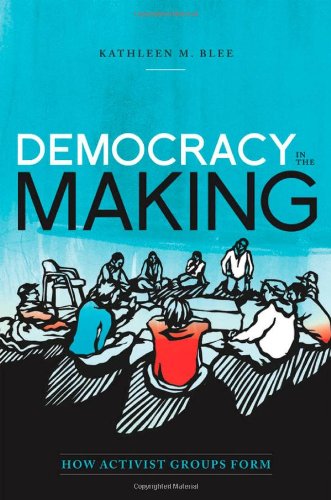
Democracy in the Making: How Activist Groups Form (Oxford Studies...
Authors:
Kathleen M. Blee
Publisher:
Oxford University Press, USA
Publication Date:
Not available
ISBN:
0199842760
With civic engagement commonly understood to be on the decline and traditional bases of community and means of engagement increasingly fractured, how do... people become involved in collective civic action? How do activist groups form? What hampers the ability of these groups to invigorate political life, and what enables it? Kathleen Blee's groundbreaking new study provides a provocative answer: the early times matter. By following grassroots groups from their very beginnings, Blee traces how their sense of possibility shrinks over time as groups develop a shared sense of who they are that forecloses options that were once open. At the same time, she charts the turning points at which options re-open and groups become receptive to change and reinvention. Based on observing more than sixty grassroots groups in Pittsburgh for three years, Democracy in the Making is an unprecedented look at how ordinary people come together to change society. It gives a close-up look at the deliberations of activists on the left and right as they work for animal rights, an end to the drug trade in their neighbourhood, same-sex marriage, global peace, and more. It shows how grassroots activism can provide an alternative to civic disengagement and a forum for envisioning how the world can be transformed. At the same time, it documents how activist groups become mired in dysfunctional and undemocratic patterns that their members dislike, but cannot fix.By analyzing the possibilities and pitfalls that face nascent activist organizations, Blee reveals how critical early choices are to the success of grassroots activism. Vital for scholars and activists alike, this practical yet profound study shows us, through the examples of both groups that flourish and those that flounder, how grassroots activism can better live up to its democratic potential.

Democracy in Translation: Understanding Politics in an Unfamiliar...
Authors:
Frederic Charles Schaffer
Publisher:
Cornell University Press
Publication Date:
Not available
ISBN:
0801486912
Frederic C. Schaffer challenges the assumption often made by American scholars that democracy has been achieved in foreign countries when criteria such... as free elections are met. Elections, he argues, often have cultural underpinnings that are invisible to outsiders. To examine grassroots understandings of democratic institutions and political concepts, Schaffer conducted fieldwork in Senegal, a mostly Islamic and agrarian country with a long history of electoral politics. Schaffer discovered that ideas of "demokaraasi" held by Wolof-speakers often reflect concerns about collective security. Many Senegalese see voting as less a matter of choosing leaders than of reinforcing community ties that may be called upon in times of crisis.By looking carefully at language, Schaffer demonstrates that institutional arrangements do not necessarily carry the same meaning in different cultural contexts. Democracy in Translation asks how social scientists should investigate the functioning of democratic institutions in cultures dissimilar from their own, and raises larger issues about the nature of democracy, the universality of democratic ideals, and the practice of cross-cultural research.

Democracy in What State? (New Directions in Critical Theory)
Authors:
Giorgio Agamben
Publisher:
Columbia University Press
Publication Date:
Not available
ISBN:
0231152981
"Is it meaningful to call oneself a democrat? And if so, how do you interpret the word?"In responding to this question, eight iconoclastic thinkers... prove the rich potential of democracy, along with its critical weaknesses, and reconceive the practice to accommodate new political and cultural realities. Giorgio Agamben traces the tense history of constitutions and their coexistence with various governments. Alain Badiou contrasts current democratic practice with democratic communism. Daniel Bensaid ponders the institutionalization of democracy, while Wendy Brown discusses the democratization of society under neoliberalism. Jean-Luc Nancy measures the difference between democracy as a form of rule and as a human end, and Jacques Rancière highlights its egalitarian nature. Kristin Ross identifies hierarchical relationships within democratic practice, and Slavoj Zizek complicates the distinction between those who desire to own the state and those who wish to do without it.Concentrating on the classical roots of democracy and its changing meaning over time and within different contexts, these essays uniquely defend what is left of the left-wing tradition after the fall of Soviet communism. They confront disincentives to active democratic participation that have caused voter turnout to decline in western countries, and they address electoral indifference by invoking and reviving the tradition of citizen involvement. Passionately written and theoretically rich, this collection speaks to all facets of modern political and democratic debate.

Democracy Is a Good Thing: Essays on Politics, Society, and Culture...
Authors:
Keping Yu
Publisher:
Brookings Institution Press
Publication Date:
Not available
ISBN:
0815722184
"Democracy is a good thing. This is true not only for individuals or certain officials but also for the entire nation and for all the people of... China."–Yu KepingSo begins "Democracy Is a Good Thing," an essay of great influence that has commanded attention and provoked discussion throughout the world. It is the touchstone of this important volume of the same name. As one of China's foremost political thinkers and a leading proponent of democratizing the People's Republic, Yu Keping is a major figure not only in his native land, but also in the international community. This book brings together much of his most important work and makes it readily accessible to readers in the West for the first time."Democracy Is a Good Thing" created a stir internationally. Perhaps more important, however, is the heated debate it spurred within China on the desirability of democratic reform. That important essay appears here, along with several of Yu Keping's other influential works on politics, culture, and civil society. His topics include China's economic modernization, its institutional environment, and the cultural changes that have accompanied the nation's reforms. Democracy Is a Good Thing pulls back the curtain to reveal ongoing discourse in Chinese political and intellectual circles, discussions that will go a long way toward determining the future of the world's most populous nation.
 '





