production
/viewbook/list/all/?page=3353
/
/static/
None
Designing Effective Science Instruction: What Works in Science...
Authors:
Anne Tweed
Publisher:
National Science Teachers Association
Publication Date:
Not available
ISBN:
1935155067
Science teachers, like all teachers, start each school year with high hopes and expectations for students to succeed. They plan their lessons, scramble... to get the necessary equipment, and work hard to engage their students. However, despite good intentions and best-laid plans, not all students do well in science classes, and even fewer achieve mastery. We see the effects of this all around us. Student performance on national and international assessments, including science assessments, is poor. More and more adults are unable to understand the scientific issues that affect their lives and society. The media reports that national economic competitiveness is at stake. It s clear that something must be done now to help science teachers put power behind their hopes and expectations for student achievement. Designing Effective Science Instruction: What Works in Science Classrooms is meant to help teachers focus on what can and must be done. It draws upon recent research in science education, most notably a well-designed study of science classrooms which sheds light on possible reasons for poor student performance in science (Weiss et al. 2003; Banilower et al. 2008). This research study and subsequent report on effective science instruction revealed that, in a national sample of science classrooms, about two-thirds of science lessons observed were of low quality. In other words, too many science students sit passively, never being asked to make sense of the content that teachers deliver. Too many science activities masquerade as science lessons and fail to develop students understanding of science concepts. Too many teachers lower their expectations and avoid teaching a rigorous science curriculum. The pressure teachers feel to meet student achievement goals is immense. With emerging research findings about how students learn and how to teach effectively, guidance for teachers is available
Designing E-Learning (Astd E-Learning Series, 6th Bk.)
Authors:
Saul Carliner
Publisher:
ASTD Press
Publication Date:
Not available
ISBN:
1562863320
Don't design e-learning programs from scratch-use this book to adapt your instructional design expertise to the demands of this new technology. Receive... step-by-step guidelines, discover solutions to key challenges, and learn how to balance the educational needs of your learners with the practical constraints of e-learning.
Designing Elementary Instruction and Assessment: Using the...
Authors:
Not Available
Publisher:
Corwin Press
Publication Date:
Not available
ISBN:
1412971217
Covering the major content areas, this resource shows how to develop measurable, standards-based lesson objectives and appropriate assessments that tap... into all levels of Bloom’s Taxonomy.
Designing Embedded Hardware
Authors:
John Catsoulis
Publisher:
O'Reilly Media
Publication Date:
Not available
ISBN:
0596007558
Embedded computer systems literally surround us: they're in our cell phones, PDAs, cars, TVs, refrigerators, heating systems, and more. In fact,... embedded systems are one of the most rapidly growing segments of the computer industry today.Along with the growing list of devices for which embedded computer systems are appropriate, interest is growing among programmers, hobbyists, and engineers of all types in how to design and build devices of their own. Furthermore, the knowledge offered by this book into the fundamentals of these computer systems can benefit anyone who has to evaluate and apply the systems.The second edition of Designing Embedded Hardware has been updated to include information on the latest generation of processors and microcontrollers, including the new MAXQ processor. If you're new to this and don't know what a MAXQ is, don't worry--the book spells out the basics of embedded design for beginners while providing material useful for advanced systems designers.Designing Embedded Hardware steers a course between those books dedicated to writing code for particular microprocessors, and those that stress the philosophy of embedded system design without providing any practical information. Having designed 40 embedded computer systems of his own, author John Catsoulis brings a wealth of real-world experience to show readers how to design and create entirely new embedded devices and computerized gadgets, as well as how to customize and extend off-the-shelf systems.Loaded with real examples, this book also provides a roadmap to the pitfalls and traps to avoid. Designing Embedded Hardware includes:The theory and practice of embedded systems Understanding schematics and data sheets Powering an embedded system Producing and debugging an embedded system Processors such as the PIC, Atmel AVR, and Motorola 68000-series Digital Signal Processing (DSP) architectures Protocols (SPI and I2C) used to add peripherals RS-232C, RS-422, infrared communication, and USB CAN and Ethernet networking Pulse Width Monitoring and motor control If you want to build your own embedded system, or tweak an existing one, this invaluable book gives you the understanding and practical skills you need.
Designing Embedded Systems with PIC Microcontrollers, Second...
Authors:
Tim Wilmshurst
Publisher:
Newnes
Publication Date:
Not available
ISBN:
1856177505
PIC microcontrollers are used worldwide in commercial and industrial devices. The 8-bit PIC which this book focuses on is a versatile work horse that... completes many designs. An engineer working with applications that include a microcontroller will no doubt come across the PIC sooner rather than later. It is a must to have a working knowledge of this 8-bit technology. This book takes the novice from introduction of embedded systems through to advanced development techniques for utilizing and optimizing the PIC family of microcontrollers in your device. To truly understand the PIC, assembly and C programming language must be understood. The author explains both with sample code and examples, and makes the transition from the former to the latter an easy one. This is a solid building block for future PIC endeavors. New to the 2nd Edition:*Include end of chapter questions/activities moving from introductory to advanced*More worked examples *Includes PowerPoint slides for instructors *Includes all code snips on a companion web site for ease of use *A survey of 16/32-bit PICs*A project using ZigBee *Covers both assembly and C programming languages, essential for optimizing the PIC*Amazing breadth of coverage moving from introductory to advanced topics covering more and more complex microcontroller families*Details MPLAB and other Microchip design tools

Designing Experiments and Analyzing Data: A Model Comparison...
Authors:
Scott E. Maxwell
Publisher:
Routledge Academic
Publication Date:
Not available
ISBN:
0805837183
Through this book's unique model comparison approach, students and researchers are introduced to a set of fundamental principles for analyzing data.... After seeing how these principles can be applied in simple designs, students are shown how these same principles also apply in more complicated designs. Drs. Maxwell and Delaney believe that the model comparison approach better prepares students to understand the logic behind a general strategy of data analysis appropriate for various designs; and builds a stronger foundation, which allows for the introduction of more complex topics omitted from other books. Several learning tools further strengthen the reader's understanding: *flowcharts assist in choosing the most appropriate technique; *an equation cross-referencing system aids in locating the initial, detailed definition and numerous summary equation tables assist readers in understanding differences between different methods for analyzing their data; *examples based on actual research in a variety of behavioral sciences help students see the applications of the material; *numerous exercises help develop a deeper understanding of the subject. Detailed solutions are provided for some of the exercises and *realistic data sets allow the reader to see an analysis of data from each design in its entirety. Updated throughout, the second edition features: *significantly increased attention to measures of effects, including confidence intervals, strength of association, and effect size estimation for complex and simple designs; *an increased use of statistical packages and the graphical presentation of data; *new chapters (15 & 16) on multilevel models; *the current controversies regarding statistical reasoning, such as the latest debates on hypothesis testing (ch. 2); *a new preview of the experimental designs covered in the book (ch. 2); *a CD with SPSS and SAS data sets for many of the text exercises, as well as tutorials reviewing basic statistics and regression; and *a Web site containing examples of SPSS and SAS syntax for analyzing many of the text exercises. Appropriate for advanced courses on experimental design or analysis, applied statistics, or analysis of variance taught in departments of psychology, education, statistics, business, and other social sciences, the book is also ideal for practicing researchers in these disciplines. A prerequisite of undergraduate statistics is assumed. An Instructor's Solutions Manual is available to those who adopt the book for classroom use.

Designing Field Studies for Biodiversity Conservation
Authors:
Peter Feinsinger
Publisher:
Island Press
Publication Date:
Not available
ISBN:
1559638788
This work explains how to undertake field studies to guide conservation work. It is aimed at anyone working in conservation regardless of their... professional or scientific background. The methods and procedures of scientific inquiry are explained in a step-by-step manner. The author wants to make the process of doing science accessible and effective. The purpose of this book is not only to offer information, but primarily to catalyze the process of good thinking, so that readers can learn how to think and understand the importance of broad inquiry, no matter what the conservation project.
Designing for Cisco Internetwork Solutions (DESGN) Foundation...
Authors:
Sean Wilkins
Publisher:
Cisco Press
Publication Date:
Not available
ISBN:
158720424X
Designing for Cisco Internetwork Solutions (DESGN) Foundation Learning Guide Third Edition Sean Wilkins Foundation learning for the CCDA DESGN... 640-864 exam Designing for Cisco Internetwork Solutions (DESGN) Foundation Learning Guide, Third Edition, is a Cisco®-authorized, self-paced learning tool for CCDA® foundation learning. This book provides you with the knowledge needed to design enterprise networks. By reading this book, you will gain a thorough understanding of designing routed and switched network infrastructures and services involving LAN, WAN, and broadband access for businesses and organizations. Designing for Cisco Internetwork Solutions (DESGN) Foundation Learning Guide, Third Edition teaches you how to gather internetworking requirements, identify solutions, and design the network infrastructure and services to ensure basic functionality using the principles of hierarchical network design to structure and modularize a converged enterprise network design. Specific topics include understanding the design methodology; structuring and modularizing the network design; designing the Enterprise Campus, Enterprise Data Center, Enterprise Edge, and remote modules as needed; designing an addressing plan and selecting suitable routing protocols; designing basic voice transport across the network; designing a basic wireless solution; and evaluating security solutions. Chapter-ending review questions illustrate and help solidify the concepts presented in the book. Whether you are preparing for CCDA certification or simply want to gain a better understanding of network design principles, you will benefit from the foundation information presented in this book. Designing for Cisco Internetwork Solutions (DESGN) Foundation Learning Guide, Third Edition, is part of a recommended learning path from Cisco that includes simulation and hands-on training from authorized Cisco Learning Partners and self-study products from Cisco Press. To find out more about instructor-led training, e-learning, and hands-on instruction offered by authorized Cisco Learning Partners worldwide, please visit www.cisco.com/go/authorizedtraining. · Understand network design methodologies and the lifecycle of a network · Learn how to structure and modularize network designs within the Cisco Network Architectures for the Enterprise · Design basic campus and data center networks · Build designs for remote connectivity with WAN technologies · Examine IPv4 and IPv6 addressing schemes · Select the appropriate routing protocols for various modules in the enterprise architecture · Evaluate security solutions for the network · Identify voice and video networking considerations · Understand design technologies and considerations when implementing a controller-based wireless network This book is in the Foundation Learning Guide Series. These guides are developed together with Cisco® as the only authorized, self-paced learning tools that help networking professionals build their understanding of networking concepts and prepare for Cisco certification exams.
Designing for Emotion
Authors:
Aaron Walter
Publisher:
Prentice Hall
Publication Date:
Not available
ISBN:
1937557006
Make your users fall in love with your site via the precepts packed into this brief, charming book by MailChimp user experience design lead Aarron... Walter. From classic psychology to case studies, highbrow concepts to common sense, Designing for Emotion demonstrates accessible strategies and memorable methods to help you make a human connection through design.
Designing for Growth: A Design Thinking Toolkit for Managers...
Authors:
Jeanne Liedtka
Publisher:
Columbia University Press
Publication Date:
Not available
ISBN:
0231158386
Jeanne Liedtka and Tim Ogilvie educate readers in one of the hottest trends in business: "design thinking," or the ability to turn abstract ideas into... practical applications for maximal business growth. Liedtka and Ogilvie cover the mind-set, techniques, and vocabulary of design thinking, unpack the mysterious connection between design and growth, and teach managers in a straightforward way how to exploit design's exciting potential. Exemplified by Apple and the success of its elegant products and cultivated by high-profile design firms such as IDEO, design thinking unlocks creative right-brain capabilities to solve a range of problems. This approach has become a necessary component of successful business practice, helping managers turn abstract concepts into everyday tools that grow business while minimizing risk.
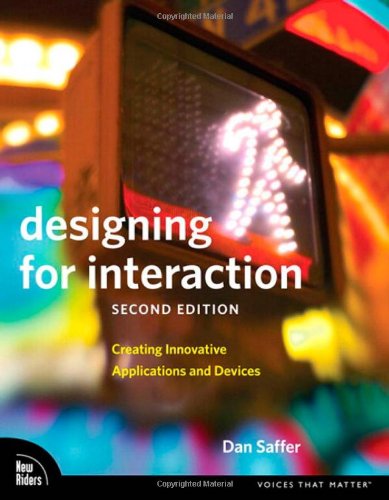
Designing for Interaction: Creating Innovative Applications and...
Authors:
Dan Saffer
Publisher:
New Riders
Publication Date:
Not available
ISBN:
0321643399
Building products and services that people interact with is the big challenge of the 21st century. Dan Saffer has done an amazing job synthesizing the... chaos into an understandable, ordered reference that is a bookshelf must-have for anyone thinking of creating new designs.”— Jared Spool, CEO of User Interface Engineering Interaction design is all around us. If you’ve ever wondered why your mobile phone looks pretty but doesn’t work well, you’ve confronted bad interaction design. But if you’ve ever marveled at the joy of using an iPhone, shared your photos on Flickr, used an ATM machine, recorded a television show on TiVo, or ordered a movie off Netflix, you’ve encountered good interaction design: products that work as well as they look. Interaction design is the new field that defines how our interactive products behave. Between the technology that powers our devices and the visual and industrial design that creates the products’ aesthetics lies the practice that figures out how to make our products useful, usable, and desirable. This thought-provoking new edition of Designing for Interaction offers the perspective of one of the most respected experts in the field, Dan Saffer. This book will help you learn to create a design strategy that differentiates your product from the competition use design research to uncover people’s behaviors, motivations, and goals in order to design for them employ brainstorming best practices to create innovativenew products and solutions understand the process and methods used to define product behavior It also offers interviews and case studies from industry leaders on prototyping, designing in an Agile environment, service design, ubicomp, robots, and more.

Designing for Interaction: Creating Smart Applications and Clever...
Authors:
Dan Saffer
Publisher:
Peachpit Press
Publication Date:
Not available
ISBN:
0321432061
Explore the new design discipline that is behind such products as the iPod and innovative Web sites like Flickr. While other books on this subject are... either aimed at more seasoned practitioners or else are too focused on a particular medium like software, this guide will take a more holistic approach to the discipline, looking at interaction design for the Web, software, and devices. It is the only interaction design book that is coming from a designers point of view rather than that of an engineer. This much-needed guide is more than just a how-to manual. It covers interaction design fundamentals, approaches to designing, design research, and more, and spans all mediums—Internet, software, and devices. Even robots! Filled with tips, real-world projects, and interviews, you’ll get a solid grounding in everything you need to successfully tackle interaction design. Designing for Interaction is an AIGA Design Press book, published under Peachpit's New Riders imprint in partnership with AIGA.
Designing for Learning: Six Elements in Constructivist Classrooms
Authors:
George W. Gagnon
Publisher:
Corwin Press
Publication Date:
Not available
ISBN:
0761921591

Designing for Older Adults: Principles and Creative Human Factors...
Authors:
Arthur D. Fisk
Publisher:
CRC Press
Publication Date:
Not available
ISBN:
1420080555
The first edition of Designing for Older Adults: Principles and Creative Human Factors Approaches broke ground as an easily accessible source of... information, a primer on designing for older adults. In this second edition, the authors, as any good human factors practitioner would, have considered comments from readers. They have revised and updated each of the original chapters, rearranged some of them for a more natural flow, added a new section of tutorials, and provided updated recommended readings. New in the Second Edition: Two new applications chapters: Transportation and Aging-in-Place New Tutorials section provides hands-on guidance for critical issues Re-organization of Design Guidelines section allows for better flow of topics The new Tutorials section begins by focusing on general issues that need to be considered when involving older adults generally in research and usability studies and more specifically in focus group studies. It elucidates statistical considerations relevant to user testing with older adults and modeling approaches such as task analysis, error prediction, and GOMS analysis. Given the prevalence of multimedia in today’s world, the authors include a tutorial on design considerations for multimedia products in general but especially for older adults. Meet the Needs of Older Adults through Proper Design Reflecting the multidisciplinary nature of the field, this multidisciplinary author team translates a vast array of academic literature into guidelines without losing its strong grounding in science. They discuss the role the field of human factors plays in creating technology that is effective and safe to use. This book provides information specific enough to be immediately applicable yet general enough to be relevant to technologies of the future.
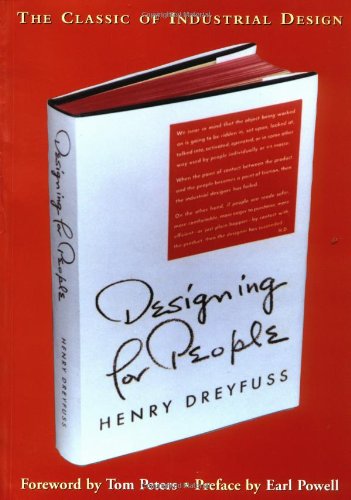
Designing for People
Authors:
Henry Dreyfuss
Publisher:
Allworth Press
Publication Date:
Not available
ISBN:
1581153120
A cult read among designers for more than half a century, the famous manifesto of America's greatest industrial designer is finally back in print!From... the first answering machine ("the electronic brain") and the Hoover vacuum cleaner to the SS Independence and the Bell telephone, the creations of Henry S. Dreyfuss have shaped the cultural landscape of the 20th century. Written in a robust, fresh style, this book offers an inviting mix of professional advice, case studies, and design history along with historical black-and-white photos and the author's whimsical drawings. In addition, the author's uncompromising commitment to public service, ethics, and design responsibility makes this masterful guide a timely read for today's designers. 152 B&W Illustrations
 '





