production
/viewbook/list/all/?page=3354
/
/static/
None

Designing for Print
Authors:
Charles Conover
Publisher:
Wiley
Publication Date:
Not available
ISBN:
0470905972
This book is a single-source guide to planning, designing and printing successful projects using the Adobe Creative Suite 5. Packed with real-world... design exercises, this revised edition is fully updated to align with CS5. Dozens of sidebars and step-by-step descriptions walk readers through the design process in the same order actual projects are implementedContent progresses from planning through execution

Designing for Print Production: Essential Concepts
Authors:
Martin L. Greenwald
Publisher:
Delmar Cengage Learning
Publication Date:
Not available
ISBN:
1418042277
In this innovative book, print design concepts are united with graphic production technology information, providing readers with an understanding of the... processes involved in both the design and print/publishing fields. While traditional books have viewed design and production as two separate fields of study, the rapidly changing technological landscape has blurred this distinction, resulting in an increasing amount of design and production activities performed by the same people. Therefore, this book provides designers and production personnel with a solid knowledge of both fields, which will better prepare them for success in the industry. Designing for Print Production: Essential Concepts focuses on the content, concepts and instructional strategies that will be relevant long after the book has been read. By acknowledging the critical and changing technologies that will impact the design and publication process, this book is a comprehensive, valuable resource for anyone entering the design and production fields.

Designing for Privacy and Related Needs
Authors:
Julie Stewart-Pollack
Publisher:
Fairchild Pubns
Publication Date:
Not available
ISBN:
1563673401
This timely book provides a synthesis of research, theory, and practical application toexplore and examine the concept of privacy as a function of... interior design responsibility.Filled with cutting edge material, the text presents information in a straightforwardmanner. Privacy needs and solutions are examined for residential, healthcare,hospitality, and work environments. Age-specific privacy needs are also covered.Students learn that privacy is not a luxury experience but a basic and restorativehuman need that reduces stress, enhances self-identity and creativity, and enablespeople to better manage both personal activities and social interactions.
Designing for Quality
Authors:
Robert H. Lochner
Publisher:
Productivity Press
Publication Date:
Not available
ISBN:
0527916331
Designing for Quality explores a vital design technique called design of experiments (DOE). It integrates both the engineering and statistical aspects... of designed experiments combining the best of Dr. Genichi Taguchi's approach with the best techniques from western design. With these designs you can: improve product performance; make product and process characteristics less sensitive to factors that cannot be controlled; reduce development, manufacturing, and use costs. Topics covered include: Full factorial and fractional factorial designs for two-level experiments. Experimental designs for factors at three and four levels. Analysis of variance in engineering design. Using experiments to improve processes. Types of computer software for experimental design.

Designing for Small Screens (Required Reading Range)
Authors:
Carolla Zwick
Publisher:
AVA Publishing
Publication Date:
Not available
ISBN:
2940373078
The design of interactive applications or presentations on small screens can be challenging for the designer. Not all design concepts that are valid on... larger screens can be implemented on the small screen. A multitude of different devices with dissimilar technical specifications fall under the category of small- screen interfaces. Devices in this category differ in size and type of their display, in the nature of their physical interaction and in their performance. This book equips the student or practitioner with the appropriate tools with which to develop functional concepts and realise good designs for small screens. In order to tackle and visualise complex design issues, each of the ten chapters in this book is structured in three segments. The first section is dedicated to theoretical reflection, and an overview of the fundamental design options that relate to the specific issue in question. The second section offers examples of good working practice and application of the theory described, and the final section offers useful background information, such as an explanation of the technical terms that will help you to make informed design decisions. Selling points: shows professional designers and students how to develop functional concepts and good design for the small screen, and pertinent subject given advancing technology in mobile phones, palm- top computers and other small-screen devices. Readership - both professional designers and students alike. Authors Professor Carola Zwick; studied at the University of Arts Berlin where she gained an MA in Industrial Design. In 1993, she joined the teaching body at the University of Arts Berlin as an Assistant Professor and, together with Burkhard Schmitz, she initiated the media group ID 5 within the design course. Carola Zwick has been teaching interface design at the University of Applied Sciences Magdeburg-Stendal since 1998. Professor Burkhard Schmitz; studied at the University of Arts in Berlin where he too gained an MA in Industrial Design. In 1989 he became Professor for Media Design at the University of Applied Sciences Schwabisch-Gmund. In 1993 he returned once more to the University of Arts Berlin, where he has taught Interactive Systems since. Dipl. Designer Kerstin Kuhl studied at the University of Applied Sciences Dessau where she gained a diploma in Graphic Design.
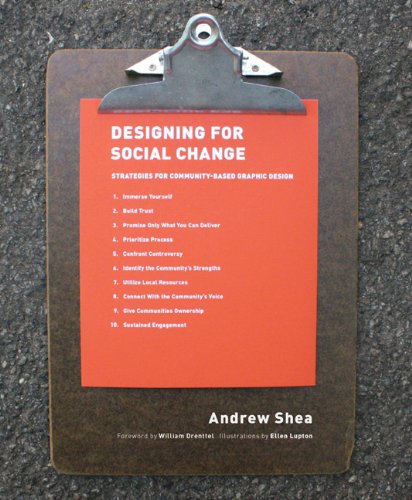
Designing For Social Change: Strategies for Community-Based Graphic...
Authors:
Andrew Shea
Publisher:
Princeton Architectural Press
Publication Date:
Not available
ISBN:
1616890479
Some call it design for the greater good. Others call it social design. Whatever you call it, it's clear that an altruistic impulse is on the rise in... the design community. The latest addition to our Design Briefs series, Designing for Social Change, is a compact, hands-on primer for graphic designers who want to use their unique problem-solving skills to help others. Author Andrew Shea presents ten proven strategies for working effectively with community organizations. These strategies can frame the design challenge and create a checklist to keep a project on track. Twenty case studies illustrate how design professionals and students approach unique challenges when working on a social agenda. This essential guide provides design educators with a valuable teaching resource and professionals with a set of tools to use in their practice. A chapter on grassroots funding solutions can aid designers as they take on their own projects.
Designing for the Digital Age: How to Create Human-Centered...
Authors:
Kim Goodwin
Publisher:
Wiley
Publication Date:
Not available
ISBN:
0470229101
Whether you’re designing consumer electronics, medical devices, enterprise Web apps, or new ways to check out at the supermarket, today’s... digitally-enabled products and services provide both great opportunities to deliver compelling user experiences and great risks of driving your customers crazy with complicated, confusing technology.Designing successful products and services in the digital age requires a multi-disciplinary team with expertise in interaction design, visual design, industrial design, and other disciplines. It also takes the ability to come up with the big ideas that make a desirable product or service, as well as the skill and perseverance to execute on the thousand small ideas that get your design into the hands of users. It requires expertise in project management, user research, and consensus-building. This comprehensive, full-color volume addresses all of these and more with detailed how-to information, real-life examples, and exercises. Topics include assembling a design team, planning and conducting user research, analyzing your data and turning it into personas, using scenarios to drive requirements definition and design, collaborating in design meetings, evaluating and iterating your design, and documenting finished design in a way that works for engineers and stakeholders alike.
Designing for the Social Web
Authors:
Joshua Porter
Publisher:
New Riders
Publication Date:
Not available
ISBN:
0321534921
No matter what type of web site or application you’re building, social interaction among the people who use it will be key to its success. They will... talk about it, invite their friends, complain, sing its high praises, and dissect it in countless ways. With the right design strategy you can use this social interaction to get people signing up, coming back regularly, and bringing others into the fold. With tons of examples from real-world interfaces and a touch of the underlying social psychology theory, Joshua Porter shows you how to design your next great social web application. Inside, you’ll discover:• The real reasons why people participate online and the psychology behind them• The Usage Lifecycle—or how people use your web application over time• How to get people past that trickiest of hurdles: sign-up• What to do when you’ve launched a web application and nobody is using it• How to analyze the effectiveness of your application screens and flows• How to grow your social web application from zero users to 1000—and beyond Designing for the social web is about much more than adding features. It’s about embracing the social interaction of the people who make you successful—and then designing smartly to encourage it.
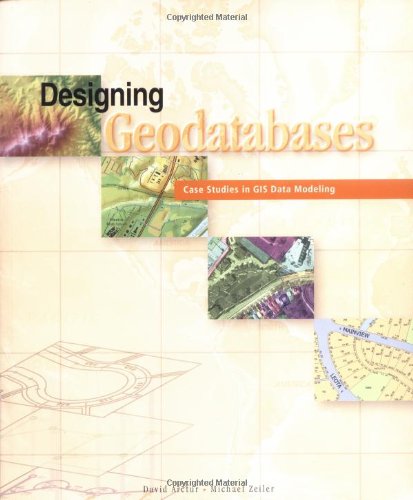
Designing Geodatabases: Case Studies in GIS Data Modeling
Authors:
David Arctur
Publisher:
ESRI Press
Publication Date:
Not available
ISBN:
158948021X
This guide to creating a dynamic GIS data model helps database managers design a schema that has comprehensive and descriptive query definitions, a... user-friendly cartographic display, and increased performance standards. The five steps for taking a data model through its conceptual, logical, and physical phases, including modeling the user's view, defining objects and relationships, selecting geographic representations, matching geodatabase elements, and organizing the geodatabase structure are studied in detail. A look at nine decision points that deal with concerns common to all data modeling exercises, such as validating feature geometries, modeling linear networks, managing raster data, and labeling map features help database managers fine-tune their GIS data models. Several design models for a variety of applications are considered including addresses and locations, census units and boundaries, stream and river networks, and topography and the base map.

Designing Geodatabases for Transportation
Authors:
J Allison Butler
Publisher:
ESRI Press
Publication Date:
Not available
ISBN:
158948164X
Designing Geodatabases for Transportation addresses the development of a GIS to manage data relating to the transportation facilities and service... commonly organized around various modes of travel for accurate and reliable data exchange. Transportation involves several modes of travel, and although the details of each mode can be quite different, this book demonstrates how all follow a basic conceptual structure. That structure consists of an origin, a destination, a path between the two, and a conveyance that provides the ability to move along the path to establish a common data structure.

Designing Groupwork: Strategies for the Heterogeneous Classroom
Authors:
Elizabeth G. Cohen
Publisher:
Teachers College Press
Publication Date:
Not available
ISBN:
0807733318
This edition features new material on such topics as skill-building for more advanced students and how to use multiple-ability treatments. The book aims... to combine easy-to-follow theory with examples and teaching strategies that are adaptable to any situation.

Designing Healthy Communities
Authors:
Richard J. Jackson
Publisher:
Jossey-Bass
Publication Date:
Not available
ISBN:
1118033663
Designing Healthy Communities, the companion book to the acclaimed public television documentary, highlights how we design the built environment and its... potential for addressing and preventing many of the nation's devastating childhood and adult health concerns. Dr. Richard Jackson looks at the root causes of our malaise and highlights healthy community designs achieved by planners, designers, and community leaders working together. Ultimately, Dr. Jackson encourages all of us to make the kinds of positive changes highlighted in this book.'In this book Dr. Jackson inhabits the frontier between public health and urban planning, offering us hopeful examples of innovative transformation, and ends with a prescription for individual action. This book is a must read for anyone who cares about how we shape the communities and the world that shapes us.' —Will Rogers, president and CEO, The Trust for Public Land'While debates continue over how to design cities to promote public health, this book highlights the profound health challenges that face urban residents and the ways in which certain aspects of the built environment are implicated in their etiology. Jackson then offers up a set of compelling cases showing how local activists are working to fight obesity, limit pollution exposure, reduce auto-dependence, rebuild economies, and promote community and sustainability. Every city planner and urban designer should read these cases and use them to inform their everyday practice.' —Jennifer Wolch, dean, College of Environmental Design, William W. Wurster Professor, City and Regional Planning, UC Berkeley'Dr. Jackson has written a thoughtful text that illustrates how and why building healthy communities is the right prescription for America.' —Georges C. Benjamin, MD, executive director, American Public Health Association

Designing Instructional Strategies: The Prevention of Academic...
Authors:
Edward J. Kameenui
Publisher:
Pearson
Publication Date:
Not available
ISBN:
0675210046

Designing Instruction for Adult Learners (Professional Practices in...
Authors:
Gary J. Dean
Publisher:
Krieger Pub Co
Publication Date:
Not available
ISBN:
1575242052
Dr. Dean's work is a model to aid adult educators in the development of instructional activities for adult learners. The three-part model consists of... gathering information, designing instruction, and evaluating the instructional plan. The data gathering phase emphasizes systematic reflection on the adult educator's knowledge and skills, the adult learners, the content to be learned, and the organizational context in which the learning takes place. In the designing instruction phase the development of instructional goals and objectives, learning activities, and learner assessment is explored. Evaluation is accomplished by systematically reviewing the instructional plan and how it was developed. The model encourages the participation of adult learners in the process. It is a flexible approach to planning instruction and can be employed in a wide variety of educational settings such as higher education, business and industry, adult basic and literacy education, community colleges, health education, social service agencies, and community education organizations.

Designing Interactions
Authors:
Bill Moggridge
Publisher:
The MIT Press
Publication Date:
Not available
ISBN:
0262134748
Digital technology has changed the way we interact with everything from the games we play to the tools we use at work. Designers of digital technology... products no longer regard their job as designing a physical object--beautiful or utilitarian--but as designing our interactions with it. In Designing Interactions, award-winning designer Bill Moggridge introduces us to forty influential designers who have shaped our interaction with technology. Moggridge, designer of the first laptop computer (the GRiD Compass, 1981) and a founder of the design firm IDEO, tells us these stories from an industry insider's viewpoint, tracing the evolution of ideas from inspiration to outcome. The innovators he interviews--including Will Wright, creator of The Sims, Larry Page and Sergey Brin, the founders of Google, and Doug Engelbart, Bill Atkinson, and others involved in the invention and development of the mouse and the desktop--have been instrumental in making a difference in the design of interactions. Their stories chart the history of entrepreneurial design development for technology.Moggridge and his interviewees discuss such questions as why a personal computer has a window in a desktop, what made Palm's handheld organizers so successful, what turns a game into a hobby, why Google is the search engine of choice, and why 30 million people in Japan choose the i-mode service for their cell phones. And Moggridge tells the story of his own design process and explains the focus on people and prototypes that has been successful at IDEO--how the needs and desires of people can inspire innovative designs and how prototyping methods are evolving for the design of digital technology.Designing Interactions is illustrated with more than 700 images, with color throughout. Accompanying the book is a DVD that contains segments from all the interviews intercut with examples of the interactions under discussion.Interviews with:Bill Atkinson • Durrell Bishop • Brendan Boyle • Dennis Boyle • Paul Bradley • Duane Bray • Sergey Brin • Stu Card • Gillian Crampton Smith • Chris Downs• Tony Dunne • John Ellenby • Doug Englebart • Jane Fulton Suri • Bill Gaver • Bing Gordon • Rob Haitani • Jeff Hawkins • Matt Hunter • Hiroshi Ishii • Bert Keely • David Kelley • Rikako Kojima • Brenda Laurel • David Liddle • Lavrans Løvlie • John Maeda • Paul Mercer • Tim Mott • Joy Mountford • Takeshi Natsuno • Larry Page • Mark Podlaseck • Fiona Raby • Cordell Ratzlaff • Ben Reason • Jun Rekimoto • Steve Rogers • Fran Samalionis • Larry Tesler • Bill Verplank • Terry Winograd • Will Wright
 '





