production
/viewbook/list/all/?page=3957
/
/static/
None
The notion of empire has in recent years taken on a renewed importance in world politics. US foreign policy has in particular been associated with this... concept by both critics and supporters of American global power. But what exactly is an empire? What distinguishes different forms of empire? Is this category still useful in a post-colonial world?These and other related questions are addressed in this historically informed conceptual introduction to the idea of empire. Alejandro Colás draws on interdisciplinary debates surrounding this disputed notion and offers a survey of different imperial experiences across time and place. Successive chapters consider the imperial organization of political space, the role of markets in sustaining imperial rule and the contradictory expressions of imperial culture.Colás argues that in each of these arenas we can establish differences among empires but also contrast imperial polities to other forms of political rule. In addition he suggests that the experiences and legacies of empire are key to an understanding of the world today, including forms of global governance and experiments in nation-building. Using wide-ranging examples, the book discusses some of the major theories of empire and imperialism in an accessible and engaging way. Above all, the text aims to bring the concept of empire alive to those concerned with contemporary world politics and society. It will be of great interest to those studying and teaching world history, international relations, comparative politics or global sociology.
Empire
Authors:
Orson Scott Card
Publisher:
Tor Books
Publication Date:
Not available
ISBN:
0765316110
The American Empire has grown too fast, and the fault lines at home are stressed to the breaking point. The war of words between Right and Left has... collapsed into a shooting war, though most people just want to be left alone. The battle rages between the high-technology weapons on one side, and militia foot-soldiers on the other, devastating the cities, and overrunning the countryside. But the vast majority, who only want the killing to stop and the nation to return to more peaceful days, have technology, weapons and strategic geniuses of their own. When the American dream shatters into violence, who can hold the people and the government together? And which side will you be on?Orson Scott Card is a master storyteller, who has earned millions of fans and reams of praise for his previous science fiction and fantasy novels. Now he steps a little closer to the present day with this chilling look at a near future scenario of a new American Civil War.
Empire
Authors:
Michael Hardt
Publisher:
Harvard University Press
Publication Date:
Not available
ISBN:
0674006712
Imperialism as we knew it may be no more, but Empire is alive and well. It is, as Michael Hardt and Antonio Negri demonstrate in this bold work, the new... political order of globalization. It is easy to recognize the contemporary economic, cultural, and legal transformations taking place across the globe but difficult to understand them. Hardt and Negri contend that they should be seen in line with our historical understanding of Empire as a universal order that accepts no boundaries or limits. Their book shows how this emerging Empire is fundamentally different from the imperialism of European dominance and capitalist expansion in previous eras. Rather, today’s Empire draws on elements of U.S. constitutionalism, with its tradition of hybrid identities and expanding frontiers. Empire identifies a radical shift in concepts that form the philosophical basis of modern politics, concepts such as sovereignty, nation, and people. Hardt and Negri link this philosophical transformation to cultural and economic changes in postmodern society—to new forms of racism, new conceptions of identity and difference, new networks of communication and control, and new paths of migration. They also show how the power of transnational corporations and the increasing predominance of postindustrial forms of labor and production help to define the new imperial global order. More than analysis, Empire is also an unabashedly utopian work of political philosophy, a new Communist Manifesto. Looking beyond the regimes of exploitation and control that characterize today’s world order, it seeks an alternative political paradigm—the basis for a truly democratic global society.
Empire and Communications (Critical Media Studies: Institutions,...
Authors:
Harold A. Innis
Publisher:
Rowman & Littlefield Publishers
Publication Date:
Not available
ISBN:
0742555089
It's been said that without Harold A. Innis there could have been no Marshall McLuhan. Empire and Communications is one of Innis's most important... contributions to the debate about how media influenced the development of consciousness and societies. In this foundational work, he traces humanity's movement from the oral tradition of preliterate cultures to the electronic media of recent times. Along the way, he presents his own influential concepts of oral communication, time and space bias, and monopolies of knowledge. With a new introduction by Alexander John Watson, author of Marginal Man: The Dark Vision of Harold Innis, and a new foreword by series editor Andrew Calabrese, this previously hard-to-obtain book is now readily available again. All communication scholars should have this classic book on their shelves, and it also serves as a great supplementary text in communication and economics courses.
Empire and Dissent: The United States and Latin America (American...
Authors:
Not Available
Publisher:
Duke University Press Books
Publication Date:
Not available
ISBN:
0822342782
Since the early nineteenth century, the United States has repeatedly intervened in the affairs of Latin American nations to pursue its own interests and... to “protect” those countries from other imperial powers or from internal “threats.” The resentment and opposition generated by the encroachment of U.S. power has been evident in the recurrent attempts of Latin American nations to pull away from U.S. dominance and in the frequent appearance of popular discontent and unrest directed against imperialist U.S. policies. In Empire and Dissent, senior Latin Americanists explore the interplay between various dimensions of imperial power and the resulting dissent and resistance.Several essays provide historical perspective on contemporary U.S.–hemispheric relations. These include an analysis of the nature and dynamics of imperial domination, an assessment of financial relations between the United States and Latin America since the end of World War II, an account of Native American resistance to colonialism, and a consideration of the British government’s decision to abolish slavery in its colonies. Other essays focus on present-day conflicts in the Americas, highlighting various modes of domination and dissent, resistance and accommodation. Examining southern Mexico’s Zapatista movement, one contributor discusses dissent in the era of globalization. Other contributors investigate the surprisingly conventional economic policies of Brazil’s president, Luiz Inácio Lula da Silva; Argentina’s recovery from its massive 2001 debt default; the role of coca markets in the election of Bolivia’s first indigenous president, Evo Morales; and the possibilities for extensive social change in Venezuela. A readers’ guide offers a timeline of key events from 1823 through 2007, along with a list of important individuals, institutions, and places.Contributors: Daniel A. Cieza, Gregory Evans Dowd, Steve Ellner, Neil Harvey, Alan Knight, Carlos Marichal, John Richard Oldfield, Silvia Rivera, Fred Rosen, Jeffrey W. Rubin
Empire and Education: A History of Greed and Goodwill from the War...
Authors:
A.J. Angulo
Publisher:
Palgrave Macmillan
Publication Date:
Not available
ISBN:
1137024526
The time was March 2003. The United States was on the cusp of invading Iraq and the American public was split over the impending conflict. Some saw the... decision to invade as rooted in corporate greed and a desire for control over one of the world's largest oil deposits. Others spoke of spreading democracy abroad, the human atrocities committed by dictator Saddam Hussein, and the alleged threat of weapons of mass destruction.Shortly after the invasion, award-winning author A. J. Angulo began a study on the long history of US occupations abroad and the role that greed and goodwill played in each. The result is this lively and engaging history of Empire and Education. It offers the first single-volume narrative history devoted to the role of education in American interventions abroad from the War of 1898 to the War on Terror. Pulling together isolated case studies and archival research into a coherent, accessible, narrative sweep, this path-breaking volume inspires new directions in the study of American history. It also serves as a cautionary tale filled with familiar names, colorful personalities, and obscure U.S. figures who impacted the lives of others around the world in the name of citizens back home. It's a story that spans 110 years of American efforts to extract wealth and promote democracy abroad.
Empire and Identity: An Eighteenth Century Sourcebook
Authors:
Stephen Gregg
Publisher:
Palgrave Macmillan
Publication Date:
Not available
ISBN:
1403921415
This anthology of primary material brings together literary and non-literary texts from the eighteenth-century focusing on issues including commerce and... colonialism. Britons' sense of identity in the eighteenth-century see-sawed between embattled vulnerability and unassailable supremacy. Empire was crucial in shaping this, but contact with other peoples often threw into sharp relief or transformed this sense of identity. This book will be an essential resource for those studying this period; it traces these shifts in mood and the impact of imperial encounters in a variety of material, including poems, plays, speeches, letters, and accounts of travel, exploration and captivity.
Empire And Imperialism (Key Issues Series)
Authors:
Peter Cain
Publisher:
St. Augustines Press
Publication Date:
Not available
ISBN:
1890318248
The 1870s is a key decade in the evolution of British thinking about the nature, purpose, and future of empire. Increasing economic competition began to... disturb the complacent assumption about Britain's leadership in technology and in the world economy. The growth of other countries, most notably the United States and Germany, put in question Britain's survival as a great power. These changes set in motion a reappraisal of Britain's empire and its importance to the motherland, and a heated debated as to whether colonialism and imperialism were a burden rather than a benefit to Britain. The discussion of the 1870s set the agenda for the debates of the next half-century. This volume documents the writing central to the debate; it includes contributions by such leading British thinkers and statesmen as J. A. Froude, Robert Lowe, Edward Dicey, Frederic Seebohm, Lord Carnarvon, Gladstone, Julius Vogel, and Lord Blachford.
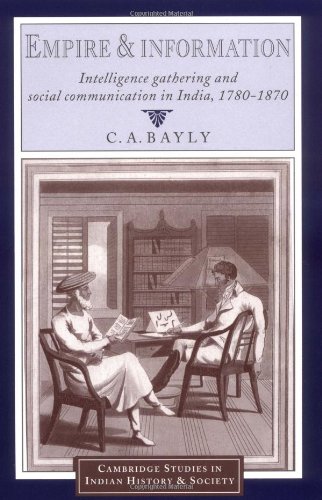
Empire and Information: Intelligence Gathering and Social...
Authors:
C. A. Bayly
Publisher:
Cambridge University Press
Publication Date:
Not available
ISBN:
0521663601
In a penetrating account of the evolution of British intelligence gathering in India, C. A. Bayly shows how networks of Indian spies, runners and... political secretaries were recruited by the British to secure information about their subjects. He also examines the social and intellectual origins of these informants, and considers how the colonial authorities interpreted and often misinterpreted the information they supplied. As Professor Bayly demonstrates, it was such misunderstandings which ultimately contributed to the failure of the British to anticipate the mutinies of 1857. He argues, however, that, even before this, India's complex systems of communication were challenging the political and intellectual dominance of the European rulers.
Empire and Nation
Authors:
Forrest McDonald
Publisher:
Liberty Fund
Publication Date:
Not available
ISBN:
0865972036
Empire and Nationhood
Authors:
Mary Ann Heiss
Publisher:
Columbia University Press
Publication Date:
Not available
ISBN:
0231108192
Heiss provides a detailed account of the 1951 seizure of British oil holdings in Iran by prime minister Mohammed Mossadegh, a turning point in cold war... history.
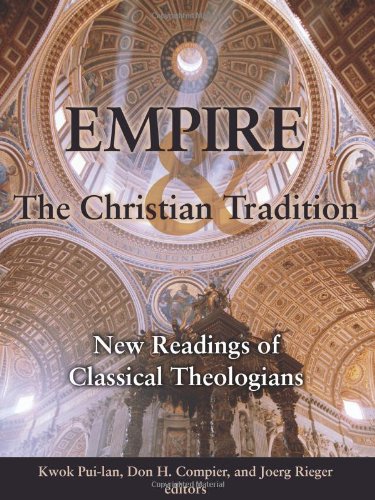
Empire and the Christian Tradition: New Readings of Classical...
Authors:
Not Available
Publisher:
Fortress Press
Publication Date:
Not available
ISBN:
0800662156
Distinguished theologians assess the achievements and legacies of thirty- one theological giants in light of Christianity's engagement with imperial... power, conquest, colonization, and post colonial themes. A unique textbook anthology ideal for classroom use.
Empire and the Ends of Politics
Authors:
Plato
Publisher:
Focus Publishing/R. Pullins Co.
Publication Date:
Not available
ISBN:
0941051706
This text brings together for the first time two complete key works from classical antiquity on the politics of Athens: Plato's Menexenus and Pericles'... funeral oration (from Thucydides' history of the Peloponnesian War).
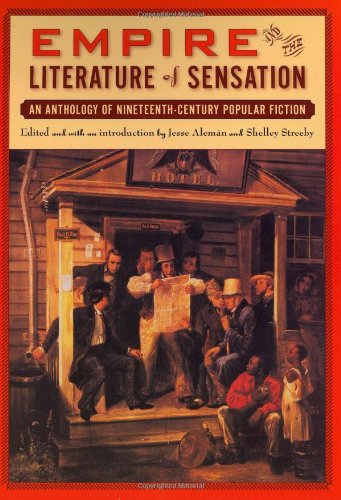
Empire and The Literature of Sensation: An Anthology of...
Authors:
Not Available
Publisher:
Rutgers University Press
Publication Date:
Not available
ISBN:
0813540763
Mid-nineteenth-century American literature teems with the energy and excitement characteristic of the nation's era of expansion. It also reveals the... intense anxiety and conflict of a country struggling with what it will mean, socially and culturally, to incorporate previously held Spanish territories. Empire and the Literature of Sensation is a critical anthology of some of the most popular and sensational writings published before the Civil War. It is a collection of transvestite adventures, forbidden love, class conflict, and terrifying encounters with racial "others." Most of the accounts, although widely distributed in nineteenth-century newspapers, pamphlets, or as dime novels, have long been out of print. Reprinted here for the first time are novelettes by two superstars of the cheap fiction industry, Ned Buntline and George Lippard. Also included are selections from one of the first dime novels as well as the first-person narratives of Leonora Siddons and Sophia Delaplain, both of whom claim in their pamphlets to have cross-dressed as men and participated in the Texas rebellion and Cuban filibustering. Originally written for entertainment and enormously popular in their day, these sensational thrillers reveal for today's audiences how the rhetoric of empire was circulated for mass consumption and how imperialism generated domestic and cultural instability during the period of the American literary renaissance. Jesse Alemán is an associate professor of English at the University of New Mexico. He has published in a variety of journals and edited the reprint of Loreta Janeta Velazquez's The Woman in Battle. Shelley Streeby is an associate professor of literature at the University of California, San Diego. Her first book, American Sensations: Class, Empire, and the Production of Popular Culture, was awarded the American Studies Association's Lora Romero First Book Prize.
Empire As A Way of Life: An Essay on the Causes and Character of...
Authors:
William Appleman Williams
Publisher:
Ig Publishing
Publication Date:
Not available
ISBN:
0977197239
“An unblinkered look at our imperial past . . . a perceptive work by one of our most perceptive historians.”—Studs TerkelA work of remarkable... prescience, Empire As A Way of Life is influential historian William Appleman Williams’s groundbreaking work highlighting imperialism—“empire as a way of life”—as the dominant theme in American history. Analyzing U.S. history from its revolutionary origins to the dawn of the Reagan era, Williams shows how America has always been addicted to empire in its foreign and domestic ideology. Detailing the imperial actions and beliefs of revered figures such as Benjamin Franklin, Thomas Jefferson, Abraham Lincoln and Franklin Delano Roosevelt, this book is the most in-depth historical study of the American obsession with empire, and is essential to understanding the origins of our current foreign and domestic undertakings.Back in print for the first time in twenty-five years, this new edition features an introduction by Andrew Bacevich, author of The New American Militarism: How Americans Are Seduced by War and American Empire: The Realities and Consequences of U.S. Diplomacy.
 '





