production
/viewbook/list/all/?page=4265
/
/static/
None

European Union and the Deconstruction of the Rhineland Frontier
Authors:
Michael Loriaux
Publisher:
Cambridge University Press
Publication Date:
Not available
ISBN:
0521707072
The Rhineland region includes the core regional economy of western Europe, encompassing Belgium, Luxemburg and parts of the Netherlands, France,... Switzerland and Germany. Throughout history there have been tensions between this region's roles as a frontier and as western Europe's economic core. Michael Loriaux argues that the European Union arose from efforts to deconstruct this frontier. He traces Rhineland geopolitics back to its first emergence, restoring frontier deconstruction to the forefront of discussion about the EU. He recounts how place names were manipulated to legitimate political power and shows how this manipulation generated the geopolitics that the EU now tries to undo. Loriaux also argues that the importance of this issue has significantly affected the nature of the EU's development and helps condition a festering legitimation crisis.
European Union: An Historical and Political Survey
Authors:
Richard McAllister
Publisher:
Routledge
Publication Date:
Not available
ISBN:
0415407613
The new edition of this best-selling text provides the most up-to-date single volume history of the European Union from its origins through to the... present day. Fully updated and revised throughout, this is the ideal starting point for students and others wishing to read an accessible, readable and comprehensive account of the development of the EU. Topics new to this edition: The impact of the Euro and economic and monetary union. Analysis of post-9/11 splits in the EU over Afghanistan and Iraq, and debates on the New European security order and the threat posed by terrorism. The enlargement of the EU to 27 members and discussions over further expansion. The initial failure of the EU Constitutional Treaty. The growth in Euroscepticism across the continent. An engaging contribution to the understanding of the past, present and uncertain future of European integration, European Union is essential reading for all students of European history, European Union politics, and International Relations.
European Union Law in a Nutshell, 7th (In a Nutshell (West...
Authors:
Ralph H. Folsom
Publisher:
West
Publication Date:
Not available
ISBN:
0314268499
It covers the history and growth of the European Union, its legislative procedures, and case law of the European Court of Justice. Litigating European... Union law, free movement of goods, people, capital and technology, and internal Union policies are detailed. This Nutshell also reviews EU international trade and business competition (antitrust) law.
European Union Politics
Authors:
Michelle Cini
Publisher:
Oxford University Press, USA
Publication Date:
Not available
ISBN:
0199548633
An authoritative text that covers both EU theories and EU institutions, European Union Politics, Third Edition, provides students with a solid... introduction to the field. FEATURES * Presents carefully edited contributions from experts, providing students with comprehensive and stimulating content * Assumes no background knowledge, making it accessible to students new to the subject * Provides excellent learning features, including reader's guides, boxes of further information, key points, figures, questions, further reading, websites, and glossary NEW TO THIS EDITION * Additional editor Dr. Nieves Perez-Solorzano Borragan * Two new chapters: Policy-Making in the European Union (Chapter 13) and Environmental Policy (Chapter 14) * Coverage of differentiated European integration now incorporated within the new policy-making chapter * The Lisbon Treaty incorporated within the text * Updated Companion Website (www.oup.com/uk/orc/bin/9780199548637/) with resources for students--including interactive maps of Europe; interactive timeline of key events in the history of the EU; multiple choice questions; biographies of important figures in EU history; exam study guide; flashcard glossary; and links to OUP journal articles--and instructors (PowerPoint lecture slides; essay, seminar, and quiz questions; and boxes and figures from the textbook)
European Union Politics (Palgrave Foundations)
Authors:
John McCormick
Publisher:
Palgrave Macmillan
Publication Date:
Not available
ISBN:
0230577075
This major new text provides an authoritative introduction to all aspects of politics and policy in the European Union. Written in the author's... inimitably accessible style, it brings the European Union to life, giving readers a sense of the color and flavor of European Union politics and its impact on the citizens of Europe. -A major new introductory text specifically designed for students studying the European Union for the first time-Broad and detailed coverage of all aspects of European Union politics and policy and the nature of European integration -Written in the author's inimitably lively and accessible style - an extremely student-friendly new addition to a generally dry and dusty field -Readable and relevant, and alive to the human side of the European Union and the impact it has on the lives of Europe's citizens-Packed with a wide range of maps, charts, photos, and boxed features, including profiles of key figures in the theory and practice of European integration and country profiles of member states-Companion website includes updated materials, self test questions and answers, a searchable chronology glossary of terms, links, and further reading and an instructor's site providing additional teaching resources

EUROPEAN UNION:THE ROAD TO LISBON
Authors:
Not Available
Publisher:
Not available
Publication Date:
Not available
ISBN:
Not available

European Universalism: The Rhetoric of Power
Authors:
Immanuel Wallerstein
Publisher:
New Press, The
Publication Date:
Not available
ISBN:
1595580611
How ideas such as civilization and progress have been used as a smoke screen for western dominance, by the world-renowned sociologist.Ever since the... Enlightenment, Western intervention around the world has been justified by appeals to notions of civilization, development, and progress. The assumption has been that such ideas are universal, encrusted in natural law. But, as Immanuel Wallerstein argues in this short and elegant philippic, these concepts are, in fact, not global. Rather, their genesis is firmly rooted in European thought and their primary function has been to provide justification for powerful states to impose their will against the weak under the smoke screen of what is supposed to be both beneficial to humankind and historically inevitable.With great acuity Wallerstein draws together discussions of the idea of orientalism, the right to intervene, and the triumph of science over the humanities to explain how strategies designed to promote particular Western interests have acquired an all-inclusive patina.Wallerstein concludes by advocating a true universalism that will allow critical appraisal of all justifications for intervention by the powerful against the weak. At a time when such intervention—in the name of democracy and human rights—has returned to the center stage of world politics, his treatise is both relevant and compelling.
European Women and the Second British Empire (A Midland Book)
Authors:
Strobel
Publisher:
Indiana University Press
Publication Date:
Not available
ISBN:
0253206316
"It enhances our understanding of intracultural and cross-cultural relationships and raises significant questions about the complexities of the colonial... phenomenon in the modern era." —Journal of World History"Provides a powerful and important analysis foregrounding the ideological construction of whiteness in understandings of gender and sexuality.... Margaret Strobel manages to provide a convincing analysis of the contradictory and often challenging space occupied by European women in the project of empire."Â —Signs"Strobel is to be highly commended for an historical analysis that brings critical light to bear on the complex interactions of gender, race, and class that have shadowed both European men's and women's participation in colonialism." —Women and Politics"... a clear exposition and synthesis... In this useful introduction to a new field, Strobel lays out clearly the arguments on which it is built. Her book makes it possible to acquaint students with the initial array of scholarship that is already growing. She also demonstrates that rewriting an imperial history that is sensitive to gender, culture, race, sexuality, and power is an exhilarating enterprise." —American Historical ReviewBased on the published accounts of travelers and officials' wives, biographies and other materials, this is a lively, fast-paced account of the roles of white women in the British empire, from about 1880 to the recent past. The European women of the second British empire carved out a space for themselves amid the options made available to them by British expansion, but they too were treated as inferiors—the inferior sex within the superior race.
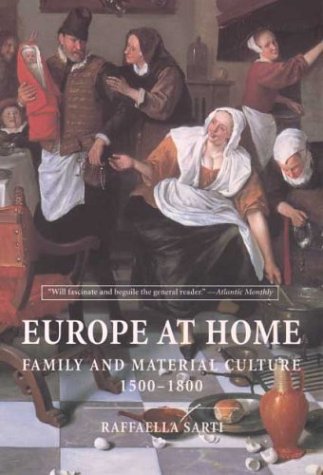
Europe at Home
Authors:
Raffaella Sarti
Publisher:
Yale University Press
Publication Date:
Not available
ISBN:
0300102593
In this fascinating guide to European homes, families, and possessions of the sixteenth through nineteenth centuries, Raffaella Sarti invites us to... return to earlier times and observe the daily lives of masters and servants, parents and children, husbands and wives. 'This vivid book takes readers through the daily life of European families at every economic level over three centuries ... This book, with its clear writing and wealth of arresting details, will fascinate and beguile the general reader.' Atlantic Monthly 'The most fascinating work I have read this year.' Eric Hobsbawn, BBC History Magazine 'Sarti deals with a subject of widespread curiosity: how people actually lived in the past. Hers is a wonderful book, tackling questions about housing, furnishings, food, dining, and clothes, and providing one fascinating discussion after another.' David Kertzer, Brown University 'Like a miracle, Raffaella Sarti brings our European ancestors to life.' Jaques le Goff Raffaella Sarti teaches early modern history at the University of Urbino, Italy, and is associate member of the Centre de Recherches Historiques of the Ecole des Hautes Etudes en Sciences Sociales in Paris.
Europe Between the Oceans: 9000 BC-AD 1000
Authors:
Barry Cunliffe
Publisher:
Yale University Press
Publication Date:
Not available
ISBN:
0300170866
Europe is, in world terms, a relatively minor peninsula attached to the Eurasian land mass. Yet it became one of the most innovative regions on the... planet, generating restless adventurers who traversed the globe to trade, to explore, and often to settle. By the fifteenth century Europe was a driving world force, but the origins of its success have until now remained obscured in prehistory.In this magnificent book, distinguished archaeologist Barry Cunliffe views Europe not in terms of states and shifting political land boundaries but as a geographical niche particularly favored in facing many seas. These seas, and Europe’s great transpeninsular rivers, ensured a rich diversity of natural resources while also encouraging the dynamic interaction of peoples across networks of communication and exchange. The development of these early Europeans is rooted in complex interplays, shifting balances, and geographic and demographic fluidity.Weaving together titanic concepts while remaining sensitive to specifics, Cunliffe has produced an interdisciplinary tour de force. His is a bold book of exceptional scholarship, erudite and engaging, and it heralds an entirely new understanding of Old Europe.
Europe Between the Wars (2nd Edition)
Authors:
Martin Kitchen
Publisher:
Longman
Publication Date:
Not available
ISBN:
058289414X
'Professor Kitchen is altogether a shrewd, clear, balanced and often witty guide.' The Times Educational Supplement Martin Kitchen’s compelling... account of Europe between the wars sets the twenty-year crisis within the context of the profound sense of cultural malaise shared by many philosophers and artists, the economic crises that plagued a Europe ruined by war and the social upheavals caused by widespread unemployment and grinding poverty amid a noticeable improvement of living standards.

Europe in a Wider World, 1350-1650
Authors:
Robin W. Winks
Publisher:
Oxford University Press, USA
Publication Date:
Not available
ISBN:
0195154487
Between roughly 1350 and 1650, Europe underwent seismic changes in economics, politics, culture, and religion. Feudal monarchies were reconceived as... abstract states. The new technology of the printing press transformed how information was disseminated, bringing texts to different social groups. Painters perfected the artifice of perspective for an increasingly commercial patronage, even as they themselves cultivated the value of their own "genius" through increasingly distinctive styles and visions. Reformers called into question 1500 years of tradition, splitting the One True Church into multiple churches. In the midst of all these changes, Europeans reached farther and farther out into a world they did not yet dominate, even as they lived uneasily under the shadow of an expansionist Islamic Mediterranean. Indeed, that wider world was inseparable from those seismic changes in the political and cultural landscape of Europe. Europe in a Wider World, 1350-1650 offers a concise discussion of these events and the impact they had upon an evolving European society. It provides a clear outline of political events and a lively exploration of developments in the social and cultural landscape. Along with traditional themes, such as Protestantism, the book examines the changing roles of European women and the effects of environmental fluctuation on the history of the continent. By looking at these years as a whole, the authors attempt to restore interconnections among events that are often lost when the time period is viewed through the double categories of "The Renaissance" and "The Reformation." Illustrated with nine detailed maps and twenty-four images, and offering chapter summaries and a chronology to aid students, this text is ideal for undergraduate courses in early modern European history.

Europe in Flames - Understanding WWII.
Authors:
Harold J. Goldberg
Publisher:
Stackpole Books
Publication Date:
Not available
ISBN:
081170873X
Highlights the key decisions and events of World War II in Europe from Allied and Axis perspectives Begins with the 1939 invasion of Poland and ends... with Germany's surrender in 1945, with a concluding look at the Nuremberg Trials Covers old controversies and relatively unexplored events Presents information objectively
Europe in the Contemporary World: 1900 to Present: A Narrative...
Authors:
Bonnie G. Smith
Publisher:
Bedford/St. Martin's
Publication Date:
Not available
ISBN:
0312406991
Offering a twenty-first century perspective on twentieth-century Europe, pre-eminent scholar Bonnie Smith's engaging new synthesis is the first text to... provide both a thorough integration of social and cultural material with political history and substantive treatment of Europe's broader global context. Each of the twelve chapters combines compelling narrative with a wonderfully rich set of primary texts and picture essays, reinforcing for students the importance of primary sources to the study of history. Neither overtly triumphalist nor disparaging, this even-handed and thoughtful account takes the full measure of Europe's negative and positive legacies at home and its impact on and interactions with the world at large.

Europe in the Eighteenth Century 1713-1789: General History of...
Authors:
M.S. Anderson
Publisher:
Longman
Publication Date:
Not available
ISBN:
0582357438
This is a survey of all aspects of European life in the eighteenth century . Europe in the Eighteenth Century provides a continent wide... examination and is distinctive for its comprehensive treatment of eastern, as well as, western Europe and in the coverage of European colonial empires. Key themes explored include society, economic life, government, monarchy, diplomacy and international relations, education and cultural life, expansionism, enlightenment and religion & the churches. Anyone interested in European history or eighteenth century history. Hardcover - 0-582-35744-6 $79.95y
 '





