production
/viewbook/list/all/?page=4694
/
/static/
None
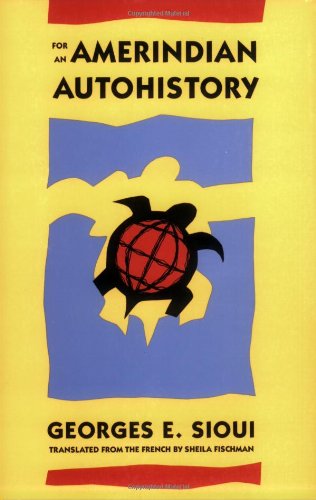
For an Amerindian Autohistory: An Essay on the Foundations of a...
Authors:
George E. Sioui
Publisher:
McGill-Queen's University Press
Publication Date:
Not available
ISBN:
0773513280
This is a presentation of guidelines for the study of native history from an Amerindian perspective. Georges Sioui, a Huron Indian, argues that these... guidelines must be respected if the self-image and social ethics of native people are to be understood and preserved. He also shows how they provide a means of greatly improving the way native and non-native peoples perceive each other. Sioui contrasts Euroamerican ethnocentrism and feelings of racial superiority with the Amerindian belief in th Great Circle of Life. Fully aware of the injustices that Aboriginal peoples of North America have suffered, and continue to suffer, at the hands of the Euroamericans, he argues that human beings must establish intellectual and emotional connections with the entire living world, if they hope to achieve abundance, quality and peace for all.

For an Architecture of Reality
Authors:
Michael Benedikt
Publisher:
Lumen Books
Publication Date:
Not available
ISBN:
0930829050
Michael Benedikt teaches, practices architecture, and writes in Austin, where he is a Professor of Architecture at the University of Texas. His second... book, Deconstructing the Kimbell (0-930829-16-6), is also published by Lumen."Benedikt has written a bold theoretical essay, with stirring cultural implications, that argues to restore the missing sense of reality to architecture and insists on ‘the direct esthetic experience of the real.’ . . . a timely manifesto. Thought-provoking and eminently quotable, it succeeds admirably in what it sets out to do: to recall architecture, and not only architecture, to those all but mute meanings so often passed over and yet inseparable from our everyday existence.—Karsten Harries"This book will still be useful when this year's round arches have all been remodeled (isn't it inevitable?) into pointed. And because it is so vividly -and thoughtfully--written, it will still be a pleasure to read."—Charles Moore"Every literate architect should take an afternoon off to read and ponder this brief and thoughtful and thoroughly engaging book. . . . Benedikt says more about some central aesthetic and philosophical issues confronting contemporary architecture than many celebrated pundits manage to squeeze into a shelfful of books. . . . He offers a straightforward account of his own struggle to understand the pleasures and responsibilities of architecture in an age when aesthetic pleasure is all but indiscernible from entertainment, and responsibility is often a cover for thoughtless conformity."—Roger Kimball, Architectural Record"Benedikt marches bravely into the philosophical thicket to find a working definition of reality. . . . In his sensibilities, he is quite transcendental, much like a Thoreau or an Emerson in a hotel lobby of potted ficus trees."—Howard Mansfield, Small Press". . . the book of the decade in Texas architectural circles. . . "—Texas Architect
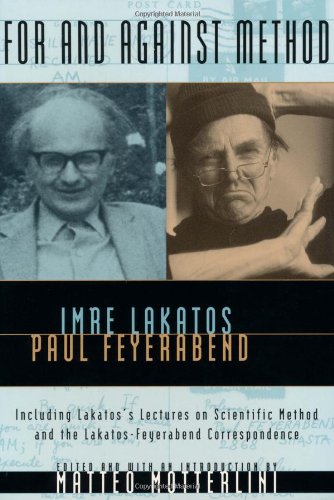
For and Against Method: Including Lakatos's Lectures on Scientific...
Authors:
Imre Lakatos
Publisher:
University Of Chicago Press
Publication Date:
Not available
ISBN:
0226467759
The work that helped to determine Paul Feyerabend's fame and notoriety, Against Method, stemmed from Imre Lakatos's challenge: "In 1970 Imre cornered me... at a party. 'Paul,' he said, 'you have such strange ideas. Why don't you write them down? I shall write a reply, we publish the whole thing and I promise you—we shall have a lot of fun.' " Although Lakatos died before he could write his reply, For and Against Method reconstructs his original counter-arguments from lectures and correspondence previously unpublished in English, allowing us to enjoy the "fun" two of this century's most eminent philosophers had, matching their wits and ideas on the subject of the scientific method.For and Against Method opens with an imaginary dialogue between Lakatos and Feyerabend, which Matteo Motterlini has constructed, based on their published works, to synthesize their positions and arguments. Part one presents the transcripts of the last lectures on method that Lakatos delivered. Part two, Feyerabend's response, consists of a previously published essay on anarchism, which began the attack on Lakatos's position that Feyerabend later continued in Against Method. The third and longest section consists of the correspondence Lakatos and Feyerabend exchanged on method and many other issues and ideas, as well as the events of their daily lives, between 1968 and Lakatos's death in 1974.The delight Lakatos and Feyerabend took in philosophical debate, and the relish with which they sparred, come to life again in For and Against Method, making it essential and lively reading for anyone interested in these two fascinating and controversial thinkers and their immense contributions to philosophy of science."The writings in this volume are of considerable intellectual importance, and will be of great interest to anyone concerned with the development of the philosophical views of Lakatos and Feyerabend, or indeed with the development of philosophy of science in general during this crucial period."—Donald Gillies, British Journal for the Philosophy of Science (on the Italian edition)"A stimulating exchange of letters between two philosophical entertainers."—Tariq Ali, The IndependentImre Lakatos (1922-1974) was professor of logic at the London School of Economics. He was the author of Proofs and Refutations and the two-volume Philosophical Papers. Paul Feyerabend (1924-1994) was educated in Europe and held numerous teaching posts throughout his career. Among his books are Against Method; Science in a Free Society; Farewell to Reason; and Killing Time: The Autobiography of Paul Feyerabend, the last published by the University of Chicago Press.
For a New Critique of Political Economy
Authors:
Bernard Stiegler
Publisher:
Polity
Publication Date:
Not available
ISBN:
0745648045
The catastrophic economic, social and political crisis of our time calls for a new and original critique of political economy - a rethinking of Marx's... project in the very different conditions of twenty-first century capitalism.Stiegler argues that today the proletarian must be reconceptualized as the economic agent whose knowledge and memory are confiscated by machines. This new sense of the term ‘proletarian' is best understood by reference to Plato's critique of exteriorized memory. By bringing together Plato and Marx, Stiegler can show how a generalized proletarianization now encompasses not only the muscular system, as Marx saw it, but also the nervous system of the so-called creative workers in the information industries. The proletarians of the former are deprived of their practical know-how, whereas the latter are shorn of their theoretical practice, and both suffer from a confiscation of the very possibility of a genuine art of living.But the mechanisms at work in this new and accentuated form of proletarianization are the very mechanisms that may spur a reversal of the process. Such a reversal would imply a crucial distinction between one's life work, originating in otium (leisure devoted to the techniques of the self), and the job, consisting in a negotium (the negotiation and calculation, increasingly restricted to short-term expectations), leading to the necessity of a new conception of economic value.This short text offers an excellent introduction to Stiegler's work while at the same time representing a political call to arms in the face of a deepening economic and social crisis.

For a New Novel: Essays on Fiction
Authors:
Alain Robbe-Grillet
Publisher:
Northwestern University Press
Publication Date:
Not available
ISBN:
0810108216
“A riveting chronicle of the rise and fall of the American reader.”—Village VoicePost-war American publishing has been ruthlessly transformed... since Andre Schiffrin joined its ranks in 1956. Gone is a plethora of small but prestigious houses that often put ideas before profit in their publishing decisions, sometimes even deliberately. Now six behemoths share 80% of the market and profit margin is all. Andre Schiffrin can write about these changes with authority because he witnessed them from inside a conglomerate, as head of Pantheon, co-founded by his father, bought (and sold) by Random House. And he can write about them with candor because he is no longer on the inside, having quit corporate publishing in disgust to set up a flourishing independent house, The New Press. Schiffrin's evident affection for his authors sparkles throughout a story woven around publishing the work of those such as Studs Terkel, Noam Chomsky, Gunnar Myrdal, George Kennan, Juliet Mitchell, R. D. Laing, Eric Hobsbawm and E.P.Thompson. Part-memoir, part-history, here is an account of the collapsing standards of contemporary publishing that is irascible, acute and passionate. An engaging counterpoint to recent, celebratory memoirs of the industry written by those with more stock options and fewer scruples than Schiffrin, The Business of Books warns of the danger to adventurous, intelligent publishing in the bullring of today's marketplace.

For Argument's Sake: A Guide to Writing Effective Arguments
Authors:
Katherine Mayberry
Publisher:
Wadsworth Publishing
Publication Date:
Not available
ISBN:
0618917950
This concise rhetoric features practical advice for writing the four most common types of argument: factual, causal, evaluation, and recommendation.... Structured around three main phases of writing -- focusing, supporting, and reviewing--For Argument's Sake, Fifth Edition, helps students find and focus a claim, gather and organize supporting information, and refine and polish their argument. Numerous sample arguments, including several pieces written by students, illustrate principles and strategies for strong, compelling writing.
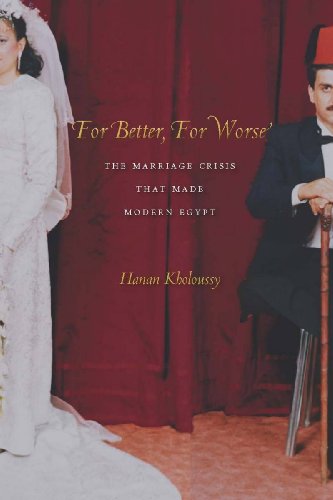
For Better, For Worse: The Marriage Crisis That Made Modern Egypt
Authors:
Hanan Kholoussy
Publisher:
Stanford University Press
Publication Date:
Not available
ISBN:
0804769605
For many Egyptians in the early twentieth century, the biggest national problem was not British domination or the Great Depression but a "marriage... crisis" heralded in the press as a devastating rise in the number of middle-class men refraining from marriage. Voicing anxieties over a presumed increase in bachelorhood, Egyptians also used the failings of Egyptian marriage to criticize British rule, unemployment, the disintegration of female seclusion, the influx of women into schools, middle-class materialism, and Islamic laws they deemed incompatible with modernity.For Better, For Worse explores how marriage became the lens through which Egyptians critiqued larger socioeconomic and political concerns. Delving into the vastly different portrayals and practices of marriage in both the press and the Islamic court records, this innovative look at how Egyptians understood marital and civil rights and duties during the early twentieth century offers fresh insights into ongoing debates about nationalism, colonialism, gender, and the family.

For Better: How the Surprising Science of Happy Couples Can Help...
Authors:
Tara Parker-Pope
Publisher:
Plume
Publication Date:
Not available
ISBN:
0452297109
Take The For Better Quiz #3: Defining Your Love Style. "The most credible and interesting marital self-help book of all time." -Newsweek Tara... Parker-Pope's Well column in The New York Times has made her one of the most popular and e-mailed journalists in the nation. In this eye-opening-and ultimately optimistic-look at marriage today, Parker-Pope reveals the heart behind the statistics to bust the myths and share the true secrets to marital happiness. Among her surprising findings: • most marriages today are succeeding • newlywed couples who don't fight are at a higher risk for divorce than those who do • how couples divide household chores influences how often they have sex Whatever their stage of life or marital status, readers will be fascinated and buoyed by this classic in the making.
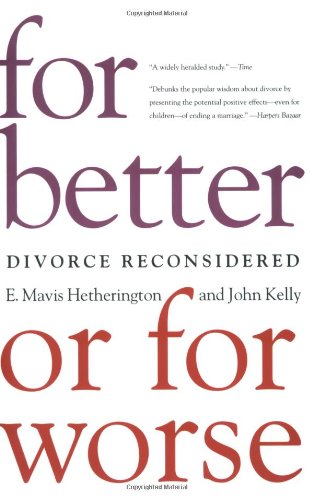
For Better or For Worse: Divorce Reconsidered
Authors:
E. Mavis Hetherington
Publisher:
W. W. Norton & Company
Publication Date:
Not available
ISBN:
0393324133
"A reader-friendly guide to how people can build success out of the stress and adversity of divorce."—Michael Rutter, Institute of Psychiatry,... LondonMavis Hetherington, "without doubt the world's preeminent researcher on the family processes that surround divorce,...has distilled the wisdom growing out of her many studies of the short-term and long-term impact of divorce on family members" (Eleanor Maccoby, Stanford University). Offering "a welcome corrective to misleading and simplistic accounts," Hetherington "not only provides scientifically sound and wonderfully sensible guidance but dispels the myth that divorce is always negative" (Ross D. Parke, University of California, Riverside). This "widely-heralded study" (Time) is a "reader-friendly guide to how people can build success out of the stress and adversity of divorce" (Michael Rutter, Institute of Psychiatry, London), presenting a more nuanced picture of marital breakup—not as a momentary event but as a life process. Hetherington identifies the kinds of marriages that predispose a couple to divorce or not and also pinpoints "windows of change" that allow some to fashion the challenges of divorce into an opportunity for themselves and for their children. "Gold standard [research] aimed at clearing up confusion among moms and dads worried about divorce."—USA Today "Sure to become a classic in the field!"—Constance R. Ahrons, author of The Good Divorce "Without doubt the world's preeminent researcher on the family processes that surround divorce."—Eleanor Maccoby, Stanford University "A welcome corrective to misleading and simplistic accounts...dispels the myth that divorce is always negative."—Ross D. Parke, University of California, Riverside

Forbidden Acts: Pioneering Gay & Lesbian Plays of the 20th Century
Authors:
Ben Hodges
Publisher:
Applause Theatre & Cinema Books
Publication Date:
Not available
ISBN:
155783587X
(Applause Books). Applause Theatre & Cinema Books is proud to announce the publication of the first collected anthology of gay and lesbian plays... from the entire span of the twentieth century, sure to find wide acceptance by general readers and to be studied on campuses around the world. Among the ten plays, three are completely out of print. Included are The God of Venegeance (1918) by Sholom Ash, the first play to introduce lesbian characters to an English-language audience; Lillian Hellman's classic The Children's Hour (1933), initially banned in London and passed over for the Pulitzer Prize because of its subject matter; and Oscar Wilde (1938) by Leslie and Sewell Stokes, a major award-winning success that starred Robert Morley. More recent plays include Mart Crowley's The Boys in the Band (1968), the first hit "out" gay play that was the most realistic and groundbreaking portrayal of gays on stage up to that time; Martin Sherman's Bent (1978), which daringly focused on the love between two Nazi concentration camp inmates and starred Richard Gere; William Hoffman's As Is (1985), which was one of the first plays to deal with the AIDS crisis and earned three Tony Award nominations; and Terrence McNally's Love! Valour! Compassion! (1994), which starred Nathan Lane and won the Tony Award for Best Play. The other plays are Edouard Bourdet's The Captive (1926), Ruth and Augustus Goetz's The Immoralist (1954) and Frank Marcus' The Killing of Sister George (1967). Forbidden Acts includes a broad range of theatrical genres: drama, tragedy, romance, comedy and farce. They remain vibrant and relevant today as a testament of art's ability to persevere in the face of oppression.

Forbidden Colors
Authors:
Yukio Mishima
Publisher:
Vintage
Publication Date:
Not available
ISBN:
0375705163

Forbidden Creatures: Inside the World of Animal Smuggling and...
Authors:
Peter Laufer
Publisher:
HOMEGROWN
Publication Date:
Not available
ISBN:
1599219263
Laufer exposes the network of hunters, traders, breeders, and customers who constitute this nefarious business—which, estimated at $10 to $20 billion... annually, competes with illegal drug and weapons trafficking in the money it earns criminals.
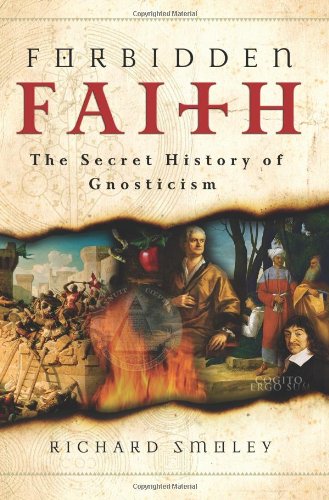
Forbidden Faith: The Secret History of Gnosticism
Authors:
Richard Smoley
Publisher:
HarperOne
Publication Date:
Not available
ISBN:
0060858303
The success of books such as Elaine Pagels's Gnostic Gospels and Dan Brown's Da Vinci Code proves beyond a doubt that there is a tremendous thirst today... for finding the hidden truths of Christianity – truths that may have been lost or buried by institutional religion over the last two millennia. In Forbidden Faith, Richard Smoley narrates a popular history of one such truth, the ancient esoteric religion of gnosticism, which flourished between the first and fourth centuries A.D., but whose legacy remains even today, having survived secretly throughout the ages.

Forbidden Family: Wartime Memoir of the Philippines, 1941-1945...
Authors:
Margaret Sams
Publisher:
University of Wisconsin Press
Publication Date:
Not available
ISBN:
0299121445
Written just five years after the end of World War II, this is Margaret Sams’s moving testimony of life in a Japanese internment camp—the can of... Spam hoarded for Christmas dinner, the clandestine radio hidden in her sewing kit, the beheading of other prisoners for transgressions. With her husband held elsewhere as a prisoner of war and with a small son to protect, Margaret broke the rules both of society and of her captors to fall in love and bear a child with a kind and daring fellow internee, Jerry Sams.
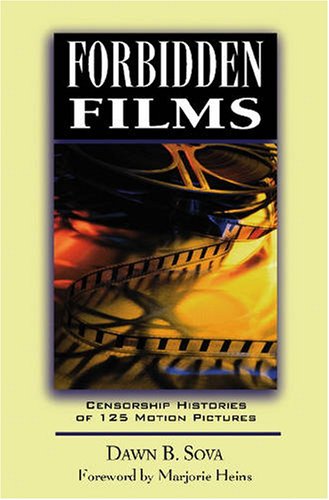
Forbidden Films: Censorship Histories of 125 Motion Pictures (Facts...
Authors:
Dawn B. Sova
Publisher:
Facts on File
Publication Date:
Not available
ISBN:
0816043361
Since the earliest days of the film industry, mainstream films have been banned for their sexual, religious, social, and political content. Forbidden... Films traces the efforts to censor 125 films, ranging from the silent Birth of a Nation to Schlindler's List. This fascinating reference examines the continued efforts to regulate the industry, providing a summary of each banned film-including production details, censorship history, and suggestions for further reading. Coverage includes: * Early efforts to regulate the movie industry, such as the Hays Code in 1922 and the Motion Picture Production Code in 1930 * The emergence of the Catholic League of Decency, which wielded extensive power for nearly forty years * The reasoning behind different types of film censorship-including racism and anti-Semitism, sexual "indecency," and the fear of Communism * Classic and contemporary films that have faced censorship, for sexual content (Last Tango in Paris, A Streetcar Named Desire), social content (Basic Instinct, Of Human Bondage), political content (Anna and the King, Revenge at Daybreak), religious content (La Dolce Vita, The Last Temptation of Christ), and violence content (Natural Born Killers, Scarface) * Appendixes profiling the directors of the banned films, films classified according to the reason for their censorship or ban, and a listing of 125 additional challenged, censored, and banned films.
 '





