production
/viewbook/list/all/?page=5208
/
/static/
None
Governance and Information Technology: From Electronic Government...
Authors:
Not Available
Publisher:
The MIT Press
Publication Date:
Not available
ISBN:
0262633493
Developments in information and communication technology and networked computing over the past two decades have given rise to the notion of electronic... government, most commonly used to refer to the delivery of public services over the Internet. This volume argues for a shift from the narrow focus of "electronic government" on technology and transactions to the broader perspective of information government--the information flows within the public sector, between the public sector and citizens, and among citizens--as a way to understand the changing nature of governing and governance in an information society. The chapters discuss the interplay between recent technological developments and evolving information flows, and the implications of different information flows for efficiency, political mobilization, and democratic accountability. The chapters are accompanied by short case studies from around the world, which cover such topics as electronic government efforts in Singapore and Switzerland, the U.S Environmental Protection Agency's effort to solicit input on planned regulations over the Internet, and online activism "cyberprotesting" globalization.ContributorsRobert D. Behn, Maria Christina Binz-Scharf, Herbert Burkert, Lorenzo Cantoni, Cary Coglianese, Martin J. Eppler, Jane E. Fountain, Monique Girard, Åke Grönlund, Matthew Hindman, Edwin Lau, David Lazer, Viktor Mayer-Schönberger, Ines Mergel, Gopal Raman, David Stark, Sandor Vegh, Darrell M. West Viktor Mayer-Schönberger is Associate Professor of Public Policy at the John F. Kennedy School of Government at Harvard University and chairs the Rueschlikon Conferences on Information Policy. David Lazer is Associate Professor of Public Policy at the John F. Kennedy School of Government and Director and founder of the Program on Networked Governance at Harvard University. He is the editor of DNA and the Criminal Justice System: The Technology of Justice (MIT Press, 2004).

Governance and Ministry: Rethinking Board Leadership
Authors:
Dan Hotchkiss
Publisher:
The Alban Institute
Publication Date:
Not available
ISBN:
1566993709
In Governance and Ministry, Alban Institute senior consultant Dan Hotchkiss offers congregational leaders a roadmap and tools for changing the way... boards and clergy work together to lead congregations. Hotchkiss demonstrates that the right governance model is the one that best enables a congregation to fulfill its mission--to achieve both the outward results and the inward quality of life to which it is called. Resources on governance for the nonprofit sector have burgeoned over the past decade, and this book translates some of what is most helpful from that world for clergy and lay leaders. it also recognizes that in some ways congregations are unique and need governance structures and processes different from those that work in other organizations. Leaders must continually balance the conserving function of an institution with the expectation of disruptive, change-inducting creativity that comes when individuals peek past the temple veil and catch fresh visions of the Holy. Governance in congregations is not the science of achieving optimal results through organizational re-engineering. Governance is an expressive art, like preaching. The forms of our congregations must reflect the values and perceptions of the sacred at their heart. Congregations need skills and methods for negotiating "our way" of governance and for passing the torch effectively to new leaders.

Governance and Policy in Sport Organizations
Authors:
Mary A. Hums
Publisher:
Holcomb Hathaway Publishers
Publication Date:
Not available
ISBN:
1890871893
This book introduces you to the governance, power, and politics of sport organizations. You will learn the basics of managerial activities necessary for... governance and policy development in sport organizations, as well as the structure and function of the various organizations with which you will work and interact when you enter the workforce. You will discover where the power lies in an organization or industry segment and how individual sport organizations fit into the greater industry. Current policy issues and the ethical questions they raise are also addressed. Designed to encourage you to integrate management theory with governance and policy development practices, the second edition of this book provides you with an overview of the sport industry that will help you understand your place in it as a future sport management professional.
Governance and Politics in Africa
Authors:
Goran Hyden
Publisher:
Lynne Rienner Pub
Publication Date:
Not available
ISBN:
1555872859
The question of "getting politics right" has taken on growing importance in Africa, as the continent's economic crisis continues unabated, and with... political reform occurring in the Soviet Union and Eastern Europe. In response to this situation, scholars are addressing how African countries are being governed and what the constraints and opportunities are for political reform. Their focus on governance marks a new departure in comparative politics, recognizing the potential significance of actors other than governments, notably the various associations that make up civil society. This book is the first to systematically explore this new conceptual orientation. Governance and politics in Africa edited by Göran Hydén; Michael Bratton. Publisher: Boulder, Colo. : L. Rienner, 1992. ISBN: 1555872859. OCLC Number: 24064898. Description:xii, 329 p. ; 24 cm. Contents: Governance and the study of politics / Goran Hyden, Toward governance in Africa : popular demands and state responses / Michael Bratton & Nicolas van de Walle, Governance, democracy, and the 1988 Senegalese elections / Crawford Young & Babacar Kante, State-society relations in Botswana : beginning liberalization / John D. Holms & Patrick P. Molutsi, Accommodation in the midst of crisis? : Assessing governance in Nigeria / Donald C. Williams, Liberalization, governance, and political space in Ghana / Naomi Chazan, Grassroots legitimation of military governance in Burkina Faso and Niger : the core contradictions / Pearl T. Robinson, The rise and fall of a governance realm in Kenya / Joel D. Barkan, Rwanda : recent debates over governance and rural development / Catharine Newbury, Local organizations, participation, and the state in urban Tanzania / Aili Mari Tripp, Initiatives from below : Zaire's other path to social and economic restructuring / Janet MacGaffey, The institutional bases of governance in Africa / Michael Bratton & Donald Rothchild.

Governance and Politics of China
Authors:
Tony Saich
Publisher:
Palgrave Macmillan
Publication Date:
Not available
ISBN:
0230279937
Now available in a substantially revised 3rd edition covering the changes of the Seventeenth Party Congress and Eleventh National People's Congress and... other recent developments, this major text by a leading academic authority provides a thorough introduction to all aspects of politics and governance in post-Mao China.

Governance and Politics of the Netherlands (Comparative Government...
Authors:
Rudy B. Andeweg
Publisher:
Palgrave Macmillan
Publication Date:
Not available
ISBN:
0230580459
This fully revised and updated new edition of the leading text on politics in The Netherlands explores the causes and impact of the distinctively Dutch... quest for consensus and provides full coverage of recent developments and events.
Governance And the Public Good (Suny Series, Frontiers in Education)
Authors:
William G. Tierney
Publisher:
State University of New York Press
Publication Date:
Not available
ISBN:
0791468763
Governance as Leadership: Reframing the Work of Nonprofit Boards
Authors:
Richard P. Chait
Publisher:
Wiley
Publication Date:
Not available
ISBN:
0471684201
A new framework for helping nonprofit organizations maximize the effectiveness of their boards.Written by noted consultants and researchers attuned to... the needs of practitioners, Governance as Leadership redefines nonprofit governance. It provides a powerful framework for a new covenant between trustees and executives: more macrogovernance in exchange for less micromanagement. Informed by theories that have transformed the practice of organizational leadership, this book sheds new light on the traditional fiduciary and strategic work of the board and introduces a critical third dimension of effective trusteeship: generative governance. It serves boards as both a resource of fresh approaches to familiar territory and a lucid guide to important new territory, and provides a road map that leads nonprofit trustees and executives to governance as leadership. Governance as Leadership was developed in collaboration with BoardSource, the premier resource for practical information, tools and best practices, training, and leadership development for board members of nonprofit organizations. Through its highly acclaimed programs and services, BoardSource enables organizations to fulfill their missions by helping build effective nonprofit boards and offering credible support in solving tough problems. For the latest in nonprofit governance, visit www.boardsource.org, or call us at 1-800-883-6262.

Governance for the Environment: New Perspectives
Authors:
Not Available
Publisher:
Cambridge University Press
Publication Date:
Not available
ISBN:
0521743001
We live in an era of human-dominated ecosystems in which the demand for environmental governance is rising rapidly. At the same time, confidence in the... capacity of governments to meet this demand is waning. How can we address the resultant governance deficit and achieve sustainable development? This book brings together perspectives from economics, management, and political science in order to identify innovative approaches to governance and bring them to bear on environmental issues. The authors' analysis of important cases demonstrates how governance systems need to fit their specific setting and how effective policies can be developed without relying exclusively on government. They argue that the future of environmental policies lies in coordinated systems that simultaneously engage actors located in the public sector, the private sector, and civil society. Governance for the Environment draws attention to cutting-edge questions for practitioners and analysts interested in environmental governance.
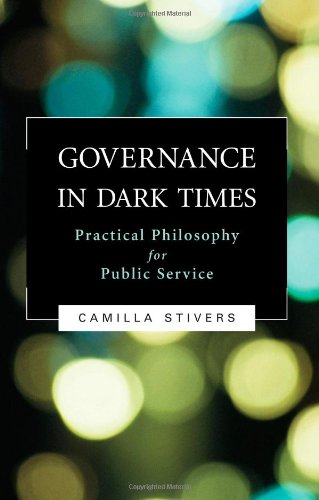
Governance in Dark Times: Practical Philosophy for Public Service
Authors:
Camilla Stivers
Publisher:
Georgetown University Press
Publication Date:
Not available
ISBN:
158901197X
With the rush of calamitous events in recent years -- the September 11 terror attacks, the Iraq imbroglio, and hurricanes Katrina and Rita -- Americans... feel themselves to be living in dark times. Trust in one another and in the government is at low ebb. People in public service face profound challenges to the meaning and efficacy of their work. Where can a public servant turn for a public philosophy to sustain practice?Inspired by Hannah Arendt and several other philosophers, Governance in Dark Times is the first book to explore the philosophical and value underpinnings needed to guide public servants in these times. Featuring down-to-earth discussions of such issues as terrorism, torture, and homeland security, it suggests ways for people in government to think more deeply, judge more wisely, and act more meaningfully. Camilla Stivers argues that the most urgent requirement in dark times is re-kindling what Arendt called "the light of the public," and offers practical steps for public servants to create spaces for citizen dialogue and engagement in public life. Ideas like "governance of the common ground" and "public service as social hope" will spark discussion and encourage renewed dedication to the work of governing. Grounded in the author's more than thirty years of teaching and administrative practice, Governance in Dark Times urges public servants in clear, jargon-free prose to reflect, to understand the world we live in, and to act responsibly, both individually and with fellow citizens.

Governance in Pacific Asia: Political Economy and Development from...
Authors:
Peter Ferdinand
Publisher:
Continuum
Publication Date:
Not available
ISBN:
1441167595
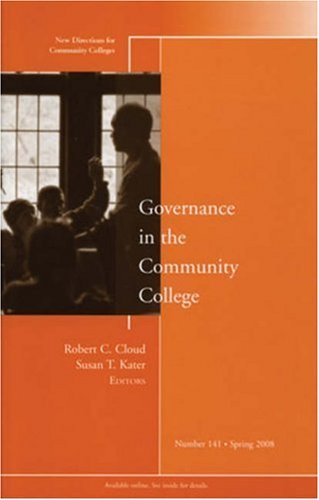
Governance in the Community College: New Directions for Community...
Authors:
Not Available
Publisher:
Jossey-Bass
Publication Date:
Not available
ISBN:
0470321342
Community college governance is a process for distributing authority, influence, and resources among internal and external constituencies. Having... evolved from traditional public school bureaucratic and political models that emphasize control and oversight, community college governance is now a dynamic process with a host of participants. Gone are the days when presidents and trustees acted unilaterally on college issues. Although boards retain the legal authority to govern their colleges, prudent trustees now encourage broad-based involvement in governance. Nationwide, the trend is toward more participation and shared responsibility, and some states are codifying the process. For example, the California legistlature has mandated a shared governance system in public community colleges, reflecting the movement toward involvement and transparency. College leaders resist or ignore that trend to the detriment of their colleges and at their own peril.Interest in community college governance will increase among scholars and practitioners for many reasons. Enrollments are increasing rapidly while funding is not keeping pace. Taxpayer resistance is a reality. Workforce training programs will compete with transfer curricula for resources. Increasing numbers of poorly prepared students will require remediation. For-profit institutions will compete for students. Employee unions will press for better salaries and benefits and meaning participation in governance. Special interest groups will continue electing advocates to governing boards. P-19 initiatives will require close collaboration with public schools. In the meantime, rogue trustees will try the patience of everyone. Traditional governance models will not suffice in this demanding arena. Governance structures that are more collegial, flexible, and inclusive will be essential in the future as community colleges evolve to meet the needs of an increasingly complex and diverse society.OL {list-style:disc}P:{margin-left 60px}Chapters includeCommunity College Governance: What Matters and Why?Governance over the Years: A Trustee's PerspectiveGovernance in a Union EnvironmentInternal Governance in the Community College: Models and QuiltsThe Effect of the Community College Workforce Development Mission on GovernanceClosing the Gaps in Texas: The Critical Role of Community CollegesYanks, Canucks, and Aussies: Governance as LiberationGovernance in Strategic ContextKey Resources on Community College GovernanceThis is the 141th volume of the Jossey-Bass higher education quarterly report series New Directions for Community Colleges, an essential guide for presidents, vice presidents, deans, and other leaders in today's open-door institutions, this quarterly provides expert guidance in meeting the challenges of their distinctive and expanding educational mission.

Governance in the Twenty-First-Century University: Approaches to...
Authors:
Dennis John Gayle
Publisher:
Jossey-Bass
Publication Date:
Not available
ISBN:
078797174X
Explores approaches to effective leadership and strategic management in the twenty-first century university that recognize and respond to the... perceptions and attitudes of university leaders toward institutional structures. It examines the differences between treating universities as businesses and managing universities in a businesslike manner, what kinds of leadership will best address challenges, and how to gain consensus among constituents that change is needed. From historical background to modern e-learning techniques, we look at governance to find systems that are effectively structured to balance the needs of students, educators, administrators, trustees, and legislators.
Governance in World Affairs
Authors:
Oran R. Young
Publisher:
Cornell University Press
Publication Date:
Not available
ISBN:
0801486238
In this book Oran Young extends and generalizes his earlier work on international environmental regimes to present a comprehensive account of the... current status and future prospects of regime theory as a way of thinking about governance in world affairs.Young organizes his assessment around two overarching issues. The first emphasizes the idea that regimes are dynamic systems. An understanding of regime formation is thus a springboard for inquiries into the effectiveness of these arrangements once they become operational and into the processes through which regimes change over time. The second stresses the importance of fostering a dialogue between scholars who espouse distinct ways of thinking about international institutions: the collective-action perspective arising from the fields of economics and public choice and the social-practice perspective associated with the fields of sociology and anthropology.Within this framework, the book offers cutting-edge contributions regarding the tasks institutions perform, the effectiveness of regimes, institutional change, and linkages among distinct regimes.
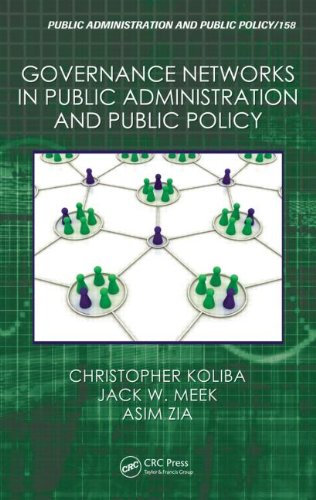
Governance Networks in Public Administration and Public Policy
Authors:
Christopher Koliba
Publisher:
CRC Press
Publication Date:
Not available
ISBN:
1420071262
What do public administrators and policy analysts have in common? Their work is undertaken within networks formed when different organizations align to... accomplish some kind of policy function. To be effective, they must find ways to navigate complexity and generate effective results. Governance Networks in Public Administration and Public Policy describes a variety of trends and movements that have contributed to the complexity of these systems and the challenges that must be faced as a result. Providing a theoretical and empirical foundation in governance networks, the book offers a conceptual framework for describing governance networks and provides a holistic way to conceive their construction. The text details the skills and functions of public administrators in the context of networked relationships and presents the theoretical foundations to analyze governance networks. It identifies the reforms and trends in governing that led to governance networks, explains the roles that various actors take on through networked relationships, highlights the challenges involved in the failure of networked activities, and illustrates how policy tools are mobilized by these relationships. Be a part of building governance networks 2.0! The author’s website contains support materials such as PowerPoint® presentations, writable case study templates, and other useful items related to building the field’s capacity to describe, evaluate, and design governance networks using the framework of this book. You can post case studies of governance networks, draw on other’s case study materials, and learn about research and educational opportunities. Based on research and real-life experience, the book highlights the interplay between public actors and policy tools. The authors demystify this complex topic of governance networks and explore the practical applications of the conceptual framework. Practical and accessible, the book presents concepts in such a way that readers can engage in these ideas, apply them, and deepen their understanding of the dynamics unfolding around them.
 '





