production
/viewbook/list/all/?page=5209
/
/static/
None

Governance, Regulation and Powers on the Internet
Authors:
Not Available
Publisher:
Cambridge University Press
Publication Date:
Not available
ISBN:
1107013429
Digital technologies have prompted the emergence of new modes of regulation and governance, since they allow for more decentralized processes of... elaboration and implementation of norms. Moreover, the Internet has been raising a wide set of governance issues since it affects many domains, such as individual rights, public liberties, property rights, economic competition, market regulation, conflict management, security and the sovereignty of states. There is therefore a need to understand how technical, political, economic and social norms are articulated, as well as to understand who the main actors of this process of transformation are, how they interact and how these changes may influence international rulings. This book brings together an international team of scholars to explain and analyse how collective regulations evolve in the broader context of the development of post-modern societies, globalization, the reshaping of international relations and the profound transformations of nation-states.

Governing 3rd edition plus State and Local Government 11-12
Authors:
Not Available
Publisher:
CQ Press
Publication Date:
Not available
ISBN:
1608719197
Advance praise for Farewell, My Subaru“Fine is Bryson Funny.” ——Santa Cruz Sentinel “Fine is an amiable and self-deprecating storyteller in... the mold of Douglas Adams. If you're a fan of Hitchhiker's Guide to the Galaxy-style humor -- and also looking to find out how to raise your own livestock to feed your ice-cream fetish -- Farewell may prove a vital tool.” —— The Washington Post “Fine is an eco-hero for our time..” —— Miami Herald“An afterward offers solid advice and sources for learning more.” —— On Earth Magazine, Natural Resources Defense Fund “This is Green Acres for the smart set—: a witty and educational look at sustainable living. Buy it, read it, compost it.” –A. J. Jacobs, author of The Year of Living Biblically “The details of Doug Fine’s experiment in green living are great fun——but more important is the spirit, the dawning understanding that living in connection to something more tangible than a computer mouse is what we were built for. It’ll make you want to move!”–Bill McKibben, author of Deep Economy: The Wealth of Communities and the Durable FutureLike many Americans, Doug Fine enjoys his creature comforts, but he also knows full well they keep him addicted to oil. So he wonders: Is it possible to keep his Netflix and his car, his Wi-Fi and his subwoofers, and still reduce his carbon footprint? In an attempt to find out, Fine up and moves to a remote ranch in New Mexico, where he brazenly vows to grow his own food, use sunlight to power his world, and drive on restaurant grease. Never mind that he’s never raised so much as a chicken or a bean. Or that he has no mechanical or electrical skills. Whether installing Japanese solar panels, defending the goats he found on Craigslist against coyotes, or co-opting waste oil from the local Chinese restaurant to try and fill the new “veggie oil” tank in his ROAT (short for Ridiculously Oversized American Truck), Fine’s extraordinary undertaking makes one thing clear: It ain’t easy being green. In fact, his journey uncovers a slew of surprising facts about alternative energy, organic and locally grown food, and climate change. Both a hilarious romp and an inspiring call to action, Farewell, My Subaru makes a profound statement about trading today’s instant gratifications for a deeper, more enduring kind of satisfaction.
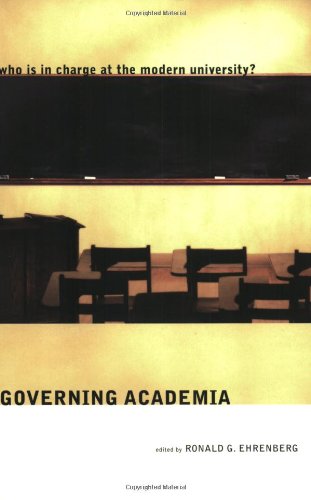
Governing Academia
Authors:
Not Available
Publisher:
Cornell University Press
Publication Date:
Not available
ISBN:
0801472822
Public concern over sharp increases in undergraduate tuition has led many to question why colleges and universities cannot behave more like businesses... and cut their costs to hold tuition down. Ronald G. Ehrenberg and his coauthors assert that understanding how academic institutions are governed provides part of the answer. Factors that influence the governance of academic institutions include how states regulate higher education and govern their public institutions; the size and method of selection of boards of trustees; the roles of trustees, administrators, and faculty in shared governance at campuses; how universities are organized for fiscal and academic purposes; the presence or absence of collective bargaining for faculty, staff, and graduate student assistants; pressures from government regulations, donors, insurance carriers, athletic conferences, and accreditation agencies; and competition from for-profit providers.Governing Academia, which covers all these aspects of governance, is enlightening and accessible for anyone interested in higher education. The authors are leading academic administrators and scholars from a wide range of fields including economics, education, law, political science, and public policy.
Governing America's Urban Areas
Authors:
Alan L. Saltzstein
Publisher:
Wadsworth Publishing
Publication Date:
Not available
ISBN:
0155073796
GOVERNING AMERICA'S URBAN AREAS offers students a detailed understanding of the structures and political processes intrinsic to metropolitan government.... Focusing on the problems and promises of coordinated metropolitan governance, Alan Saltzstein demonstrates that American cities--which need strong government--are often governed in reality by a variety of weak institutions and forces. This theme is woven throughout the text, giving students a common framework within which to understand such fundamental social science concepts as power, efficiency, violence, representation, and organizational structure.
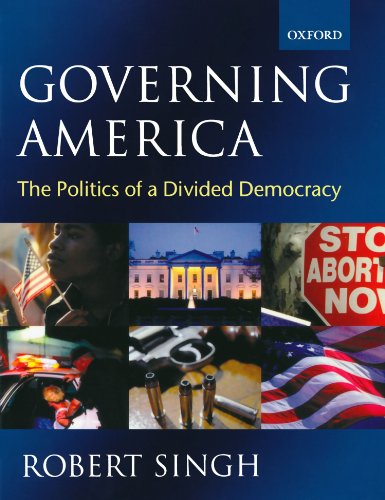
Governing America: The Politics of a Divided Democracy
Authors:
Not Available
Publisher:
Oxford University Press, USA
Publication Date:
Not available
ISBN:
0199250499
An innovative edited textbook, designed for first-time students of American politics. This volume offers an accessible and comprehensive examination of... American politics both before and after September 11. Governing America covers the foundations of modern American politics, the structure of American governing institutions, domestic and foreign public policies and a series of contemporary controversies.
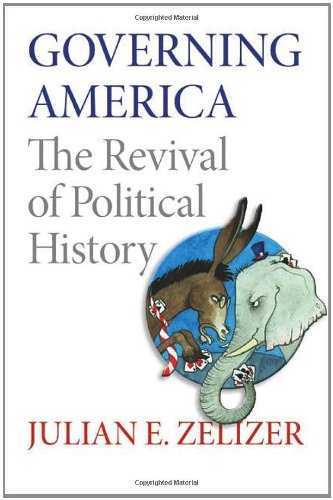
Governing America: The Revival of Political History
Authors:
Julian E. Zelizer
Publisher:
Princeton University Press
Publication Date:
Not available
ISBN:
0691150737
In recent years, the study of American political history has experienced a remarkable renaissance. After decades during which the subject fell out of... fashion and disappeared from public view, it has returned to prominence as the study of American history has shifted its focus back to politics broadly defined. In this book, one of the leaders of the resurgence in American political history, Julian Zelizer, assesses its revival and demonstrates how this work not only illuminates the past but also helps us better understand American politics today. Governing America addresses issues of wide interest, including the rise of the welfare state, the development of modern conservatism, the history of Congress, the struggle over campaign finance, changing views about presidential power, and national security. Throughout, it addresses four big questions: How have interpretations of American political history changed over time? How have taxes and budgets constrained policymakers? How have changes in the political process defined historical eras? And how have policy and politics interacted on decisions like going to war? Zelizer's answers to these questions are fresh and often surprising, providing compelling new perspectives on modern American politics.
Governing Boards: Their Nature and Nurture (Jossey-Bass Nonprofit...
Authors:
Cyril O. Houle
Publisher:
Jossey-Bass
Publication Date:
Not available
ISBN:
0787909165
A Publication of the National Center for Nonprofit BoardsShould be required reading for every new board member.--NonProfit TimesShows how to handle the... challenges facing board members, including board organization, procedures, accountability, and more!
Governing by Campaigning: The Politics of the Bush Presidency, 2007...
Authors:
George C. Edwards
Publisher:
Pearson
Publication Date:
Not available
ISBN:
0205529623
In this brief book, George Edwards, one of the foremost experts on the presidency and author of "Why the Electoral College is Bad for America,”... explores how the Bush administration has attempted sweeping changes in public policy – without broad support for doing so – by taking its case to the American public more than any other president in history.
Governing By Contract: Challenges and Opportunities For Public...
Authors:
Phillip Cooper
Publisher:
CQ Press
Publication Date:
Not available
ISBN:
156802620X
Is the public getting a good deal when the government contracts out the delivery of goods and services? Phillip Cooper attempts to get at the heart of... this question by exploring what happens when public sector organizations--at the federal, state and local levels--form working relationships with other agencies, communities, non-profit organizations and private firms through contracts. Rather than focus on the ongoing debate over privatization, the book emphasizes the tools managers need to form, operate, terminate or transform these contracts amidst a complex web of intergovernmental relations. Cooper frames the issues of public contract management by showing how managers are caught in between governance by authority and government by contract. By looking at cases ranging from the management of Baltimore schools to the contracting of senior citizen programs in Kansas, he offers practical information to students and practitioners and a theoretical context for their work. At every turn, the author avoids bogging readers down in technical jargon. Instead the book sheds light on a crucial part of any public manager's job with lively case material and no-nonsense guidance for making the most of taxpayer dollars.
Governing by Network: The New Shape of the Public Sector
Authors:
Stephen Goldsmith
Publisher:
Brookings Institution Press
Publication Date:
Not available
ISBN:
0815731299
A fundamental, but mostly hidden, transformation is happening in the way public services are being delivered, and in the way local and national... governments fulfill their policy goals. Government executives are redefining their core responsibilities away from managing workers and providing services directly to orchestrating networks of public, private, and nonprofit organizations to deliver the services that government once did itself. Authors Stephen Goldsmith and William D. Eggers call this new model governing by network and maintain that the new approach is a dramatically different type of endeavor that simply managing divisions of employees. Like any changes of such magnitude, it poses major challenges for those in charge. Faced by a web of relationships and partnerships that increasingly make up modern governance, public managers must grapple with skill-set issues (managing a contract to capture value); technology issues (incompatible information systems); communications issues (one partner in the network, for example, might possess more information than another); and cultural issues (how interplay among varied public, private, and nonprofit sector cultures can create unproductive dissonance). Governing by Network examines for the first time how managers on both sides of the aisle, public and private, are coping with the changes. Drawing from dozens of case studies, as well as established best practices, the authors tell us what works and what doesnt. Here is a clear roadmap for actually governing the networked state for elected officials, business executives, and the broader public.
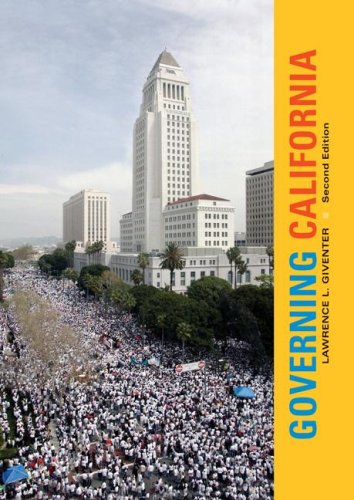
Governing California
Authors:
Lawrence Giventer
Publisher:
McGraw-Hill Humanities/Social Sciences/Languages
Publication Date:
Not available
ISBN:
0073526339
This brief, affordable text examines the essential elements of California governance and answers fundamental questions: What do you and I, as ordinary... residents, citizens, and taxpayers of California, need to know about our government? How does government work and how does it affect us? Governing California presents a new way to perceive the student of California government: as a participant.
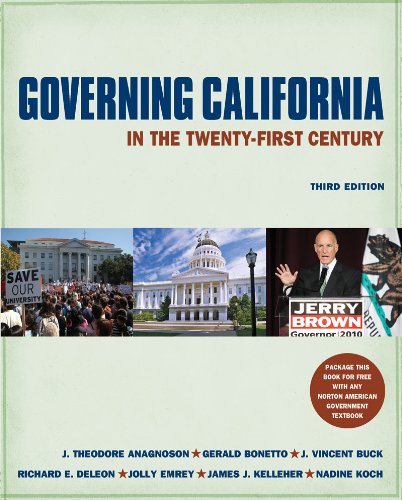
Governing California in the Twenty-First Century (Third Edition)
Authors:
J. Theodore Anagnoson
Publisher:
W. W. Norton & Company
Publication Date:
Not available
ISBN:
0393912027
The Third Edition has been updated to cover recent developments, including the 2010 elections, the budget crisis, and Governor Schwarzenegger’s... influence on California politics.Governing California encourages students to think critically about how California government and politics impact their own lives. Incorporating several of the successful features of We the People, the text emphasizes critical thinking and the relevance of government to students’ everyday lives. Governing California can be used with any American government textbook or on its own.
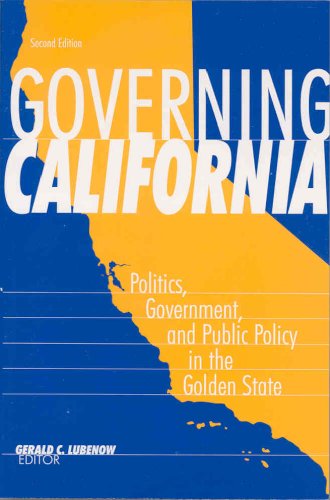
Governing California: Politics, Government, And Public Policy in...
Authors:
Gerald C. Lubenow
Publisher:
Institute of Governmental Studies Press
Publication Date:
Not available
ISBN:
0877724202
Diversity and change are hallmarks of California political life, and the changes often chart new paths for other states to follow. California blazed a... trail to direct democracy, personal politics, disdain for parties, professional campaign consultants, huge campaign budgets, and modern media techniques. This book explains how this diverse, entrepreneurial, and individualistic collection of people functions politically, how its most important institutions of government operate, and how it makes public policy. There are surprisingly few good books on California politics and government. Our goal is to give students and interested observers of state politics and government an analytical and interpretive overview of the machinery of state government, the pivotal issues that dominate political discourse, and the primary interest groups that play off one another in the ebb and flow of political life. Chapters include The Changing Legislative Landscape, by Patrick Johnston, Resolving Differences and Crafting Compromise: Creating a Budget for California, by John Decker, California: A Professional Legislature after Term Limits, by Bruce Cain, Thad Kousser, and Karl Kurtz, The Governor: Managing a Mega-State, by John Jacobs and A.G. Block, The Courts, by Preble Stolz, Jerry Uelmen, and Susan Rasky, Cities, Counties, and the State, by Revan Tranter, Direct Democracy: Initiative, Referendum, and Recall, by Eugene C. Lee, Redistricting: California 1971-2001, by J. Morgan Kousser, Do Debates Matter? The 2003 Gubernatorial Debates, by Rachel VanSickle-Ward and Darshan Goux, Immigration, by Jack Citrin and Andrea Campbell, Water in California: A Case Study in Federalism, by Megan Mullin
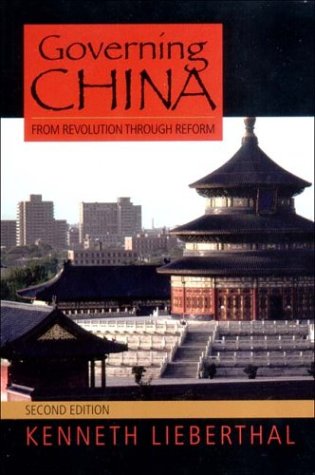
Governing China: From Revolution Through Reform
Authors:
Kenneth Lieberthal
Publisher:
W. W. Norton & Company
Publication Date:
Not available
ISBN:
0393924920
Governing China: From Revolution to Reform, the leading text for courses on Chinese politics has been thoroughly revised and updated.The new Second... Edition includes discussions of: The consumer revolution that has brought China’s major urban areas to the forefront of the developed world and created a new middle class An expanding private sector that has become the major generator of new employment in the overall economy as the state sector has shed jobs The increase in foreign direct investment which has set China on track to becoming the manufacturing center of the world. An enormous population migration from rural to urban areas and from the interior to the coast that is becoming one of the most massive movements of people in human history, and its significant impact on the environment The unprecedented integration into the international economic system as China has joined virtually every major multilateral regime The reactions of the top and the bottom of the political system to these recent developments and the continuing struggles between the government’s large bureaucratic structures and sporadic popular political movements.
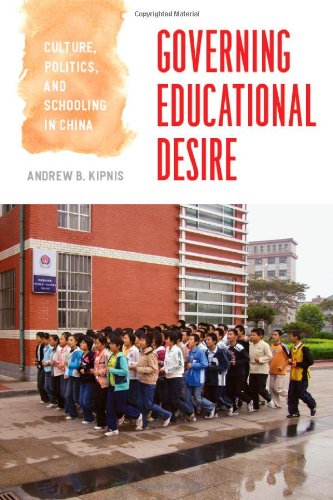
Governing Educational Desire: Culture, Politics, and Schooling in...
Authors:
Andrew B. Kipnis
Publisher:
University Of Chicago Press
Publication Date:
Not available
ISBN:
0226437558
Parents in China greatly value higher education for their children, but the intensity and effects of their desire to achieve this goal have largely gone... unexamined—until now. Governing Educational Desire explores the cultural, political, and economic origins of Chinese desire for a college education as well as its vast consequences, which include household and national economic priorities, birthrates, ethnic relations, and patterns of governance.Where does this desire come from? Andrew B. Kipnis approaches this question in four different ways. First, he investigates the role of local context by focusing on family and community dynamics in one Chinese county, Zouping. Then, he widens his scope to examine the provincial and national governmental policies that affect educational desire. Next, he explores how contemporary governing practices were shaped by the Confucian examination system, uncovering the historical forces at work in the present. Finally, he looks for the universal in the local, considering the ways aspects of educational desire in Zouping spread throughout China and beyond. In doing so, Kipnis provides not only an illuminating analysis of education in China but also a thought-provoking reflection on what educational desire can tell us about the relationship between culture and government.
 '





