production
/viewbook/list/all/?page=5210
/
/static/
None

Governing Gaza: Bureaucracy, Authority, and the Work of Rule,...
Authors:
Ilana Feldman
Publisher:
Duke University Press Books
Publication Date:
Not available
ISBN:
0822342405
Marred by political tumult and violent conflict since the early twentieth century, Gaza has been subject to a multiplicity of rulers. Still not part of... a sovereign state, it would seem too exceptional to be a revealing site for a study of government. Ilana Feldman proves otherwise. She demonstrates that a focus on the Gaza Strip uncovers a great deal about how government actually works, not only in that small geographical space but more generally. Gaza’s experience shows how important bureaucracy is for the survival of government. Feldman analyzes civil service in Gaza under the British Mandate (1917–48) and the Egyptian Administration (1948–67). In the process, she sheds light on how governing authority is produced and reproduced; how government persists, even under conditions that seem untenable; and how government affects and is affected by the people and places it governs.Drawing on archival research in Gaza, Cairo, Jerusalem, and London, as well as two years of ethnographic research with retired civil servants in Gaza, Feldman identifies two distinct, and in some ways contradictory, governing practices. She illuminates mechanisms of “reiterative authority” derived from the minutiae of daily bureaucratic practice, such as the repetitions of filing procedures, the accumulation of documents, and the habits of civil servants. Looking at the provision of services, she highlights the practice of “tactical government,” a deliberately restricted mode of rule that makes limited claims about governmental capacity, shifting in response to crisis and operating without long-term planning. This practice made it possible for government to proceed without claiming legitimacy: by holding the question of legitimacy in abeyance. Feldman shows that Gaza’s governments were able to manage under, though not to control, the difficult conditions in Gaza by deploying both the regularity of everyday bureaucracy and the exceptionality of tactical practice.

Governing Girls: Rehabilitation in the Age of Risk
Authors:
Christie L. Barron
Publisher:
Fernwood Publishing Co., Ltd.
Publication Date:
Not available
ISBN:
1552664368
Recognizing the significant media hype and moral panic over assaults and violent crimes perpetrated by young women in recent years, this investigation... reveals how Canadian governmental response to control crime overall and provide citizen protection has taken various—and often contradictory—forms. The current research agenda is explored, revealing how it focuses on risk assessment for controlling youth violence while ignoring the very concept of “risk” as a sociocultural phenomenon. Through interviews with young female offenders and youth justice authorities, this study examines female youth violence in the contemporary landscape of control, analyzing the increasing reliance on risk assessment tools. Delving into the meaning of treatment; analyzing the gender, race, and class dimensions of the risk construct; and questioning the impact of risk rationality, this reference contends that actuarial technologies depoliticize the process of control, further excluding and marginalizing young female offenders.
Governing Health: The Politics of Health Policy
Authors:
William G. Weissert
Publisher:
The Johns Hopkins University Press
Publication Date:
Not available
ISBN:
1421406217
Governing Health examines health care policy from a political perspective, describing how Congress, the president, special interest groups,... bureaucracy, and state governments help define health policy problems and find politically feasible solutions. William G. Weissert and Carol S. Weissert provide a highly readable and comprehensive synthesis of political science research on how government and private institutions affect the policy process. Extensive reviews of the policies that have governed health care since Lyndon Johnson's administration are capped off with a prognosis for the future.Updates to the fourth edition of Governing Health include • new examples and theory perspectives• recent statistics• discussion of the 2010 Obama health reform
Governing Health: The Politics of Health Policy
Authors:
Carol S. Weissert
Publisher:
The Johns Hopkins University Press
Publication Date:
Not available
ISBN:
0801884322
Governing Health examines health care policy making from a long-term, political perspective, describing how Congress, the president, special interest... groups, bureaucracy, and state governments help define health policy problems and find politically feasible solutions. The third edition of this pathbreaking book is updated to cover recent legislative efforts, including the Medicare prescription drug benefit.Praise for previous editions of Governing Health
Governing How We Care: Contesting Community and Defining Difference...
Authors:
Susan J. Shaw
Publisher:
Temple University Press
Publication Date:
Not available
ISBN:
1439906831
As local governments and organizations assume more responsibility for ensuring the public health, identity politics play an increasing yet largely... unexamined role in public and policy attitudes toward local problems. In Governing How We Care, medical anthropologist Susan Shaw examines the relationship between government and citizens using case studies of needle exchange and Welfare-to-Work programs to illustrate the meanings of cultural difference, ethnicity, and inequality in health care. Drawing on ethnographic research conducted over six years in a small New England city, Shaw presents critical perspectives on public health intervention efforts. She looks at online developments in health care and makes important correlations between poverty and health care in the urban United States. Shaw also highlights the new concepts of community and forms of identity that emerge in our efforts to provide effective health care. Governing How We Care shows how government-sponsored community health and health care programs operate in an age of neoliberalism. Susan J. Shaw is Associate Professor in the School of Anthropology at the University of Arizona.

GOVERNING ILLINOIS
Authors:
Not Available
Publisher:
Not available
Publication Date:
Not available
ISBN:
Not available

Governing New Mexico
Authors:
Not Available
Publisher:
University of New Mexico Press
Publication Date:
Not available
ISBN:
0826341284
The beginning of the twenty-first century was marked by the presence of more than 1.8 million New Mexicans, continued growth in the Rio Grande corridor,... and changes in the state's governorship and top legislative posts. This revision of New Mexico Government, Third Edition, updates information found in the earlier edition. Throughout the writing, the editors compare New Mexico's governmental institutions and practices with those of other states of the union."Though many of the political faces have changed, many of the issues have not. New Mexicans and their governments continue to wrestle with issues as diverse as water and the environment, DWI, education, crime and drugs, and economic development. In [Governing New Mexico], we attempt to present descriptions and explanations of the structures and environments in which some of those efforts occur."--from Governing New MexicoFollowing a brief look at New Mexico's history and culture, chapters cover the state's constitution, the three branches of government, local governmental structures, American Indian tribal governments, elections, and education.

Governing Nonprofit Organizations: Federal and State Law and...
Authors:
Marion R. Fremont-Smith
Publisher:
Belknap Press of Harvard University Press
Publication Date:
Not available
ISBN:
0674030451
The nonprofit sector is a vital component of our society and is allowed the greatest freedom to operate. The public understandably assumes that since... nonprofit organizations are established to do good, the people who run nonprofits are altruistic, and the laws governing nonprofits have reflected this assumption. But as Marion Fremont-Smith argues, the rules that govern how nonprofits operate are inadequate, and the regulatory mechanisms designed to enforce the rules need improvement. Despite repeated instances of negligent management, self-interest at the expense of the charity, and outright fraud, nonprofits continue to receive minimal government regulation. In this time of increased demand for corporate accountability, the need to strengthen regulation of nonprofits is obvious. Fremont-Smith addresses this need from a historical, legal, and organizational perspective. She combines summaries and analysis of the substantive legal rules governing the behavior of charitable officers, directors, and trustees with descriptions of the federal and state regulatory schemes designed to enforce these rules. Her unique and exhaustive historical survey of the law of nonprofit organizations provides a foundation for her analysis of the effectiveness of current law and proposals for its improvement.
GOVERNING NORTH DAKOTA: 2011-2013
Authors:
Not Available
Publisher:
Not available
Publication Date:
Not available
ISBN:
Not available

Governing Pleasures: Pornography and Social Change in England,...
Authors:
Lisa Z. Sigel
Publisher:
Rutgers University Press
Publication Date:
Not available
ISBN:
0813530024
How did concepts of sex & gender, race & class, home & empire develop in Victorian society? Here, Sigel charts the evolution of these ideas... through the medium of pornography (PN). She details its prod'n., dist'n., & cons'n. in Great Britain between Waterloo & WWI. Sigel examines how this medium changed over time to explore key questions: How did Brit. society define PN? Who had access to it? What did people make of its ideas? And how did these messages affect sexual & social dynamics? PN offered people a way to make sense of sexuality & its relationship to the world during the transition of Brit. society from an era of radical politics to one of consumer pleasures. Illustrated with literary & visual materials drawn from public & private collections.

Governing Risk: The IMF and Global Financial Crises (International...
Authors:
Manuela Moschella
Publisher:
Palgrave Macmillan
Publication Date:
Not available
ISBN:
023036795X
By comparing the policies the international community requested the IMF to follow in the aftermath of the Mexican, Asian and subprime crises, the book... traces the evolution of the international regulatory framework from an agent-centered constructivist perspective.
Governing States & Localities
Authors:
Kevin B Smith
Publisher:
CQ Press
Publication Date:
Not available
ISBN:
0872893790
Despite reports of the recession nearing an end, states will have to struggle to make ends meet well into the foreseeable future. The choices are... sometimes stark: trade-offs between roads and schools, public safety and health care. The new edition of Governing States and Localities responds to this reality with a new, sharper focus on economic and budget pressures. The chapter on finances comes earlier in the book, helping to frame each of the subsequent issues, and a new feature called “States under Stress” helps students see how fiscal and budgetary policy affects all areas of state and local governance. A brand-new chapter on the environment highlights the leadership role the states have taken in fighting climate change, creating green jobs, and combating pollution. Still a great blend of engaging journalistic writing, high-quality academic analysis, and the latest scholarship, the third edition has been thoroughly updated to account for such major developments as the recentralization of federalism under the Obama administration and the further politicization and rising costs of judicial elections. The authors have expanded coverage of referendums and direct democracy, as well as the increased role states play in homeland security. A series of well-designed features asks students to apply the comparative method (“A Difference that Makes a Difference”), to see how intergovernmental relations impact localities (“Local Focus”), and to see examples of how policies are actually implemented (“Policy in Practice”). An engaging full-color design, more than thirty maps, a vivid selection of photographs, updated tables and figures, and a marginal glossary all combine to keep your students focused and learning.
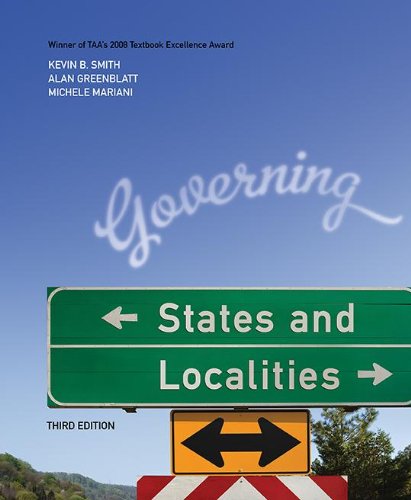
Governing States and Localities
Authors:
Kevin B Smith
Publisher:
CQ Press College
Publication Date:
Not available
ISBN:
1604267283
Despite reports of the recession nearing an end, states will have to struggle to make ends meet well into the foreseeable future. The choices are... sometimes stark: trade-offs between roads and schools, public safety and health care. The new edition of Governing States and Localities responds to this reality with a new, sharper focus on economic and budget pressures. The chapter on finances comes earlier in the book, helping to frame each of the subsequent issues, and a new feature called “States under Stress” helps students see how fiscal and budgetary policy affects all areas of state and local governance. A brand-new chapter on the environment highlights the leadership role the states have taken in fighting climate change, creating green jobs, and combating pollution. Still a great blend of engaging journalistic writing, high-quality academic analysis, and the latest scholarship, the third edition has been thoroughly updated to account for such major developments as the recentralization of federalism under the Obama administration and the further politicization and rising costs of judicial elections. The authors have expanded coverage of referendums and direct democracy, as well as the increased role states play in homeland security. A series of well-designed features asks students to apply the comparative method (“A Difference that Makes a Difference”), to see how intergovernmental relations impact localities (“Local Focus”), and to see examples of how policies are actually implemented (“Policy in Practice”). An engaging full-color design, more than thirty maps, a vivid selection of photographs, updated tables and figures, and a marginal glossary all combine to keep your students focused and learning.

Governing Subjects: An Introduction to the Study of Politics
Authors:
Isaac D. Balbus
Publisher:
Routledge
Publication Date:
Not available
ISBN:
0415998905
This introduction to the study of politics explores the multiple meanings of "governance" as well as the several senses of what it means to be a... "subject." It takes the reader on a journey through and across the domains of law and institutions, markets and power, and culture and identity, and shows how the understanding of any one of these domains demands an understanding of them all. The path through these related regions is marked by regular encounters with leading and competing thinkers—from the expected, such as James Madison, Robert Dahl, Michel Foucault, and Adam Smith, to the unexpected, such as Joseph Raz, Lisa Disch, Doug Henwood, and Joan Scott—that encourage the reader to evaluate their arguments for their internal coherence and explanatory power. Governing Subjects is at once a holistic and critical introduction to the study of politics.

Governing the Commons: The Evolution of Institutions for Collective...
Authors:
Elinor Ostrom
Publisher:
Cambridge University Press
Publication Date:
Not available
ISBN:
0521405998
Congratulations to Elinor Ostrom, Co-Winner of The Sveriges Riksbank Prize in Economic Sciences in Memory of Alfred Nobel 2009! The governance of... natural resources used by many individuals in common is an issue of increasing concern to policy analysts. Both state control and privatization of resources have been advocated, but neither the state nor the market have been uniformly successful in solving common pool resource problems. After critiquing the foundations of policy analysis as applied to natural resources, Elinor Ostrom here provides a unique body of empirical data to explore conditions under which common pool resource problems have been satisfactorily or unsatisfactorily solved. Dr. Ostrom first describes three models most frequently used as the foundation for recommending state or market solutions. She then outlines theoretical and empirical alternatives to these models in order to illustrate the diversity of possible solutions. In the following chapters she uses institutional analysis to examine different ways--both successful and unsuccessful--of governing the commons. In contrast to the proposition of the tragedy of the commons argument, common pool problems sometimes are solved by voluntary organizations rather than by a coercive state. Among the cases considered are communal tenure in meadows and forests, irrigation communities and other water rights, and fisheries.
 '





