production
/viewbook/list/all/?page=5276
/
/static/
None
Green Chemistry: An Introductory Text
Authors:
Mike Lancaster
Publisher:
Royal Society of Chemistry
Publication Date:
Not available
ISBN:
1847558739
Sustainable development and environmental issues are at the forefront of public and Government concern. Chemistry and Chemical Engineering may offer the... solution to many of these challenges, but chemicals can also be part of the problem. Green chemistry aims to provide environmentally benign products from sustainable resources, using processes that do not harm people or the environment. Aimed at undergraduate and postgraduate students, this introduction to green chemistry encourages new ways of thinking about how products and processes are developed. These include methods of waste minimization, use of renewable feed stocks and the role of catalysis in reducing raw material use. The text is easy to understand and particularly relevant to courses on . It includes case studies and real examples from industry to demonstrate how the techniques work in practice.

Green Chemistry: Theory and Practice
Authors:
Paul T. Anastas
Publisher:
Oxford University Press, USA
Publication Date:
Not available
ISBN:
0198506988
This book provides the first introductory treatment of the design, development, and evaluation processes central to Green Chemistry. As s comprehensive... textbook, it takes a broad view of the subject and integrates a wide variety of approaches. Topics include alternative feedstocks, environmentally benign syntheses, the design of safer chemical products, new reaction conditions, alternative solvents and catalyst development, and the use of biosynthesis and biomimetic principles. It introduces new evaluation processes that encompass the complete health and environmental impact of a synthesis, from the choice of starting materials to the final product. Throughout, the text provides specific examples which compare the new methods with classical ones.
Green Cities of Europe: Global Lessons on Green Urbanism
Authors:
Not Available
Publisher:
Island Press
Publication Date:
Not available
ISBN:
1597269751
In the absence of federal leadership, states and localities are stepping forward to address critical problems like climate change, urban sprawl, and... polluted water and air. Making a city fundamentally sustainable is a daunting task, but fortunately, there are dynamic, innovative models outside U.S. borders. Green Cities of Europe draws on the world's best examples of sustainability to show how other cities can become greener and more livable. Timothy Beatley has brought together leading experts from Paris, Freiburg, Copenhagen, Helsinki, Heidelberg, Venice, Vitoria-Gasteiz, and London to illustrate groundbreaking practices in sustainable urban planning and design. These cities are developing strong urban cores, building pedestrian and bicycle infrastructure, and improving public transit. They are incorporating ecological design and planning concepts, from solar energy to natural drainage and community gardens. And they are changing the way government works, instituting municipal "green audits" and reforming economic incentives to encourage sustainability. Whatever their specific tactics, these communities prove that a holistic approach is needed to solve environmental problems and make cities sustainable. Beatley and these esteemed contributors offer vital lessons to the domestic planning community about not only what European cities are doing to achieve that vision, but precisely how they are doing it. The result is an indispensable guide to greening American cities. Contributors include: Lucie Laurian (Paris)Dale Medearis and Wulf Daseking (Freiburg)Michaela Brüel (Copenhagen)Maria Jaakkola (Helsinki)Marta Moretti (Venice)Luis Andrés Orive and Rebeca Dios Lema (Vitoria-Gasteiz)Camilla Ween (London)
Green Cities: Urban Growth and the Environment
Authors:
Matthew E. Kahn
Publisher:
Brookings Institution Press
Publication Date:
Not available
ISBN:
0815748159
What is a green city? What does it mean to say that San Francisco or Vancouver is more "green" than Houston or Beijing? When does urban growth lower... environmental quality, and when does it yield environmental gains? How can cities deal with the environmental challenges posed by growth? These are the questions Matthew Kahn takes on in this smart and engaging book.Written in a lively, accessible style, Green Cities takes the reader on a tour of the extensive economic literature on the environmental consequences of urban growth. Kahn starts with an exploration of the Environmental Kuznets Curve (EKC) --the hypothesis that the relationship between environmental quality and per capita income follows a bell-shaped curve. He then analyzes several critiques of the EKC and discusses the implications of growth in urban population and surface area, as well as income. The concluding chapter addresses the role of cities in promoting climate change and asks how cities in turn are likely to be affected by this trend.As Kahn points out, although economics is known as the "dismal science," economists are often quite optimistic about the relationship between urban development and the environment. In contrast, many ecologists and environmentalists remain wary of the environmental consequences of free-market growth. Rather than try to settle this dispute, this book conveys the excitement of an ongoing debate. Green Cities does not provide easy answers complex dilemmas. It does something more important --it provides the tools readers need to analyze these issues on their own.
Green Community
Authors:
National Building Museum
Publisher:
American Planning Association (Planners Press)
Publication Date:
Not available
ISBN:
1932364749
The health of our planet and ourselves depends on how we plan, design, and construct the world between our buildings. Our increasing dependence on... fossil fuels over the last century has given us unprecedented individual mobility and comfort, but the consequences are clear. Climate change, sprawl, and reliance on foreign oil are just a few of the challenges we face in designing new-and adapting existing-communities to be greener. Based on the National Building Museum's Green Community exhibition, this book is a collection of thought-provoking essays that illuminate the connections among personal health, community health, and our planet's health. Green Community brings together diverse experts, each of whom has a unique approach to sustainable planning, design, politics, and construction.
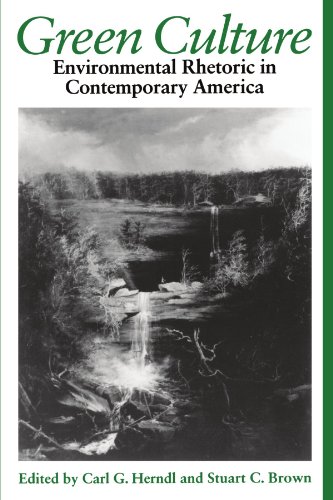
Green Culture: Environmental Rhetoric In Contemporary America
Authors:
Carl Herndl
Publisher:
University of Wisconsin Press
Publication Date:
Not available
ISBN:
0299149943
Green Culture is about an idea—the environment—and how we talk about it. Is the environment something simply “out there” in the world to be... found? Or is it, as this book suggests, a concept and a set of cultural values constructed by our use of language? That language, in its many forms, comes under scrutiny here, as distinguished authors writing from a variety of perspectives consider how our idea and our discussion of the environment evolve together, and how this process results in action—or inaction. Listen to politicians, social scientists, naturalists, and economists talk about the environment, and a problem becomes clear: dramatic differences on environmental issues are embedded in dramatically different discourses. This book explores these differences and shows how an understanding of rhetoric might lead to their resolution. The authors examine specific environmental debates—over the Great Lakes and Yellowstone, a toxic waste dump in North Carolina and an episode in Red Lodge, Montana. They look at how genres such as nature writing and specific works such as Rachel Carson’s Silent Spring have influenced environmental discourse. And they investigate the impact of cultural traditions, from the landscape painting of the Hudson River School to the rhetoric of the John Birch Society, on our discussions and positions on the environment. Most of the scholars gathered here are also hikers, canoeists, climbers, or bird watchers, and their work reflects a deep, personal interest in the natural world in connection with the human community. Concerned throughout to make the methods of rhetorical analysis perfectly clear, they offer readers a rare chance to see what, precisely, we are talking about when we talk about the environment.
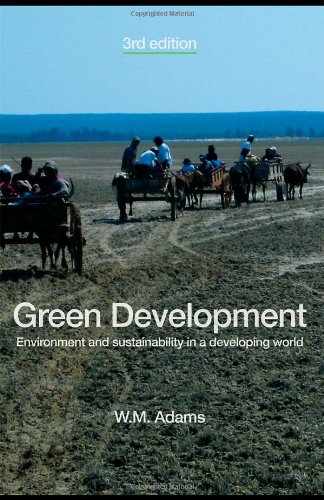
Green Development: Environment and Sustainability in a Developing...
Authors:
Bill Adams
Publisher:
Routledge
Publication Date:
Not available
ISBN:
0415395089
The concept of sustainability lies at the core of the challenge of environment and development and the way governments, business and environmental... groups respond to it. Green Development provides a clear and coherent analysis of sustainable development in both theory and practice. This third edition retains the clear and powerful argument of previous editions, but has been updated to reflect advances in ideas and changes in international policy. Greater attention has been given to political ecology, environmental risk and the environmental impacts of development. This fully revised third edition discusses: the origins of thinking about sustainability and sustainable development and its evolution to the present day the ideas that dominate mainstream sustainable development (ecological modernization, market environmentalism and environmental economics) the nature and diversity of alternative ideas about sustainability that challenge ‘business as usual’ thinking (for example ecosocialism, ecofeminism, deep ecology and political ecology) the dilemmas of sustainability in the context of dryland degradation, deforestation, biodiversity conservation, dam construction and urban and industrial development the nature of policy choices about the environment and development strategies and between reformist and radical responses to the contemporary global dilemmas. Green Development offers clear insights into the challenges of environmental sustainability and social and economic development. It is unique in offering a synthesis of theoretical ideas on sustainability and in its coverage of the extensive literature on the environment and development around the world. This book has proved its value to generations of students as an authoritative, thought-provoking and readable guide to the field of sustainable development.
Green Development: Environment and Sustainability in the Third World
Authors:
W. M. Adams
Publisher:
Routledge
Publication Date:
Not available
ISBN:
0415147654
This revised and updated new edition retains the clear and powerful argument which characterized the original. It gives a valuable analysis of the... theory and practice of sustainable development and suggests that at the start of the new millennium, we should think radically about the challenge of sustainability. Fully revised, this latest edition includes further reading, chapter outlines, chapter summaries and new discussion topics, and explores: the roots of sustainable development thinking and its evolution in the last three decades of the twentieth century the dominant ideas within mainstream sustainable development the nature and diversity of alternative ideas about sustainability the problems of environmental degradation and the environmental impacts of development strategies for building sustainability in development from above and below. Offering a synthesis of theoretical ideas on sustainability based on the industrialized economies of the North and the practical, applied ideas in the South which tend to ignore 'First World' theory, this important text gives a clear discussion of theory and extensive practical insights drawn from Africa, Latin America and Asia.
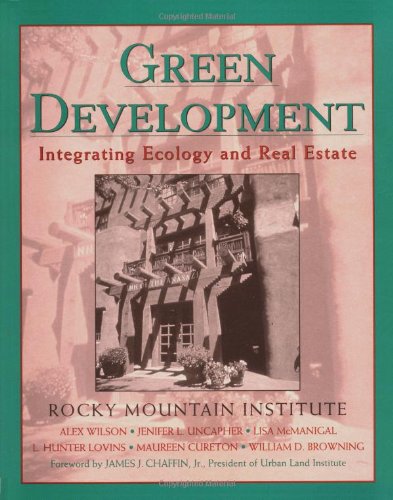
Green Development: Integrating Ecology and Real Estate
Authors:
Rocky Mountain Institute
Publisher:
Wiley
Publication Date:
Not available
ISBN:
0471188786
"Green Development is good for business. Tenants, owners, purchasers, and brokers are all becoming more sophisticated and are realizing the financial... and social benefits of green product." --Gerald Hines, Chairman of Hines.Environmentally responsible real estate development makes dollars and sense. Green Development describes an exciting new field in which environmental considerations are viewed as opportunities to create fundamentally better buildings and communities--more comfortable, more efficient, more appealing, and ultimately more profitable.If you're a developer, architect, planner, contractor, lender, or city official, this book speaks your language. Every stage of the development process is examined in detail: market research, site planning, design, approvals, financing, construction, marketing, and occupancy. Also included are lists of project statistics and contacts, books and other information sources, and development strategies.Based on 80 case studies drawn from Rocky Mountain Institute's extensive worldwide research and consulting work, Green Development distills proven procedures and practical lessons that work in the real world.
Green Discipleship: Catholic Theological Ethics and the Environment
Authors:
Not Available
Publisher:
Anselm Academic
Publication Date:
Not available
ISBN:
1599820242
From federal rebates for high-efficiency appliances to bottle deposits to "Meatless Mondays," practices promoting sustainability are now incorporated... into our daily lives. Due to the establishment of protection agencies and the efforts of activist groups, the wider public has become more conscious of the impact we humans make on the planet, and what we can do to preserve what we have.Religious communities, long concerned with broad issues of social responsibility and justice, have naturally become full participants in this greening movement. In Green Discipleship: Catholic Theological Ethics, scholars from the fields of theology and the social and hard sciences discuss this development, and consider how a proactive approach to the earth's welfare is, essentially, a moral obligation of Christians, and those of other faiths around the world. Accessible for undergraduate or seminary students, this anchor text: •Shows students how saving the earth is ethics in praxis•Views theology, ethics, and the environment through a variety of lenses•Includes tools such as end-of-chapter questions, glossary, and sidebarsCurrent and relevant, Green Discipleship will prompt students to think more widely about the earth, its stewardship, and how individual action is a fulfillment of duty.
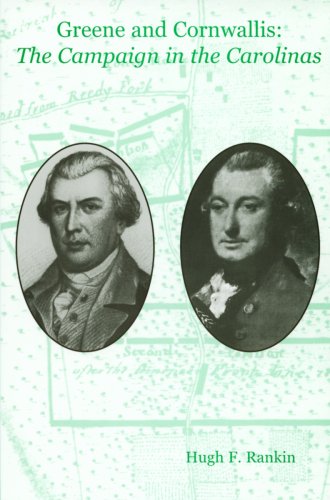
Greene and Cornwallis: The Campaign in the Carolinas
Authors:
Hugh F. Rankin
Publisher:
North Carolina Office of Archives and History
Publication Date:
Not available
ISBN:
0865261199
This book describes the masterful "retreat" of Nathanael Greene's Southern Army before Lord Cornwallis's British regulars in the winter of 1781. This... "retreat" culminated in the Battle of Guilford Courthouse (15 March 1781), a battle that severely weakened Corwallis's forces and set the stage for the British surrender at Yorktown.Dr. Rankin provides information about the battles at Camden and Cowpens in South Carolina that preceded the appointment of Greene to lead the Southern Army. In addition to Nathanael Greene and Lord Cornwallis, the author writes about other patriot generals, including Horatio Gates, "Light Hores" Harry Lee, and Daniel Morgan, and about other British military leaders, including Sir Henry Clinton and Banastre Tarleton.Fourteen portraits and period maps illustrate the text.
Green Economics: Confronting the Ecological Crisis
Authors:
Robin Hahnel
Publisher:
M.E.Sharpe
Publication Date:
Not available
ISBN:
0765627965
When Professor Eisner expanded his 1980 John Dewey Lecture into Cognition and Curriculum, the result was hailed as having the potential to "shake up the... educational decision makers as Dewey's Experience and Education did." Now, as the back-to-basics curriculum and standardized modes of evaluation are again finding favour, Eisner has chosen to revisit this work. The result is a substantially revised edition with two entirely new chapters.

Green Eggs and Ham (I Can Read It All by Myself Beginner Books)
Authors:
Dr. Seuss
Publisher:
Random House Books for Young Readers
Publication Date:
Not available
ISBN:
0394800168
Sam-I-Am mounts a determined campaign to convince another Seuss character to eat a plate of green eggs and ham. "Limited vocabulary but unlimited... exuberance of illustration."--School Library Journal.
Green Encounters: Shaping and Contesting Environmentalism in Rural...
Authors:
Luis A. Vivianco
Publisher:
Berghahn Books
Publication Date:
Not available
ISBN:
1845455045
Since the 1970s and 1980s, Monte Verde, Costa Rica has emerged as one of the most renowned sites of nature conservation and ecotourism in Costa Rica,... and some would argue, Latin America. It has received substantial attention in literature and media on tropical conservation, sustainable development, and tourism. Yet most of that analysis has uncritically evaluated the Monte Verde phenomenon, using celebratory language and barely scratching the surface of the many-faceted socio-cultural transformations provoked by and accompanying environmentalism. Because of its stature, Monte Verde represents an ideal case study to examine the socio-cultural and political complexities and dilemmas of practicing environmentalism in rural Costa Rica. Based on many years of close observation, this book offers rich and original material on the ongoing struggles between environmental activists and of collective and oppositional politics to Monte Verde s new culture of nature.
Green Engineering Environmentally Conscious Design of Chemical...
Authors:
David R Shonnard David T Allen
Publisher:
Prentice Hall
Publication Date:
Not available
ISBN:
0130619086
A chemical engineer's guide to managing and minimizing environmental impact. Chemical processes are invaluable to modern society, yet they generate... substantial quantities of wastes and emissions, and safely managing these wastes costs tens of millions of dollars annually. Green Engineering is a complete professional's guide to the cost-effective design, commercialization, and use of chemical processes in ways that minimize pollution at the source, and reduce impact on health and the environment. This book also offers powerful new insights into environmental risk-based considerations in design of processes and products. First conceived by the staff of the U.S. Environmental Protection Agency, Green Engineering draws on contributions from many leaders in the field and introduces advanced risk-based techniques including some currently in use at the EPA. Coverage includes: Engineering chemical processes, products, and systems to reduce environmental impacts Approaches for evaluating emissions and hazards of chemicals and processes Defining effective environmental performance targets Advanced approaches and tools for evaluating environmental fate Early-stage design and development techniques that minimize costs and environmental impacts In-depth coverage of unit operation and flowsheet analysis The economics of environmental improvement projects Integration of chemical processes with other material processing operations Lifecycle assessments: beyond the boundaries of the plant Increasingly, chemical engineers are faced with the challenge of integrating environmental objectives into design decisions. Green Engineering gives them the technical tools they need to do so.
 '





