production
/viewbook/list/all/?page=5543
/
/static/
None
History Bundle RC: From the Gracchi to Nero: A History of Rome 133...
Authors:
H.H. Scullard
Publisher:
Routledge
Publication Date:
Not available
ISBN:
0415584884
From the Gracchi to Nero is an outstanding history of the Roman world from 133 BC to 68 AD. Fifty years since publication it is widely hailed as the... classic survey of the period, going through many revised and updated editions until H.H. Scullard’s death. It explores the decline and fall of the Roman Republic and the establishment of the Pax Romana under the early Principate. In superbly clear style, Scullard brings vividly to life the Gracchi’s attempts at reform, the rise and fall of Marius and Sulla, Pompey and Caesar, society and culture in the late Roman Republic, the Augustan Principate, Tiberius and Gaius, Claudius and Nero, and economic and social life in the early Empire.
History by Hollywood, Second Edition
Authors:
Robert Toplin
Publisher:
University of Illinois Press
Publication Date:
Not available
ISBN:
0252076893
This newly updated edition of History by Hollywood explores the question of what happens to history when Hollywood filmmakers get their hands on... it. With a fresh look at recent films and television productions such as Titanic, Pearl Harbor, The Patriot, and John Adams, Robert Brent Toplin examines how filmmakers have interpreted American history through their movies. Toplin discusses how writers, producers, and directors become involved in making historical films, what influences their interpretations of the past, and the responses they make to the controversies their works excite. With a realistic appreciation of the challenges filmmakers face, he effectively measures the strengths and weaknesses of Hollywood's presentation of history in the films Mississippi Burning, JFK, Sergeant York, Missing, Bonnie and Clyde, Patton, All the President's Men, and Norma Rae.
HistoryClass for Understanding The American Promise, Combined &...
Authors:
James L. Roark
Publisher:
Bedford/St. Martin's
Publication Date:
Not available
ISBN:
1457610892
With fresh interpretations from two new authors, wholly reconceived themes, and a wealth of cutting-edge scholarship, the Fifth Edition of America: A... Concise History is designed to work perfectly with the way you teach the survey today. Building on the book’s hallmark strengths — balance, explanatory power, and a brief-yet-comprehensive narrative — as well as its outstanding full-color visuals and built-in primary sources, authors James Henretta, Rebecca Edwards, and Robert Self have shaped America into the ideal brief book for the modern survey course, at a value that can’t be beat. Read the preface.

HISTORY COURSEMATE ACCESS CODE
Authors:
Not Available
Publisher:
Not available
Publication Date:
Not available
ISBN:
Not available
HISTORY COURSEMATE FOR VOYAGES ACC. CAR
Authors:
Not Available
Publisher:
Not available
Publication Date:
Not available
ISBN:
Not available
HISTORY COURSEMATE WITH EBOOK & INTERACTIVE QUIZZING PRINTED ACCESS...
Authors:
Not Available
Publisher:
Not available
Publication Date:
Not available
ISBN:
Not available
History, Culture & Region in Southeast Asian Perspectives...
Authors:
O. W. Wolters
Publisher:
Cornell University Southeast Asia Program Publications
Publication Date:
Not available
ISBN:
0877277257
A study of regional history based on culture and intra-regional relationships, this collection of essays marks a difference in approach and focus on the... part of the author himself, who explores questions of historiography (his lengthy postscripts give extensive commentary on the 1982 edition). Arguing for the need for interdisciplinary studies in Southeast Asian Studies, as well as for the necessity of history to establish a basis for such study, Wolters focuses upon classical Southeast Asia (whereas almost all other historical studies focus on modern or contemporary Southeast Asia). He explores ideas of geography, gender, kinship, religion (Hinduism, Buddhism), literature, and past European perspectives on the region.
History Derailed: Central and Eastern Europe in the Long Nineteenth...
Authors:
Ivan T. Berend
Publisher:
University of California Press
Publication Date:
Not available
ISBN:
0520245253
There is probably no greater authority on the modern history of central and eastern Europe than Ivan Berend, whose previous work, Decades of Crisis, was... hailed by critics as "masterful" and "the broadest synthesis of the modern social, economic, and cultural history of the region that we possess." Now, having brought together and illuminated this region's storm-tossed history in the twentieth century, Berend turns his attention to the equally turbulent period that preceded it. The "long" nineteenth century, extending up to World War I, contained the seeds of developments and crises that continue to haunt the region today.The book begins with an overview of the main historical trends in the sixteenth to the eighteenth centuries, during which time the region lost momentum and became the periphery, no longer in step with the rising West. It concludes with an account of the persisting authoritarian political structures and the failed modernization that paved the way for social and political revolts. The origins of twentieth-century extremism and its tragedies are plainly visible in this penetrating account.
History From Things: Essays on Material Culture
Authors:
Not Available
Publisher:
Smithsonian Books
Publication Date:
Not available
ISBN:
1560986131
History from Things explores the many ways objects—defined broadly to range from Chippendale tables and Italian Renaissance pottery to... seventeenth-century parks and a New England cemetery—can reconstruct and help reinterpret the past. Eighteen essays describe how to “read” artifacts, how to “listen to” landscapes and locations, and how to apply methods and theories to historical inquiry that have previously belonged solely to archaeologists, anthropologists, art historians, and conservation scientists. Spanning vast time periods, geographical locations, and academic disciplines, History from Things leaps the boundaries between fields that use material evidence to understand the past. The book expands and redirects the study of material culture—an emerging field now building a common base of theory and a shared intellectual agenda.
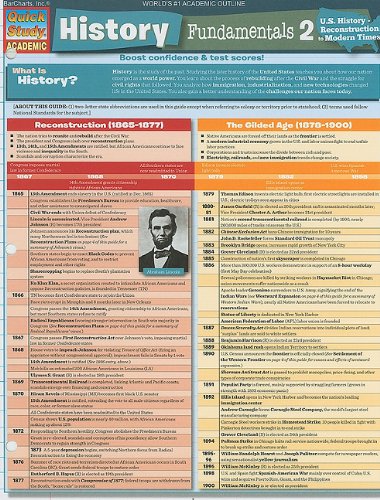
History Fundamentals 2 (Quickstudy: Academic)
Authors:
Inc. BarCharts
Publisher:
QuickStudy
Publication Date:
Not available
ISBN:
1423214285
Covering U.S. history from 1865 through the beginning of the 21st century, our guide covers critical aspects of this time period, such as:... Reconstruction; American emergence as a world power; global depression and the world wars of the 20th century; immigration, industrialization, civil rights, technology, terrorism—and other issues we still face today. Key events, figures and concepts are concisely explained for this grade range, and callout features illustrate our nation’s westward expansion, as well as New Deal organizations, challenges facing African Americans, and the participants/battles of World Wars I & II. Divided chronologically to help middle-schoolers gain a better understanding of historical perspective, this guide’s sections/topics include: •Reconstruction (1865–1877) •The Gilded Age (1878–1900) •Emergence of a Modern America (1901–1929) •Great Depression & World War II (1930–1945) •Post-War United States (1946–1975) •Contemporary United States (1976–2001) •And much more!
History Goes to the Movies: Studying History on Film
Authors:
Marnie Hughes-Warrington
Publisher:
Routledge
Publication Date:
Not available
ISBN:
0415328284
Can films be used as historical evidence? Do historical films make good or bad history? Are documentaries more useful to historians than historical... drama? Written from an international perspective, this book offers a lucid introduction to the ways films are made and used, cumulating with the exploration of the fundamental question, what is history and what is it for? Incorporating film analysis, advertisements, merchandise and internet forums; and ranging from late-nineteenth century short films to twenty-first century DVD ‘special editions’, this survey evaluates the varied ways in which filmmakers, promoters, viewers and scholars understand film as history. From Saving Private Ryan to Picnic at Hanging Rock to Pocahontas, History Goes to the Movies considers that history is not simply to be found in films, but in the perceptions and arguments of those who make and view them. This helpful introductory text blends historical and methodological issues with real examples to create a systematic guide to issues involved in using historical film in the study of history. History Goes to the Movies is a much-needed overview of an increasingly popular subject.
History Handbook (value-pack-2 books)
Authors:
Carol Berkin
Publisher:
Houghton Mifflin Company
Publication Date:
Not available
ISBN:
0618873600
As with every area of study, success in a history course involves learning the tricks of the trade. THE HISTORY HANDBOOK is a no-nonsense guide to the... skills you need to succeed. The authors offer practical information on how to read primary sources, research historical topics, correctly cite sources, and more. THE HISTORY HANDBOOK also offers tips for Internet research and evaluating online sources.
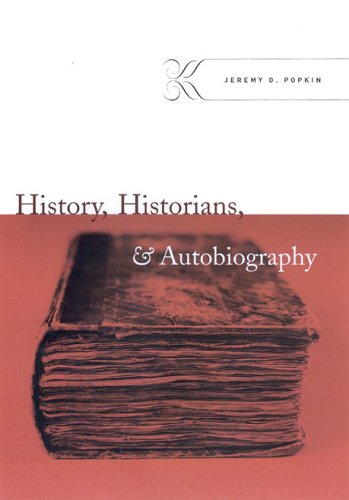
History, Historians, and Autobiography
Authors:
Jeremy D. Popkin
Publisher:
University Of Chicago Press
Publication Date:
Not available
ISBN:
0226675432
Though history and autobiography both claim to tell true stories about the past, historians have traditionally rejected first-person accounts as... subjective and therefore unreliable. What then, asks Jeremy D. Popkin in History, Historians, and Autobiography, are we to make of the ever-increasing number of professional historians who are publishing stories of their own lives? And how is this recent development changing the nature of history-writing, the historical profession, and the genre of autobiography?Drawing on the theoretical work of contemporary critics of autobiography and the philosophy of Paul Ricoeur, Popkin reads the autobiographical classics of Edward Gibbon and Henry Adams and the memoirs of contemporary historians such as Emmanuel Le Roy Ladurie, Peter Gay, Jill Ker Conway, and many others, he reveals the contributions historians' life stories make to our understanding of the human experience. Historians' autobiographies, he shows, reveal how scholars arrive at their vocations, the difficulties of writing about modern professional life, and the ways in which personal stories can add to our understanding of historical events such as war, political movements, and the traumas of the Holocaust.An engrossing overview of the way historians view themselves and their profession, this work will be of interest to readers concerned with the ways in which we understand the past, as well as anyone interested in the art of life-writing.
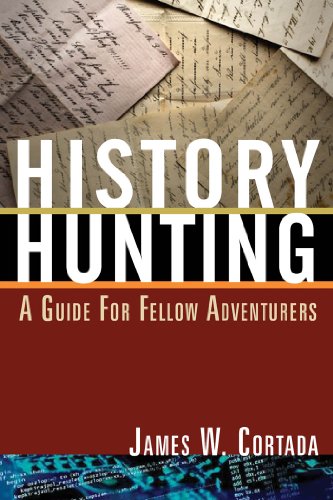
History Hunting: A Guide for Fellow Adventurers
Authors:
James W. Cortada
Publisher:
M.E.Sharpe
Publication Date:
Not available
ISBN:
0765633221
The author recounts his adventures over the past 50 years in this compelling blend of memoir and practical introduction to historical research. Each... chapter opens with a personal story told with wit and warmth, then moves into how-to mode to describe the historian s craft. The book offers guidance to aspiring historians at every stage of life, from practical advice on tackling and organizing projects to recommendations for finding and using resources of all kinds, whether at the local library or historical society or on the Internet. It is intended to be a serious expose on the best practices for researchers as well as a good read as a collection of research stories. The author includes useful bibliographies, vetted websites, and practical advice on doing research well.
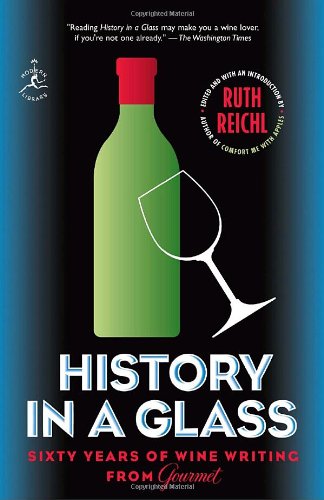
History in a Glass: Sixty Years of Wine Writing from Gourmet...
Authors:
Not Available
Publisher:
Modern Library
Publication Date:
Not available
ISBN:
0812971949
When Gourmet magazine debuted in the 1940s, America’s wineries were still reeling from the lingering effects of Prohibition and the loss of wines from... war-torn Europe. But for every closed door, there was an open bottle: The bleak postwar years were actually a prelude to today’s unprecedented and widespread appreciation for the grape. New York Times bestselling author Ruth Reichl reread sixty-five years of wine articles in Gourmet to select the best for History in a Glass. The result is a rollicking tale of great meals, great walks, and wonderful drinks as Americans discover the pleasures of wine. These marvelous essays were written by men and women who were not only on hand to witness wine’s boom but, in many cases, helped to foster the environment that made it thrive. The early days after World War II provided a great opportunity for James Beard and Frank Schoonmaker to reacquaint oenophiles with the joys of European wines. Through tireless dispatches from the Continent, they inspired American vintners to produce world-class wines on their own rich soil. In subsequent pieces, an impressive, surprisingly diverse roster of writers revel in the sensual and emotional pleasures of wine: the legendary Gerald Asher reflects on the many faces of Chianti; Hillaire Belloc dispenses bits of wisdom by the glass to his niece on her wedding day; the science fiction titan Ray Bradbury rhapsodizes about the earthy pleasures of dandelion wine; Kate Colman explores the moral quandary surrounding a friend’s unintentionally generous gift of a rare Bordeaux; Hugh Johnson reports on Hungarian varieties during the height of Cold War tensions in the early 1970s; even Gourmet’s current spirits editor, James Rodewald, reminisces on the first time he fell in love–with a bottle of Pinot Noir.With an Introduction by Ruth Reichl, and covering more than six decades of epicurean delights, History in a Glass is an astonishing celebration of all things good and grape.
 '





