production
/viewbook/list/all/?page=731
/
/static/
None

ANATOMY UH HILO
Authors:
Not Available
Publisher:
Not available
Publication Date:
Not available
ISBN:
Not available
ANATOMY WITH BLACKBOARD/CONNECT TIPS & CONNECT PLUS
Authors:
Not Available
Publisher:
Not available
Publication Date:
Not available
ISBN:
Not available
ANAT & PHYS LAB MANUAL [CUSTOM]
Authors:
Not Available
Publisher:
Not available
Publication Date:
Not available
ISBN:
Not available
ANAT+PHYS.TEXT+LAB+CASES+NUTRICALC+CODE
Authors:
Not Available
Publisher:
Not available
Publication Date:
Not available
ISBN:
Not available
ANAT.+PHYS. W/ APR & CONNECT ACCESS
Authors:
Not Available
Publisher:
Not available
Publication Date:
Not available
ISBN:
Not available
ANAT & PHYS W/CD, ATLAS, & MED CASE HIS
Authors:
Not Available
Publisher:
Not available
Publication Date:
Not available
ISBN:
Not available
ANAT.&PHYS.W/DVD,LAB ATLAS+LAB PKG.
Authors:
Not Available
Publisher:
Not available
Publication Date:
Not available
ISBN:
Not available
ANAT.+PHYS.W/MANUALS+CONNECT PKG
Authors:
Not Available
Publisher:
Not available
Publication Date:
Not available
ISBN:
Not available
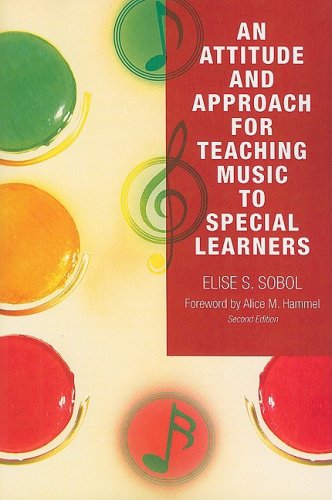
An Attitude and Approach for Teaching Music to Special Learners
Authors:
Elise S. Sobol
Publisher:
R&L Education
Publication Date:
Not available
ISBN:
1578868564
An Attitude and Approach for Teaching Music to Special Learners is a valuable reference guide and text for music teachers who instruct students with... special needs. Based on years of practical teaching experience, Sobol begins with the basics of classroom setup and management and moves on to musical literacy, the National Standards for Music Education, special education law, and teaching critical thinking skills. Throughout her book, Sobol consistently promotes the role of the teacher in reinforcing and building each student's inner confidence.Focusing on teaching students with moderate to severe learning, social, emotional, psychological, physical, intellectual, and language impairments, Sobol provides instructional strategies tailored to various disabilities and disorders. An extensive list of categories of disabilities is also included.The colors of the well-known stoplight-red, green, and yellow-are used to help students understand the foundations of harmony and differences in pitch, learn rhythmic notation, and link to concepts in other disciplines and to help teachers with classroom management. Color illustrations on the accompanying CD provide materials for use in the classroom. Sobol also provides a six-part sample lesson plan based on mediated learning techniques and a curriculum project designed to teach critical thinking skills.Throughout, Sobol's positive attitude infuses the book with possibilities. Her desire to provide a happy place in music where students feel safe is infectious. Her approach is an inspiration for all teachers: "Inside each and every child is a perfect human soul with unlimited potential locked up needing to be set free to find his or her ultimate power of expression."

A Natural History of Families
Authors:
Scott Forbes
Publisher:
Princeton University Press
Publication Date:
Not available
ISBN:
0691094829
Why do baby sharks, hyenas, and pelicans kill their siblings? Why do beetles and mice commit infanticide? Why are twins and birth defects more common in... older human mothers? A Natural History of Families concisely examines what behavioral ecologists have discovered about family dynamics and what these insights might tell us about human biology and behavior. Scott Forbes's engaging account describes an uneasy union among family members in which rivalry for resources often has dramatic and even fatal consequences. In nature, parents invest resources and control the allocation of resources among their offspring to perpetuate their genetic lineage. Those families sometimes function as cooperative units, the nepotistic and loving havens we choose to identify with. In the natural world, however, dysfunctional familial behavior is disarmingly commonplace. While explaining why infanticide, fratricide, and other seemingly antisocial behaviors are necessary, Forbes also uncovers several surprising applications to humans. Here the conflict begins in the moments following conception as embryos struggle to wrest control of pregnancy from the mother, and to wring more nourishment from her than she can spare, thus triggering morning sickness, diabetes, and high blood pressure. Mothers, in return, often spontaneously abort embryos with severe genetic defects, allowing for prenatal quality control of offspring. Using a broad sweep of entertaining examples culled from the world of animals and humans, A Natural History of Families is a lively introduction to the behavioral ecology of the family.

A Natural History of Latin
Authors:
Tore Janson
Publisher:
Oxford University Press, USA
Publication Date:
Not available
ISBN:
0199214050
No known language, including English, has achieved the success and longevity of Latin. French, Spanish, Italian, and Romanian are among its direct... descendants, and countless Latin words and phrases comprise the cornerstone of English itself. A Natural History or Latin tells its history from its origins over 2500 years ago to the present. Brilliantly conceived, popularizing but authoritative, and written with the fluency and light touch that have made Tore Janson's Speak so attractive to tens of thousands of readers, it is a masterpiece of adroit synthesis. The book commences with a description of the origins, emergence, and dominance of Latin over the Classical period. Then follows an account of its survival through the Middle Ages into modern times, with emphasis on its evolution throughout the history, culture, and religious practices of Medieval Europe. By judicious quotation of Latin words, phrases, and texts the author illustrates how the written and spoken language changed, region by region over time; how it met resistance from native languages; and how therefore some entire languages disappeared. Janson offers a vivid demonstration of the value of Latin as a means of access to a vibrant past and a persuasive argument for its continued worth. A concise and easy-to-understand introduction to Latin grammar and a list of the most frequent Latin words, including 500 idioms and phrases still in common use, complement the work.

A Natural History of Love
Authors:
Diane Ackerman
Publisher:
Random House
Publication Date:
Not available
ISBN:
0679761837
The bestselling author of A Natural History of the Senses now explores the allure of adultery, the appeal of aphrodisiacs, and the cult of the kiss.... Enchantingly written and stunningly informed, this "audaciously brilliant romp through the world of romantic love" (Washington Post Book World) is the next best thing to love itself.

A Natural History of the Brown Mouse Lemur
Authors:
Sylvia Atsalis
Publisher:
Pearson
Publication Date:
Not available
ISBN:
0132432714
A Natural History of the Brown Mouse Lemur provides the most complete look at the behavior and ecology of mouse lemurs. There are very few books... that address the biology of nocturnal primates. There are even fewer that delve with any detail regarding the behavior of specific species. These animals are difficult to follow. Their diminutive size, the thickness of the vegetation, and their nocturnal habits, make the study of their habits a demanding task.Through a trial of patience, Sylvia Atsalis has undertaken this task. Here she provides an in depth view at the life and behavioral patterns of these tiny primates.

A Natural History of the Chicago Region (Center for American Places...
Authors:
Joel Greenberg
Publisher:
University Of Chicago Press
Publication Date:
Not available
ISBN:
0226306496
In A Natural History of the Chicago Region, Joel Greenberg takes readers on a journey that begins in 1673 with Father Jacques Marquette and Louis... Joliet—the first Europeans known to have visited the Chicago region—and that we're still on today. This is a fascinating story, told with humor and passion, of forests battling prairies for dominance; of grasslands plowed, wetlands drained, and species driven to extinction in the settlement of the Midwest; and of caring conservationists fighting to preserve and restore the native plants and animals. Intermingling historical anecdotes and episodes straight from the words of early settlers and naturalists with current scientific information, Greenberg places the natural history of the region in a human context, showing how it affects our everyday existence in even the most urbanized landscape of Chicago.

A Natural History of the Monterey Bay National Marine Sanctuary
Authors:
Not Available
Publisher:
Monterey Bay Aquarium Press
Publication Date:
Not available
ISBN:
1878244116
a sharp, abundantly illustrated work that describes all aspects of the 5,300-square-mile sanctuary which protects a fifth of [California's] coastal... waters ... simultaneously informative and visually appealing. A great way to introduce kids to the region's fascinating natural history.
 '
'