production
/viewbook/list/all/?page=902
/
/static/
None

APLIA W/CUTSOM EBOOK FOR BIOLOGY: CNCPT
Authors:
Not Available
Publisher:
Not available
Publication Date:
Not available
ISBN:
Not available
APLIA W/EBOOK 1 SEMESTER ACCESS CARD
Authors:
Not Available
Publisher:
Not available
Publication Date:
Not available
ISBN:
Not available
APLIA W/EBOOK FOR ESST OF BUS COMM CODE
Authors:
Not Available
Publisher:
Not available
Publication Date:
Not available
ISBN:
Not available
APLIA WITH EBOOK FOR STARR'S BIOLOGY
Authors:
Not Available
Publisher:
Cengage Learning
Publication Date:
Not available
ISBN:
1133507751
APLIA WITH EBOOK PRINTED ACCESS CARD FOR GARMAN/FORGUE'S PERSONAL...
Authors:
Not Available
Publisher:
Not available
Publication Date:
Not available
ISBN:
Not available
APLIA WITH EBOOK PRINTED ACCESS CARD FOR LAMB/HAIR/MCDANIEL'S...
Authors:
Not Available
Publisher:
Not available
Publication Date:
Not available
ISBN:
Not available
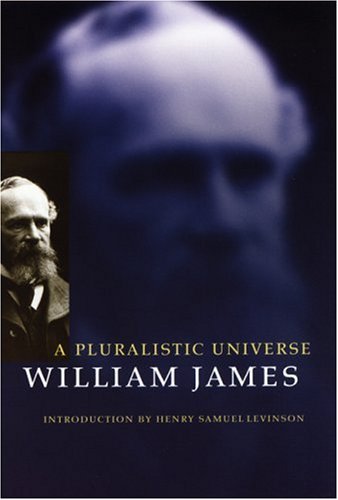
A Pluralistic Universe
Authors:
William James
Publisher:
University of Nebraska Press
Publication Date:
Not available
ISBN:
0803275919
In his famous lectures at Oxford University in 1908 and 1909, William James made a sustained and eloquent case against absolute idealism and... intellectualism in philosophy. Ever since Socrates and Plato, the philosophy of the absolute had held sway—the emphasis on essence at the expense of concrete appearance, the insistence on a coherent universe, abstract, timeless, finished, enclosed in its totality. James’s own thinking led him to renounce monistic idealism and the intellectualization of all “truth.”Going against the grain of entrenched philosophy, James argues in A Pluralistic Universe that the world is not a uni-verse but a multi-verse. He honors the human experience of manyness and disconnection (and various kinds of unity) in the world of flux and sensation, a world that is discounted scornfully by the monists. “Pluralistic empiricism,” as James called it, permits intellectual freedom, while the artificial concepts of monism do not. It approaches the only reality that has any meaning, one that follows the pattern of daily experience. A Pluralistic Universe, like Some Problems in Philosophy and Essays in Radical Empiricism (also available as Bison Books), is basic to an understanding of James’s thought.
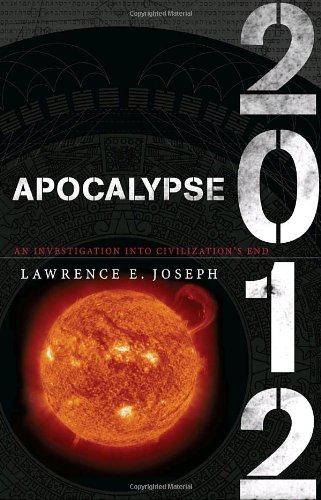
Apocalypse 2012: An Investigation into Civilization's End
Authors:
Lawrence E. Joseph
Publisher:
Three Rivers Press
Publication Date:
Not available
ISBN:
0767924487
Don’t look upIt won’t help. You can’t get out of the way, you can’t dig a hole deep enough to hide. The end is coming, and there’s nothing you... can do about it.So why read this book?Because you can’t look away when not just the religious fanatics are saying we’re all going to be destroyed but the scientists are in on the act too. Here’s what they’re saying:We’re a million years over due for a mass extinction.The sun at radiation minimum is acting much worse than at solar maximum, and one misdirected spewing of plasma could fry us in an instant.The magnetic field—which shields us from harmful radiation—is developing a mysterious crack.Our solar system is entering an energetically hostile part of the galaxy.The Yellowstone supervolcano is getting ready to blow, and if it does, we can look forward to nuclear winter and 90 percent annihilation.The Maya, the world’s greatest timekeepers ever, say it’s all going to stop on December 21, 2012.So, see? There’s nothing you can do, but you might as well sit back and enjoy the show. You’ll get a good chuckle.That’s why you should read this book.Dear Reader,If there were a chance that opening this book could set off a chain of events that would lead to Apocalypse, to the end of Life as we know it, would you be tempted? Finger poised uncertainly above the flashing red button? How about if the Apocalypse promised to result in a new age of enlightenment, a Heaven on Earth like never before? Personally, I’ll take the security of my cozy life over a chance at nirvana. But status quo may no longer be an option, for any of us. This book will convince you that there is a nonnegligible chance that the year 2012 will be more tumultuous, catastrophic, and, quite possibly, revelatory, than any other year in human history. Parts of this book are best read with a bowl of popcorn: looking into the jaws of a great white shark in search of the meaning of death; touring a picturesque Guatemalan town with Mayan shaman just weeks before it is utterly destroyed. Other sections go better with a tranquilizer, such as the impending eruption of the Yellowstone supervolcano, or the mass extinction headed our way—on the scale of the great collision that destroyed the dinosaurs and 70 percent of all other species, our best scientists contend that it’s now overdue. Nail-biters should beware the fact that the next peak in the sunspot cycle, due in 2012, is widely expected to set records for the number and intensity of solar storms pummeling the Earth with radiation and igniting natural calamities such as earthquakes, volcanoes, and Katrina-sized hurricanes. And that our entire solar system appears to be moving into a dangerous interstellar energy cloud. Is it a coincidence that the burgeoning war between Christianity and Islam seems hell-bent for Armageddon? Or that numerous other religions, philosophies, and cultural traditions are signaling that the end is near, with 2012 emerging as the consensus target date? A new era is about to be born, with all the pain and blood and joy and release that birth naturally entails. Facing oblivion, or at least mega-metamorphosis, is something that few of us are emotionally prepared to do. Thus my excuse for the gallows humor that pervades this story. In a memorable Mary Tyler Moore episode, Mary cracks up laughing at the funeral of Chuckles the Clown who, dressed as a peanut while marching in a parade, was shucked to death by an elephant. If Mary can giggle in the face of death, so can we.With kind regards,Lawrence E. Joseph
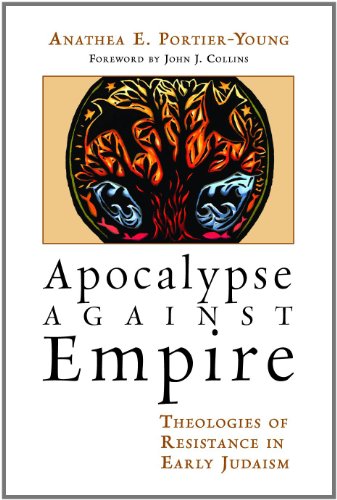
Apocalypse against Empire: Theologies of Resistance in Early Judaism
Authors:
Anathea E. Portier-Young
Publisher:
Wm. B. Eerdmans Publishing Company
Publication Date:
Not available
ISBN:
0802865984
A fresh and daring take on ancient apocalyptic books. The year 167 b.c.e. marked the beginning of a period of intense persecution for the people of... Judea, as Seleucid emperor Antiochus IV Epiphanes attempted — forcibly and brutally — to eradicate traditional Jewish religious practices. In Apocalypse against Empire Anathea Portier-Young reconstructs the historical events and key players in this traumatic episode in Jewish history and provides a sophisticated treatment of resistance in early Judaism. Building on a solid contextual foundation, Portier-Young argues that the first Jewish apocalypses emerged as a literature of resistance to Hellenistic imperial rule. She makes a sturdy case for this argument by examining three extant apocalypses, giving careful attention to the interplay between social theory, history, textual studies, and theological analysis. In particular, Portier-Young contends, the book of Daniel, the Apocalypse of Weeks, and the Book of Dreams were written to supply an oppressed people with a potent antidote to the destructive propaganda of the empire — renewing their faith in the God of the covenant and answering state terror with radical visions of hope..
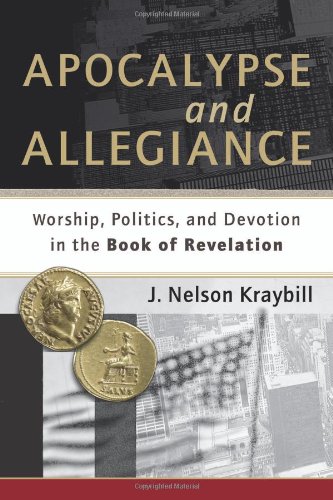
Apocalypse and Allegiance: Worship, Politics, and Devotion in the...
Authors:
J. Nelson Kraybill
Publisher:
Brazos Press
Publication Date:
Not available
ISBN:
1587432617
In this lively introduction, J. Nelson Kraybill shows how the book of Revelation was understood by its original readers and what it means for Christians... today. Kraybill places Revelation in its first-century context, opening a window into the political, economic, and social realities of the early church. His fresh interpretation highlights Revelation's liturgical structure and directs readers' attentions to twenty-first-century issues of empire, worship, and allegiance, showing how John's apocalypse is relevant to the spiritual life of believers today. The book includes maps, timelines, photos, a glossary, discussion questions, and stories of modern Christians who live out John's vision of a New Jerusalem.
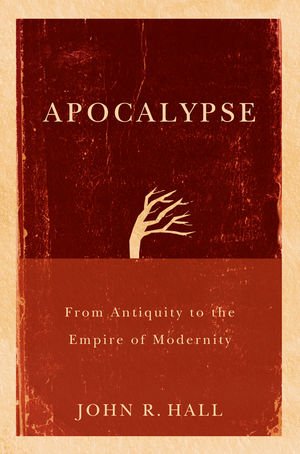
Apocalypse: From Antiquity to the Empire of Modernity
Authors:
John R. Hall
Publisher:
Polity
Publication Date:
Not available
ISBN:
0745645097
Winner of the American Sociological Association's 'Distinguished Book Award' in the Religion category.For most of us, “Apocalypse” suggests the... cataclysmic end of the world. Yet in Greek “apocalypse” means “revelation,” and the real subject of the Book of Revelation is how the sacred arises in history at a moment of crisis and destiny. With origins in ancient religions, the apocalyptic has been a transformative force from the time of the Crusades, through the Reformation, the French Revolution and modern communism, all the way to the present day “Islamic Jihad” and “War on Terror.” In Apocalypse, John R. Hall explores the significance of apocalyptic movements and the role they have played in the rise of the West and “The Empire of Modernity.”This brilliant cross-disciplinary study offers a novel basis for rethinking our social order and its ambivalent relations to sacred history. Apocalypse will attract general readers seeking new understandings of the world in challenging times. Scholars and students will find a compelling synthesis that draws them into conversation with others interested in religion, theology, culture, philosophy, and phenomenology, as well as sociology, social theory, western civilization, and world history.

Apocalypse in Islam
Authors:
Jean-Pierre Filiu
Publisher:
University of California Press
Publication Date:
Not available
ISBN:
0520272641
This is an eye-opening exploration of a troubling phenomenon: the fast-growing belief in Muslim countries that the end of the world is at hand--and with... it the "Great Battle," prophesied by both Sunni and Shii tradition, which many believers expect will begin in the Afghan-Pakistani borderlands. Jean-Pierre Filiu uncovers the role of apocalypse in Islam over the centuries, and highlights its extraordinary resurgence in recent decades. Identifying 1979 as a decisive year in the rise of contemporary millenarian speculation, he stresses the ease with which subsequent events in the Middle East have been incorporated into the intellectual universe of apocalyptic propagandists. Filiu also shows how Christian and Jewish visions of the Final Judgment have stimulated alarmist reaction in Islamic lands, both in the past and today, and examines the widespread fear of Christian Zionist domination as an impetus to jihad. Though the overwhelming majority of Muslims remains unpersuaded, the mounting conviction in the imminence of apocalypse is a serious matter, especially for those who are preparing for it.
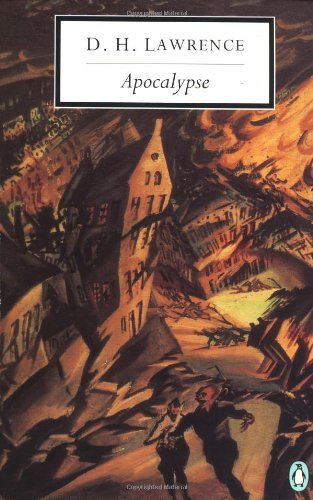
Apocalypse (Penguin Twentieth-Century Classics)
Authors:
D. H. Lawrence
Publisher:
Penguin Books
Publication Date:
Not available
ISBN:
0140187812
Written during the winter of 1929-30 and his last major work, "Apocalypse" is Lawrence's radical criticism of the political, religious and social... structures that have shaped Western civilization. In his view the perpetual conflict within man, in which emotion, instinct and the senses vie with the intellect and reason, has resulted in society's increasing alienation from the natural world. Yet Lawrence's belief in humanity's power to regain the imaginative and spiritual values which alone can revitalize our world also makes "Apocalypse" a powerful statement of hope. Presenting his thoughts on psychology, science, politics, art, God and man, and including a fierce protest against Christianity, "Apocalypse" is Lawrence's last testament, his final attempt to convey his vision of man and of the cosmos.
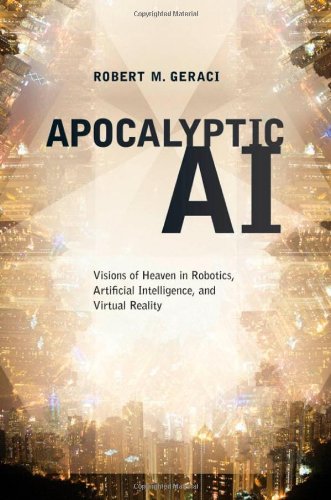
Apocalyptic AI: Visions of Heaven in Robotics, Artificial...
Authors:
Robert Geraci
Publisher:
Oxford University Press, USA
Publication Date:
Not available
ISBN:
0195393023
Apocalyptic AI, the hope that we might one day upload our minds into machines or cyberspace and live forever, is a surprisingly wide-spread and... influential idea, affecting everything from the world view of online gamers to government research funding and philosophical thought. In Apocalyptic AI, Robert Geraci offers the first serious account of this "cyber-theology" and the people who promote it. Drawing on interviews with roboticists and AI researchers and with devotees of the online game Second Life, among others, Geraci illuminates the ideas of such advocates of Apocalyptic AI as Hans Moravec and Ray Kurzweil. He reveals that the rhetoric of Apocalyptic AI is strikingly similar to that of the apocalyptic traditions of Judaism and Christianity. In both systems, the believer is trapped in a dualistic universe and expects a resolution in which he or she will be translated to a transcendent new world and live forever in a glorified new body. Equally important, Geraci shows how this worldview shapes our culture. For instance, Apocalyptic AI has influenced funding agencies such as the National Science Foundation, helping to prioritize robotics and AI research. It has become the ideology of choice for online gamers, such as those involved in Second Life; it has had a profound impact on the study of the mind; and it has inspired scientists and theologians alike to wonder about the super robots of the future. Should we think of robots as persons? What kind of morality would intelligent robots espouse?Apocalyptic AI has become a powerful force in modern culture. In this fascinating volume, Robert Geraci shines a light on this belief system, revealing what it is and how it is changing society.
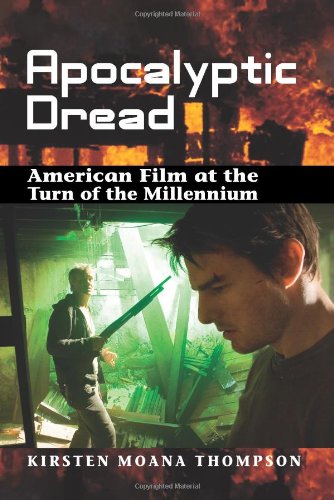
Apocalyptic Dread: American Film at the Turn of the Millennium...
Authors:
Kirsten Moana Thompson
Publisher:
State University of New York Press
Publication Date:
Not available
ISBN:
079147044X
 '
'